
The convergence of artificial intelligence (AI) and medical robot technology represents a transformative frontier in global healthcare, promising to redefine precision, accessibility, and efficiency in clinical practice. As intelligent systems evolve, their integration into surgical, rehabilitative, and logistical workflows is no longer speculative but a pressing imperative for modern health systems. Drawing from extensive analysis of technological trends, policy landscapes, and clinical adoption barriers, this report articulates a comprehensive framework to accelerate the responsible and widespread integration of AI-driven medical robot systems. The core argument posits that strategic policy intervention, centered on creating demonstrative clinical ecosystems, is essential to overcome current adoption hurdles, foster indigenous innovation, and ultimately establish a leading position in the global intelligent medical equipment industry.
The foundational power of this synergy stems from the complementary strengths of both fields. AI provides the cognitive layer—enabling perception through computer vision, planning through advanced algorithms, and adaptation through machine learning. The medical robot provides the physical layer—executing tasks with superhuman steadiness, accessing constrained anatomical spaces, and automating repetitive processes. The combined entity, an AI-empowered medical robot, is greater than the sum of its parts. Its decision-making can be modeled as an optimization function seeking to maximize surgical outcome \( O \) based on patient-specific data \( D \), surgical constraints \( C \), and robotic actions \( A \), guided by a learned policy \( \pi \):
$$ \pi^* = \arg\max_{\pi} \mathbb{E}[O(D, C, A) | \pi] $$
This integration is actively reshaping specialties from orthopedics to neurosurgery. For instance, in robotic-assisted joint replacement, AI algorithms pre-operatively analyze 3D CT scans to generate a patient-specific surgical plan, optimizing implant positioning and alignment. The medical robot then executes the bone cuts with sub-millimeter accuracy, adhering precisely to the AI-generated plan. The real-time feedback loop, where intraoperative data (e.g., force, position) is fed back to the AI system, allows for dynamic adjustment and is the hallmark of next-generation systems.
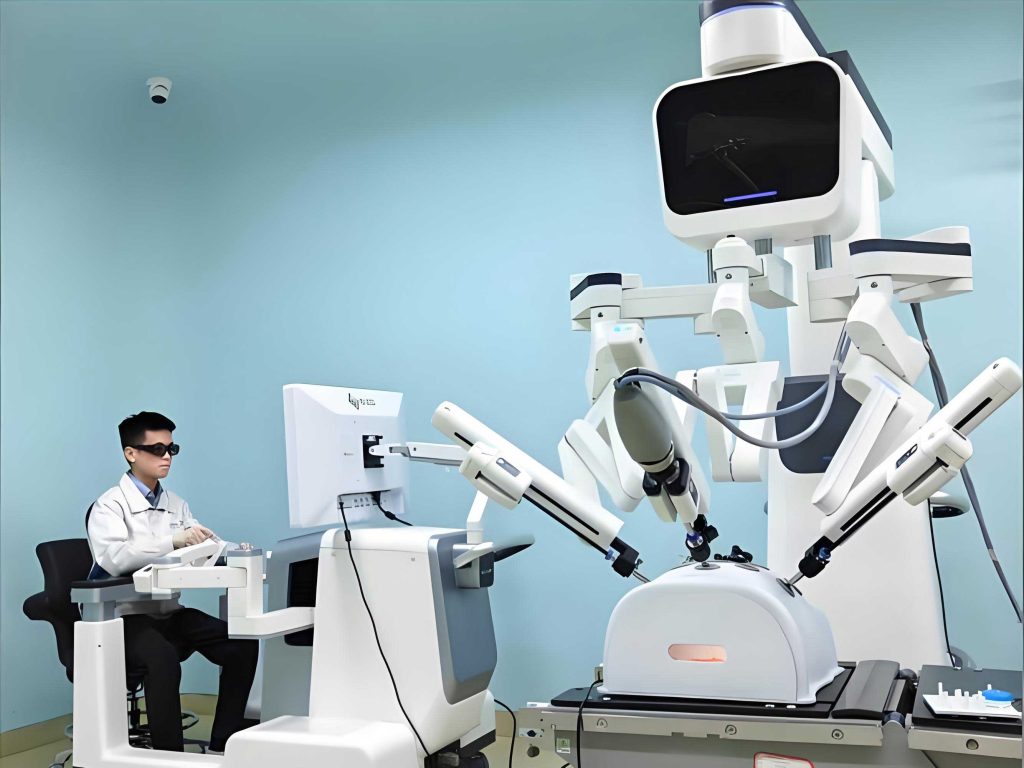
The global market trajectory reflects this potential. As illustrated in Table 1, the sector is experiencing aggressive growth, driven by technological maturation and increasing clinical validation.
| Region | Market Size (2023) | Projected CAGR (2024-2030) | Primary Driver |
|---|---|---|---|
| North America | $6.8 Billion | 18.5% | High hospital adoption, favorable reimbursement |
| Europe | $3.2 Billion | 16.8% | Aging population, regulatory harmonization (MDR) |
| Asia-Pacific | $2.1 Billion | 22.3% | Rising healthcare investment, large patient pools |
| Rest of World | $0.9 Billion | 19.0% | Growing medical tourism, infrastructure development |
Despite the compelling vision, the path to ubiquitous adoption is fraught with systemic challenges that stifle innovation and limit patient access. Hospitals, as the primary end-users, face a multifaceted dilemma. The capital expenditure (CAPEX) and operational expenditure (OPEX) for a high-end surgical medical robot system are prohibitively high. A simplified cost model for a hospital can be expressed as:
$$ \text{Total Cost of Ownership (TCO)} = C_{\text{proc}} + C_{\text{main}} + C_{\text{tra}} + \sum_{i=1}^{n} (C_{\text{disp}, i} + C_{\text{op}, i}) $$
Where \( C_{\text{proc}} \) is procurement cost, \( C_{\text{main}} \) is annual maintenance, \( C_{\text{tra}} \) is team training, \( C_{\text{disp}, i} \) is disposable cost per procedure \( i \), and \( C_{\text{op}, i} \) is operational overhead. For many institutions, the high upfront \( C_{\text{proc}} \) and recurring \( C_{\text{main}} \) create a significant financial barrier, often resulting in low utilization rates as administrators struggle to justify the investment. This is compounded by a lack of clear reimbursement pathways from national health insurance schemes, transferring a substantial financial burden to patients and further depressing demand.
Beyond economics, significant technical and regulatory friction exists. The “black box” nature of some AI algorithms raises valid concerns about explainability and safety. A regulatory framework must assess not just the device’s mechanical function but the performance and drift of its embedded intelligence. A proposed safety assurance metric \( S \) for an AI-driven medical robot could incorporate:
$$ S = \alpha \cdot \text{Accuracy} + \beta \cdot \text{Robustness} + \gamma \cdot \text{Explainability} + \delta \cdot \text{Failure Recovery Rate} $$
where \( \alpha, \beta, \gamma, \delta \) are weighting coefficients determined by the specific clinical risk class. Furthermore, data silos within hospitals prevent the aggregated, high-quality datasets needed to train and validate robust AI models. This creates a vicious cycle: without widespread clinical use, medical robot developers cannot gather the real-world data needed to improve their products, which in turn hampers clinical confidence and adoption.
Examining international paradigms offers critical insights for constructing an effective policy response. The United States’ ecosystem thrives on a synergy between robust venture capital, a fee-for-service reimbursement model that often covers robotic procedures, and a flexible yet rigorous FDA regulatory pathway for software-as-a-medical-device (SaMD). Japan’s strategy has been more top-down, with the government explicitly identifying medical robots as a strategic solution for elder care, directly funding R&D, and integrating approved robotic procedures into the national health insurance payment schedule promptly. The European Union emphasizes a stringent, risk-based regulatory framework under the Medical Device Regulation (MDR), fostering high safety standards but also creating a complex approval landscape. South Korea demonstrates the effectiveness of public-private partnerships, with government-led consortia linking major hospitals with conglomerates like Samsung to develop and commercialize domestic surgical robots.
The central policy proposal emerging from this analysis is the strategic creation of national-level “AI-Medical Robot Demonstration and Application Hospitals.” These are not merely hospitals with robots, but integrated innovation platforms designed to de-risk adoption, generate evidence, and refine the entire ecosystem. Their core functions would be:
- Clinical Validation Hub: Serve as primary sites for pivotal clinical trials and real-world evidence generation for domestic medical robot platforms.
- Policy Sandbox: Operate under a tailored regulatory and reimbursement framework that allows for testing innovative payment models (e.g., bundled payments, lease-to-own schemes) and adaptive regulatory oversight.
- Data Nexus: Implement standardized data capture protocols (with strong privacy safeguards like federated learning) to build shareable, high-fidelity datasets for AI training.
- Training Center of Excellence: Develop and disseminate standardized credentialing programs for surgeons, nurses, and biomedical engineers.
The operational model for such a hospital must address the core cost barrier. A feasible financial model could involve a hybrid of public funding and innovative procurement. A proposed cost-sharing structure is shown in Table 2.
| Cost Component | Traditional Model (Hospital-Borne) | Demonstration Hospital Model (Shared) |
|---|---|---|
| Capital Equipment (Robot) | 100% Hospital CAPEX | 40% Gov’t Grant, 40% Manufacturer Loan, 20% Hospital |
| Annual Software License & AI Updates | 100% Hospital OPEX | Subsidized via national R&D fund; cost tied to usage metrics |
| Disposable Instruments | 100% Patient/Hospital | Priced into a DRG-like bundled payment approved for pilot |
| Training & Certification | Hospital/Physician cost | Fully funded by national skill development initiative |
The technological architecture of these hospitals should be built on an open, interoperable platform that encourages modular innovation. The control paradigm for the medical robot within such a system can be described as a hierarchical hybrid control system:
$$
\begin{align*}
\text{High-Level (AI Planner):} & \quad \text{Generates trajectory } \tau^* \text{ from preoperative plan and real-time sensor fusion.} \\
\text{Mid-Level (Adaptive Controller):} & \quad u(t) = K_p e(t) + K_i \int e(t)dt + K_d \frac{de(t)}{dt} + \hat{f}_{\text{AI}}(sensory\_input) \\
\text{Low-Level (Actuation):} & \quad \text{Executes motor commands with haptic feedback and safety interlocks.}
\end{align*}
$$
Here, \( \hat{f}_{\text{AI}} \) represents an AI-based term that adapts the classic PID controller (\(K_p, K_i, K_d\)) parameters in real-time based on tissue interaction forces and anatomical compliance, vastly improving delicate manipulation.
To transition from pilot to proliferation, a clear, phased national roadmap is essential. This roadmap must synchronize technological development, regulatory evolution, reimbursement policy, and workforce training.
| Phase | Timeline | Strategic Objective | Key Policy Actions | Success Metrics |
|---|---|---|---|---|
| Phase 1: Foundation & Pilot | Years 1-3 | Establish 3-5 flagship demonstration hospitals; create agile regulatory sandbox. | Launch national demonstration hospital fund; enact provisional reimbursement codes for robotic procedures in pilot sites; establish multi-specialty training curricula. | 50+% utilization rate of robots in pilot hospitals; 1000+ certified surgeons; first domestic robot approvals via sandbox pathway. |
| Phase 2: Scale & Integrate | Years 4-7 | Expand to 20+ regional hubs; integrate robots into standard care pathways. | Implement national bundled payment model for common robotic procedures; mandate interoperable data standards for all new devices; launch public-awareness campaigns. | Domestic medical robot market share >50%; robotic procedures covered in national insurance catalog; demonstration network generates largest clinical robotics dataset globally. |
| Phase 3: Lead & Export | Years 8-12 | Become a global leader in AI-robotic surgery; export technology and standards. | Establish international medical robot training and certification center; lead ISO/IEC working groups on AI in medical devices; create export financing facilities for domestic manufacturers. | Rank among top 3 global patent holders in surgical AI; significant export volume of complete robotic systems; domestic standards adopted internationally. |
Sustainability and ethics must be embedded in the roadmap’s core. A dynamic benefit-risk assessment model for continuous monitoring is crucial:
$$ \text{Net Clinical Benefit (NCB)}_t = \sum_{i} w_i \cdot \text{Improvement}_i(t) – \sum_{j} \lambda_j \cdot \text{Risk}_j(t) $$
Where \( w_i \) and \( \lambda_j \) are time-varying weights for clinical outcome improvements (e.g., reduced blood loss, shorter recovery) and emerging risks (e.g., algorithmic bias, cybersecurity threats), respectively, assessed at time \( t \). This requires establishing national registries for all robotic procedures to enable longitudinal safety and outcome surveillance.
In conclusion, the integration of AI and medical robots is an irreversible trend that holds the key to the next leap in healthcare quality and efficiency. The principal obstacle is no longer purely technological but systemic, residing in misaligned incentives, fragmented data, and rigid policies. The strategic establishment of dedicated demonstration hospitals, acting as integrated accelerators for clinical evidence, policy innovation, and workforce development, presents a powerful mechanism to break this logjam. By deliberately creating these fertile environments for the medical robot ecosystem to mature, nations can catalyze domestic innovation, improve patient outcomes, and position themselves at the forefront of the impending revolution in intelligent, robotic-assisted healthcare. The time for proactive, coherent, and ambitious policy action is now.