
In my exploration of artificial intelligence, I have come to see embodied intelligence as a paradigm shift—one where intelligence emerges not from static data but from dynamic interaction between a physical body and its environment. Embodied AI robots, as I define them, are systems that possess a silicon-based “brain” enabling them to perceive, learn, remember, and act in real-world contexts. This brain is not a single entity but a complex integration of modules that mimic cognitive processes, and understanding its composition is crucial for advancing robotics. From my perspective, the core of an embodied AI robot lies in its ability to couple sensing, reasoning, and action seamlessly, moving beyond traditional disembodied AI that relies solely on pre-trained models. Here, I delve into what constitutes this brain, drawing on principles of embodiment, situatedness, and interactivity.
Embodied intelligence, as I see it, is characterized by four key attributes: embodiment, where the physical form influences cognition; situatedness, where context shapes understanding; proactivity, where the system actively explores; and interactivity, where continuous feedback drives adaptation. An embodied AI robot must integrate these into a cohesive system. The brain of such a robot serves as the central hub, coordinating hardware and software to achieve intelligent behavior. I believe that by dissecting this brain, we can unlock new potentials for robots in industries like manufacturing, healthcare, and exploration. Throughout this discussion, I will emphasize how each component contributes to the holistic intelligence of embodied AI robots.
| Module | Function | Analog to Human Brain | Key Technologies |
|---|---|---|---|
| Physical Morphology | Provides the body for interaction; includes robots, drones, or vehicles | Musculoskeletal system | Mechanical design, actuators |
| Sensing Module | Collects multimodal data (e.g., visual, auditory, tactile) | Sensory cortices (e.g., occipital lobe) | Cameras, LiDAR, tactile sensors |
| Computation Module | Processes data, runs algorithms, and controls actions | Neural processing networks | CPUs, GPUs, edge computing |
| Intelligent Algorithm Module | Enables perception, memory, learning, and decision-making | Cognitive regions (e.g., prefrontal cortex) | Deep learning, reinforcement learning |
The architecture of an embodied AI robot, as I analyze it, revolves around tight coupling between these modules. The physical morphology sets the stage for interaction; for instance, a humanoid embodied AI robot uses joints and limbs to manipulate objects, while a drone relies on aerial mobility. Sensing feeds raw data into the brain, computation crunches numbers, and algorithms extract meaning. I argue that this integration is what distinguishes embodied AI robots from conventional AI—they are not just processing information but engaging with the world through a body. In my view, the brain must orchestrate these elements to achieve tasks like navigation, object manipulation, or social interaction.
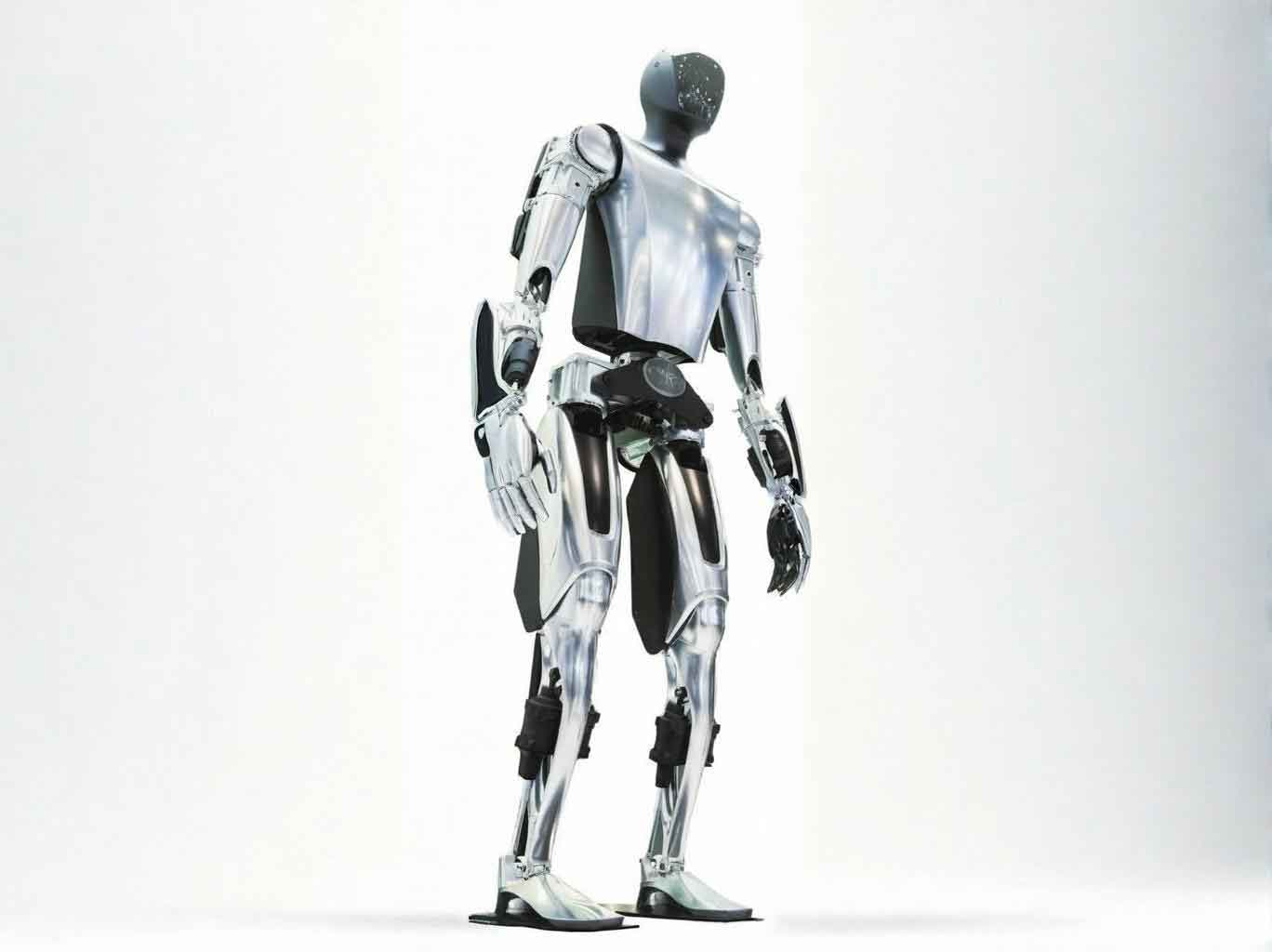
Looking at the brain’s capabilities, I categorize them into three interconnected functions: perception, memory and learning, and decision-making. These mirror human cognitive processes but are implemented through silicon and code. For an embodied AI robot, perception involves more than just sensing; it requires contextual understanding. I model this as a transformation from raw sensor inputs to semantic representations. For example, visual perception can be expressed as:
$$ \mathbf{P} = f_{\text{percept}}(\mathbf{I}, \mathbf{C}) $$
where $\mathbf{I}$ is the input image, $\mathbf{C}$ is the context (e.g., location, task), and $\mathbf{P}$ is the perceived representation. This allows an embodied AI robot to not only see an object but understand its relevance in a scene. Memory and learning, in my analysis, enable the robot to accumulate experiences. I see this as a dynamic storage system that encodes episodes, akin to hippocampal functions. A simple formulation for memory update is:
$$ \mathbf{M}_{t+1} = \mathbf{M}_t + \alpha \cdot \text{encode}(\mathbf{S}_t, \mathbf{A}_t, \mathbf{R}_t) $$
where $\mathbf{M}$ is the memory state, $\mathbf{S}$ is the current state, $\mathbf{A}$ is the action, $\mathbf{R}$ is the reward, and $\alpha$ is a learning rate. This supports lifelong learning for embodied AI robots, allowing them to adapt over time. Decision-making integrates perception and memory to plan actions. I frame this as an optimization problem:
$$ \mathbf{A}^* = \arg\max_{\mathbf{A}} \mathbb{E} \left[ \sum_{t=0}^{T} \gamma^t R(\mathbf{S}_t, \mathbf{A}_t) \mid \mathbf{P}, \mathbf{M} \right] $$
where $\mathbf{A}^*$ is the optimal action sequence, $R$ is the reward function, $\gamma$ is a discount factor, and expectations are conditioned on perception $\mathbf{P}$ and memory $\mathbf{M}$. This enables an embodied AI robot to make proactive choices, such as navigating around obstacles or selecting tools.
| Function | Embodied AI Robot | Traditional AI | Key Differences |
|---|---|---|---|
| Perception | Multimodal, context-aware, real-time | Often unimodal, static datasets | Embodied AI robots use sensor fusion for situated understanding |
| Memory | Episodic, adaptive, supports online learning | Fixed knowledge bases or model weights | Embodied AI robots update memory through interaction |
| Decision-Making | Action-oriented, predictive, involves physical constraints | Outputs labels or text, lacks embodiment | Embodied AI robots plan sequences that affect the environment |
| Learning | Interactive, reinforcement-driven, lifelong | Supervised, offline training | Embodied AI robots learn from trial and error in the world |
In my examination of technical implementations, several key technologies shape the brain of embodied AI robots. Embodied foundation models, for instance, combine vision, language, and action into unified architectures. I view these as large-scale neural networks trained on diverse data, but crucially, they incorporate embodied feedback. For an embodied AI robot, a foundation model might be expressed as:
$$ \mathbf{O} = \text{Transformer}_{\text{embodied}}(\mathbf{X}_{\text{vision}}, \mathbf{X}_{\text{language}}, \mathbf{X}_{\text{action}}) $$
where $\mathbf{O}$ is the output action or prediction, and $\mathbf{X}$ denotes multimodal inputs. This allows embodied AI robots to perform tasks like “pick up the red block” by aligning perception with motor commands. World models, another critical area, enable prediction of future states. I conceptualize these as internal simulations that help an embodied AI robot anticipate outcomes. A basic world model can be formulated as:
$$ \hat{\mathbf{S}}_{t+1} = g(\mathbf{S}_t, \mathbf{A}_t; \theta) $$
where $\hat{\mathbf{S}}_{t+1}$ is the predicted next state, $g$ is a learned function parameterized by $\theta$, and $\mathbf{A}_t$ is the action taken by the embodied AI robot. By training on interaction data, embodied AI robots can improve their predictions and plan more effectively. Embodied memory systems store and retrieve experiences. I often represent these as graph structures or attention-based mechanisms, such as:
$$ \mathbf{Q} = \text{Attention}(\mathbf{K}, \mathbf{V}, \mathbf{q}) $$
where $\mathbf{Q}$ is the retrieved memory, $\mathbf{K}$ and $\mathbf{V}$ are key-value pairs from past episodes, and $\mathbf{q}$ is a query from the current context. This helps embodied AI robots recall relevant knowledge, like how to open a door based on prior attempts.
Behavior prediction and autonomous learning are equally vital. For behavior prediction, I use sequence models to forecast trajectories of objects or other agents in the environment. A common approach involves recurrent neural networks:
$$ \mathbf{T}_{future} = \text{RNN}(\mathbf{T}_{past}; \phi) $$
where $\mathbf{T}$ denotes trajectory data and $\phi$ are model parameters. This allows an embodied AI robot to avoid collisions or coordinate with humans. Autonomous learning, through reinforcement learning, drives skill acquisition. I frame this as maximizing cumulative reward:
$$ J(\pi) = \mathbb{E}_{\pi} \left[ \sum_{t=0}^{\infty} \gamma^t r_t \right] $$
where $\pi$ is the policy of the embodied AI robot, $r_t$ is the reward at time $t$, and $\gamma$ is the discount factor. By exploring the environment, embodied AI robots can learn complex behaviors, from walking to manipulating tools. These technologies, in my synthesis, are not isolated; they form a feedback loop where perception informs memory, memory guides decisions, and decisions lead to actions that update perception. This闭环 is essential for the adaptability of embodied AI robots.
| Technology | Description | Mathematical Formulation | Role in Embodied AI Robots |
|---|---|---|---|
| Embodied Foundation Models | Multimodal models integrating perception and action | $$ \mathbf{Y} = f_{\text{model}}(\mathbf{X}_1, \mathbf{X}_2, …) $$ | Enable end-to-end control for embodied AI robots |
| World Models | Internal representations for predicting state dynamics | $$ \mathbf{S}’ = h(\mathbf{S}, \mathbf{A}) $$ | Help embodied AI robots simulate and plan actions |
| Embodied Memory | Systems for storing and retrieving interactive experiences | $$ \mathbf{M} = \text{store}(\mathbf{E}), \mathbf{R} = \text{retrieve}(\mathbf{Q}) $$ | Support lifelong learning in embodied AI robots |
| Behavior Prediction | Forecasting future movements of entities | $$ \mathbf{P}_{t+k} = \text{predict}(\mathbf{H}_t) $$ | Enhance safety and coordination for embodied AI robots |
| Autonomous Learning | Algorithms like reinforcement learning for self-improvement | $$ \pi^* = \arg\max_{\pi} \mathbb{E}[R] $$ | Allow embodied AI robots to acquire skills through interaction |
Looking ahead, I identify several trends that will shape the brain of embodied AI robots. First, a shift from data-driven to interaction-driven emergence: instead of relying solely on offline datasets, embodied AI robots will learn through real-time engagement with the world. I envision this as a move toward more organic intelligence, where embodied AI robots develop cognitive abilities by doing, much like humans. Second, from real-time perception to future prediction: embodied AI robots will not just react but anticipate, using world models to forecast scenarios and preemptively act. This requires advanced probabilistic modeling, such as:
$$ p(\mathbf{S}_{t+1} | \mathbf{S}_t, \mathbf{A}_t) $$
which can be learned via variational methods. Third, from hierarchical to integrated decision-making: traditional pipelines separate perception, planning, and control, but I advocate for end-to-end architectures that unify these in embodied AI robots. This can be expressed as a single policy network:
$$ \mathbf{A}_t = \pi_{\text{integrated}}(\mathbf{O}_t, \mathbf{M}_t) $$
where $\mathbf{O}_t$ is the observation and $\mathbf{M}_t$ is the memory state. Finally, from directed training to autonomous evolution: embodied AI robots will self-evolve through meta-learning and neural-symbolic integration. I propose frameworks where embodied AI robots set their own goals, represented as:
$$ \mathcal{G} = \text{meta-learner}(\mathcal{E}, \mathcal{H}) $$
with $\mathcal{E}$ as the environment and $\mathcal{H}$ as historical performance. These trends, in my projection, will enable embodied AI robots to become more adaptive, predictive, and autonomous, transforming fields like manufacturing, where embodied AI robots assemble products, or healthcare, where they assist in rehabilitation.
In conclusion, the brain of an embodied AI robot is a sophisticated synthesis of hardware and software, designed to emulate cognitive functions through embodied interaction. From my standpoint, it encompasses perception that is context-aware, memory that is experience-based, and decision-making that is action-oriented. Technologies like embodied foundation models and world models are pivotal, but they must be coupled with physical embodiment to achieve true intelligence. As I reflect on the future, I see immense potential for embodied AI robots to bridge the digital and physical worlds, evolving from mere tools to collaborative partners. The journey is ongoing, and by deepening our understanding of this brain, we can unlock new frontiers for intelligent systems.
Throughout this discussion, I have emphasized the centrality of embodiment in AI. Embodied AI robots, with their integrated brains, represent a leap toward more natural and effective intelligence. Whether in industrial settings or daily life, these robots will continue to advance, driven by innovations in perception, learning, and decision-making. I remain optimistic that as we refine these components, embodied AI robots will become increasingly capable, shaping a future where machines truly understand and interact with our world.