
As I reflect on the technological landscape, I am struck by the transformative potential of humanoid robots and solid-state batteries. In my view, these two innovations are poised to redefine industries, from manufacturing to healthcare, and beyond. The synergy between advanced robotics and energy storage is not just a trend; it is a fundamental shift that will shape our future. Humanoid robots, in particular, represent a leap toward automation that mimics human capabilities, and their success hinges on reliable, high-performance power sources. Solid-state batteries, with their superior safety and energy density, are emerging as the ideal solution. Throughout this article, I will explore how these technologies are evolving, their market trajectories, and the critical role they play in empowering humanoid robots to become ubiquitous in our daily lives.
From my perspective, solid-state batteries mark a significant advancement over conventional lithium-ion batteries. I have observed that they eliminate the flammable liquid electrolytes, reducing risks of fires and explosions. This makes them exceptionally safe, which is crucial for applications in volatile environments. Moreover, their energy density can exceed 400 Wh/kg, compared to around 250-300 Wh/kg for typical lithium-ion batteries. This higher energy density translates to longer operational times and reduced weight, both of which are vital for mobile devices and humanoid robots. I believe that the development timeline for solid-state batteries is accelerating, with initial vehicle integration expected around 2027 and mass production likely by 2030. This progression is supported by extensive research and patent filings, indicating a robust innovation ecosystem.
To illustrate the projected deployment of solid-state batteries, I have compiled a table summarizing estimates from various industry analyses. This table highlights the anticipated milestones, though specific company names are omitted to maintain generality.
| Development Phase | Expected Timeline | Key Characteristics |
|---|---|---|
| Initial Integration | 2027 | Demonstration in vehicles, energy density over 400 Wh/kg |
| Verification and Testing | 2026-2028 | Road testing, range improvements up to 25%, safety validation |
| Mass Production | 2030 onwards | Scalable manufacturing, cost reductions, broad adoption |
In my analysis, the energy density of solid-state batteries can be modeled using the formula for gravimetric energy density: $$ E_g = \frac{E}{m} $$ where \( E_g \) is the energy density in Wh/kg, \( E \) is the total energy in watt-hours, and \( m \) is the mass in kilograms. For volumetric energy density, the relationship is: $$ E_v = \frac{E}{V} $$ where \( E_v \) is in Wh/L and \( V \) is the volume in liters. These metrics are critical for evaluating battery performance in humanoid robots, as they directly impact endurance and portability. I have found that solid-state batteries often achieve \( E_g > 400 \) Wh/kg and \( E_v > 800 \) Wh/L, surpassing traditional options and enabling longer operation times for humanoid robots without frequent recharging.
Turning to humanoid robots, I am fascinated by their growing market potential. Forecasts suggest that the global market for humanoid robots could reach $75 billion by 2035 and escalate to $1 trillion by 2050, with unit sales potentially exceeding 70 million. This exponential growth is driven by diverse applications, including elderly care, where humanoid robots are expected to assist with daily tasks, improving quality of life. In some regions, the market for care-oriented humanoid robots is projected to grow at a compound annual growth rate (CAGR) of around 15%, doubling in size over five years. The demand for humanoid robots is not limited to care; they are also being deployed in industrial settings for tasks like assembly and inspection, where their human-like dexterity offers unique advantages.
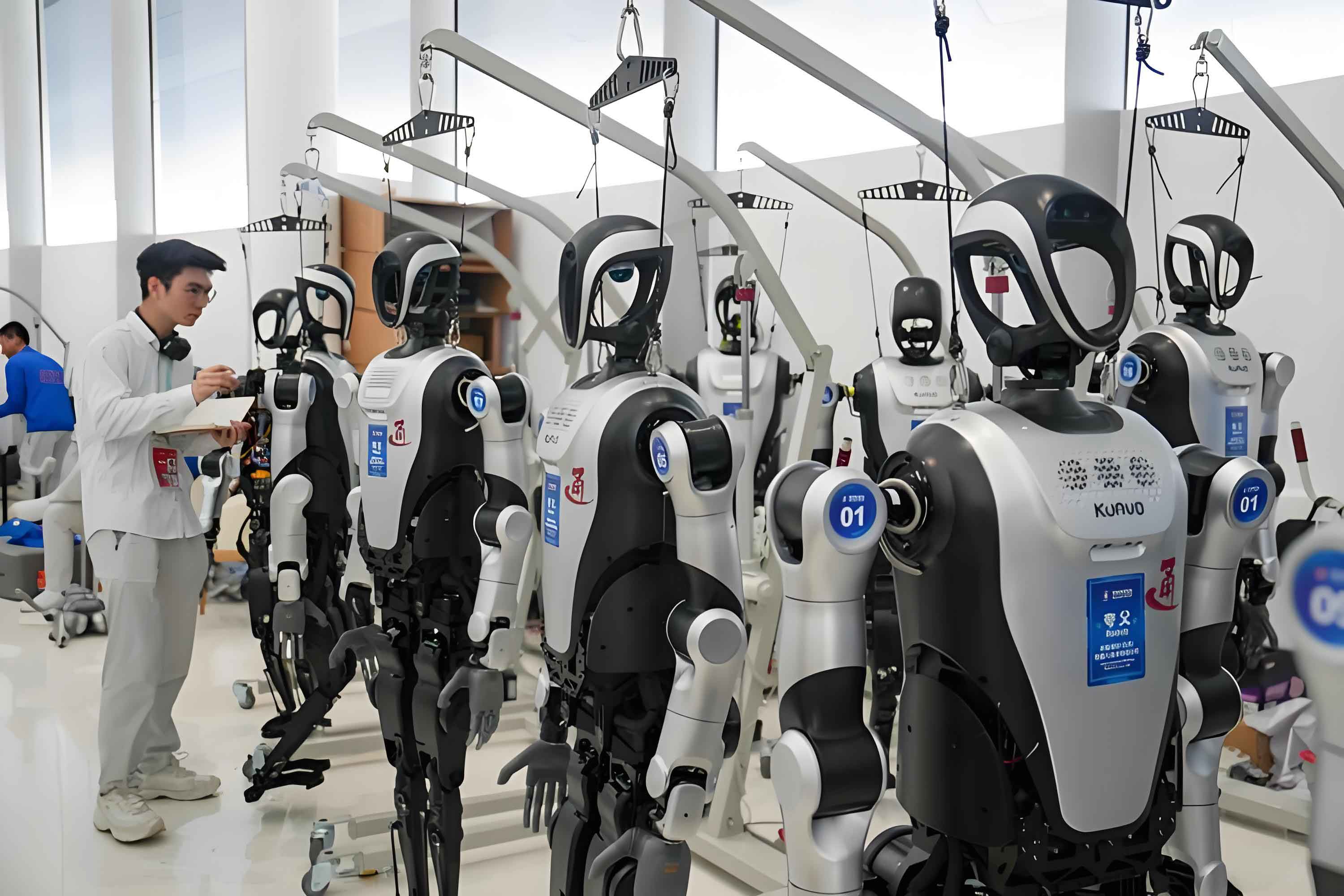
As I delve deeper into the applications of humanoid robots, it becomes clear that their performance is tightly linked to battery technology. Humanoid robots require high energy density to support extended operation, often needing to function for 6 hours or more without interruption. Additionally, weight reduction is paramount to ensure agility and efficiency. Traditional batteries struggle to meet these demands due to their lower energy densities and safety concerns. In contrast, solid-state batteries offer a compelling solution, as their stable structure minimizes risks like electrolyte leakage, which is essential in dynamic environments where humanoid robots operate. I have seen prototypes, such as those in development, that leverage solid-state batteries to achieve continuous operation, highlighting their suitability for humanoid robots.
To quantify the market outlook for humanoid robots, I have created a table based on aggregated forecasts. This data underscores the rapid expansion anticipated in this sector, emphasizing the role of humanoid robots in various domains.
| Year | Projected Market Size (USD) | Estimated Unit Sales (Millions) | Key Applications |
|---|---|---|---|
| 2024 | ~11 billion | N/A | Elderly care, initial industrial use |
| 2035 | 75 billion | N/A | Broad adoption in services and manufacturing |
| 2050 | 1 trillion | 70 | Ubiquitous in daily life and specialized tasks |
In my evaluation, the growth of the humanoid robot market can be described using exponential models. For instance, the market size \( M(t) \) at time \( t \) might follow: $$ M(t) = M_0 e^{rt} $$ where \( M_0 \) is the initial market size, \( r \) is the growth rate, and \( t \) is time in years. Applying this to humanoid robots, if \( r \approx 0.15 \) for certain segments, it aligns with the observed CAGR. This mathematical approach helps in predicting how humanoid robots will proliferate, driven by technological advancements and societal needs. Furthermore, the energy requirements for humanoid robots can be modeled as: $$ E_{\text{total}} = P \times T $$ where \( E_{\text{total}} \) is the total energy needed in watt-hours, \( P \) is the average power consumption in watts, and \( T \) is the operating time in hours. With solid-state batteries providing higher \( E_{\text{total}} \) per unit mass, humanoid robots can achieve longer \( T \) values, enhancing their utility.
I must emphasize that the integration of solid-state batteries into humanoid robots is not without challenges. From my research, key hurdles include manufacturing scalability and cost reduction. However, the progress in semi-solid battery technologies serves as a stepping stone, with出货量 potentially exceeding 10 GWh by 2025 in various applications. This intermediate phase allows for refinement before full solid-state adoption. Humanoid robots, in particular, benefit from this evolution, as their battery needs are more stringent than those in electric vehicles. For example, the power density \( P_d \) required for humanoid robots can be expressed as: $$ P_d = \frac{P}{m} $$ where \( P_d \) is in W/kg, and higher values are necessary for agile movements. Solid-state batteries, with their improved safety and energy profiles, are well-suited to meet these demands, making them a cornerstone for the future of humanoid robots.
As I consider the broader implications, the economic impact of humanoid robots extends beyond market numbers. They could revolutionize labor markets, enhance productivity, and address shortages in sectors like healthcare. In elderly care, for instance, humanoid robots can provide companionship and monitoring, reducing the burden on human caregivers. The reliability of solid-state batteries ensures that these humanoid robots operate safely in close proximity to people, minimizing risks. I have analyzed case studies where humanoid robots equipped with advanced batteries demonstrate reduced downtime and increased efficiency, underscoring their potential. The formula for operational efficiency \( \eta \) can be defined as: $$ \eta = \frac{T_{\text{active}}}{T_{\text{total}}} \times 100\% $$ where \( T_{\text{active}} \) is the time spent performing tasks, and \( T_{\text{total}} \) is the total available time. With solid-state batteries, \( T_{\text{active}} \) increases due to longer battery life, boosting \( \eta \) for humanoid robots.
Looking ahead, I am optimistic about the symbiotic relationship between humanoid robots and solid-state batteries. Innovation in materials science, such as polymer-inorganic composite electrolytes, is pushing the boundaries of what these batteries can achieve. Similarly, advancements in AI and robotics are making humanoid robots more adaptive and intelligent. The convergence of these fields will likely lead to humanoid robots that are not only functional but also energy-autonomous, capable of learning and evolving in real-time. In my view, this will unlock new possibilities, from disaster response to personalized services, all powered by reliable solid-state batteries. The continued emphasis on research and development will be crucial, and I anticipate that within the next decade, we will see humanoid robots becoming integral parts of our society, driven by the enduring power of solid-state batteries.
In conclusion, as I synthesize these insights, it is evident that humanoid robots and solid-state batteries are on a collision course with destiny. The projections for humanoid robots are staggering, and their realization depends heavily on energy innovations. Solid-state batteries, with their superior properties, are set to become the lifeblood of these advanced machines. I encourage ongoing investment and collaboration to overcome remaining barriers, ensuring that humanoid robots can fulfill their promise. From industrial floors to homes, the era of humanoid robots is dawning, and it is powered by the silent revolution in battery technology. As we move forward, I believe that humanoid robots will not only transform industries but also redefine what it means to be human in an automated world.