
As a researcher deeply involved in the field of robotics, I have witnessed firsthand the remarkable evolution of bionic robots, especially their foray into unconventional environments like winter sports. The recent demonstrations of hexapod robots on ski slopes and ice rinks during events akin to the Winter Olympics have been a testament to the versatility and potential of bionic robot technology. These experiences have solidified my belief that bionic robots are not just laboratory curiosities but pivotal tools for future applications. In this article, I will delve into the technical intricacies, challenges, and broad prospects of bionic robots, drawing from my engagements with projects that push the boundaries of what these machines can achieve.
The journey began with the development of a hexapod skiing bionic robot, designed to navigate snowy terrains. Unlike traditional ground scenarios, snow presents unique hurdles: sub-zero temperatures can destabilize sensitive electronic components, and skiing requires reliance on gravity and inertia for movement, demanding exceptional control stability and flexibility. To address this, our team engineered a bionic robot with six mechanical legs. Two legs were equipped with poles for support and maneuvering, while the remaining four were attached to skis, each with five degrees of freedom. This design allowed for precise speed and path control, enabling actions like sudden stops and turns. The core intelligence of this bionic robot lies in its smart system, which analyzes human skiing data and mimics movements, facilitating autonomous navigation. In tests, the bionic robot achieved impressive speeds, such as over 10 m/s on a 400-meter, 18-degree slope, showcasing its potential for patrol and rescue operations in snowy areas.
To quantify the performance of such bionic robots, we can summarize key parameters in a table. This highlights how bionic robot designs are optimized for specific environmental challenges.
| Parameter | Value | Description |
|---|---|---|
| Maximum Speed (Remote Control) | 3.2 m/s | Stable turning on ski simulator |
| Maximum Speed (Autonomous) | 5.17 m/s | Straight-line skiing on simulator |
| Turning Speed (Autonomous) | 2.45 m/s | Stable turning on simulator |
| Outdoor Slope Speed | >10 m/s | On 18-degree, 400-meter slope |
| Degrees of Freedom per Ski | 5 | Enables flexible control |
| Operating Temperature | Sub-zero conditions | Withstands cold environments |
The control dynamics of a bionic robot like this can be modeled using equations of motion. For instance, the velocity and orientation during skiing can be described by:
$$ \dot{x} = v \cos(\theta), \quad \dot{y} = v \sin(\theta), \quad \dot{\theta} = \omega $$
where \( x \) and \( y \) are position coordinates, \( v \) is speed, \( \theta \) is heading angle, and \( \omega \) is angular velocity. The bionic robot’s stability relies on balancing forces, which can be expressed as:
$$ \sum F = m a, \quad \sum \tau = I \alpha $$
with \( m \) as mass, \( a \) acceleration, \( \tau \) torque, \( I \) moment of inertia, and \( \alpha \) angular acceleration. These principles underpin the bionic robot’s ability to mimic human skiing techniques.
Building on this, another fascinating application emerged: a hexapod curling bionic robot. This machine mimics human athletes by using its front legs to hold and spin the curling stone, middle legs for support, and rear legs for thrusting forward. The bionic robot employs vision and force sensing to assess ice friction, constructing a dynamic model for accurate throws. The trajectory prediction involves equations like:
$$ s = ut + \frac{1}{2}at^2, \quad \text{with } a = -\mu g $$
where \( s \) is distance, \( u \) initial velocity, \( t \) time, \( \mu \) friction coefficient, and \( g \) gravitational acceleration. This allows the bionic robot to serve as a training partner, refining strategies through repeated simulations. The development of such bionic robots underscores their adaptability, from icy rinks to snowy peaks.
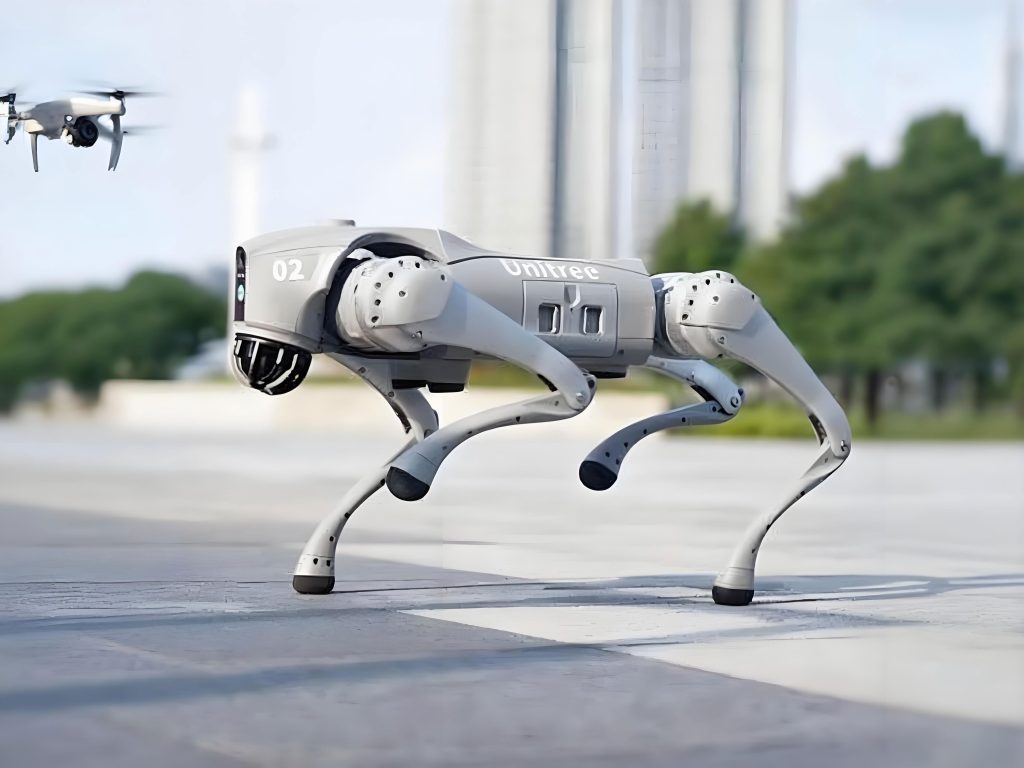
Beyond winter sports, bionic robots have found traction in diverse fields. Quadruped robots, often called “robot dogs,” exemplify this expansion. Their bionic design grants them agility across complex terrains, making them ideal for security patrols, industrial inspections, and even companionship. During health crises, bionic robots have been deployed to monitor crowds and ensure safety protocols. To illustrate the scope, consider this comparison of bionic robot types and their applications:
| Bionic Robot Type | Key Features | Primary Applications | Challenges |
|---|---|---|---|
| Hexapod Skiing Robot | Six legs with skis, pole support, autonomous navigation | Snow patrol, rescue, recreational skiing | Low-temperature durability, speed control |
| Hexapod Curling Robot | Leg-based throwing, ice friction sensing, trajectory prediction | Sports training, demonstration events | Precision in dynamic ice conditions |
| Quadruped Robot (Robot Dog) | Four-legged mobility, AI-driven perception, compact size | Security, inspection, companionship, entertainment | Cost, battery life, public acceptance |
| Bipedal Robot | Human-like gait, balance algorithms, versatile manipulation | Healthcare, logistics, service industries | Complex control, stability on uneven surfaces |
The commercialization of bionic robots is accelerating globally. Companies are investing heavily in bionic robot technologies, leading to products that are increasingly accessible. For instance, domestic firms have introduced quadruped bionic robots for consumer use, while international giants showcase advanced models capable of intricate tasks. The economic potential of bionic robots can be analyzed through growth projections. If we model market expansion using a logistic function:
$$ P(t) = \frac{K}{1 + e^{-r(t-t_0)}} $$
where \( P(t) \) is market penetration at time \( t \), \( K \) is carrying capacity, \( r \) is growth rate, and \( t_0 \) is the inflection point. For bionic robots, \( r \) is increasing due to technological advancements, suggesting rapid adoption in sectors like logistics and healthcare. This bionic robot revolution is not just about hardware; software algorithms play a crucial role. The control logic for a bionic robot often involves PID controllers, expressed as:
$$ u(t) = K_p e(t) + K_i \int_0^t e(\tau) d\tau + K_d \frac{de(t)}{dt} $$
where \( u(t) \) is control output, \( e(t) \) error signal, and \( K_p, K_i, K_d \) are tuning parameters. Such equations enable bionic robots to adapt in real-time, enhancing their reliability.
Looking ahead, the future of bionic robots is brimming with possibilities. In industrial settings, bionic robots can automate hazardous inspections, using sensors to detect anomalies. The data collected by a bionic robot can be processed through machine learning models, such as:
$$ y = f(x; \theta) = \sigma(Wx + b) $$
with \( \sigma \) as an activation function, \( W \) weights, \( b \) biases, and \( \theta \) parameters learned from training data. This allows bionic robots to identify patterns, like equipment failures, with high accuracy. In daily life, bionic robots could evolve into personal assistants, helping with chores or providing companionship. The societal value of bionic robots is profound, potentially reducing human risk in dangerous jobs and improving efficiency.
To further explore the technical depth, consider the mechanical design of bionic robots. The leg coordination in a hexapod bionic robot can be optimized using inverse kinematics. For a leg with joints angles \( \theta_1, \theta_2, \theta_3 \), the end-effector position \( (x, y, z) \) might be given by:
$$ x = l_1 \cos(\theta_1) + l_2 \cos(\theta_1+\theta_2) + l_3 \cos(\theta_1+\theta_2+\theta_3) $$
$$ y = l_1 \sin(\theta_1) + l_2 \sin(\theta_1+\theta_2) + l_3 \sin(\theta_1+\theta_2+\theta_3) $$
$$ z = \text{constant offset} $$
where \( l_1, l_2, l_3 \) are link lengths. This mathematics ensures precise movement, whether on snow or ice. Moreover, energy efficiency is critical for bionic robots. Power consumption can be modeled as:
$$ E = \int P(t) dt = \int (I^2 R + \tau \omega) dt $$
with \( I \) current, \( R \) resistance, \( \tau \) torque, and \( \omega \) angular velocity. Advancements in materials and batteries are extending the operational life of bionic robots, making them more practical for extended missions.
The integration of bionic robots into smart cities is another frontier. Imagine networks of bionic robots collaborating for tasks like disaster response. Their communication can be based on protocols that minimize latency, ensuring coordinated actions. The potential applications are vast, as summarized below:
| Scenario | Bionic Robot Role | Technological Requirements | Expected Impact |
|---|---|---|---|
| Urban Search and Rescue | Navigate rubble, deliver supplies, locate survivors | Robust sensors, AI for decision-making, durable construction | Reduced response time, saved lives |
| Agricultural Automation | Monitor crops, apply treatments, harvest produce | Computer vision, gentle manipulation, all-terrain mobility | Increased yield, lower labor costs |
| Healthcare Assistance | Aid rehabilitation, fetch items, provide social interaction | Safe human-robot interaction, precision control, empathy algorithms | Improved patient outcomes, caregiver support |
| Education and Research | Demonstrate scientific principles, engage students in STEM | User-friendly interfaces, modular designs, affordability | Enhanced learning experiences, innovation inspiration |
In my view, the evolution of bionic robots is driven by interdisciplinary collaboration. From mechanical engineering to artificial intelligence, each breakthrough propels bionic robot capabilities forward. The skiing and curling bionic robots are just early examples of how bionic robot technology can adapt to niche environments. As algorithms improve, we might see bionic robots mastering even more complex sports, perhaps even competing alongside humans. The key is continuous iteration, fueled by real-world testing and feedback.
Ethical considerations also arise with bionic robots. Issues like privacy, job displacement, and safety must be addressed through regulations and transparent design. However, the benefits of bionic robots—such as reducing human exposure to hazards—often outweigh concerns. By embedding ethical guidelines into bionic robot development, we can foster trust and acceptance.
To conclude, the journey of bionic robots from labs to snowy slopes and beyond is a thrilling narrative of innovation. As a participant in this field, I am optimistic about the future where bionic robots become ubiquitous assistants. Whether it’s a hexapod bionic robot patrolling a mountain or a quadruped bionic robot comforting the elderly, these machines embody the fusion of biology and engineering. The recurring theme is clear: bionic robot technology is not just about imitation; it’s about enhancement, pushing the boundaries of what machines can do for humanity. With ongoing research, the dream of bionic robots enriching our daily lives is inching closer to reality, promising a world where technology and nature harmonize through the lens of bionic robot advancements.