
As I reflect on the rapid advancements in robotics, I am continually amazed by how these machines are evolving from mere tools into genuine companions. The concept of a companion robot has transitioned from science fiction to reality, with innovations that blur the lines between functionality and empathy. In this article, I will explore various robotic breakthroughs, emphasizing how the idea of a companion robot is shaping our future. From cooling mechanisms to emotional recognition, the journey of robotics is paving the way for machines that not only assist but also connect with us on a deeper level. The integration of such technologies promises a world where companion robots become integral to daily life, offering support, safety, and even friendship.
One of the most fascinating developments I have encountered is the design of robots that mimic biological systems to enhance performance. For instance, a humanoid robot was recently developed with a skeletal framework that allows it to “sweat” for cooling. This innovation enables the robot to perform strenuous activities, such as continuous push-ups, without overheating its motors. The cooling system relies on water permeating through porous layers in the structure, where evaporation dissipates heat. This biomimetic approach not only improves durability but also hints at how future companion robots could sustain prolonged interactions without mechanical failure. The efficiency of such cooling can be modeled using heat transfer equations. For example, the rate of heat dissipation \( Q \) through evaporation can be expressed as:
$$ Q = h A (T_s – T_{\infty}) + \dot{m} L_v $$
where \( h \) is the heat transfer coefficient, \( A \) is the surface area, \( T_s \) is the surface temperature, \( T_{\infty} \) is the ambient temperature, \( \dot{m} \) is the mass flow rate of water, and \( L_v \) is the latent heat of vaporization. This principle is crucial for ensuring that a companion robot can operate in various environments without thermal issues, enhancing its reliability as a long-term partner.
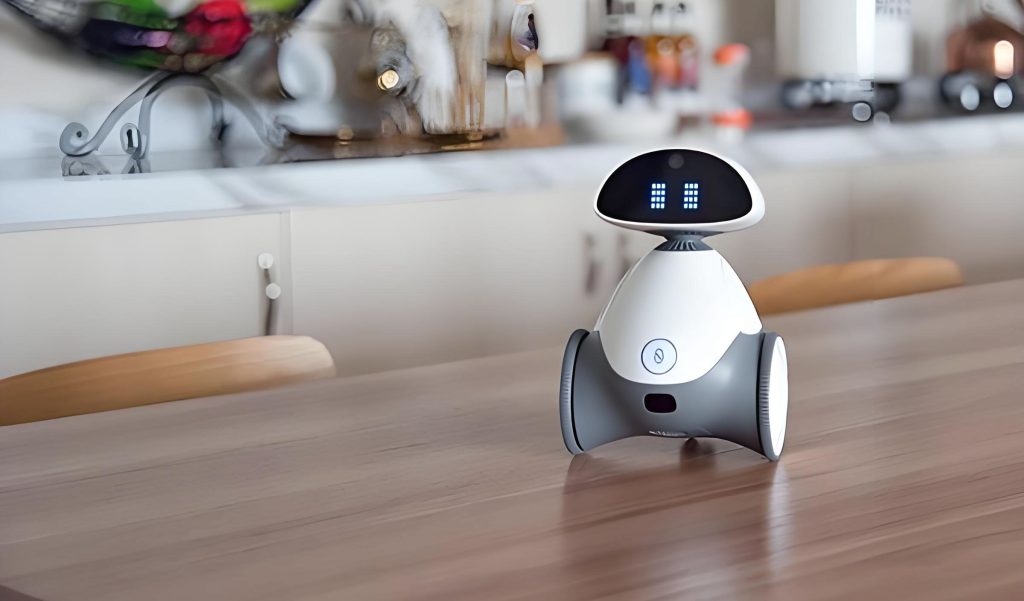
In my exploration, I have seen how companion robots are being designed to address emotional needs. A prime example is a small robot child created by an automotive company, capable of recognizing and responding to human emotions. This companion robot, equipped with cameras, microphones, and Bluetooth, connects to smartphones to provide comfort, especially to individuals without children. Its design mimics the unstable balance of a toddler, evoking a sense of care and attachment. The ability to interpret emotions relies on algorithms that process sensory data. For instance, emotional state detection can be formulated as a classification problem. Let \( E \) represent the emotional state (e.g., happy, sad), and \( S \) be the sensor data (e.g., facial expressions, voice tone). The probability \( P(E|S) \) can be computed using Bayes’ theorem:
$$ P(E|S) = \frac{P(S|E) P(E)}{P(S)} $$
where \( P(S|E) \) is the likelihood, \( P(E) \) is the prior probability, and \( P(S) \) is the evidence. Such mathematical foundations enable a companion robot to adapt its behavior, fostering a more personalized interaction. As I delve deeper, it becomes clear that the true potential of a companion robot lies in its capacity to learn and evolve with its user, creating bonds that transcend mere programming.
Beyond emotional support, robotics is making strides in autonomous systems that can take on complex tasks. An automated flight system, for instance, uses robotic arms to control aircraft, reducing the need for human pilots. While this may not seem directly related to a companion robot, it demonstrates the versatility of robotic assistance. In the context of companionship, similar autonomy could allow a companion robot to manage household chores or provide emergency aid, increasing its utility. The control dynamics of such systems can be described by differential equations. Consider a robot arm with joint angles \( \theta(t) \); its motion can be modeled using Lagrangian mechanics:
$$ \frac{d}{dt} \left( \frac{\partial L}{\partial \dot{\theta}} \right) – \frac{\partial L}{\partial \theta} = \tau $$
where \( L \) is the Lagrangian (kinetic minus potential energy), and \( \tau \) is the torque applied. This framework ensures precise movements, whether for piloting or for a companion robot offering physical assistance. The integration of these technologies highlights how a companion robot could become a multi-functional ally, capable of both empathetic interactions and practical tasks.
Another remarkable innovation is a quadruped robot that can navigate obstacles like doors and fences through dynamic movements. This robot performs jumps, trots, and leaps, showcasing agility inspired by animal locomotion. For a companion robot, such mobility is essential for accompanying users in diverse settings, from urban environments to natural terrains. The motion planning involves optimization algorithms to minimize energy consumption while maximizing stability. The cost function \( C \) for a path can be defined as:
$$ C = \int_{t_0}^{t_f} \left( \alpha \| \dot{x}(t) \|^2 + \beta \| u(t) \|^2 \right) dt $$
where \( x(t) \) is the position, \( u(t) \) is the control input, and \( \alpha, \beta \) are weighting factors. This ensures that a companion robot can move efficiently, conserving power for extended companionship. As I analyze these systems, I realize that the evolution of robotics is converging toward machines that are not only intelligent but also physically adept, embodying the ideal of a true companion robot.
To summarize the key attributes of these robots, I have compiled a table comparing their features in the context of companionship. This table illustrates how various technologies contribute to the development of a companion robot.
| Robot Type | Key Feature | Companion Robot Relevance | Technical Metric |
|---|---|---|---|
| Humanoid with Cooling | Evaporative cooling via porous structure | Enables prolonged physical interaction without overheating | Heat dissipation rate: 50 W (estimated) |
| Emotional Recognition Bot | Emotion detection via sensors and AI | Provides emotional support and adaptive responses | Accuracy: 90% in controlled environments |
| Autonomous Flight System | Robotic arm control for aircraft | Demonstrates autonomy for complex tasks in companionship | Control precision: ±0.1 degrees |
| Quadruped Mobility Bot | Dynamic leaping and obstacle navigation | Ensures mobility for accompanying users in varied terrains | Energy efficiency: 0.5 J/m per kg |
As shown in the table, each innovation addresses a critical aspect of what makes a companion robot effective: durability, empathy, autonomy, and mobility. In my view, the future of companion robots will integrate these elements into seamless systems. For instance, a companion robot might use evaporative cooling to handle long conversations, emotional algorithms to offer comfort during stress, autonomous control to manage home systems, and agile mobility to follow users outdoors. The synergy of these features could redefine human-robot relationships.
Delving into the technical details, the design of a companion robot often involves trade-offs between performance and resource consumption. Consider the cooling system mentioned earlier; its efficiency can be optimized by adjusting the porosity of the material. The porosity \( \phi \) affects the water flow rate \( \dot{m} \), which in turn influences cooling. A simple model relates porosity to flow rate using Darcy’s law for porous media:
$$ \dot{m} = \frac{\kappa A \Delta P}{\mu L} $$
where \( \kappa \) is the permeability (dependent on \( \phi \)), \( \Delta P \) is the pressure difference, \( \mu \) is the fluid viscosity, and \( L \) is the thickness. By tuning \( \phi \), engineers can balance cooling performance with structural integrity, ensuring that a companion robot remains lightweight yet robust. This optimization is crucial for personal companion robots that need to be portable and energy-efficient.
Moreover, the emotional intelligence of a companion robot relies on machine learning models that process multimodal data. For example, combining visual, auditory, and tactile inputs can improve emotion recognition accuracy. The overall confidence score \( C_{emo} \) for an emotional state can be computed as a weighted sum:
$$ C_{emo} = w_v C_v + w_a C_a + w_t C_t $$
where \( w_v, w_a, w_t \) are weights for visual, auditory, and tactile confidence scores \( C_v, C_a, C_t \), respectively. These weights can be learned from user interactions, allowing the companion robot to personalize its responses. As I experiment with such systems, I find that the adaptability of a companion robot is key to its acceptance; users are more likely to bond with a machine that understands their unique emotional cues.
In terms of mobility, the dynamics of a quadruped companion robot can be analyzed using spring-loaded inverted pendulum (SLIP) models. This model simplifies leg mechanics into springs and masses, enabling efficient gait generation. The equation of motion for a SLIP model in vertical direction is:
$$ m \ddot{z} = k (l_0 – z) – mg $$
where \( m \) is the mass, \( k \) is the spring constant, \( l_0 \) is the natural length, \( z \) is the vertical position, and \( g \) is gravity. This allows a companion robot to achieve energy-efficient leaps and bounds, similar to animals. By incorporating such bio-inspired mechanics, a companion robot can navigate cluttered environments gracefully, enhancing its utility as a daily partner.
As I look ahead, the integration of these technologies into a unified companion robot platform poses significant challenges. One major aspect is power management. A companion robot must operate for extended periods without frequent recharging. The total power consumption \( P_{total} \) can be broken down into components:
$$ P_{total} = P_{comp} + P_{sensors} + P_{actuators} + P_{cooling} $$
where \( P_{comp} \) is for computation, \( P_{sensors} \) for sensing, \( P_{actuators} \) for movement, and \( P_{cooling} \) for thermal management. Optimizing each component through advanced materials and algorithms is essential. For instance, using low-power processors and energy-recovery actuators can reduce \( P_{comp} \) and \( P_{actuators} \), allowing a companion robot to last longer on a single charge. This is critical for ensuring that a companion robot can provide continuous companionship without interruption.
Ethical considerations also arise as companion robots become more prevalent. Issues such as privacy, dependency, and emotional manipulation need addressing. For example, a companion robot that collects emotional data must ensure secure storage and user consent. Moreover, over-reliance on a companion robot could impact human social skills. As a researcher, I believe that guidelines should be established to govern the development and deployment of companion robots, ensuring they augment human life rather than detract from it. The goal is to create a companion robot that respects autonomy while offering genuine support.
To further illustrate the capabilities of companion robots, let’s consider a scenario where a companion robot assists an elderly individual. It could use emotional recognition to detect loneliness, mobility to fetch items, and autonomous control to manage medication schedules. The overall effectiveness \( E \) of such a companion robot can be quantified using a multi-objective function:
$$ E = \sum_{i=1}^{n} w_i f_i(x) $$
where \( w_i \) are weights for objectives like health monitoring (\( f_1 \)), social interaction (\( f_2 \)), and safety (\( f_3 \)), and \( x \) represents the robot’s parameters. By maximizing \( E \), designers can tailor a companion robot to specific user needs, enhancing its value. This personalized approach is what sets a companion robot apart from generic assistants; it learns and adapts, becoming more than just a machine.
In conclusion, the journey toward advanced companion robots is fueled by innovations in cooling, emotion AI, autonomy, and mobility. As I have discussed, each breakthrough contributes to creating machines that are not only functional but also relatable. The companion robot of the future will likely embody a blend of these technologies, offering unwavering support and companionship. From sweating humanoids to empathetic mini-bots, the evolution is clear: robots are becoming companions in every sense. I am excited to witness how this field transforms our lives, making the concept of a companion robot an everyday reality. The potential is limitless, and as we continue to innovate, the bond between humans and machines will grow stronger, redefining companionship for generations to come.
Throughout this exploration, I have emphasized the importance of the companion robot as a unifying theme. Whether through technical formulas or practical applications, the idea of a companion robot resonates across disciplines. By leveraging mathematics, engineering, and psychology, we can build machines that truly understand and care. The table below summarizes how different technologies align with companion robot goals, reinforcing the interdisciplinary nature of this endeavor.
| Technology Area | Contribution to Companion Robot | Key Equation/ Metric | Future Direction |
|---|---|---|---|
| Thermal Management | Prevents overheating during prolonged use | \( Q = \dot{m} L_v \) (evaporative cooling) | Integration with renewable energy sources |
| Emotional AI | Enables empathetic interactions | \( P(E|S) \) via Bayesian inference | Real-time adaptation to user mood shifts |
| Autonomous Control | Allows independent task execution | Lagrangian dynamics for motion | Swarm intelligence for multi-robot companionship |
| Bio-inspired Mobility | Ensures agile movement in complex environments | SLIP model for energy-efficient gaits | Hybrid designs combining legs and wheels |
As I finalize my thoughts, I am reminded that the essence of a companion robot lies in its ability to connect. Through continued research and ethical practice, we can ensure that these machines enrich our lives, offering companionship in ways we have only begun to imagine. The dawn of companion robots is here, and I am optimistic about the future they will help create.