
In recent years, the integration of artificial intelligence with the real economy has deepened, propelling industrial intelligence from traditional automation toward a new phase where systems can perceive, think, and autonomously execute tasks—what I refer to as the era of embodied AI robots. This shift represents not just a technological upgrade but a fundamental rethinking of how manufacturing operates. As an observer and participant in this field, I have witnessed the transformative potential of embodied AI robots, which fuse AI, physical entities, and environments into cohesive systems capable of active cognition, autonomous decision-making, real-time execution, and continuous learning. In this article, I will delve into the essence, breakthroughs, challenges, and pathways for industrial embodied AI robots, drawing on insights and emphasizing the need for cross-disciplinary collaboration.
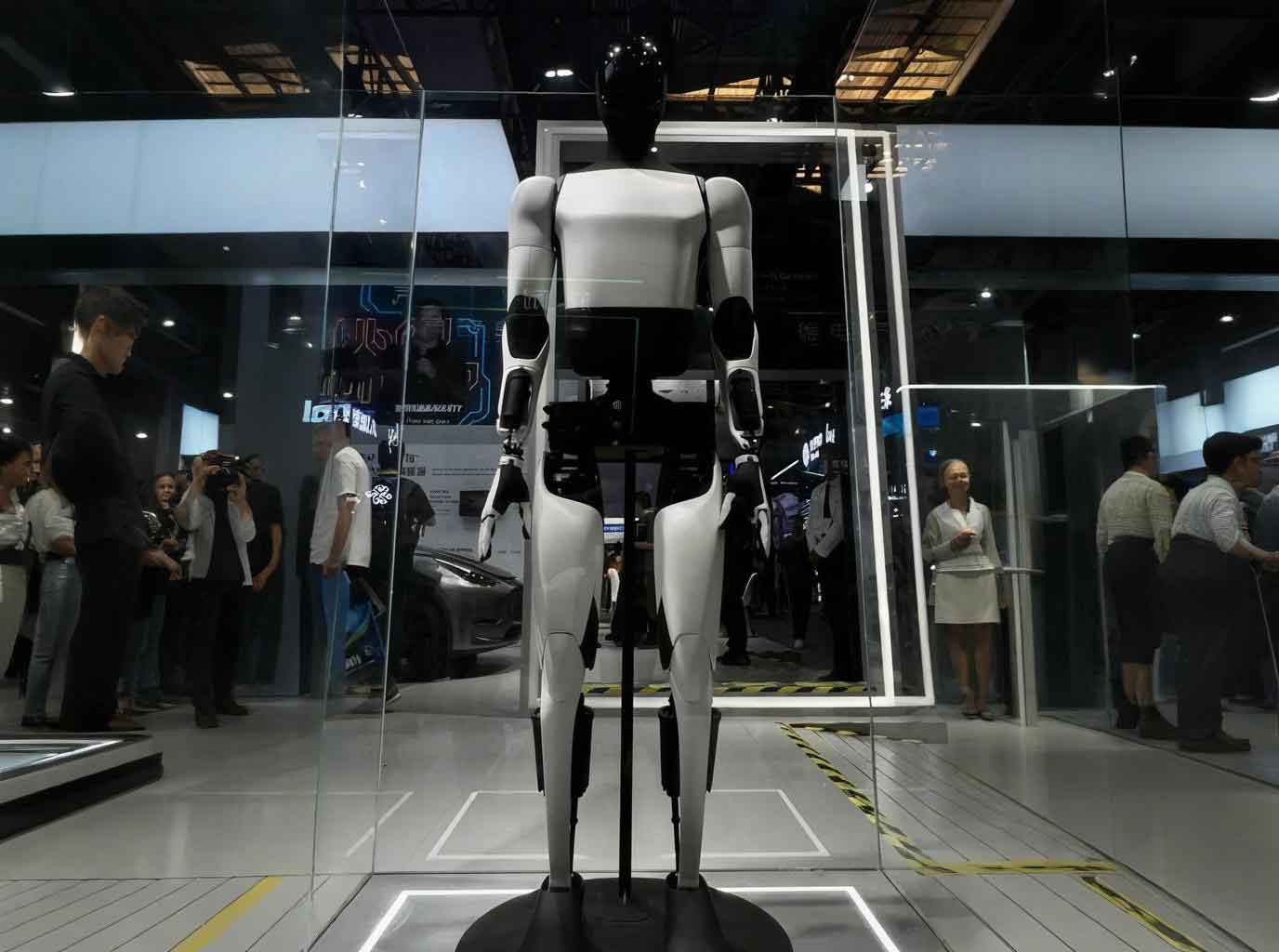
To begin, let me clarify what I mean by “embodied AI robot” in an industrial context. An embodied AI robot is an intelligent system designed to autonomously complete production tasks by deeply integrating artificial intelligence with physical industrial entities and their surroundings. It forms a closed-loop system that actively perceives, makes decisions, executes actions, interacts efficiently, and continuously optimizes through learning. The core characteristics of embodied AI robots can be summarized in the following table, which contrasts them with traditional automated systems:
| Feature | Traditional Automation | Embodied AI Robot |
|---|---|---|
| Perception | Limited, pre-programmed sensors | Multi-modal, active, and adaptive sensing |
| Decision-Making | Rule-based, fixed logic | Model-driven, autonomous with generalization |
| Execution | Sequential, rigid actions | Real-time, flexible, and context-aware |
| Learning | Static, no self-improvement | Continuous learning and evolution |
| Adaptability | Low, suited for mass production | High, supports customization and dynamic tasks |
The mathematical representation of this closed-loop process can be expressed as:
$$ \text{Action}_{t+1} = f(\text{Perception}_t, \text{Model}_t, \text{Feedback}_t) $$
where \( \text{Action}_{t+1} \) is the next execution step, \( \text{Perception}_t \) is the multi-modal sensory input at time \( t \), \( \text{Model}_t \) is the cognitive or decision-making model (e.g., a large language model or world model), and \( \text{Feedback}_t \) is the result from prior executions. This equation highlights how embodied AI robots operate in a continuous feedback cycle, enabling self-optimization.
In my view, the most fundamental breakthrough of embodied AI robots lies in overcoming the limitations of traditional robotics and automated guided vehicles (AGVs), which often have disjointed perception, cognition, decision, and execution stages. Embodied AI robots achieve a seamless integration, leading to a paradigm shift from “data input-rule output” to “environment interaction-intelligent emergence.” This breakthrough manifests in three key areas: multi-modal perception and cognition, generalization and autonomous decision-making driven by large models, and the deep integration of software and hardware for “knowledge-action unity.” For instance, the perception capability of an embodied AI robot can be modeled as:
$$ P = \sum_{i=1}^{n} w_i \cdot S_i $$
where \( P \) is the fused perception output, \( S_i \) represents inputs from various sensors (e.g., vision, tactile, auditory), and \( w_i \) are adaptive weights learned through interaction. This allows the embodied AI robot to develop a “super sensory” system that understands the physical world comprehensively.
The impact of embodied AI robots on manufacturing is profound, reshaping the underlying logic across three dimensions: production processes, production relations, and production systems. First, in production processes, embodied AI robots accelerate the transition from rigid mass production to flexible manufacturing. Their generalization and rapid task-switching abilities enable adaptation to high-frequency, small-batch, and customized demands. This can be quantified by a flexibility metric:
$$ F = \frac{\text{Number of Tasks Handled}}{\text{Setup Time}} $$
where higher \( F \) values indicate greater flexibility. With embodied AI robots, \( F \) increases significantly, allowing companies to respond to consumer needs with lower costs and higher efficiency. Second, in production relations, embodied AI robots redefine the boundary between humans and machines. Humans shift from operators to “teachers” and “collaborators,” guiding embodied AI robots in learning and task completion. This new synergy enhances productivity and safety. Third, in production systems, embodied AI robots foster a self-organizing intelligent ecosystem, moving from passive digital/event-driven processes to active model-driven ones. The system’s adaptability can be represented as:
$$ A = \int_{0}^{T} R(t) \, dt $$
where \( A \) is the overall adaptability over time \( T \), and \( R(t) \) is the real-time response rate to environmental changes. Embodied AI robots maximize \( A \), creating a manufacturing environment that is感知自调节 (self-regulating) and任务自组织 (self-organizing).
Despite the promise, the large-scale deployment of embodied AI robots faces significant challenges. From my analysis, the main industrial bottlenecks include technological immaturity, scarcity of high-quality data, inadequate standards, and fragmented ecosystems. These are summarized in the table below, along with potential mitigation strategies:
| Bottleneck | Description | Impact | Potential Solutions |
|---|---|---|---|
| Technology Divergence | Multiple approaches (e.g., learning-based models, end-to-end systems) lack convergence; hardware-software协同 issues persist. | Slows innovation, increases R&D costs. | Focus on unified architectures; prioritize reliability and energy efficiency in embodied AI robot design. |
| Data Scarcity | High cost and difficulty in collecting, processing, and labeling embodied AI robot data; data silos prevail. | Limits model training and generalization. | Establish shared data spaces; incentivize data sharing and交易 markets. |
| Standardization Gaps | Lack of unified technical and safety standards for embodied AI robots. | Hinders interoperability, raises deployment risks. | Develop industry-wide standards; create safety评估 frameworks. |
| Ecosystem Fragmentation | Weak collaboration among suppliers, manufacturers, algorithm firms, and users; no commercial闭环. | Impedes scaling and profitability. | Foster “政产学研用金” collaboration; build open platforms and开源生态. |
The data challenge, in particular, can be modeled by the data requirement for training an embodied AI robot:
$$ D_{\text{required}} = k \cdot C^{m} $$
where \( D_{\text{required}} \) is the amount of high-quality data needed, \( C \) is the complexity of tasks, \( k \) is a constant based on the algorithm, and \( m > 1 \) indicates exponential growth. Currently, \( D_{\text{required}} \) often exceeds available data, slowing progress. To overcome this, I advocate for a “共建-共享-交易” (co-build, share, trade) system where stakeholders contribute to and benefit from data pools.
To accelerate the adoption of embodied AI robots, I believe we must construct a cross-disciplinary合作生态 that integrates technology, data, standards, and industry. This involves four key pillars: scenario-driven breakthroughs, data-centric牵引, platform-based foundations, and policy-capital linkages. For scenario-driven approaches, we should start with standardized tasks like sorting and搬运, using them as testbeds to develop “lighthouse projects” that demonstrate the value of embodied AI robots. The success rate \( S \) in such scenarios can be estimated as:
$$ S = p \cdot e^{-r \cdot d} $$
where \( p \) is the technical proficiency, \( r \) is the risk factor, and \( d \) is the场景 complexity. By lowering \( d \) initially, we boost \( S \), enabling gradual expansion to complex manufacturing cores. For data, building trusted data spaces and encouraging commercial data transactions can create sustainable supply loops. Platforms should offer common technologies and开源工具, reducing barriers for small enterprises. For example, a通用 platform for embodied AI robots might provide APIs for perception and control, expressed as:
$$ \text{API}_{\text{perception}} = g(\text{sensor inputs}), \quad \text{API}_{\text{control}} = h(\text{decision outputs}) $$
where \( g \) and \( h \) are optimized functions shared across the community.
Policy and capital play crucial roles as well. Governments should enact top-level plans to create initial markets and support应用验证, while “patient capital” should fund long-term R&D for embodied AI robot底层技术. The生态闭环 can be represented by a feedback loop:
$$ \text{Innovation} \rightarrow \text{Policy Support} \rightarrow \text{Market Demand} \rightarrow \text{Commercial Success} \rightarrow \text{Further Innovation} $$
This cycle ensures that embodied AI robots evolve from prototypes to mainstream solutions. In my experience, only through deep collaboration among government, industry, academia, research, users, and finance can we build an open,融合的产业生态 that allows embodied AI robots to thrive in industrial settings.
Looking ahead, embodied AI robots are not merely a technological evolution but a profound shift in manufacturing mindset and logic. They promise to inject new momentum into high-quality development and intelligent transformation. As we navigate this journey, it is essential to remember that the success of embodied AI robots hinges on collective effort—breaking down silos, sharing resources, and embracing innovation. The公式 for future manufacturing could well be:
$$ \text{Future Factory} = \sum_{\text{embodied AI robots}} (\text{Autonomy} + \text{Flexibility} + \text{Learning}) $$
where each embodied AI robot contributes to a smarter, more responsive production ecosystem. I am optimistic that with sustained focus on the challenges and opportunities, embodied AI robots will redefine industrial landscapes worldwide, making manufacturing more adaptive, efficient, and human-centric.