
The landscape of intelligence is undergoing a profound transformation. For decades, artificial intelligence existed primarily within the pristine, deterministic confines of the digital realm—processing language, recognizing images in datasets, and mastering complex board games. Yet, a new paradigm is rapidly emerging, one where AI must learn to navigate the messy, unpredictable, and physically constrained real world. This paradigm is embodied intelligence, and its most compelling and ambitious physical avatar is the embodied AI robot, particularly in humanoid form. I perceive this not merely as an engineering challenge, but as a fundamental shift in how machines learn, adapt, and ultimately, collaborate with us.
At its core, embodied intelligence (Embodied AI) posits that intelligence cannot be separated from a physical body that interacts with the environment. An embodied AI robot is not a passive receiver of data but an active participant in a sensory-motor loop. It learns by doing, by feeling the consequence of an action, by stumbling and recalibrating. This is a radical departure from traditional AI models trained on static datasets. The canonical formula for this interactive learning can be framed as a continuous cycle:
$$
\text{Perception}(P_t) \xrightarrow{\text{Model}} \text{Decision}(D_t) \xrightarrow{\text{Actuation}} \text{Action}(A_t) \xrightarrow{\text{Environment}} \text{New State}(S_{t+1}) \rightarrow \text{New Perception}(P_{t+1})
$$
Where at time \(t\), the robot’s sensors provide perceptual data \(P_t\) (visual, tactile, proprioceptive). Its internal world model, often a multimodal large model, processes this to form a decision \(D_t\). This decision is translated into motor commands, resulting in an action \(A_t\) that alters the environment, leading to a new state \(S_{t+1}\) and new sensory input \(P_{t+1}\). The loop reinforces learning, allowing the embodied AI robot to build a causal understanding of the physical world.
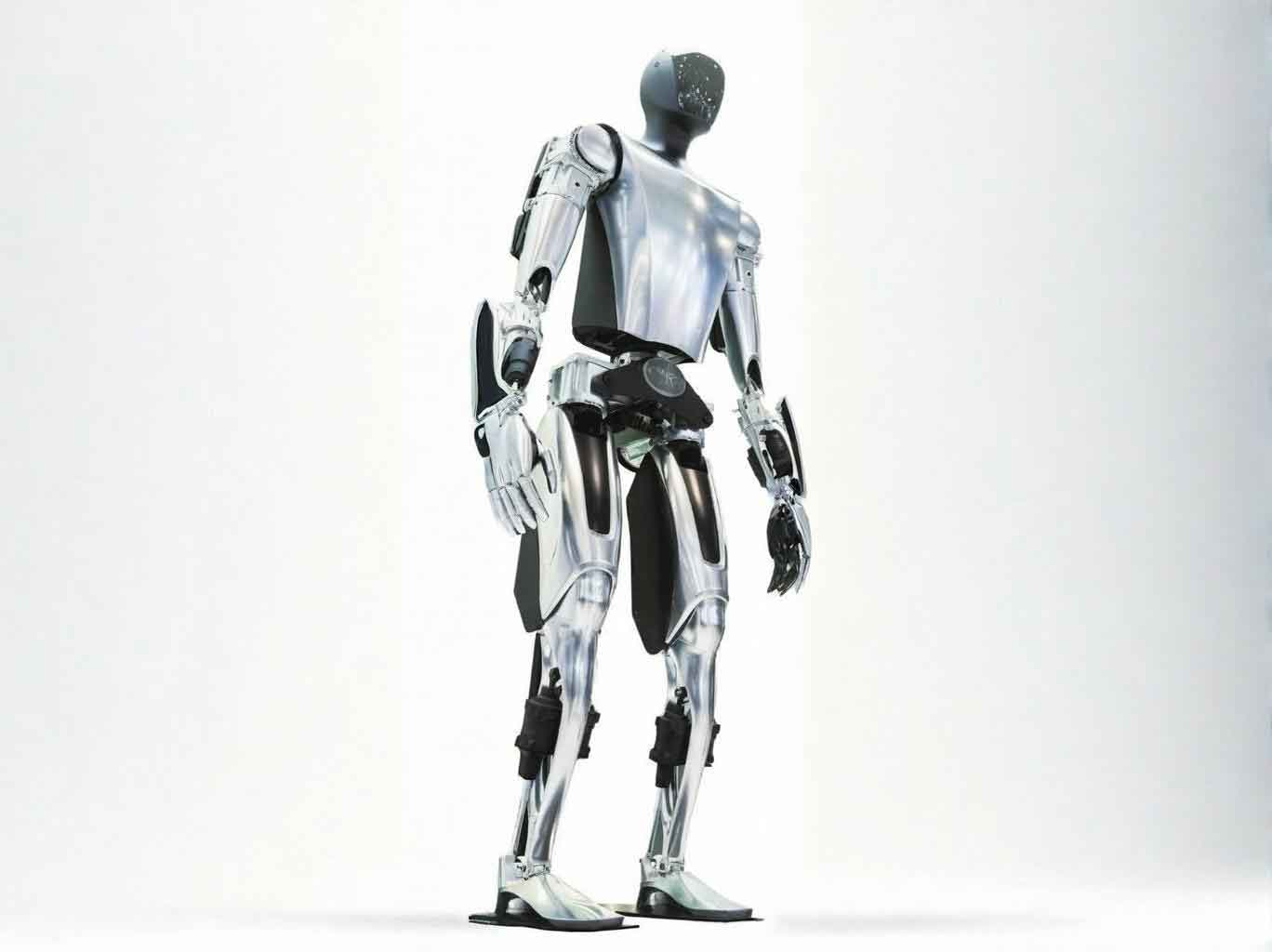
The drive towards humanoid embodied AI robot platforms is not merely an aesthetic choice. The human form is a product of millions of years of evolution optimized to operate in environments built by and for humans. Stairs, door handles, workbenches, vehicle cockpits, and kitchen tools are all designed around our bipedal stance, opposable thumbs, and stereoscopic vision. Therefore, a general-purpose embodied AI robot intended to seamlessly integrate into our existing infrastructure logically adopts a humanoid morphology. This design philosophy argues that it is more feasible to adapt the machine to the world than to redesign the entire world for the machine.
The development path for humanoid robots has historically bifurcated, representing two distinct philosophies:
| Development Path | Core Philosophy | Focus | Status & Outcome |
|---|---|---|---|
| Traditional Robotics Path (e.g., Honda’s ASIMO) | The robot as a sophisticated hardware platform. | Mastery of mechanical engineering, kinematics, dynamics, and pre-programmed motion stability. Intelligence is largely separate. | Reached impressive technical milestones in locomotion but limited autonomy and scalability. Development often discontinued as the approach hit complexity ceilings. |
| Modern Embodied AI Path (e.g., Tesla’s Optimus) | The robot as an embodied AI robot integrated with AI infrastructure. | Fusion of advanced actuation with a “brain” powered by multimodal AI, cloud-based training, and massive real-world data. Emphasis on learning, not just programming. | The prevailing direction. Aims for generality, scalability, and continuous improvement via software updates, mirroring the evolution of autonomous vehicles. |
The modern paradigm can thus be expressed as a synergistic union:
$$
\text{Modern Humanoid Robot} = \text{Advanced Robotic Hardware} + \text{Embodied AI} + \text{AI Infrastructure (Compute, Data, Cloud)}
$$
This equation highlights that the value of the embodied AI robot shifts decisively from the cost of its actuators and gears to the power of its software and the ecosystem that trains it.
The Technical Pillars of an Embodied AI Robot
Constructing a capable embodied AI robot rests on several interdependent technological pillars. Each presents formidable challenges that researchers and engineers are actively tackling.
1. Perception and Multimodal Fusion: An embodied AI robot must be a master of sensor fusion. It integrates streams from cameras (2D, 3D, depth), LiDAR, inertial measurement units (IMUs), force-torque sensors, and tactile skin. The core processing unit is increasingly a multimodal large model (MLM) that can understand and correlate these disparate data types. For instance, it must associate the visual appearance of a glass with the expected tactile feedback and appropriate gripping force, a concept linked to the binding problem in cognitive science. The model creates a unified spatial and semantic representation:
$$
R_t = \text{MLM}(V_t, L_t, I_t, F_t, \Theta_t)
$$
where \(R_t\) is the rich internal representation at time \(t\), built from visual \(V\), LiDAR \(L\), inertial \(I\), force \(F\), and proprioceptive (joint angle) \(\Theta\) inputs.
2. Learning, Adaptation, and World Modeling: This is the “intelligence” in embodied AI robot. Instead of hard-coded rules for every scenario, the robot uses machine learning—especially reinforcement learning (RL) and imitation learning—trained in vast simulation environments and refined with real-world data. A key concept is learning a “world model,” a neural network that predicts the future state of the environment given the current state and a proposed action. This allows for planning and reasoning. The loss function for training such a model often aims to minimize prediction error:
$$
\mathcal{L}_{\text{model}} = \mathbb{E}_{(s_t, a_t, s_{t+1}) \sim \mathcal{D}} [\| \hat{s}_{t+1} – s_{t+1} \|^2]
$$
where \(s_t\) is the state, \(a_t\) the action, \(s_{t+1}\) the true next state, and \(\hat{s}_{t+1}\) the model’s prediction, over a dataset \(\mathcal{D}\).
3. Motion Control and Dexterous Manipulation: Translating high-level goals (“pick up the screwdriver”) into stable, efficient, and safe low-level motor commands is a monumental task. For bipedal locomotion, control algorithms must solve complex optimization problems in real-time to maintain balance, often formulated as a quadratic program (QP) minimizing deviation from a desired motion while respecting physical constraints (joint limits, friction cones):
$$
\begin{aligned}
\min_{\ddot{q}, \tau, f} \quad & \| \ddot{q} – \ddot{q}_{\text{des}} \|^2 + \| \tau \|^2 \\
\text{s.t.} \quad & M(q)\ddot{q} + C(q, \dot{q}) + G(q) = \tau + J_c^T f \\
& \text{(Joint limit constraints)} \\
& \text{(Friction cone constraints for contacts)}
\end{aligned}
$$
Here, \(q, \dot{q}, \ddot{q}\) are joint positions, velocities, and accelerations; \(M, C, G\) are the inertial, Coriolis, and gravitational terms; \(\tau\) are joint torques; and \(f\) are contact forces with Jacobian \(J_c\). For manipulation, the challenge is in compliant, adaptive control that can handle uncertain geometries and fragile objects, moving beyond simple position control to impedance or force control.
4. Human-Robot Interaction (HRI) and Safety: An embodied AI robot operating alongside humans must be inherently safe and intuitively interactive. This requires compliant actuators (series elastic actuators, variable impedance drives), sophisticated collision detection and reaction algorithms, and natural language interfaces. Safety is not just a physical hardware property but must be embedded in the AI’s decision-making process, often through constrained RL or symbolic safety layers that override unsafe actions.
Industrial Application: The Proving Ground
The transition from laboratory marvel to economic workhorse begins in structured industrial environments. Factories and warehouses provide the perfect proving ground for the embodied AI robot. The tasks are repetitive, the environments are semi-structured, and the value proposition—addressing labor shortages, improving consistency, and taking over dull, dirty, or dangerous jobs—is clear and quantifiable.
We are already witnessing pioneering deployments. In automotive logistics warehouses, humanoid robots are being trained to perform material handling tasks: bending down, grasping parts from standardized containers, transporting them, and loading them onto autonomous guided vehicles. The initial metric is not outright speed against a conveyor belt, but on versatility. A single embodied AI robot platform can be tasked with fetching tools, conducting visual quality inspections on assembly lines with millimeter precision, or performing light assembly, all with minimal retooling. This flexibility is the killer advantage over single-task, fixed automation.
The following table outlines potential and early application areas for embodied AI robot platforms in industry:
| Industry Sector | Potential Applications | Key Challenges for Embodied AI | Value Proposition |
|---|---|---|---|
| Automotive Manufacturing | Final assembly (cable routing, component insertion), quality inspection (panel gap, paint, lights), logistics (kitting, parts delivery). | Operating in cramped spaces (car interior), handling deformable cables/hoses, high-reliability requirements. | Fill gaps in automation for non-ergonomic tasks, provide adaptable production line support. |
| Electronics Assembly | Precise placement of small components, testing and debugging, device handling and packaging. | Extreme dexterity for micro-parts, anti-static requirements, integration with high-precision vision systems. | Adapt to rapid product iteration cycles, reduce damage from human handling. |
| Logistics & Warehousing | Picking from open shelves (non-uniform items), palletizing/de-palletizing, loading/unloading trucks, inventory scanning. | Unstructured environments with vast item variety, robust grasping under uncertainty, long-duration operation. | Automate the “last mile” of warehouse automation where fixed robotics fails, enable 24/7 operation. |
| Aerospace & Heavy Industry | Drilling, riveting, welding in confined fuselage sections, interior cabin finishing, inspection in hazardous areas (fuel tanks). | High-force applications, operation in extreme orientations (overhead), compliance with stringent safety protocols. | Perform dangerous or physically taxing jobs, improve precision in large-scale structures. |
The economic equation driving adoption is based on Total Cost of Operation (TCO). While the upfront cost of an advanced embodied AI robot is high, it must be compared against the long-term costs of human labor (wages, benefits, training, turnover) and the inflexibility of task-specific machines. The tipping point will come when:
1. Hardware costs descend the manufacturing learning curve.
2. Software capabilities (the “brain”) reach a level of reliable autonomy for a broad set of tasks.
3. The time to deploy and train a robot for a new task approaches hours or days, not months.
The Ecosystem: Investment, Innovation, and the Road to “Production Year One”
The activity surrounding embodied AI robot development is nothing short of explosive. From a niche academic and corporate research topic just a few years ago, it has erupted into a global race involving startups, tech giants, automotive companies, and venture capital. The metrics tell the story of a field reaching critical mass: the number of humanoid robot models showcased at major international conferences has grown nearly tenfold in two years. Funding has followed ambition, with aggregate investment surging into the billions, including individual rounds approaching a billion dollars, signaling strong investor belief in the platform’s potential.
The corporate landscape is rapidly evolving. Beyond pioneering companies that have focused on humanoids for years, new entrants are emerging at a staggering pace. The total number of companies globally developing humanoid robot platforms now exceeds two hundred, with a significant concentration of innovation. This vibrant ecosystem includes not just整机 companies, but a crucial supporting cast: specialists in actuators (the “muscles”), sensors (the “senses”), simulation software (the “training ground”), and AI chips (the “nervous system”).
The industry narrative is now firmly focused on the transition from prototype to product. Major players have publicly charted aggressive roadmaps targeting initial low-volume production in the immediate future, with aspirations for high-volume manufacturing within the next few years. This period is being heralded as the “Production Year One” for humanoid robotics. Several companies have already inaugurated their first pilot production lines, with initial annual capacities in the hundreds. The goal is clear: to move beyond hand-built demonstration units and establish scalable, repeatable manufacturing processes for the embodied AI robot itself. The race is on to be the first to deploy hundreds, then thousands, of units into real-world industrial scenarios, gathering the invaluable real-world data that will fuel the next leap in AI capability.
Beyond the Factory: The Long-Term Vision for Embodied AI
While industry is the essential first market, the ultimate ambition for the embodied AI robot extends far beyond the factory floor. The long-term vision is to create a general-purpose helper capable of operating in the profoundly unstructured environment of the human home and daily life.
The challenges here are orders of magnitude greater. A domestic embodied AI robot must navigate cluttered living spaces, manipulate an infinite variety of objects (from a porcelain cup to a bag of groceries), understand nuanced human commands and social cues, and perform tasks with a high degree of common-sense reasoning. It must fold laundry, load a dishwasher whose configuration changes daily, assist an elderly person from a chair, or help a child with learning. This requires breakthroughs in:
* Common Sense and Affordance Learning: The robot must intuitively understand what actions an object affords (a chair is for sitting, a handle is for pulling) without explicit training for every object.
* Long-Horizon Task Planning: Breaking down a high-level goal like “make breakfast” into a sequence of dozens of sub-tasks (open fridge, locate milk, grasp without crushing, pour into bowl, etc.), handling failures gracefully.
* Social & Ethical Intelligence: Understanding privacy, personal space, and displaying appropriate social behavior. The ethical programming and value alignment of a domestic embodied AI robot are paramount.
The mathematical frameworks for this are still in their infancy. It likely involves hierarchical reinforcement learning, massive lifelong learning from diverse interactions, and the integration of symbolic knowledge with neural network-based perception and control. The cost trajectory must also follow that of other consumer technologies, falling dramatically from industrial-grade pricing to a level acceptable for consumer adoption, likely over a decade or more.
Conclusion: The Synergistic Future
The journey of the embodied AI robot is more than just the story of building better machines. It represents a profound feedback loop between the physical and the digital. Each robot deployed in the real world becomes a data-generating node, capturing the complexities of physics, friction, and ambiguity that pure simulation cannot fully replicate. This data feeds back into the cloud AI infrastructure, refining the models that control all robots. In this way, the embodied AI robot is both a product of advanced AI and the essential instrument for its next great advancement.
The convergence is clear: advancements in generative AI (for understanding and planning), simulation (for training), compute hardware (for on-board processing), and mechanical design (for robust and efficient actuation) are all progressing in parallel, fueling each other. The humanoid embodied AI robot sits at the apex of this convergence, a grand challenge that, if solved, will redefine productivity, care, and our very relationship with technology. We are not merely building robots; we are building a new form of embodied intelligence that will learn to see, touch, and shape our world alongside us.