
As I reflect on the rapid advancements in financial technology, I am thrilled to witness the integration of humanoid robots into bank lobbies, a transformation that promises to redefine customer service. The concept of a humanoid robot greeting clients, managing queues, and providing guidance is no longer science fiction but an emerging reality. In this article, I will delve into the intricacies of deploying humanoid robots as bank tellers, exploring their technological foundations, operational benefits, current challenges, and future potential. Throughout, I will emphasize the role of humanoid robots, a term I will repeatedly use to underscore their significance in this evolving landscape.
The journey begins with understanding the core technologies that enable humanoid robots to function in dynamic environments like bank lobbies. These robots are equipped with a synergy of hardware and software components designed to mimic human appearance and behavior. For instance, the motion control system allows for拟人化的 movements, which can be modeled using kinematic equations. Consider the forward kinematics of a robotic arm: the position and orientation of the end-effector are derived from joint angles. In a simplified form, for a planar two-link arm, the coordinates (x, y) of the end-effector can be expressed as:
$$ x = l_1 \cos(\theta_1) + l_2 \cos(\theta_1 + \theta_2) $$
$$ y = l_1 \sin(\theta_1) + l_2 \sin(\theta_1 + \theta_2) $$
where \( l_1 \) and \( l_2 \) are the link lengths, and \( \theta_1 \) and \( \theta_2 \) are the joint angles. This fundamental principle enables the humanoid robot to perform tasks like handing out queue tickets or gesturing directions. Moreover, visual perception relies on depth定位 techniques, often involving stereo vision or LiDAR sensors. The depth \( d \) of an object can be calculated using triangulation:
$$ d = \frac{f \cdot b}{x_l – x_r} $$
where \( f \) is the focal length, \( b \) is the baseline distance between cameras, and \( x_l \) and \( x_r \) are the pixel disparities in left and right images. This allows the humanoid robot to accurately识别 clients and objects in the lobby, ensuring precise interactions. To summarize the technological stack, I present a table that outlines key components and their functions:
| Component | Function | Example Technology |
|---|---|---|
| Motion Control | Enables human-like arm and leg movements for tasks like walking and gesturing. | Inverse kinematics algorithms, servo motors |
| Vision System | Provides environment awareness and object recognition for navigation and interaction. | Depth cameras, convolutional neural networks (CNNs) |
| Natural Language Processing (NLP) | Facilitates speech understanding and generation for customer consultations. | Transformer models, speech recognition APIs |
| Emotion Synthesis | Simulates facial expressions and body language to enhance亲和力. | Facial animation software, gesture libraries |
In our training基地, we place humanoid robots in real bank environments to hone these skills. This immersive approach allows the humanoid robot to learn from direct client interactions, refining its responses through reinforcement learning. The reward function \( R \) in such training can be defined as:
$$ R = \alpha \cdot S + \beta \cdot C – \gamma \cdot E $$
where \( S \) represents service efficiency (e.g., reduced wait times), \( C \) denotes customer satisfaction scores, \( E \) accounts for error rates, and \( \alpha, \beta, \gamma \) are weighting coefficients. Over time, the humanoid robot optimizes its policy \( \pi \) to maximize cumulative rewards, thereby improving performance. During these sessions, we observe how the humanoid robot adapts to various scenarios, from simple greetings to complex inquiries. To illustrate, here is an image from our training facility, showcasing a humanoid robot undergoing quality inspection in a simulated bank setting:
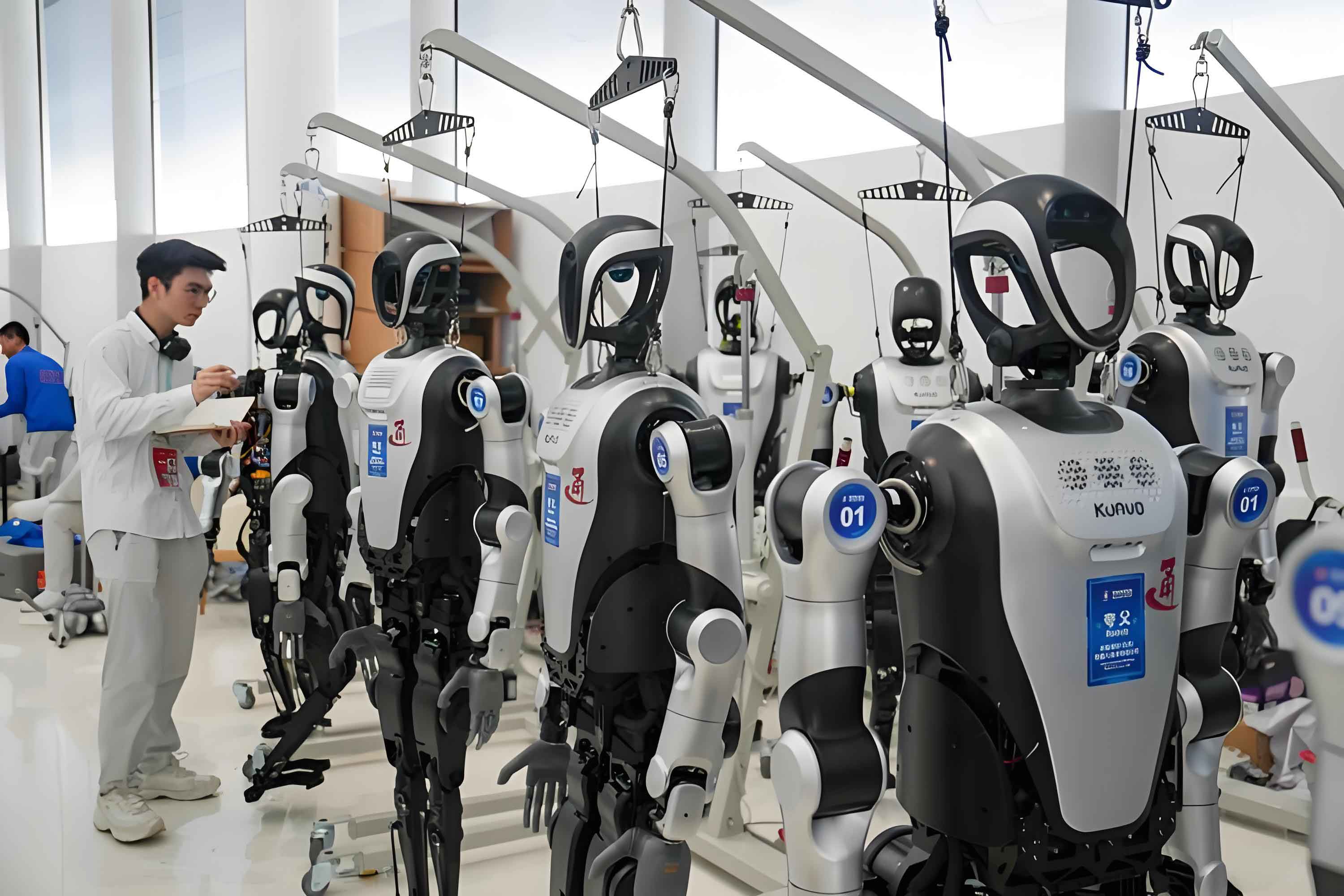
This visual highlights the meticulous process involved in preparing humanoid robots for大堂 duties. As we continue training, the humanoid robot becomes more adept at handling standardized tasks, which brings us to the advantages of deploying such systems.
The efficiency gains from using a humanoid robot as a bank teller are substantial. By automating repetitive duties, we reduce client wait times and ensure consistent service quality. For example, a humanoid robot can process queue取号 in seconds, whereas human staff might be distracted by multiple demands. To quantify this, consider a simple queueing model. Let \( \lambda \) be the arrival rate of clients, and \( \mu \) be the service rate. For a single-server system, the average wait time \( W_q \) is given by:
$$ W_q = \frac{\lambda}{\mu(\mu – \lambda)} $$
With a humanoid robot handling initial分流, \( \mu \) increases due to faster processing, thus lowering \( W_q \). Moreover, the humanoid robot operates 24/7 without fatigue, enhancing overall throughput. I have compiled a comparative table to illustrate the differences between human and humanoid robot tellers across key metrics:
| Metric | Human Teller | Humanoid Robot Teller |
|---|---|---|
| Average Service Time per Client | 3-5 minutes | 1-2 minutes |
| Error Rate in Standard Tasks | ~5% (due to human error) | <1% (with calibrated systems) |
| Availability | Limited to shifts (e.g., 8 hours/day) | Continuous, with minimal downtime |
| Customer Satisfaction Score | Variable (depends on individual mood) | Consistently high for routine interactions |
| Cost per Year (including training and salary) | $50,000 – $70,000 | $20,000 – $30,000 (amortized over lifespan) |
As seen, the humanoid robot excels in efficiency and cost-effectiveness. However, these benefits are tempered by current limitations, which I will address next.
Despite their prowess, humanoid robots face significant challenges in roles requiring deep human interaction. One major hurdle is情感理解. While humans intuitively感知 emotions through cues like tone and expression, a humanoid robot relies on computational models. For instance, emotion recognition can be framed as a classification problem. Given input features \( X \) (e.g., speech频谱, facial keypoints), the robot predicts an emotion label \( y \) using a softmax function:
$$ P(y = k | X) = \frac{e^{z_k}}{\sum_{j=1}^{K} e^{z_j}} $$
where \( z_k \) are logits from a neural network. However, this approach often fails with nuanced or mixed emotions, leading to misunderstandings. Additionally, the humanoid robot struggles with突发 situations, such as a client expressing distress or requesting complex financial advice. Its decision-making is based on pre-trained policies, which may lack the flexibility of human judgment. To model this, consider a Markov decision process (MDP) where the state space \( S \) includes lobby conditions. The optimal action \( a^* \) is chosen via:
$$ a^* = \arg\max_a Q(s, a) $$
But if \( s \) represents an unseen scenario (e.g., a medical emergency), the Q-function may be undefined, causing inefficacy. We are actively working to enhance the humanoid robot’s adaptability through advanced algorithms like meta-learning, where the robot learns to learn from few examples. Another area for improvement is个性化服务 for elderly clients, who may need more patience and clarity. Currently, the humanoid robot follows scripted protocols, but we aim to integrate adaptive dialogue systems that adjust based on client profiles.
Looking ahead, the potential for humanoid robots in banking extends beyond大堂经理 duties. We envision them assisting in back-office operations, such as document processing and fraud detection. For example, in loan application screening, a humanoid robot could use optical character recognition (OCR) to extract data from forms, followed by anomaly detection algorithms. The probability of fraud \( p_f \) might be estimated using logistic regression:
$$ p_f = \frac{1}{1 + e^{-(\beta_0 + \beta_1 x_1 + \cdots + \beta_n x_n)}} $$
where \( x_i \) are features like income discrepancies. Moreover, the humanoid robot could personalize financial product recommendations by analyzing client data through collaborative filtering. Let \( R_{u,i} \) be the predicted rating for user \( u \) and item \( i \), computed as:
$$ R_{u,i} = \mu + b_u + b_i + q_i^T p_u $$
with \( \mu \) as global average, \( b_u \) and \( b_i \) as biases, and \( q_i, p_u \) as latent factors. This enables the humanoid robot to suggest tailored investment options, though such applications require rigorous testing for regulatory compliance. To track progress, we monitor key performance indicators (KPIs) through dashboards, ensuring the humanoid robot meets evolving standards.
In conclusion, the integration of humanoid robots into bank lobbies marks a pivotal shift towards automated, yet亲切, customer service. While challenges in情感理解和应变 persist, ongoing innovations in AI and robotics promise to overcome these hurdles. As we refine training methodologies and expand应用场景, the humanoid robot will become an indispensable ally in the financial sector, offering效率 and novelty. I am optimistic that soon, encountering a humanoid robot at your local bank will be a seamless and enriching experience, thanks to relentless technological pursuit.
To further elaborate, let’s consider the training curriculum for a humanoid robot in detail. We segment training into modules, each focusing on a specific skill set. For instance, Module A covers basic interactions like greetings and queue management. The learning progress can be modeled using a logistic growth curve:
$$ P(t) = \frac{L}{1 + e^{-k(t – t_0)}} $$
where \( P(t) \) is proficiency at time \( t \), \( L \) is the maximum proficiency level, \( k \) is the learning rate, and \( t_0 \) is the inflection point. We observe that for humanoid robots, \( k \) tends to increase with exposure to diverse clients, highlighting the value of real-world training. Additionally, we use simulation environments to test edge cases. In these simulations, the humanoid robot navigates virtual lobbies with stochastic client arrivals, modeled as a Poisson process:
$$ P(N(t) = n) = \frac{(\lambda t)^n e^{-\lambda t}}{n!} $$
where \( N(t) \) is the number of arrivals in time interval \( t \). This prepares the humanoid robot for peak hours, ensuring robust performance. Another critical aspect is energy management. The power consumption \( E \) of a humanoid robot during operation can be approximated by:
$$ E = \sum_{i=1}^{n} P_i \cdot t_i $$
with \( P_i \) as the power draw of component \( i \) (e.g., actuators, processors) and \( t_i \) as its active time. We optimize this through duty cycling, allowing the humanoid robot to conserve energy during lulls.
Furthermore, the humanoid robot’s impact on staff dynamics is noteworthy. By offloading mundane tasks, human employees can focus on complex advisory roles, fostering a symbiotic relationship. We conduct regular surveys to assess team morale, often finding that the presence of a humanoid robot sparks innovation and reduces burnout. In terms of customer feedback, we analyze sentiment scores from post-interaction reviews. Let \( s_j \) be the sentiment of review \( j \), ranging from -1 (negative) to 1 (positive). The average sentiment \( \bar{s} \) is:
$$ \bar{s} = \frac{1}{m} \sum_{j=1}^{m} s_j $$
Initial data shows \( \bar{s} \) rising as the humanoid robot improves, though dips occur during technical glitches. We address these through iterative software updates, emphasizing reliability.
As we scale deployment, cybersecurity becomes paramount. The humanoid robot must be shielded from threats like data breaches or malicious操控. We implement encryption protocols for all communications, using asymmetric key algorithms where the encryption function \( E \) and decryption function \( D \) satisfy:
$$ D(E(m, k_{public}), k_{private}) = m $$
for message \( m \) and key pairs \( k_{public}, k_{private} \). Regular audits ensure the humanoid robot operates within secure parameters, maintaining client trust.
In the realm of research, we collaborate with academic institutions to advance humanoid robot capabilities. Current projects explore affective computing, aiming to embed deeper emotional intelligence into the humanoid robot. For example, we are developing multimodal fusion models that combine audio, visual, and textual inputs to infer client states more accurately. The fusion output \( F \) can be represented as:
$$ F = \sigma(W_a \cdot A + W_v \cdot V + W_t \cdot T + b) $$
where \( A, V, T \) are feature vectors from audio, video, and text modalities, \( W \) are weights, \( b \) is bias, and \( \sigma \) is an activation function. Such innovations will enable the humanoid robot to respond with greater empathy, bridging the情感理解 gap.
To encapsulate the broader implications, I foresee humanoid robots becoming ubiquitous in various service industries, from retail to healthcare. In banking specifically, they could evolve into full-fledged financial advisors, leveraging big data analytics to provide insights. The potential cost savings and enhanced customer experience drive this transformation. As I continue to oversee these developments, I am committed to ensuring that every humanoid robot we deploy not only meets functional requirements but also enriches human interactions, making technology a true partner in progress.
This extensive discussion underscores the multifaceted nature of integrating humanoid robots into banking. From technical underpinnings to practical challenges, the journey is complex yet rewarding. By persistently refining the humanoid robot’s abilities, we pave the way for a future where human and machine collaboration flourishes, delivering unparalleled service in the financial world and beyond.