
In the realm of robotics, the pursuit of human-like manipulation has long been a holy grail, driving innovations that bridge the gap between automated systems and adaptive, fine motor skills. As a leading provider of intelligent unmanned warehouse solutions, our journey began in 2015 with a vision to transform logistics, e-commerce, and industrial automation through cutting-edge technology. Our expertise spans computer vision, motion planning, autonomous navigation, and multi-robot collaboration, but one of our most ambitious endeavors has been the development of a dexterous robotic hand—a project that embodies our commitment to making advanced robotics accessible and practical. This dexterous robotic hand, born from years of research and iteration, addresses critical pain points such as high cost and maintenance complexity, paving the way for widespread adoption in research, industry, and service domains.
The inception of our dexterous robotic hand project dates back to 2016, with a formal design phase commencing in July 2019. From concept to market-ready product, this dexterous robotic hand has undergone four major iterative upgrades, each refining its capabilities and aligning with real-world demands. The evolution can be summarized in the table below, which outlines the key milestones and focus areas for each version:
| Version | Timeline | Key Objectives | Outcomes |
|---|---|---|---|
| 1 – Concept Validation | 2019-2020 | Preliminary design and validation of core technologies based on market needs | Proof-of-concept for modularity and sensor integration |
| 2 – Product Prototype | 2020-2021 | Optimization of product definition and development of functional prototypes | Prototype with independent finger modules and basic force sensing |
| 3 – Stable Version | 2021-2022 | Performance stabilization and compliance with industry standards | Reliable operation with enhanced durability and certification readiness |
| 4 – First-Generation Product | 2022-Present | Market launch balancing demand, performance, and stability | Commercial-grade dexterous robotic hand ready for diverse applications |
Throughout this journey, the most formidable challenge was defining the product itself. In a market where dexterous robotic hands often cost tens or even hundreds of thousands of dollars, we aimed to create a high-performance yet cost-effective solution. This required a delicate balance between technological sophistication and practical affordability. Our approach centered on two pillars: proprietary force-tactile sensors and modular design. By developing our own sensing units, we reduced reliance on expensive imported components, while modularity streamlined maintenance and scalability. This dexterous robotic hand was crafted with an minimalist aesthetic, adhering to the principle that form follows function—ensuring optimal harmony between commercial viability, technical innovation, and design elegance. The finger design, in particular, epitomizes this synergy: a straight, vertical fingertip configuration that maximizes functionality within minimal space, a triumph of collaborative engineering and design.
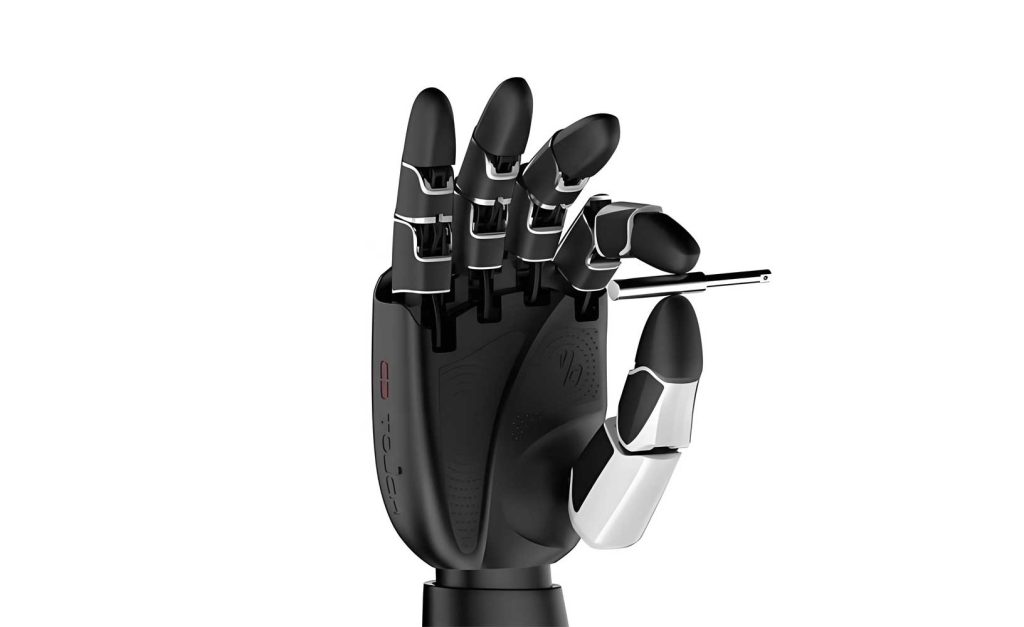
The technological innovations embedded in our dexterous robotic hand are groundbreaking, setting it apart as the world’s first multi-fingered hand based on modular finger design. Three core advancements define its capabilities: modularity, sensitivity, and dexterity. First, modularity enables each finger to operate as an independent unit with its own drive, control, and perception systems, supporting hot-swapping for ease of maintenance and future product expansions. Second, sensitivity is achieved through advanced force-tactile sensing; for instance, our three-fingered version incorporates 42 sensors across fingers and palm, capable of detecting force levels with 1024-bit resolution and pinpointing application locations. This can be modeled by a sensing function: $$ F_s = k \cdot \int_{0}^{t} P(x,y) \, dx \, dy $$ where \( F_s \) represents the sensed force, \( k \) is a calibration constant, and \( P(x,y) \) denotes pressure distribution over time \( t \). Such sensitivity rivals human touch, enabling precise, adaptive grasping. Third, dexterity stems from its 8 degrees of freedom (DOF), each independently controllable to form diverse gestures. The DOF configuration can be expressed as: $$ \text{Total DOF} = \sum_{i=1}^{n} (J_i + A_i) $$ where \( n \) is the number of fingers, \( J_i \) denotes joint freedoms, and \( A_i \) represents actuator adjustments. This allows the dexterous robotic hand to handle over 90% of common objects in daily scenarios. Below is a comparison of key specifications with traditional robotic hands:
| Feature | Our Dexterous Robotic Hand | Conventional Robotic Hands |
|---|---|---|
| Modularity | Fully modular, hot-swappable fingers | Integrated, difficult to repair |
| Force Sensing Resolution | 1024 levels with location tracking | Typically < 256 levels, limited spatial data |
| Degrees of Freedom | 8 independently controlled DOF | Often 4-6 DOF, less flexible |
| Cost Ratio | Approx. 1/3 of comparable imports | High, due to proprietary components |
| Maintenance Complexity | Low, user-friendly modules | High, requires specialized technicians |
Collaboration between designers and engineers was pivotal to realizing this dexterous robotic hand. We adopted a project-based management system, where both teams worked under a unified project manager to ensure seamless integration. Designers contributed not only to aesthetics but also to structural optimization, participating in every phase from Engineering Verification Test (EVT) to Design Verification Test (DVT) and Production Verification Test (PVT). Engineers, in turn, balanced design constraints with functional requirements, fostering a culture of iterative refinement. Regular cross-team reviews ensured that technological prowess and design elegance converged, exemplifying how collaborative synergy can elevate a dexterous robotic hand from concept to reality.
In the global market, dexterous robotic hands are predominantly offered by foreign entities, with notable examples including Robotiq, SDH Schunk, BarrettHand, and Shadow Hand. However, our dexterous robotic hand stands out through its core competitiveness: unparalleled cost-effectiveness. By leveraging in-house force-tactile sensors and modular architecture, we’ve slashed component expenses and maintenance overheads. The selling price is roughly one-third that of comparable international products, dramatically lowering barriers for research and commercial deployment. This affordability, coupled with robust performance, positions our dexterous robotic hand as a game-changer, especially in emerging markets where budget constraints often hinder technological adoption.
The applications for this dexterous robotic hand are vast and varied, spanning multiple industries. In research, it serves as a hardware platform for advancing robotics in computer science, mechanical engineering, electronics, and embedded systems. For service sectors, it enables tasks like delivery assistance and medical pipetting, while in logistics, it facilitates complex grasping and sorting operations. Beyond the three-fingered award-winning model, we’ve developed customized five-fingered versions for research clients, enabling teleoperation capabilities. Moreover, when integrated with our composite mobile collaborative robots, this dexterous robotic hand extends its utility to indoor object manipulation and transportation, showcasing its versatility. The table below highlights specific use cases across domains:
| Industry | Application Scenario | Benefits of Dexterous Robotic Hand |
|---|---|---|
| Research & Academia | Algorithm development, human-robot interaction studies | High configurability, real-time data acquisition |
| Logistics & Warehousing | Parcel sorting, fragile item handling | Adaptive grip, reduced damage rates |
| Healthcare | Laboratory automation, patient aid | Sterile operation, precise force control |
| Manufacturing | Assembly line tasks, quality inspection | Flexibility, cost-efficient automation |
| Service Robotics | Household assistance, retail support | User-friendly design, safe human interaction |
Iterative development of our dexterous robotic hand continues unabated, with newer versions already attaining industry certifications and gradual market rollout. As a technological culmination, this dexterous robotic hand drives progress in two key areas: disseminating tactile perception across robotics, allowing machines to “feel” their environment, and promoting high-DOF end-effectors for solving intricate real-world problems. Future iterations aim to enhance autonomy through machine learning algorithms, such as reinforcement learning for grasp optimization: $$ Q(s,a) = \mathbb{E}[R_t + \gamma \max_{a’} Q(s’,a’)] $$ where \( Q(s,a) \) represents the expected reward for action \( a \) in state \( s \), \( R_t \) is the immediate reward, and \( \gamma \) is a discount factor. We envision branching variants of the dexterous robotic hand tailored to niche applications, fostering scalable adoption and catalyzing industry-wide technological upgrades. Ultimately, the dexterous robotic hand is not merely a product but a catalyst for democratizing advanced robotics, empowering diverse sectors to harness its potential for innovation and efficiency.
In conclusion, the journey of creating a dexterous robotic hand has been a testament to interdisciplinary collaboration, relentless innovation, and a user-centric ethos. From its modular foundations to its sensory acuity, every aspect of this dexterous robotic hand is designed to lower costs, simplify maintenance, and expand accessibility. As we look ahead, the ongoing evolution of this dexterous robotic hand promises to redefine robotic manipulation, making it an indispensable tool across research, industrial, and service landscapes. By persistently pushing the boundaries of what a dexterous robotic hand can achieve, we are not only advancing our own capabilities but also contributing to a future where robots seamlessly integrate into human endeavors, enhancing productivity and enriching lives.