
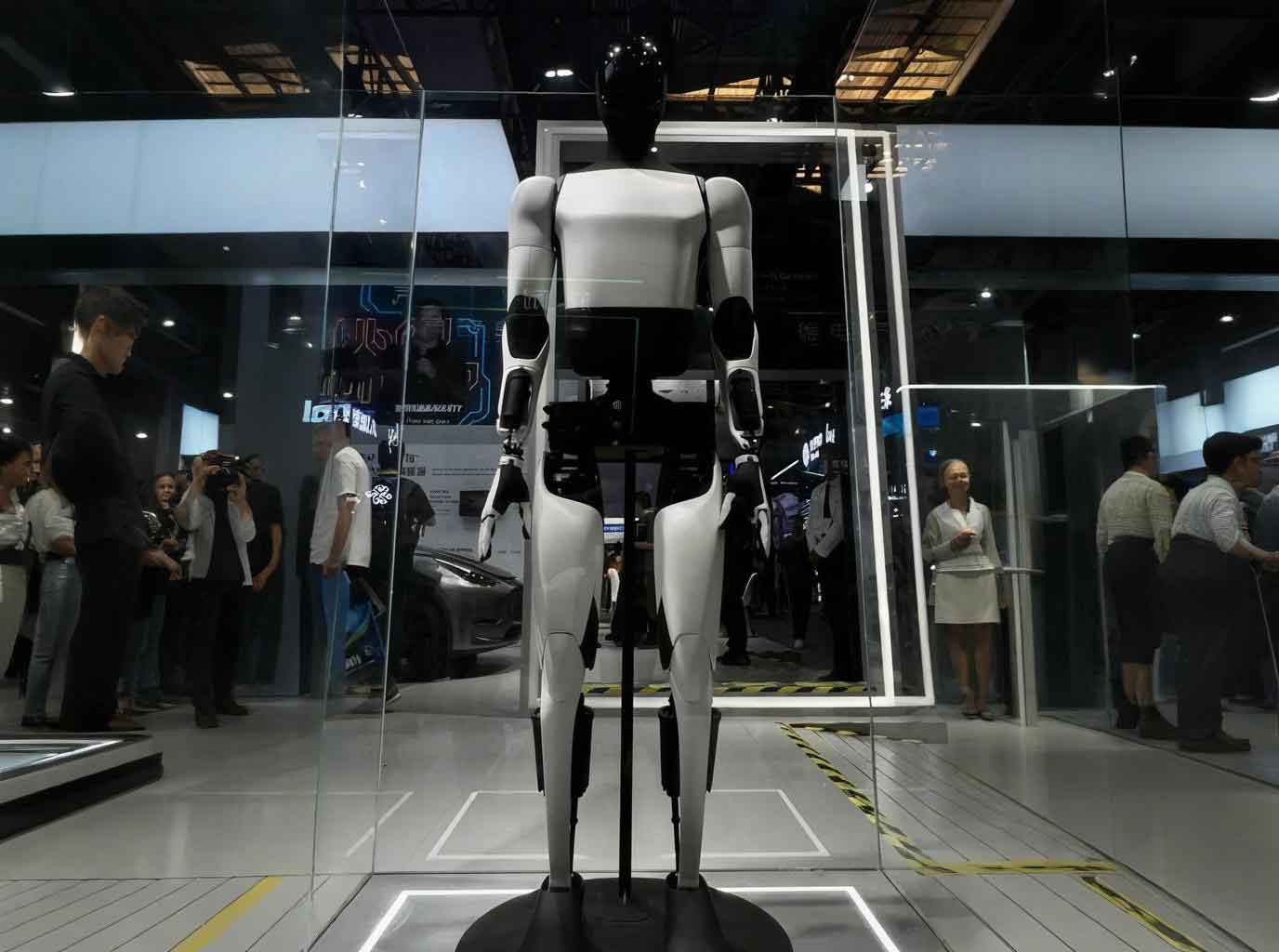
No one can predict the ultimate ceiling of future commercial scenarios. Our mission, therefore, is not to guess the distant future but to precisely identify present needs and fulfill them with solutions that are vastly superior to existing ones. We focus on specific, tangible scenarios, developing products that genuinely serve human needs, enhance the quality of life and production, and drive meaningful societal progress. This is the core philosophy guiding our approach to the development of the embodied AI robot.
In recent years, “Embodied Artificial Intelligence” has rapidly risen to become one of the most prominent fields in technology. An embodied AI robot, characterized by its ability to perceive, reason about, and physically interact with its environment, represents a paradigm shift from software-only intelligence. While the humanoid form, with its human-like perception, interaction, and bipedal locomotion, is often seen as the ideal embodiment of this intelligence and attracts significant attention, it is by no means the only viable path. The industry remains in an exploratory phase, constrained by challenges in core hardware, high R&D costs, and the absence of a clear path to large-scale commercialization. In this landscape, a pragmatic approach is essential: to create value first by landing mature technologies in suitable applications, and then progressively expand capabilities. As the saying goes, “Technology is technology, product is product; one must create value first, and let advancements follow iteratively.”
The Converging Core: From Autonomous Vehicles to Embodied Agents
The foundational technology for an advanced embodied AI robot shares profound commonalities with another transformative field: autonomous driving. At their essence, both are intelligent agents operating in the physical world. An autonomous vehicle is, in fact, a specialized form of embodied AI robot. The core technological stack overlaps significantly:
- Perception: Both rely on a suite of sensors (cameras, LiDAR, radar, ultrasonics) to build a real-time, 3D understanding of their dynamic surroundings.
- Cognition & Planning: Both require a “brain” capable of scene understanding, task decomposition, trajectory planning, and real-time decision-making, increasingly powered by foundation models.
- Control: Both depend on precise actuator control (electric motors for wheels or joints) to execute planned motions safely and efficiently.
- Power & Platform: Both are built on electrified platforms, requiring advanced battery systems, thermal management, and distributed compute architecture.
This convergence can be formalized. The decision-making process for both an autonomous car and a legged embodied AI robot can be modeled as a Partially Observable Markov Decision Process (POMDP), seeking an optimal policy $\pi^*$:
$$
\pi^* = \arg\max_{\pi} \mathbb{E} \left[ \sum_{t=0}^{\infty} \gamma^t R(s_t, a_t) \mid \pi \right]
$$
where at time $t$, the agent in state $s_t$ (inferred from observations $o_t$) takes action $a_t$ to maximize the expected cumulative discounted reward $R$. The primary differences lie not in this core formulation, but in the action space (steering/throttle vs. multi-joint kinematics) and the operational design domain (structured roads vs. unstructured, multi-dimensional environments). A decade ago, the automotive and consumer electronics sectors offered the most mature supply chains and clear commercialization paths for these technologies. Today, the exponential advancement in AI, particularly in multimodal large language models (MLLMs) and vision-language-action (VLA) models, has dramatically raised the capability ceiling and efficiency for developing an embodied AI robot, making this the perfect inflection point to enter the field. The underlying technology is now more extensible than ever, applicable to a vast array of scenarios beyond transportation.
Form Follows Function: Matching Morphology to Scenario
The explosive interest in humanoid robots, evidenced by a 274% year-on-year increase in financing deals in one major market, often obscures a critical principle: the morphology of an embodied AI robot must be dictated by the demands of its target scenario, not by a rigid pursuit of human likeness. While the humanoid form is a long-term ideal for general-purpose utility, its commercial viability today is limited by significant technical hurdles in dexterous manipulation, full-body dynamic balance, and cost. Industry analysis often categorizes capability progression into levels:
| Capability Level | Description | Current Industry State |
|---|---|---|
| L1: Basic Mobility & Action | Stable locomotion, simple predefined tasks. | Most universal humanoids; industrial testing. |
| L2: Primary Intelligence | Basic environment understanding, simple task planning. | Advanced research prototypes. |
| L3: Scenario-Specific Intelligence | Reliable operation in defined, complex scenarios. | Nascent commercialization in specific verticals. |
| L4: Multi-Scenario Adaptation | Competence across a broad range of related scenarios. | Future target. |
| L5: Comprehensive General Intelligence | Full generalization, human-like reasoning and adaptation. | Long-term vision. |
The majority of humanoid robots today operate at L1, often in controlled industrial settings where tasks are repetitive. This highlights a key insight: for many tasks, a humanoid shape is not necessary. A welding task on an assembly line can be better performed by a optimized robotic arm, not a bipedal machine mimicking a human welder. The form factor should be an engineered solution to a functional requirement.
This principle mirrors the automotive industry. All cars share a core technology base (chassis, powertrain, controls), yet their forms vary drastically—from compact city cars to rugged SUVs to massive tractor-trailers. This diversity is driven by specific scenarios, payload requirements, efficiency goals, and user experience. An embodied AI robot ecosystem will evolve similarly. A “wheeled + manipulator” robot might be optimal for indoor home assistance, a quadruped for rugged outdoor terrain, and a humanoid for environments built entirely for human morphology. The strategic approach, therefore, is to be “AI Native” from inception, letting the AI capabilities define the product’s value, while pragmatically choosing the physical platform that best delivers that value for a chosen scenario. We focus on creating “personal and family robots,” a mission that is agnostic to a single form but dedicated to solving real problems.
Product Strategy: Prioritizing Viable Scenarios for Embodied AI
While conventional wisdom suggests business-to-business (B2B) applications like manufacturing will be the first domain for embodied AI robot commercialization, a compelling case exists for targeted consumer (B2C) scenarios. These scenarios offer a direct path to value creation and, critically, to the data required for advancement. Our initial focus is on the role of an intelligent companion, a consumer-grade embodied AI robot designed for both “Outdoor” and “Indoor” contexts.
| Primary Scenario | Core Robot Capability Emphasis | Example User Functions |
|---|---|---|
| Outdoor / Mobile | Generalized spatial understanding, robust navigation, persistent following, outdoor-rated durability. | “Little Follower”: Autonomous accompany, carrying items, hands-free photography/videography, monitoring children or elderly during walks. |
| Indoor / Home | Fine-grained environment interaction, object manipulation in human spaces, contextual awareness in rooms. | “Little Helper”: Fetching objects, basic monitoring, interactive companionship, providing reminders, acting as a mobile smart home interface. |
This dual-scenario approach addresses immediate user needs—providing utility as a “follow, film, and guard” partner—while strategically positioning the platform for data collection. The key is to solve a specific problem exceptionally well, rather than attempting to poorly solve all problems. The commercial viability of an embodied AI robot hinges on this focus. We predict a wave of specialized robotic products emerging in the near future, tackling well-defined local scenarios. However, robots capable of complex, long-horizon tasks like preparing a full meal or maintaining a garden represent a L4/L5 capability and likely remain a decade or more away from widespread commercialization.
The Fuel for Intelligence: Data Diversity and the Path to Emergence
The ultimate differentiator for a truly intelligent embodied AI robot will not be its hardware alone, but the sophistication of its “brain.” The goal is to achieve “emergent intelligence”—capabilities not explicitly programmed but which arise from training on vast, diverse datasets. A genuine intelligent agent must possess strong generalization and cross-domain adaptation skills. For instance, a person who knows English and music can intuitively sing an English song without explicit training. An embodied AI robot, even if trained on separate language and music models, may fail at this synthesis without exposure to multifaceted, cross-modal data.
The quality of intelligence is a function of data diversity and scale. The learning objective for an embodied agent can be seen as maximizing the likelihood of successful actions across a universe of scenarios $S$:
$$
\mathcal{L}(\theta) = \mathbb{E}_{(s, a) \sim \mathcal{D}} \left[ \log \pi_\theta(a \mid s) \right], \quad \text{where } s \in S_{\text{diverse}}
$$
Here, $\mathcal{D}$ is the dataset and $S_{\text{diverse}}$ must encompass a wide range of environments, tasks, and objects. The greater the diversity and coverage of the training data, the stronger the model’s ability to generalize to novel situations. This presents a fundamental challenge: high-quality, task-specific robotic data from real-world physical interactions is scarce and expensive to collect. While simulation data ($\mathcal{D}_{\text{sim}}$) is valuable, the sim-to-real gap is non-trivial. Commercial data is often a guarded “strategic asset.”
This is why starting with consumer-facing, daily-life scenarios is strategically vital. Deploying an embodied AI robot into homes and public spaces generates a continuous, organic stream of real-world interaction data ($\mathcal{D}_{\text{real}}$). This can be combined with user-generated content (UGC) and refined simulation data to build the comprehensive, multimodal dataset needed for emergence:
$$
\mathcal{D}_{\text{comprehensive}} = \mathcal{D}_{\text{real}} + \alpha \mathcal{D}_{\text{ugc}} + \beta \mathcal{D}_{\text{sim}}
$$
where $\alpha$ and $\beta$ are scaling factors for balancing data sources. Outdoor and home environments are particularly rich data sources, covering a vast portion of human-centric physics and social interactions. By creating a product that users willingly bring into their lives, we establish a virtuous cycle: the robot provides utility, which generates diverse data, which trains a more capable AI, which in turn increases the robot’s utility.
Technical Horizons and Cross-Industry Challenges
The development of advanced embodied AI robot platforms is a grand challenge that stretches across multiple industries. Progress is not limited by software algorithms alone but by fundamental hardware constraints that require collaborative breakthroughs.
| Technology Domain | Core Challenge | Industry Dependency & Required Innovation |
|---|---|---|
| Energy Storage | The “Impossible Trinity”: simultaneously improving energy density, safety, and discharge rate. | Battery chemistry & manufacturing. Requires breakthroughs in solid-state, lithium-sulfur, or other post-lithium technologies. |
| Compute Efficiency | Delivering high TOPS/Watt (Tera-Operations-Per-Second per Watt) under strict size, weight, and thermal (SWaP) constraints. | Semiconductor design & process nodes. Needs specialized AI accelerators optimized for mobile, low-power robotics. |
| Actuation & Joints | Creating high-torque, backdrivable, efficient, and compact actuator modules (e.g., for legs, arms, hands). | Precision engineering, motor design, novel materials (e.g., shape-memory alloys), and harmonic drive miniaturization. |
| Sensor Fusion | Seamlessly integrating multimodal data (vision, touch, force, audio) into a coherent, real-time world model. | Advances in sensor miniaturization, MLLM architectures for embodiment, and neuromorphic computing. |
The performance of a robotic joint, for example, can be modeled by its power density $P_d$ and efficiency $\eta$:
$$
P_d = \frac{\tau \cdot \omega}{m}, \quad \eta = \frac{P_{\text{mech out}}}{P_{\text{elect in}}}
$$
where $\tau$ is torque, $\omega$ is angular velocity, and $m$ is mass. Maximizing $P_d$ and $\eta$ while maintaining control fidelity is a core mechanical engineering challenge. Similarly, the on-board computing system must balance performance (FLOPS) with power draw $P_{\text{compute}}$ and thermal dissipation $Q$, which is governed by the heat transfer equation:
$$
Q = h A (T_{\text{chip}} – T_{\text{ambient}})
$$
where $h$ is the heat transfer coefficient and $A$ is the surface area. Increasing compute within the tight confines of a robot’s body is a severe thermal management puzzle.
Despite these multi-faceted hurdles, the trajectory is clear. As market demand for intelligent physical automation grows—whether for companionship, labor, or exploration—it will pull investment and innovation across these interdependent sectors. The future of the embodied AI robot is not a question of a single company’s ingenuity, but of an ecosystem’s coordinated evolution. By starting with pragmatic, value-driven applications today, we are not only building the first generation of useful robotic products but also laying the essential data and learning foundations for the truly intelligent, general-purpose embodied AI robot of tomorrow.