
In the current era of digital intelligence, we are witnessing a transformative wave in artificial intelligence—embodied AI robots. These systems, which integrate perception, cognition, decision-making, and execution through physical interaction with the real world, represent a pivotal shift from disembodied AI to intelligent entities capable of learning and adaptation. The embodied AI robot industry is emerging as a critical driver of technological revolution and industrial transformation, aligning with national strategies to cultivate future industries and harness new quality productive forces. As researchers and practitioners, we recognize that advancing the industrialization of embodied AI robots is essential to converting technological innovations into tangible socioeconomic benefits. This article delves into the forming logic, developmental needs across stages, and practical pathways for the embodied AI robot industry, emphasizing the role of embodied AI robots in shaping tomorrow’s economy.
The formation of the embodied AI robot industry is driven by a confluence of technological push and market pull forces. On the supply side, the deep integration of artificial intelligence and robotics technologies has created a robust foundation. Historically, AI evolved from symbolic approaches to connectionist models like deep learning, yet remained largely disembodied, confined to virtual data processing. Concurrently, robotics advanced from programmable industrial robots to sophisticated humanoid systems, but faced limitations in adaptability and cognitive depth. The fusion of these domains enables embodied AI robots to bridge the gap between software intelligence and physical action, as expressed by the technological synergy formula: $$ T_{embodied} = \alpha \cdot AI + \beta \cdot Robotics + \gamma \cdot (AI \times Robotics) $$ where $T_{embodied}$ represents embodied AI robot technology, $\alpha$ and $\beta$ are coefficients for AI and robotics contributions, and $\gamma$ captures the interactive effect of their integration. This synergy has propelled innovations such as embodied large models, multimodal perception fusion, and digital twin training platforms, making the industry’s emergence inevitable.
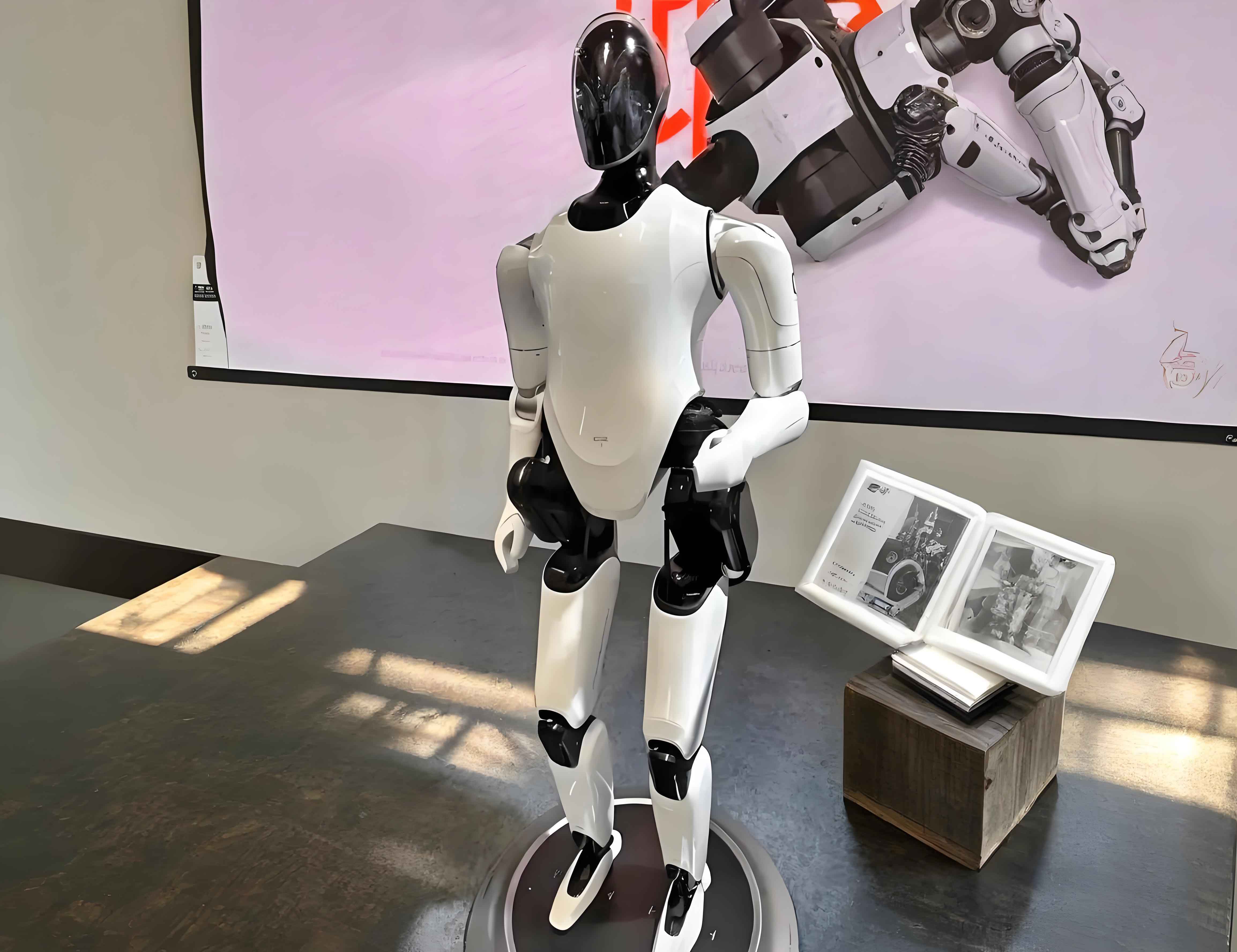
On the demand side, escalating智能化 needs across sectors fuel the growth of the embodied AI robot industry. In agriculture, rural depopulation and aging labor forces necessitate智能 replacements for complex fieldwork. The demand function can be modeled as: $$ D_{agri} = \theta \cdot L_{aging} + \mu \cdot T_{precision} $$ where $D_{agri}$ is agricultural demand for embodied AI robots, $L_{aging}$ is the aging coefficient of rural labor, and $T_{precision}$ is the shift toward precision farming. In industry, flexible manufacturing paradigms require systems that adapt to varied tasks, with demand driven by cost-efficiency gains: $$ D_{ind} = \sum_{i=1}^{n} (C_{human} – C_{robot}) \cdot A_{i} $$ where $C_{human}$ and $C_{robot}$ are costs of human and embodied AI robot labor, and $A_{i}$ represents application scenarios. In services, personalized interactive消费 scenarios in healthcare, education, and retail expand demand, highlighting the embodied AI robot’s ability to reduce人力 costs while enhancing体验. These供需 dynamics underscore the embodied AI robot industry’s role as a carrier for new quality productive forces, which革新 production要素 and drive total factor productivity leaps: $$ \Delta TFP = f(K_{embodied}, L_{smart}, D_{data}, A_{innovation}) $$ where $K_{embodied}$ is embodied AI robot capital, $L_{smart}$ is smart labor, $D_{data}$ is data要素, and $A_{innovation}$ is innovation intensity.
The development of the embodied AI robot industry progresses through distinct stages—formation, growth, maturity, and transformation—each with unique demands. We analyze these through a structured framework, as summarized in Table 1. During the formation stage, collaborative要素支撑 is critical. The embodied AI robot technology stack comprises three layers: base intelligence (e.g., embodied large models), embodied integration (e.g., multimodal sensing), and application testing (e.g., simulation platforms). Each layer relies on synergistic inputs: knowledge from cross-disciplinary fields, high-quality data streams,软硬件 technologies, and skilled人力资源. The synergy index can be expressed as: $$ S = \prod_{j=1}^{m} E_{j}^{w_{j}} $$ where $S$ is overall synergy, $E_{j}$ are要素 like knowledge or data, and $w_{j}$ are weights reflecting importance. Without such协同, innovation fragmentation occurs, impeding the embodied AI robot industry’s birth.
| Stage | Key Demand | Characteristics | Role of Embodied AI Robots |
|---|---|---|---|
| Formation | Collaborative要素支撑 | Technology system integration,颠覆性 innovation emergence | Pilot projects and prototype testing of embodied AI robots |
| Growth | Technology-based enterprise leadership | Scale expansion, market容量 increase | Embodied AI robots drive productivity gains and cost reduction |
| Maturity | Diversified scenario-driven development | Stable competition, international advantage formation | Embodied AI robots deployed across multiple sectors |
| Transformation | Industrial chain policy empowerment | Technological paradigm shift, new cycle initiation | Embodied AI robots evolve toward general AI capabilities |
Transitioning from formation to growth requires leadership from technology-based enterprises. These firms enhance innovation levels and market capacity for embodied AI robots. Their impact on industry output can be modeled as: $$ Q_{growth} = \lambda \cdot I_{R\&D} \cdot M_{enterprise} $$ where $Q_{growth}$ is output during growth, $I_{R\&D}$ is研发 intensity, and $M_{enterprise}$ is the number of technology-based enterprises. They boost科技成果转化 efficiency, reducing the gap between research and commercialization: $$ \eta_{conversion} = \frac{P_{applied}}{P_{research}} \cdot \ln(E_{investment}) $$ where $\eta_{conversion}$ is conversion efficiency, $P_{applied}$ and $P_{research}$ are applied and research outputs, and $E_{investment}$ is enterprise-led investment. By guiding关联 investments, these firms foster a cluster effect, attracting capital and talent to the embodied AI robot sector.
As the embodied AI robot industry moves into maturity, diversified scenario-driven development becomes essential. Scenarios provide real-world tasks that validate and refine embodied AI robot capabilities. The scenario utility function is: $$ U_{scenario} = \sum_{k} \phi_{k} \cdot V_{k} \cdot A_{k} $$ where $U_{scenario}$ is total utility from scenarios, $\phi_{k}$ is scenario diversity index, $V_{k}$ is validation value for embodied AI robots, and $A_{k}$ is adoption rate. Different scenarios dictate embodied AI robot morphologies: fixed-base for manufacturing, wheeled for mobility, or legged for human interaction. This diversity spurs专业化 enterprises and sustains demand growth. For instance, in industrial settings, embodied AI robots optimize production lines: $$ \text{Efficiency Gain} = \frac{T_{human} – T_{robot}}{T_{human}} \times 100\% $$ where $T_{human}$ and $T_{robot}$ are task completion times. Without多元 scenarios, the embodied AI robot industry risks stagnation, unable to achieve economies of scale.
Upon reaching maturity, the embodied AI robot industry must undergo transformation to sustain innovation, necessitating industrial chain policy empowerment. Traditional policy frameworks—industrial policy and competition policy—are converging into industrial chain policy, which targets weak links and enhances systemic resilience. For embodied AI robots, this involves延链 (extending chains),固链 (securing chains), and强链 (strengthening chains). The policy effectiveness can be quantified as: $$ \Pi = \int_{0}^{T} [\delta_{extend} \cdot L_{tech} + \delta_{secure} \cdot R_{resilience} + \delta_{strengthen} \cdot I_{innovation}] dt $$ where $\Pi$ is policy impact, $\delta$ are policy weights, $L_{tech}$ is technology linkage, $R_{resilience}$ is chain resilience, and $I_{innovation}$ is innovation intensity. By focusing on upstream R&D and knowledge flow, industrial chain policy prepares the embodied AI robot industry for a new cycle of technological breakthroughs, potentially achieving general AI.
To accelerate the embodied AI robot industry, we propose practical pathways aligned with stage-specific demands. First, promote free and orderly要素流动 to guide advanced要素集聚. This requires unified要素 markets and interconnected infrastructure. Key要素 include knowledge, data, technology, and labor. For instance, data openness for embodied AI robot training can be optimized via: $$ \text{Data Utility} = \frac{\sum D_{open}}{\sum D_{total}} \cdot \log(1 + C_{interoperability}) $$ where $D_{open}$ is open data, $D_{total}$ is total data, and $C_{interoperability}$ is interoperability系数. Additionally,算力 resources must be shared across regions to lower costs for embodied AI robot development. Strengthening intellectual property regimes, especially for开源 innovations, fosters a conducive ecosystem for embodied AI robots.
Second, optimize全生命周期金融服务 for technology-based enterprises. Financial needs vary across stages: government funding for early research, venture capital for startups, and bank credit for growth phases. The funding gap for embodied AI robot startups can be expressed as: $$ G_{funding} = \max(0, C_{development} – F_{available}) $$ where $G_{funding}$ is the gap, $C_{development}$ is development cost, and $F_{available}$ is available funds. Solutions include establishing embodied AI robot angel funds and encouraging保险 investments. For mature enterprises,知识产权质押融资 enhances信贷 access: $$ \text{Credit Score} = \omega \cdot IP_{value} + \psi \cdot Cash Flow $$ where $IP_{value}$ is intellectual property value. This ensures sustained growth for firms leading the embodied AI robot charge.
Third, drive deep integration of technological and industrial innovation to broaden embodied AI robot application scenarios. This involves bridging科研-industry divides, enhancing成果转化, standardizing systems, and cultivating talent. The innovation integration function is: $$ I_{integration} = \alpha \cdot Collab + \beta \cdot Standard + \gamma \cdot Talent $$ where $Collab$ is collaboration intensity, $Standard$ is standardization level, and $Talent$ is talent pool quality. For embodied AI robots, establishing common standards for性能, compatibility, and safety reduces fragmentation. Educational reforms should nurture interdisciplinary experts in embodied AI robot fields, addressing skill shortages that hinder deployment.
Fourth,完善产业链政策 anchored on延链,固链, and强链 goals. Industrial chain policies should foster深度连接,韧性提升, and精准支持. For embodied AI robots,延链 involves extending to basic research and application platforms;固链 ensures supply chain security via备份 systems;强链 boosts innovation through targeted R&D support. The链 resilience index can be calculated as: $$ R_{chain} = 1 – \frac{\sum \text{Weak Links}}{\text{Total Links}} \cdot \exp(-\lambda \cdot Policy_{support}) $$ where weak links are vulnerable points in the embodied AI robot chain. By coordinating with链主 enterprises, governments can tailor policies to fill gaps, such as in sensor technology or embodied AI chips, reinforcing the embodied AI robot industry’s global competitiveness.
In conclusion, the embodied AI robot industry represents a transformative force in the AI landscape, driven by technological fusion and escalating demand. Its development traverses stages with distinct needs—from协同要素 to enterprise leadership,场景多元化, and policy empowerment. By implementing pathways that enhance要素流动, financial services, innovation integration, and industrial chain policies, we can unlock the full potential of embodied AI robots. As we advance, continuous monitoring and adaptation will be crucial, ensuring that embodied AI robots evolve from niche applications to ubiquitous drivers of new quality productive forces. The journey ahead requires collective effort, but the promise of embodied AI robots—in reshaping industries, boosting efficiency, and fostering inclusive growth—makes it a pursuit worth championing for a smarter, more connected future.
To further illustrate the technological stack of embodied AI robots, we summarize key components in Table 2. This layered approach underscores the complexity and interdependence within the embodied AI robot ecosystem, highlighting areas for innovation and investment.
| Layer | Key Technologies | Function | Impact on Embodied AI Robots |
|---|---|---|---|
| Base Intelligence | Embodied large models, cognitive architectures | Provide智能 brains for decision-making | Enables embodied AI robots to understand and reason in physical contexts |
| Embodied Integration | Multimodal sensing, soft robotics, control systems | Fuse perception and action in physical bodies | Enhances embodied AI robot adaptability and interaction capabilities |
| Application Testing | Digital twins, simulation platforms, real-world deployment | Validate and refine performance in虚拟 and real environments | Reduces development costs and improves embodied AI robot reliability |
Moreover, the economic impact of embodied AI robots can be modeled through productivity equations. For example, the contribution of embodied AI robots to sectoral output is: $$ Y_{sector} = A \cdot K^{\alpha} \cdot L^{\beta} \cdot (E_{robot})^{\gamma} $$ where $Y_{sector}$ is output, $A$ is technology, $K$ and $L$ are capital and labor, and $E_{robot}$ is embodied AI robot deployment. Empirical studies suggest that $\gamma$ is positive, indicating productivity gains from embodied AI robots. As the industry matures, we anticipate embodied AI robots to permeate diverse sectors, from manufacturing to services, driven by continuous learning algorithms: $$ \text{Learning Rate} = \frac{\Delta Performance}{\Delta Experience} $$ where experience accumulates through embodied AI robot interactions. This dynamic ensures that embodied AI robots remain at the forefront of innovation, ultimately contributing to sustainable economic growth and societal well-being.