
The landscape of modern warfare is undergoing a profound transformation, driven by the relentless integration of intelligent, unmanned platforms. Unmanned Combat Systems (UCS), defined as remotely operated or autonomously functioning vehicles carrying offensive or defensive weaponry, have evolved from simple reconnaissance tools to cornerstone assets in domains ranging from fire strikes to electronic warfare. However, the increasing complexity of the multi-domain, dynamic, and contested battlefield exposes critical limitations in current systems. Their reliance on pre-programmed routines or human-in-the-loop control renders them vulnerable to unexpected countermeasures, environmental shifts, and sophisticated electronic warfare. A new technological paradigm is emerging to bridge this autonomy gap: Embodied Artificial Intelligence. This essay provides a comprehensive review of Embodied AI, analyzes the pressing needs of next-generation UCS, envisions its application forms, and discusses the formidable challenges that lie ahead.
The Embodied AI Robot: Core Tenets and Distinguishing Features
Embodied Artificial Intelligence (Embodied AI) refers to intelligent agents that possess a physical form, enabling them to perceive, understand, and interact with the real world in real-time to achieve autonomous learning and decision-making. Its core philosophy posits that intelligence is not merely an algorithmic process but is fundamentally grounded in, and emerges from, the continuous sensorimotor interaction between an agent’s body and its environment. This marks a significant departure from traditional, “disembodied” AI. The evolution of the embodied AI robot can be traced from early theoretical concepts to today’s advanced humanoid and quadrupedal platforms, fueled by breakthroughs in computer vision, deep learning, and transformer-based generative models. Three interconnected characteristics define this new paradigm:
- Embodiment: Intelligence is inseparable from the physical body. The morphology, sensors, and actuators of an embodied AI robot constrain and shape its cognition. Learning occurs through physical interaction and proprioceptive feedback, not just data processing.
- Multimodality: Intelligence is synthesized from diverse sensory streams—visual, auditory, tactile, proprioceptive. An embodied AI robot fuses these modalities to build a robust, coherent, and comprehensive understanding of its surroundings, enhancing adaptability.
- Interactivity: Intelligence is enacted through goal-directed action. An embodied AI robot actively explores and manipulates its environment, forming a closed-loop cycle of “perception → decision → action → new perception.” This interactive loop is the engine for continuous learning and skill refinement.
The relationship between these properties is foundational: Embodiment provides the physical substrate for action and multimodal sensing. Multimodality enriches environmental understanding, informing better interactive strategies. Interactivity is the ultimate purpose, generating the experiential data that fuels the intelligent evolution of the system. The critical distinction from traditional AI is summarized below:
| Concept | Embodiment | Disembodiment |
|---|---|---|
| Physical Form | Dependent on a physical entity | No physical entity required |
| Knowledge Source | Acquired from real-time environmental interaction and experience | Derived from pre-existing knowledge bases or large-scale static data training |
| Perception & Action | Tightly coupled; action informs perception | Largely decoupled |
| Environmental Adaptation | Dynamically adapts to specific, concrete situations | Relies on preset rules or broad generalization, struggles with novel specifics |
| Typical Example | Human cognition, embodied AI robot | Generative Large Language Models, symbolic systems |
Core Technological Pillars for the Embodied AI Robot
Realizing a capable embodied AI robot for complex domains like warfare rests on several interdependent technological pillars.
1. Embodied Perception and Multimodal Fusion
This involves acquiring high-fidelity state information through multi-channel sensors and fusing these disparate data streams. Key modalities include:
- Visual Perception: Utilizes cameras, LiDAR, and IR sensors for 3D reconstruction, localization (e.g., advanced SLAM algorithms), and scene understanding.
- Auditory Perception: Employs microphone arrays for sound source localization, identification, and even semantic parsing of acoustic scenes.
- Tactile Perception: Leverages advanced flexible sensors (e.g., piezoresistive, optical) to detect force, texture, and slip, enabling fine manipulation.
Multimodal fusion architectures—such as joint, coordinated, or encoder-based fusion—are critical to create a unified spatial and semantic representation from this heterogeneous data.
2. Embodied Reasoning and Decision-Making
Here, Large Foundation Models (LFMs) play a transformative role. They parse high-level, often natural language, commands and perform task planning and logical reasoning. However, a key challenge is “grounding” abstract instructions into executable, context-aware physical actions. Techniques like affordance-based frameworks evaluate the feasibility and success probability of candidate actions in the current state. Furthermore, embodied AI robot systems aim for zero-shot reasoning, generating novel action sequences for unseen tasks by composing learned primitives, often guided by LFM-generated code or policy sketches.
3. Embodied Execution and Control
This pillar translates decisions into precise, robust physical motion. Control strategies must account for the specific dynamics of the robotic platform. The three dominant paradigms are:
| Strategy | Core Principle | Typical Application |
|---|---|---|
| Model Predictive Control (MPC) | Uses an internal dynamic model to predict future states and optimizes a sequence of control inputs over a finite horizon in real-time. | Dynamic balancing of humanoids, agile locomotion for quadrupeds. |
| Reinforcement Learning (RL) | An agent learns an optimal policy (state→action mapping) by interacting with the environment and maximizing a reward signal, often formulated as: $$V^{\pi}(s) = \mathbb{E}_{\pi}\left[\sum_{t=0}^{\infty} \gamma^t R(s_t, a_t) | s_0 = s\right]$$ where $V$ is the value function, $\pi$ the policy, $\gamma$ the discount factor, and $R$ the reward. |
Learning complex dexterous manipulation skills, adaptive locomotion policies. |
| Imitation Learning (IL) | The agent learns a policy by mimicking demonstrations provided by an expert (human or algorithmic), avoiding the need to design complex reward functions. | Learning intricate, high-precision tasks like surgical procedures or tool use. |
4. World Models and Simulation
Physical trial-and-error in the real world is costly, risky, and slow. World models are internal, learned representations that allow an embodied AI robot to predict the outcomes of its actions, plan in imagination, and safely practice skills. They are the computational substrate for “common sense” about physics. High-fidelity simulation platforms (e.g., Isaac Sim, MuJoCo) are indispensable for training and validating these models and the policies that use them, providing scalable, parallelizable, and safe training environments.
| Type | Core Method | Representative Model |
|---|---|---|
| Latent-Space Models | Map high-dimensional observations to a compact latent state for efficient prediction and planning. | Dreamer, TD-MPC |
| Transformer-Based Models | Use self-attention mechanisms to capture long-range spatiotemporal dependencies in sequential data. | TransDreamer, IRIS |
| Diffusion Models | Employ a probabilistic, iterative denoising process to generate realistic future trajectories or states. | Sora, Pandora |
The Imperative for Embodied AI in Next-Generation Unmanned Combat Systems
The modern battlefield presents challenges that existing UCS architectures, often reliant on static programming and centralized control, are ill-equipped to handle. This creates a powerful imperative for the integration of embodied AI robot principles.
- Complex, Dynamic Environments: Urban canyons, dense forests, and subterranean networks are highly unstructured and non-stationary. An embodied AI robot with multimodal perception can dynamically build a situational model, while its interactive nature allows for real-time path re-planning and obstacle negotiation beyond pre-mapped waypoints.
- Complex, Multi-Stage Missions: The “sensor-to-shooter” chain now encompasses “detect, identify, decide, engage, assess” (DIDEA) loops under extreme time pressure. Embodied AI robot reasoning, powered by foundation models, can autonomously decompose high-level mission objectives (e.g., “neutralize the radar installation”) into a sequence of context-aware physical actions, adapting to target movement or defensive reactions.
- Complex Multi-Domain Adversarial Contests: Future conflict involves seamless operations across land, sea, air, cyber, and space. An embodied AI robot collective can exhibit swarm intelligence, where decentralized agents share perception, coordinate actions, and self-organize based on a shared mission model. This enables resilient, adaptive, and overwhelming tactics that are difficult to counter with traditional, centralized command and control (C2).
The core value proposition can be succinctly expressed as enabling a resilient and intelligent perception-action cycle:
$$ \text{Perception}_{\text{(Multimodal)}} \xrightarrow{\text{Reasoning}_{\text{(LFM)}}} \text{Action}_{\text{(Embodied)}} \rightarrow \text{New State} $$
This closed loop allows the system to continuously learn and adapt within the mission context.
Envisioned Application Forms of Embodied AI Robots in Warfare
1. Advanced Biomimetic Machines
Beyond today’s remotely piloted quadrupeds, future embodied AI robot systems will include a menagerie of biologically inspired platforms with deeply integrated autonomy.
- Quadrupeds & Hexapods: Will autonomously navigate rubble, stairs, and tunnels for persistent ISR, payload delivery, or casualty extraction in GPS-denied environments.
- Avian Morphologies: Flapping-wing or fixed-wing micro-drones mimicking birds could perch, observe, and blend into civilian airspace for covert, long-duration surveillance.
- Serpentine Robots: Able to infiltrate ducts, pipes, and dense undergrowth for inspection, sabotage, or emplacing sensors.
- Piscine UUVs: Bio-inspired underwater vehicles with silent propulsion would excel at clandestine harbor monitoring, mine detection, or infrastructure inspection.
The embodied AI robot control stack gives these platforms the autonomy to execute complex tasks like “search this building level for hostile signatures” without step-by-step guidance.
2. The Mech-Soldier (Advanced Humanoid Platform)
The humanoid embodied AI robot, or mech-soldier, represents the apex of versatility. Its anthropomorphic form is a strategic advantage:
- Native Environmental Compatibility: It can operate seamlessly in human-designed spaces—entering buildings, using stairs, driving standard vehicles, and operating military equipment interfaces.
- Unmatched Task Generalization: From breaching doors and clearing rooms to conducting field repairs and medical triage, a single platform could perform a vast array of soldier-level tasks.
- Force Multiplication & Risk Transfer: It can act as a direct robotic team member, carrying heavier loads, taking point in high-risk areas, or serving as an intelligent, mobile weapons platform.
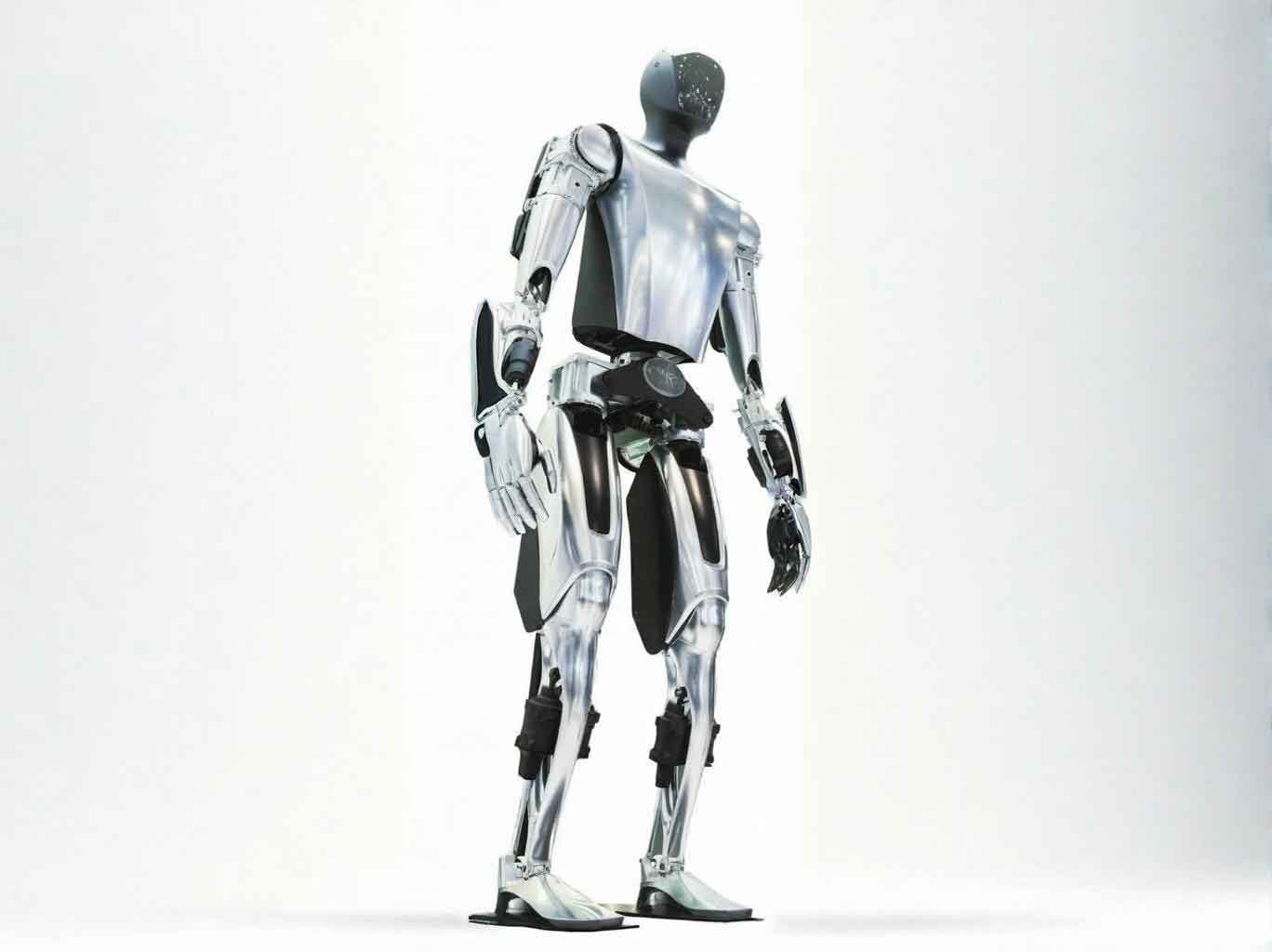
While immense challenges in power, reliability, and cost remain, the trajectory of companies like Boston Dynamics and Tesla points toward this future. The core software—the embodied AI robot “mind” of perception, reasoning, and control—is the critical enabler.
3. Highly Intelligent Unmanned Vehicles (Aerial, Ground, Maritime)
Embodied AI will transform current UAVs, UGVs, and USVs from remotely operated tools into truly intelligent agents.
- Single-Platform Autonomy: A reconnaissance UAV becomes an embodied AI robot that can interpret a commander’s intent (“Find all camouflaged vehicles in this sector”), dynamically plan its search pattern, classify targets using fused EO/IR/SAR data, and even autonomously maintain surveillance on a moving target despite obstructions or electronic warfare attempts.
- Heterogeneous Swarm Synergy: The most profound impact may be in collaborative autonomy. A mixed swarm of aerial, ground, and maritime embodied AI robot platforms could self-organize for a complex mission. For example, aerial scouts detect a target and vector in ground attack UGVs while electronic warfare UAVs suppress enemy communications, all coordinated through decentralized, model-based negotiation rather than a fragile central datalink. This represents a shift from coordinated drones to a cognitive swarm with emergent intelligence.
Challenges and Critical Paths Forward
The integration of embodied AI robot technology into UCS is not without significant hurdles.
- Computational Intensity and Latency: Foundation models with hundreds of billions of parameters demand immense compute power, creating a tension between cloud-based intelligence (with latency and jamming vulnerability) and onboard processing (constrained by SWaP). Advanced model compression, distillation, and neuromorphic computing are essential research paths.
- The “Reality Gap” in Data and Simulation: Training robust embodied intelligence requires vast amounts of interactive data from diverse, often hazardous, physical environments. Collecting this data is prohibitively expensive and dangerous. The fidelity of simulation and the effectiveness of Sim-to-Real transfer learning are thus paramount. Investment in high-fidelity, physically accurate, and scalable multi-domain combat simulators is a strategic necessity.
- Verification, Validation, and Explainability (VVE): How does one certify that a deep neural network controlling a lethal embodied AI robot will behave reliably and as intended in all conceivable combat scenarios? The “black box” nature of these systems conflicts with the military’s need for predictability and accountability. Developing techniques for explainable AI, robust adversarial testing, and formal verification within bounded contexts is critical.
- Ethical, Legal, and Safety Frameworks: This is the most profound challenge. As autonomy increases, where does meaningful human control reside? How do we ensure an embodied AI robot adheres to the Laws of Armed Conflict (LOAC) and Rules of Engagement (ROE) in dynamic situations? Can it reliably discriminate between combatants and civilians, or assess proportionality? Developing technical safeguards (e.g., ethical constraints hard-coded as reward function penalties or verification layers), alongside international legal and normative frameworks, must proceed in parallel with the technology itself.
In conclusion, Unmanned Combat Systems stand on the brink of a revolution catalyzed by Embodied Artificial Intelligence. By providing a unified framework for multimodal perception, model-based reasoning, and interactive physical action, embodied AI robot technology promises to overcome the autonomy ceiling of current systems. The future battlefield may feature resilient swarms of intelligent biomimetic agents and versatile humanoid platforms, fundamentally altering the character of war. Realizing this potential, however, demands focused investment not only in the core AI and robotics technologies but equally in the less glamorous yet vital enablers of simulation, verification, and ethical governance. The nation or coalition that most effectively navigates this complex technological and doctrinal landscape will gain a decisive advantage in the next era of conflict.