
As I delve into the intricate landscape of artificial intelligence, a fundamental realization emerges: intelligence is not a disembodied abstraction confined to a processing unit. True intelligence, I argue, is inherently embodied. It is a property that arises from the dynamic synergy between a brain (or its computational equivalent), a physical form, and the complex environment with which it interacts. My exploration begins by mapping the historical currents of AI thought onto a grand philosophical framework to better understand our journey and our destination.
The Triadic Dance of AI Paradigms: A Popperian Lens
The evolution of AI has been dominated by three competing, yet ultimately converging, schools of thought. Viewing them through Karl Popper’s “Three Worlds” theory provides remarkable clarity.
| AI Paradigm | Philosophical Root | Core Tenet | Popper’s World | Primary Limitation |
|---|---|---|---|---|
| Symbolism | Rationalism / Logicism | Intelligence as rule-based manipulation of abstract symbols (computation & representation). | World 3 (Objective Knowledge) | Brittleness in unstructured environments; requires extensive manual curation (“brittle expert”). |
| Connectionism | Empiricism | Intelligence emerges from learning statistical patterns in data via artificial neural networks. | World 2 (Subjective Experience) | “Black box” problem; lacks systematic reasoning and common-sense grounding. |
| Behaviorism | Pragmatism / Embodied Cognition | Intelligence is enacted through “situated” perception and action in a physical environment. | World 1 (Physical Reality) | Weak transfer learning; struggles with abstraction and scaling. |
Popper’s worlds help us see the divide: Symbolism inhabits the platonic realm of logic and ideas (World 3). Connectionism models the subjective realm of experience and perception (World 2). Behaviorism grounds itself squarely in the physical, tangible world (World 1). Crucially, Worlds 2 and 3 interact through human consciousness, and Worlds 1 and 2 interact through perception. However, World 1 and World 3 do not directly interact without the mediating consciousness of World 2. This explains the historical disconnect: pure logic struggled with the messiness of the physical world, while data-driven models lacked the scaffolding of reasoning.
The path forward, which I see as the central narrative of modern AI, is fusion. The integration $A \times B$ (A into B, B into A) or the synthesis $A + B \rightarrow C$ is yielding transformative paradigms. Generative AI (AIGC) merges Connectionist pattern discovery with Symbolic knowledge structures. The quest for Artificial General Intelligence (AGI) seeks to unify all three, creating systems where a neural “brain” is guided by symbolic logic to control a behaviorally adaptive embodied AI robot. This is epitomized by architectures like Google’s Transformer, which finds “scaling laws” across multimodal data, and agents like RoboCat, which demonstrate self-improvement through multi-embodiment, multi-task learning. The equation for this progress can be abstracted as a search for universal structure:
$$ \text{Intelligence}(I) \propto f(\text{Symbolic Reasoning}(S), \text{Statistical Learning}(L), \text{Embodied Interaction}(E)) $$
where the function $f$ represents the integrative architecture that is the focus of contemporary research.
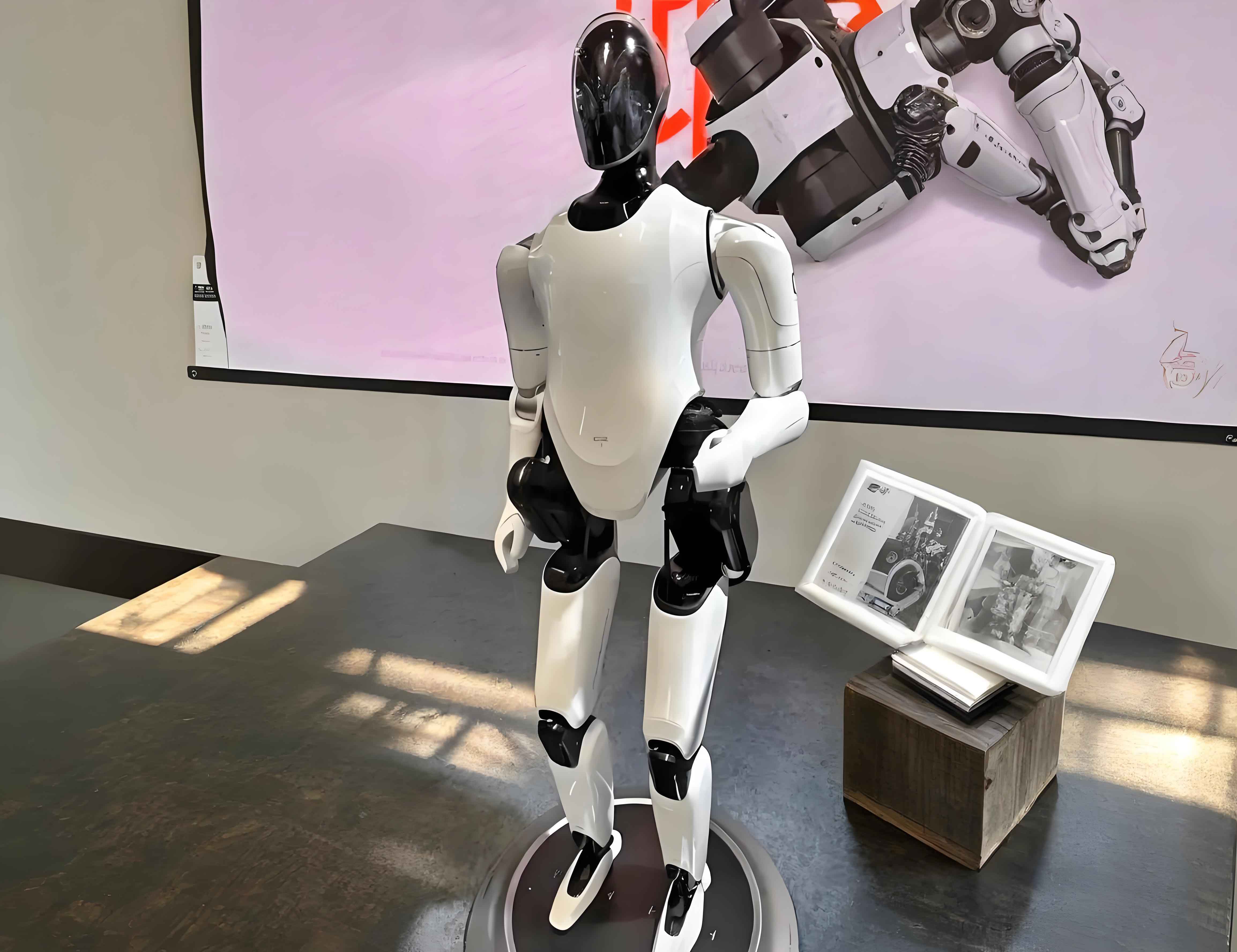
The Mirror and The Veil: Cognitive Symbiosis and the Value Alignment Problem
In developing intelligent systems, we inevitably create mirrors and veils. Embodied AI robots act as mirrors, reflecting and making observable the mechanisms of our own cognition. The concept of “embodied simulation,” rooted in mirror neuron systems, suggests that understanding actions, emotions, and intentions often involves a tacit, bodily resonance. When we program a robot to grasp an object, we are implicitly externalizing and formalizing our own sensorimotor intelligence. This process turns private cognitive acts into public, investigable phenomena.
Yet, this mirroring is accompanied by a veiling effect—a technological “enframing” (Ge-stell), as Heidegger warned. The very tools that extend our capabilities can obscure our situatedness and agency. A more profound challenge is the Moravec’s Paradox: what is effortless for humans (e.g., perception, mobility, dexterity) is extraordinarily difficult for machines, and vice versa. This paradox underscores that human intelligence is deeply rooted in a billion-year evolutionary history of embodied survival.
This leads to the critical issue of Value Alignment. As machines become more autonomous and integrated into society, ensuring their goals and actions align with human ethics and intentions is paramount. The RICE principles—Robustness, Interpretability, Controllability, and Ethicality—provide a framework. However, alignment is not merely a technical checklist; it is a philosophical and sociological puzzle. Methods like seeking overlapping consensus, applying social choice theory, or modeling Rawls’ “veil of ignorance” all confront the dilemma of pluralistic human values. The alignment problem reveals that we are not just aligning machines to us, but are forced to reflect on and define our own values more precisely. Furthermore, the “Affective-Intellectual Paradox” looms: can and should an embodied AI robot possess or simulate emotion? While affective computing can enable empathy-like responses, true emotion involves subjective feeling (qualia) and a web of interpersonal needs—a state arguably inaccessible to a machine. The danger lies not in machines feeling, but in humans forming asymmetric emotional bonds with entities that cannot reciprocate in kind.
From Flesh to Metal: The Philosophical Unshackling of the Body
The technological journey toward embodied AI is paralleled by a philosophical journey to reclaim the body. For centuries, Western thought marginalized the body in favor of the mind (Cartesian dualism). The “embodied turn,” initiated by thinkers like Nietzsche, Merleau-Ponty, and later extended by phenomenologists and cognitive scientists, has been pivotal.
- Merleau-Ponty’s “Lived Body”: He posited the body as our primary way of being-in-the-world (“être au monde”). It is neither pure subject nor object but an ambiguous, perceiving entity that structures our experience through the “body schema.” Intelligence, in this view, is not computed but enacted through our bodily engagement.
- Don Ihde’s “Threefold Body”: This framework is particularly illuminating for embodied AI.
Body Description Relevance to Embodied AI Body 1 The biological, material flesh (the physical robot body). The chassis, actuators, sensors—the physical “hardware” of the embodied AI robot. Body 2 The cultural, social, gendered body (learned behaviors, norms). The social behaviors, interaction protocols, and cultural knowledge the AI must learn or be given. Body 3 The technologically mediated body (cyborgs, avatars, tele-presence). The hybrid entity formed when a human operates through or with a robot, or when an AI’s presence is extended via a physical form. Ihde’s analysis of human-technology relations (embodiment, hermeneutic, alterity, background) provides a rich vocabulary for understanding how humans will relate to and through embodied AI robots.
This philosophical shift reconstitutes knowledge itself. It moves from a disembodied, representational model of knowledge (facts about the world) to an enacted, practical model (knowledge as skillful coping and interaction). For an embodied AI robot, knowing is not having a database; it is possessing the capacity to respond adaptively to the affordances of its environment.
The Multimodal Collective: Paradigms, Agents, and Swarms
The development of intelligent systems can be seen as a progression through modeling paradigms:
- Disembodied Modeling: Pure computation, ignoring physical instantiation (e.g., classic chess AI).
- Reflexive Modeling: Systems where actions influence the environment which in turn influences cognition, creating feedback loops (e.g., simple adaptive controllers).
- Embodied Modeling: Full integration where the morphology, sensorimotor apparatus, and environment are constitutive of intelligence (e.g., a humanoid robot learning to walk).
The ultimate embodied AI robot is a strong AI agent—a unification of an ontological body (the physical platform with its capabilities and constraints) and an agentic intelligence (the “mind” that perceives, plans, and learns). This agent exhibits a form of multimodal subjectivity: its “point of view” is built from the fusion of camera feeds, pressure sensors, proprioceptive data, and more.
The future, however, may not belong to solitary agents. Swarm Intelligence and multi-agent systems point toward a collective paradigm. Here, intelligence and problem-solving emerge from the interactions of many simpler embodied AI robots. The mathematical principles often involve concepts from dynamical systems and phase transitions:
$$ \partial_t \phi(\vec{r}, t) = \text{Interaction}(\phi, \nabla \phi) + \text{Noise} $$
where $\phi$ might represent the density or velocity field of agents. The system can be tuned near a critical point, balancing robustness and flexibility, much like flocks of birds or schools of fish. This represents a shift from individual, centralized intelligence to distributed, collective cognition—a new frontier for embodied AI.
Conclusion: The Ethical Turn in Human-Machine Relations
The trajectory of embodied AI is steering us from an instrumental view of machines as tools toward a relational view of them as partners or agents in shared environments. This necessitates a profound ethical turn. The challenges are manifold: ensuring safety and robustness in open-world interaction, maintaining meaningful human control, preventing algorithmic bias embedded in physical actions, and navigating the social and psychological impacts of living alongside machines that mimic life.
The development of a capable embodied AI robot is not merely an engineering feat; it is a philosophical undertaking that forces us to interrogate the nature of intelligence, consciousness, value, and our own humanity. The synthesis of the technical and the philosophical is not optional—it is the very path to creating intelligent systems that are not only powerful but also comprehensible, controllable, and aligned with the flourishing of the world they are built to inhabit. The paradigm is shifting under our feet, from computation in isolation to intelligence in embodiment, and we must be both its architects and its keenest philosophers.