
The recent surge in demonstrations, from humanoid robots fluidly interacting with humans to general-purpose agents performing daily tasks, signals a profound shift. We are witnessing the dawn of embodied intelligence, or embodied AI, where artificial intelligence is no longer confined to the digital ether but is gaining the capacity to perceive, reason, and act within our physical world. This transition from a purely computational paradigm to one rooted in physical interaction represents not merely an incremental upgrade, but a fundamental rethinking of how intelligence is acquired and manifested. As an observer and participant in this field, I see embodied AI robots as the key to unlocking a new era of human-machine collaboration.
1. Conceptual Foundations: What is Embodied AI?
The philosophical seeds of embodied intelligence were sown at the very inception of AI. The foundational idea posits that true intelligence is not a disembodied, abstract computation but emerges from the dynamic interaction between an agent, its body, and its environment. An embodied AI robot is the physical instantiation of this principle. Its intelligence is shaped and constrained by its sensory apparatus (cameras, LiDAR, force-torque sensors, microphones), its actuator capabilities (joints, grippers, wheels), and the physical laws it must navigate.
Formally, we can model the core loop of an embodied AI robot as a continuous process of perception, cognition, and action within a partially observable environment. This can be represented as a generative process where actions influence future states and perceptions:
$$
P(s_{t+1}, o_{t+1} | s_t, a_t)
$$
where \( s_t \) is the environmental state at time \( t \), \( a_t \) is the action taken by the robot, and \( o_{t+1} \) is the subsequent perceptual observation. The robot’s goal is to learn a policy \( \pi(a_t | o_{\leq t}) \) that maximizes the expected cumulative reward \( \mathbb{E}[\sum_{t} \gamma^t r(s_t, a_t)] \) over time, where \( \gamma \) is a discount factor. This underscores that learning is situated and experiential.
The defining elements of an embodied AI system can be summarized by a triad:
| Element | Description | Role in Embodied AI |
|---|---|---|
| Embodiment (The Body) | The physical (or simulated) form: humanoid, quadruped, mobile manipulator, vehicle. | Defines the action space, sensory modalities, and physical constraints. It is the interface to the world. |
| Environment (The World) | The physical or highly realistic simulated context in which the agent operates. | Provides the sensory data, physical rules, and task constraints. It is the source of ground truth and feedback. |
| Intelligence (The Mind) | The algorithms for perception, reasoning, planning, and learning (e.g., multimodal LLMs, reinforcement learning). | Processes sensations, generates goals, plans actions, and adapts through interaction. It closes the perception-action loop. |
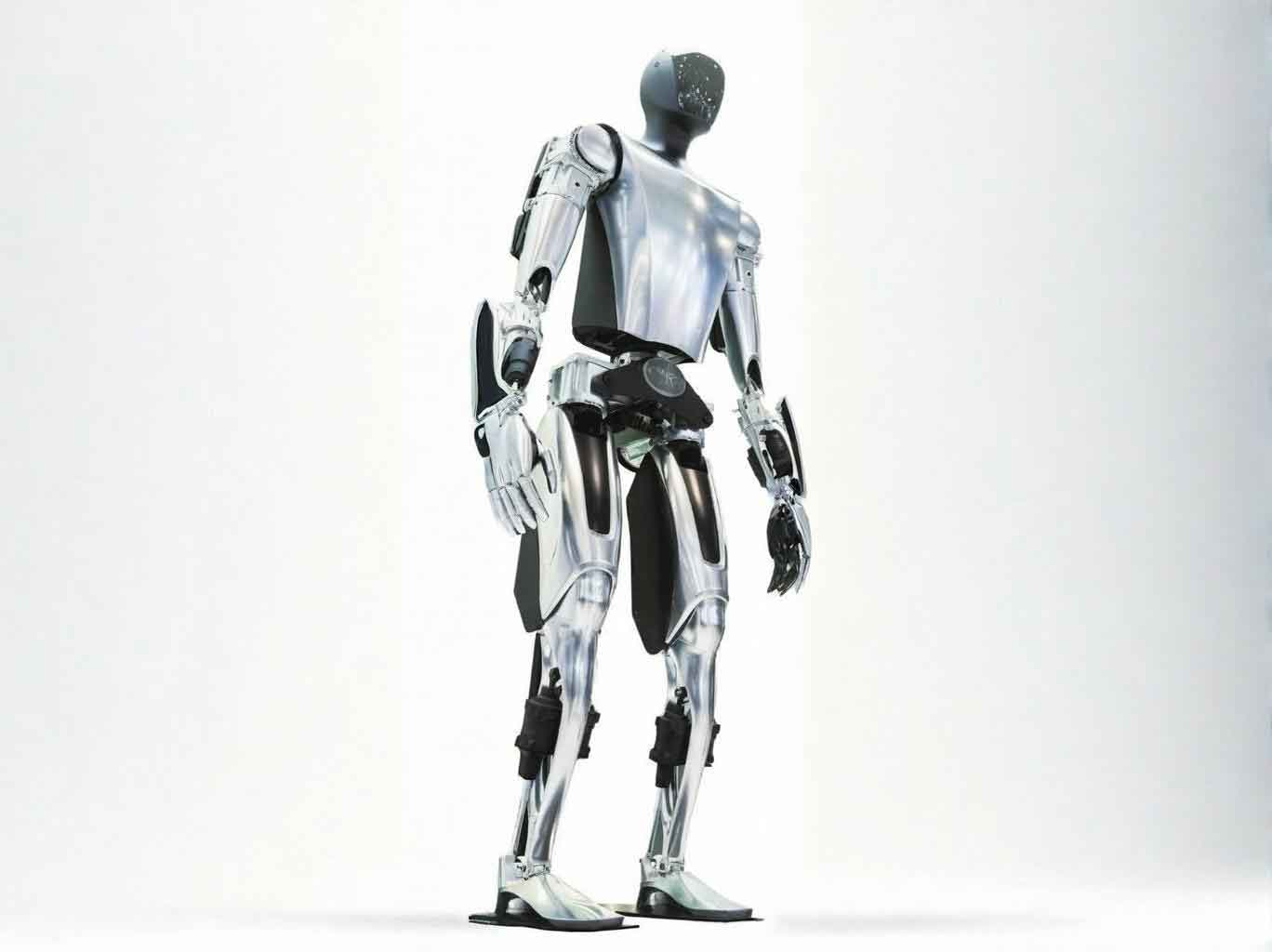
The convergence of advanced actuators, high-fidelity sensors, and powerful multimodal foundation models is what makes modern embodied AI robots a tangible reality. The physical form of the embodied AI robot is crucial, as different morphologies are suited to different environmental niches and tasks.
2. The Paradigm Shift: Embodied AI vs. Traditional AI
The rise of the embodied AI robot necessitates a clear distinction from traditional, non-embodied artificial intelligence. The contrast is not merely the presence of a body, but a foundational difference in the paradigm of learning, knowledge representation, and interaction.
| Aspect | Traditional / Non-Embodied AI | Embodied AI Robot |
|---|---|---|
| Core Principle | Intelligence as abstract symbol manipulation and pattern recognition on static datasets. | Intelligence as emerging from sensorimotor interaction with a dynamic environment. |
| Learning Data | Static, pre-collected, often single-modality datasets (text, images). Learning is “offline.” | Dynamic, first-person, multi-modal sensory streams generated through active exploration. Learning is “online” and interactive. |
| Interaction | Limited, symbolic, or through predefined interfaces (e.g., chat, API calls). | Direct, physical, and continuous. The embodied AI robot alters the state of the world and receives physics-based feedback. |
| Generalization | Often narrow; performance can degrade significantly outside the training data distribution. | Aims for broad task and environmental generalization by learning fundamental world models and physical concepts. |
| Primary Goal | Optimize for accuracy, precision, or score on a specific digital task (e.g., classification, generation). | Complete physical tasks successfully, safely, and efficiently in unstructured, real-world settings. |
| Feedback Loop | Discrete, based on labeled outcomes or reward signals defined in the data. | Continuous and rich, based on the success of actions, physical consequences, and sometimes sparse reward signals. |
An embodied AI robot does not just process information; it gathers information through purposeful action. Its learning can be framed as minimizing a “surprise” or prediction error between its internal world model and actual sensory outcomes:
$$
\mathcal{L} = \mathbb{E}_{(o_t, a_t) \sim \pi}[\| o_{t+1} – \hat{o}_{t+1} \|^2]
$$
where \( \hat{o}_{t+1} \) is the sensory prediction generated by the robot’s internal model given \( o_t \) and \( a_t \). This drive to build an accurate model of its own interaction with the world is a key engine for autonomous learning in an embodied AI robot.
3. The Key Players in the Embodied AI Landscape
The development of capable embodied AI robots is a complex endeavor, attracting a diverse ecosystem of players, each contributing different pieces of the puzzle. The collaboration and competition among them are accelerating progress.
| Category | Description & Focus | Examples of Contributions/Entities |
|---|---|---|
| Specialized Startups | Agile, mission-driven companies often focused on a specific aspect: robot hardware, embodied AI models, or vertical applications. They are hubs for rapid prototyping and innovation. | Companies developing humanoid or specialized robot platforms, as well as those creating foundational “embodied brains” or large models for control and reasoning. |
| Technology Giants | Leverage vast resources, cloud infrastructure, and AI research labs. They primarily develop foundational models, simulation platforms, and invest in or partner with hardware companies. | Creation of large multimodal models, physics simulators for training, specialized AI chips, and strategic investments across the ecosystem to foster development of the embodied AI robot. |
| Robotics Incumbents & New Wave | Companies with deep expertise in actuation, mechanical design, and control systems. They are integrating new AI stacks into robust platforms. | Long-standing industrial robot makers and newer dynamic legged robot companies, now upgrading platforms with advanced perception and cognitive modules to create the next-generation embodied AI robot. |
| Automotive & AV Companies | View autonomous vehicles as a form of embodied AI. Their work on perception, navigation, and decision-making in open environments directly informs broader embodied intelligence. | Development of self-driving stacks, and some exploring humanoid robots for manufacturing, leveraging their expertise in scalable engineering and real-world system integration. |
| Academic & Research Institutions | The source of fundamental breakthroughs in algorithms, learning paradigms, and novel hardware concepts. They often spin out startups. | Pioneering work on new reinforcement learning methods, world models, neuromorphic sensing, and soft robotics, providing the scientific backbone for future embodied AI robot capabilities. |
The synergy is clear: startups push the boundaries on specific forms of the embodied AI robot, tech giants provide the computational and algorithmic foundation, hardware specialists build reliable platforms, and academia explores the frontiers of what’s possible.
4. Transformative Application Horizons
The potential applications for a mature embodied AI robot are vast, promising to augment human capability across numerous sectors. The value proposition lies in combining the flexibility and cognitive prowess of AI with the ability to perform physical work.
| Domain | Potential Applications of Embodied AI Robot | Value Proposition |
|---|---|---|
| Industrial Manufacturing | Flexible assembly, complex parts handling, quality inspection, machine tending, and collaborative tasks with human workers. | Enables agile, small-batch production; performs tasks in hazardous environments (e.g., welding, chemical handling); reduces ergonomic strain on humans. |
| Logistics & Warehousing | Autonomous picking and packing, palletizing, depalletizing, inventory scanning, and loading/unloading in unstructured spaces. | Addresses labor shortages, operates 24/7, increases throughput and accuracy in e-commerce fulfillment and supply chains. |
| Healthcare & Assisted Living | Patient mobilization support, delivery of supplies, routine monitoring, companionship, and remote physical therapy assistance. | Supports an aging population, reduces caregiver burden, enables consistent patient support, and can provide valuable data for care plans. |
| Domestic & Service | Household chores (cleaning, organizing, cooking), elder care, personalized assistance, and educational companionship. | Frees up time for individuals and families, provides support for independent living, and offers new forms of interactive learning and assistance. |
| Field Operations | Infrastructure inspection (power lines, pipelines), search and rescue in disaster zones, agricultural monitoring and harvesting, and environmental sampling. | Performs dangerous, dirty, or dull (3D) jobs; accesses confined or hazardous areas; provides persistent surveillance and data collection. |
The economic impact can be modeled as a function of the embodied AI robot’s capability (C), reliability (R), and cost (K):
$$
\text{Economic Value} \propto \frac{\int_{0}^{T} C(t) \cdot R(t) \, dt}{K}
$$
where \( T \) is the operational lifespan. The trajectory is towards increasing \( C \) and \( R \) while driving down \( K \), unlocking more and more viable applications.
5. Core Challenges on the Path to Realization
Despite the excitement, the development of a truly robust, general-purpose embodied AI robot is fraught with significant technical and practical hurdles. A sober assessment is crucial.
1. The “Sim-to-Real” Gap & World Modeling: Training sophisticated control policies in simulation is efficient, but transferring them to the messy, unpredictable physical world remains a major challenge. An embodied AI robot must build a world model that is not just geometrically accurate but also understands physics, material properties, and cause-effect relationships. The discrepancy between the simulation dynamics \( \mathcal{S}_{sim} \) and real-world dynamics \( \mathcal{S}_{real} \) creates a domain adaptation problem that is critical to solve:
$$
\min_{\theta} \mathcal{L}(\pi_{\theta}; \mathcal{S}_{real}) \quad \text{when training data comes from} \quad \mathcal{D} \sim \mathcal{S}_{sim}.
$$
2. Data Scarcity & the “Curse of Real-World Interaction”: Unlike text or images, high-quality robotic interaction data is expensive and slow to produce. Each trial for an embodied AI robot takes time, risks hardware damage, and often requires human supervision. Creating large-scale datasets of physical failures and successes is a fundamental bottleneck for learning complex, long-horizon tasks.
3. Integration Complexity: An embodied AI robot is a system-of-systems. Seamlessly integrating low-level motor control, mid-level task planning, and high-level semantic reasoning (often from a large language model) into a reliable, real-time control loop is an enormous software engineering and systems integration challenge. Latency, error propagation, and safety verification are constant concerns.
4. Safety, Ethics, and Social Acceptance: Deploying autonomous physical agents raises profound questions. How do we guarantee the safety of an embodied AI robot operating around humans? Who is liable if it causes damage? How do we ensure its decision-making aligns with human values and privacy norms? Social trust must be earned through transparent, verifiable, and robust design.
5. Morphology and Cost-Effectiveness: There is an ongoing debate about the optimal form factor. While humanoid shapes are intuitive for human environments, they are mechanically complex and expensive. The ultimate morphology of a successful embodied AI robot for a given task may be dictated by a ruthless optimization for functionality, durability, and return on investment, not necessarily by anthropomorphism.
In conclusion, we stand at the threshold of a new frontier. The embodied AI robot represents the culmination of decades of research in robotics, computer vision, and artificial intelligence, now converging with the power of foundation models. The journey from impressive demos to ubiquitous, reliable partners will be long and require solving some of the hardest problems in engineering and cognitive science. However, the potential to create machines that can understand our world and work alongside us within it makes this one of the most consequential technological endeavors of our time. The era of embodied intelligence is not just coming; it is being built, one sensorimotor loop at a time.