
As a fundamental component of ideological and cultural work, publishing bears the critical responsibility of disseminating knowledge, transmitting culture, and serving societal progress. The ongoing digital-intelligent transformation, propelled by national strategies, aims to foster new publishing formats that integrate traditional and digital operations. While current applications of artificial intelligence have streamlined workflows from acquisition to distribution, they largely remain within the paradigm of “disembodied cognition.” This paradigm treats intelligence as abstract computation, separate from the physical experiences, sensory engagements, and situated contexts that deeply shape human understanding and creativity. The emergence of embodied AI robot technology heralds a profound shift. Rooted in embodied cognition theory, which posits that cognitive processes are deeply grounded in the body’s interactions with the environment, embodied intelligence represents the technical instantiation of this philosophy. It enables intelligent agents—embodied AI robots—to perceive, reason, and act within physical or simulated spaces through real-time, multi-sensory interaction. This article, from my perspective, explores the logical foundation, practical applications, and inherent challenges of integrating embodied intelligence into publishing, arguing that it is moving the industry from a state of “digitalized publishing” to truly “embodied digital publishing.”
Theoretical Foundation: From Disembodied Abstraction to Embodied Experience
Traditional publishing has long operated on a model of disembodied knowledge transfer. Content, encoded in symbolic forms like text and static images, is produced and distributed for the reader’s mind to decode. This process, summarized below, neglects the constitutive role of the body and sensory-motor experience in meaning-making and deep understanding.
| Aspect | Traditional/Disembodied Publishing | Embodied AI-Powered Publishing |
|---|---|---|
| Cognitive Basis | Disembodied Cognition: Mind as an abstract processor of symbols. | Embodied Cognition: Cognition emerges from the dynamic interaction of brain, body, and environment. |
| Knowledge Transfer | Linear transmission: Author/Publisher → Symbolic Content → Reader’s Mind. | Interactive construction: System/Environment + embodied AI robot + Reader’s Bodily Engagement → Emergent Understanding. |
| Reader’s Role | Passive recipient or abstract interpreter. | Active participant and experiential learner. |
| Medium Function | Neutral container or channel for symbols. | An interactive, responsive environment that affords bodily exploration. |
The philosophy of embodied cognition provides the crucial framework. It argues that an organism’s cognitive structures are shaped by its particular bodily form and its history of sensorimotor engagements with the world. A fundamental formula describing this continuous loop is:
$$C = f(B, E, I)$$
Where \(C\) represents Cognition, \(B\) is the Body (its morphology and sensorimotor capabilities), \(E\) is the Environment (physical and social context), and \(I\) is the history of Interaction between \(B\) and \(E\). This signifies that understanding is not merely computed but enacted through lived experience. An embodied AI robot in a publishing context seeks to create a technological framework where this formula can be operationalized for the user. The robot, acting as a mediator or an environmental agent, facilitates the \(I\) between the user’s body (via proxies or direct interaction) and a digitally-augmented environment \(E\), thereby fostering a more grounded cognitive outcome \(C\).
The Technological Architecture of Embodied Intelligence in Publishing
Implementing embodied publishing requires a confluence of advanced technologies that go beyond large language models. The core architecture involves creating an embodied AI robot system capable of situated understanding and interaction. This can be virtual (an agent in a VR/AR space) or physical (a robotic device). The key components are:
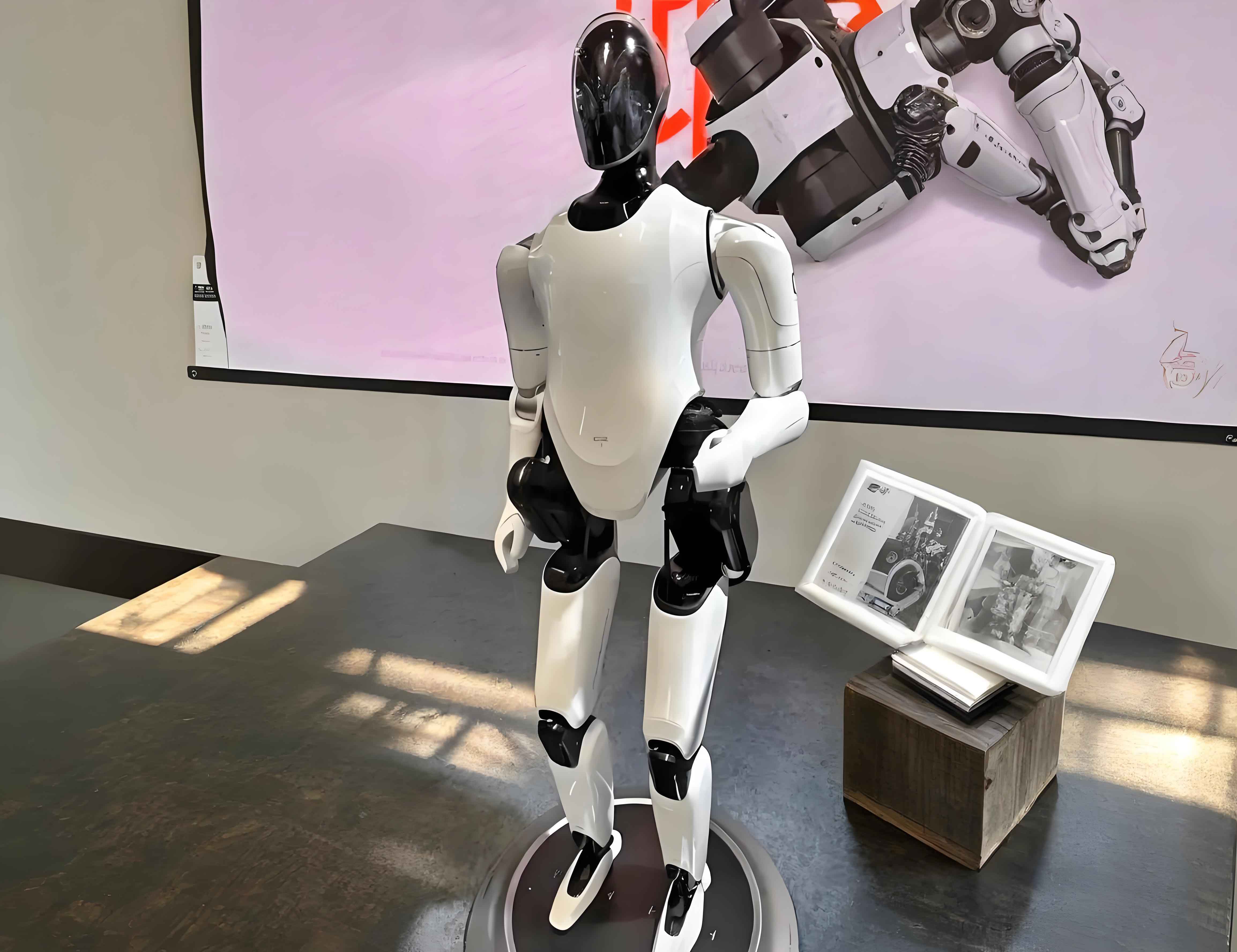
The operational cycle of an embodied AI robot in a publishing scenario can be described by a perception-cognition-action loop:
- Perception (\(P_t\)): The robot fuses multi-modal sensory data (visual \(V_t\), auditory \(A_t\), tactile \(T_t\), etc.) at time \(t\) to create a situational representation. $$P_t = \text{Fusion}(V_t, A_t, T_t, …)$$
- Cognition & Planning (\(C_t\)): A reasoning engine, often a Vision-Language-Action (VLA) model, processes \(P_t\), the user’s state \(U_t\), and the narrative/knowledge graph \(G\) to determine a goal-oriented action or response. $$A_t = \pi(O_t, G, M)$$ where \(\pi\) is the policy model, \(O_t\) is the observation (derived from \(P_t\) and \(U_t\)), and \(M\) is the memory of past interactions.
- Action & Feedback (\(A_t\)): The robot executes \(A_t\), which could be modifying the virtual environment, providing haptic feedback, uttering speech, or guiding a physical movement. The user’s response to this action generates new sensory data, closing the loop.
This technical framework enables the transformative applications outlined in the following section.
Application Exploration: Reshaping the Publishing Landscape
The integration of embodied AI robot technology catalyzes a fundamental shift across multiple publishing domains. The transformation can be mapped across three core dimensions: form, knowledge transfer, and narrative.
| Publishing Domain | Traditional Paradigm | Embodied AI Paradigm | Role of the Embodied AI Robot |
|---|---|---|---|
| Educational & STM Publishing | Textbooks with diagrams; abstract explanations of scientific phenomena or complex procedures. | Immersive, interactive lab simulations; surgical or engineering training environments. Learners perform virtual experiments or procedures. | The robot acts as a tutor or lab partner within the simulation. It can demonstrate procedures, provide real-time corrective haptic feedback (e.g., through force-feedback gloves), and assess the learner’s technique based on their embodied actions. |
| Children’s & Juvenile Publishing | Picture books, pop-up books, simple audio players. | Interactive story worlds where children can physically move, speak to characters, and influence the plot. Emotional companionship blended with learning. | The robot is a physical character (like an emotional companion robot) or a virtual agent in an AR space. It responds to the child’s touch, voice, and emotions, telling stories that adapt to the child’s choices and providing interactive learning games that require bodily engagement. |
| Cultural & Heritage Publishing | Illustrated books on history/art; museum catalogs. | Virtual time-travel experiences; interactive archaeological digs; “living” exhibitions where historical figures can be conversed with. | The robot serves as a guide or a historical persona. It can lead a user through a reconstructed ancient city, explain artifacts when looked at, and answer questions in character, making the cultural context an explorable space rather than a static description. |
| Professional & How-To Publishing | Manuals with text and photographs. | Step-by-step augmented reality overlays on actual equipment; guided repair or assembly procedures where the system recognizes user actions and provides the next instruction. | The robot is an AR overlay or a cooperative robotic assistant. It projects instructions onto machinery, recognizes when a step is completed via computer vision, and verbally/haptically guides the user through complex, hands-on tasks, reducing error and improving skill acquisition. |
The underlying principle across these applications is the translation of passive reception into active, sensorimotor exploration. Knowledge is not merely understood but practiced and felt. The narrative is not just told but lived through. The embodied AI robot is the key enabler of this translation, serving as the dynamic interface between the user’s physical self and the enriched digital content.
Challenges and Critical Considerations
While the potential is vast, the path toward embodied publishing is fraught with significant challenges that must be addressed proactively.
1. Data Security and Privacy Incursions: The very strength of embodied systems—their deep, multi-modal sensing—creates unprecedented privacy risks. An embodied AI robot tutor in an educational setting may collect not just answers, but gaze patterns, vocal stress, biometric data, and precise physical movement profiles. This data, if compromised, exposes users to profound vulnerabilities. Furthermore, maliciously corrupted training data could lead to erroneous or harmful guidance within immersive experiences. Robust encryption, strict data anonymization protocols, on-device processing, and clear ethical guidelines on data ownership are non-negotiable prerequisites.
2. The Erosion of Editorial and Cultural Stewardship: Publishing has traditionally served a gatekeeping and cultural-guiding function. Editors curate content for quality, accuracy, and cultural value. Highly personalized, interaction-driven experiences powered by embodied AI robots risk creating ultra-potent “experience bubbles.” If algorithms solely optimize for engagement and user preference, they may sideline challenging but important content, weaken narrative coherence, and diminish the role of editorial judgment in shaping cultural discourse. The technology must be designed to encourage serendipitous discovery and uphold editorial values, not just cater to existing biases.
3. The Threat to Deep Reading and Contemplative Thought: There is a valid concern that constant, high-stimulation embodied interaction could atrophy the capacity for sustained, deep reading and abstract reflection. If every classic novel is transformed into an interactive adventure game, the nuanced introspection demanded by pure text may be lost. The “slow burn” of intellectual engagement risks being displaced by the immediate gratification of sensory feedback. A balanced ecosystem must be preserved where embodied experiences complement, rather than replace, traditional deep reading.
4. The Acute Shortage of Interdisciplinary Talent: Developing meaningful embodied publishing experiences requires a fusion of skills rarely found in traditional publishing houses: narrative design, cognitive science, educational theory, 3D environment modeling, robotics, AI ethics, and software engineering. The current divide between content specialists and technologists is a major barrier. We face a pressing need for a new breed of “embodied publishing designers” and for radical restructuring of educational programs to cultivate these hybrid experts.
Conclusion and Future Trajectory
The journey from digitized content to truly embodied digital publishing represents one of the most significant frontiers for the industry. The advent of the embodied AI robot as a core component of this shift moves us beyond screens and speakers into a realm where knowledge is spatially organized, narratively navigable, and physically interactable. This is not about replacing the human intellect with machines, but about using technology to reconnect learning and storytelling to the fundamental ways in which we, as bodily beings, understand our world—through doing, feeling, and interacting.
The future publishing landscape will likely be a spectrum. At one end, traditional text will remain vital for certain forms of thought. At the other, fully immersive, robot-facilitated experiences will train skills and convey cultural contexts in unparallelled ways. The most impactful applications will lie in between, in mixed-reality scenarios where a simple trigger from a printed page or a tablet summons an embodied AI robot guide to augment the reader’s physical space with interactive layers of explanation and story.
Ultimately, success in this new paradigm will depend on our ability to navigate the associated challenges with foresight and ethics. By prioritizing human-centric design, robust privacy frameworks, editorial integrity, and the cultivation of interdisciplinary talent, we can steer the development of embodied intelligence in publishing toward a future that genuinely enriches human cognition, preserves cultural depth, and expands the very definition of what it means to publish and to read.