
The evolution from classical, disembodied artificial intelligence to embodied AI represents a profound paradigm shift, often hailed as a qualitative leap towards more general and situated machine intelligence. This “embodied turn” centers on intelligent agents or systems endowed with sensorimotor capacities, enabling them to perceive, comprehend, and interact with their surroundings to execute tasks. However, as the field progresses from theoretical models to physical instantiations in embodied AI robot platforms, significant gaps in their interactive behavior become apparent. While these robots can perform pre-programmed sequences or learned tasks in controlled settings, their ability to fluidly engage with objects, adapt to dynamic environments, and communicate with humans remains fundamentally limited. This essay argues that these limitations are not merely engineering challenges but stem from a deeper, philosophical disconnect: the absence of core structures of lived bodily experience as described by Maurice Merleau-Ponty’s phenomenology of the body. Through a first-person, phenomenological lens, we will analyze the roots of these behavioral shortcomings and propose developmental robotics as a promising path forward, inspired by the very principles of human ontogeny that phenomenology illuminates.
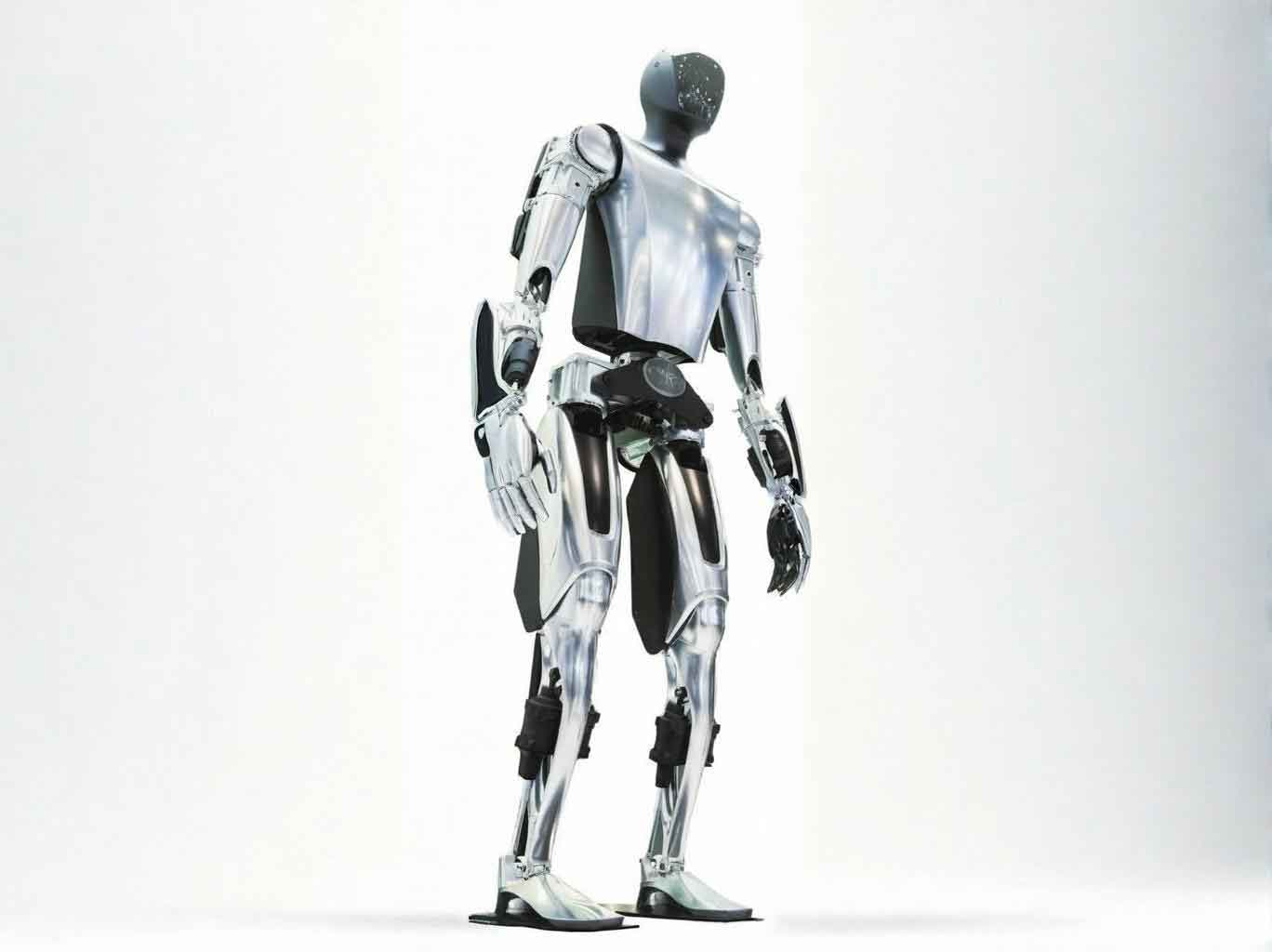
The physical instantiation of intelligence in an embodied AI robot is a complex endeavor, moving beyond software to negotiate the constraints and affordances of the real world. The current limitations of interaction can be categorized into three interrelated domains: deficient motor control, insufficient environmental coupling, and impoverished understanding and expression of body language. To understand why these persist, we must look beyond algorithms and datasets to the foundational role of the body in constituting meaning and action.
The Deficiency in Motor Control: Absence of Body Schema
Merleau-Ponty introduces the concept of the “body schema” (schéma corporel) as a pre-reflective, dynamic synthesis of our bodily posture and capabilities in relation to a task or situation. It is not a conscious map but a Gestalt—an integrated awareness of our body as a unified potentiality for action. When I reach for a cup, I do not calculate joint angles or distances; my hand moves fluidly toward its goal, guided by a tacit knowledge of my bodily spatiality. The body schema is open, incorporating tools like a blind man’s cane or a painter’s brush into its operational boundaries, transforming them from external objects into transparent extensions of bodily possibility.
In contrast, the motor control of an embodied AI robot is typically a feat of explicit computation and planning. It relies on processes like inverse kinematics, trajectory optimization, and reinforcement learning from massive datasets. Each movement is often decomposed into a sequence of planned joint states or end-effector poses. This creates a stark dichotomy with the holistic, task-oriented fluency of human movement. The robot lacks the integrated, pre-objective “body schema” that provides humans with an immediate sense of “I can.” Its movements are executed in objective, Cartesian space rather than the lived, situational space of the body. This fundamental absence leads to behaviors that are often rigid, brittle in novel situations, and lack the graceful, economic adaptation seen in even young children. The following table contrasts the two paradigms:
| Aspect | Human Motor Control (via Body Schema) | Current Embodied AI Robot Motor Control |
|---|---|---|
| Foundation | Pre-reflective, holistic bodily awareness (Body Schema). | Explicit computation, geometric planning, and optimization. |
| Spatiality | Lived, situational space (phenomenological space). | Objective, metric coordinate space. |
| Tool Use | Transparent incorporation into bodily potentiality. | Explicit modeling of tool as separate object with updated kinematics. |
| Adaptation | Fluid, online adjustment based on tacit bodily knowledge. | Requires re-planning or robust control algorithms to handle perturbations. |
| Character | Economical, task-oriented, and graceful. | Often sequential, mechanically precise, but can appear clumsy or inefficient. |
We can conceptualize the body schema’s integrative function formulaically. Let a bodily state $B$ be a vector of proprioceptive, tactile, and motor potentials. The body schema $S$ is a dynamic operator that synthesizes this state with a perceived task $T$ and environmental context $E$ to generate an action tendency $A$, all prior to conscious calculation:
$$ S(B, T, E) \rightarrow A $$
This stands in contrast to the standard robotic control pipeline, which might involve a perception module $P$ creating a world model $W$, a planner $Pl$ generating a trajectory $Tr$ based on $W$ and goal $G$, and a controller $C$ executing it:
$$ C(Pl(G, P(E))) \rightarrow Tr $$
The lack of $S$ in the embodied AI robot is the root of its motor control limitations.
The Deficiency in Environmental Interaction: Absence of the Intentional Arc
Merleau-Ponty describes the “intentional arc” as the tight, reciprocal coupling between an agent and its world. It is the circuit through which our past experiences, current projects, and future possibilities are projected onto and drawn from our environment. This arc gives the world its “affordances”—not as objective properties but as invitations for action that emerge in the dialogue between an agent’s skills and the environment’s offerings. A chair affords sitting to a human because of the human’s bodily structure and history of sitting; it does not inherently “afford sitting” in an absolute sense. The intentional arc enables what Merleau-Ponty calls “maximum grip,” the body’s tendency to optimize its engagement with the world to achieve the best possible perception or interaction.
An embodied AI robot typically interacts with its environment through a more linear, representational process. Sensors gather data, which is processed to update an internal model. This model is then used for decision-making and action. The connection is often unidirectional or features slow feedback loops. Crucially, the robot lacks the historical, developmental depth of the intentional arc. Its “understanding” of affordances is statistical, derived from patterns in training data, rather than being grounded in a history of lived, bodily engagement. Consequently, it struggles in open-ended, dynamic environments where novelty is the norm. Its behaviors are not driven by a quest for “maximum grip” on a meaningful situation but by the optimization of a pre-defined cost function or the execution of a planned sequence. When the environment deviates from its training distribution or model assumptions, its performance degrades rapidly.
| Aspect | Human Environmental Coupling (via Intentional Arc) | Current Embodied AI Robot Environmental Interaction |
|---|---|---|
| Coupling | Tight, reciprocal, and historical (Intentional Arc). | Often linear, model-based, with delayed feedback. |
| Affordances | Perceived directly as action possibilities relative to body and skills. | Inferred from sensor data using learned classifiers or models. |
| Temporal Depth | Rich with personal history and projected futures. | Largely limited to immediate past states for prediction. |
| Adaptive Principle | Seeking “maximum grip” on a meaningful situation. | Optimizing a cost function or executing a plan. |
| Robustness to Novelty | High, due to general skills and bodily understanding. | Low, dependent on similarity to training data/scenarios. |
The intentional arc establishes a circular causality. Let $A_t$ be an action at time $t$, $P_{t+1}$ the resulting perceptual change, and $Sk$ the agent’s embodied skills/history. The arc establishes a continuous loop:
$$ \ldots \xrightarrow{Sk} A_t \rightarrow P_{t+1} \xrightarrow{Sk} A_{t+1} \rightarrow P_{t+2} \xrightarrow{Sk} \ldots $$
This is missing in a standard embodied AI robot architecture, where the connection from perception to action is mediated by a world model $W$ that is not constituted by lived experience: $P_t \rightarrow W_t \rightarrow A_t$.
The Deficiency in Bodily Communication: Absence of Speech as Gesture
For Merleau-Ponty, language—including non-verbal communication—is first and foremost a bodily gesture. “Speech” is not the external clothing of internal thought but an expressive gesture that carries meaning in its very execution, like a pointing finger or a smile. Understanding another’s gesture is not an intellectual decoding but a bodily resonance, where my own bodily intentionalities meet and mesh with the other’s expressed movement. This “intercorporality” is the foundation of mutual understanding. A furrowed brow, a shift in posture, or a tone of voice communicates directly because we share a common corporeality.
The embodied AI robot approaches bodily communication as a problem of signal processing and generation. Facial expression recognition relies on detecting geometric landmarks and matching them to emotion labels. Gesture understanding involves parsing skeletal keypoints into symbolic commands. Expression generation often uses animation systems or parameterized behavior models to mimic human poses. This entire framework operates on an objective, third-person model of the body as a mechanism. The robot lacks the first-person, lived body that is the source and target of genuine gesture. It cannot engage in the mutual, pre-reflective dialogue of intercorporality. Its expressions are simulations, not genuine expressions of an embodied state, and its understanding of human body language is a classification, not an empathetic comprehension. This creates a profound asymmetry in human-robot interaction, hindering the development of natural, fluid collaboration.
| Aspect | Human Bodily Communication (via Speech-Gesture) | Current Embodied AI Robot Bodily Communication |
|---|---|---|
| Nature of Expression | Gesture; meaning inherent in the bodily act itself. | Simulation or parameterized animation of expressive forms. |
| Understanding Mechanism | Bodily resonance and intercorporality. | Pattern recognition, classification, and symbolic mapping. |
| Foundation | Shared corporeality and lived experience. | Statistical correlations in visual/audio data. |
| Goal | Mutual disclosure and coordination within a shared situation. | Transmission or reception of a predefined signal or command. |
| Depth | Carries affective, intentional, and situational nuance. | Often limited to a discrete set of categorized emotions or commands. |
The phenomenological view posits that a gesture $G$ from an Other is understood when my body’s potentialities $B_{pot}$ find a motor equivalent to it: Understanding occurs if $G \cap B_{pot} \neq \varnothing$. For an embodied AI robot, understanding is a function $F$ mapping sensory input $I_G$ to a label or command $L$: $F(I_G) = L$.
Developmental Robotics: A Phenomenologically-Inspired Path
If the core limitations of the embodied AI robot stem from missing the foundational structures of the lived body, then a promising avenue is to attempt to engineer their emergence. This leads us to the field of developmental robotics, inspired by Turing’s concept of a “child machine.” This approach does not seek to directly program a body schema or intentional arc but to create conditions under which analogous capabilities might self-organize through extended, embodied experience, much as they do in human infants.
A developmentally structured embodied AI robot would be designed with a morphology that encourages rich sensorimotor interaction. Its learning would be progressive, starting with foundational skills like tactile exploration and cross-modal integration, and gradually building towards more complex object manipulation and environmental navigation—all through autonomous exploration and socially guided learning. Crucially, it would need to be “raised” in a rich, dynamic, and socially embedded environment, not just trained on curated datasets. The robot’s history of interactions would constitute its own “intentional arc,” building a repertoire of skills and affordances grounded in its specific embodiment. Through prolonged interaction with human caregivers, it could develop proto-forms of gestural communication, driven by the reinforcement and scaffolding inherent in social dynamics.
The core formula for this approach is one of staged, embodied learning driven by intrinsic motivation $IM$ and social guidance $SG$:
$$ \text{Competence}_{t+1} = \text{Competence}_t + \alpha \cdot (IM(\text{State}_t, E_t) + \beta \cdot SG(\text{Human}, \text{State}_t)) \cdot \Delta \text{Experience} $$
Here, $\alpha$ is a learning rate, and $\beta$ scales the social influence. The goal is for structures like the body schema $S$ to emerge as a stable attractor in the robot’s sensorimotor dynamics:
$$ S \approx \lim_{t \to \infty} f(\text{Sensorimotor\_History}_t) $$
where $f$ is the developmental process itself. This is a radically different paradigm from end-to-end training of a monolithic model for a specific task. It acknowledges that true interactive intelligence in an embodied AI robot may require a developmental history that bootstraps its own conditions for meaning.
Conclusion
The journey towards robust, general, and intuitive interactive abilities in embodied AI robot systems is not merely a scaling problem of data and compute. As phenomenology reveals, it is a problem of bodily being. The current limitations in motor control, environmental coupling, and bodily communication point to a fundamental absence: the absence of a lived body that organizes itself through a pre-reflective schema, that is historically woven into its world through an intentional arc, and that expresses and understands meaning through gestural dialogue. Recognizing this is not a counsel of despair but a crucial redirection of perspective. It suggests that the most promising path may not be to increasingly sophisticatedly simulate the outputs of human behavior, but to cautiously engineer the conditions for the development of its constitutive processes. Developmental robotics, inspired by the phenomenology of the body and the empirical reality of human ontogeny, offers a framework for this endeavor. The challenge is immense, requiring deep collaboration across robotics, cognitive science, and philosophy. Yet, it is by embracing the depth of what it means to be an embodied agent that we may ultimately guide the embodied AI robot from performing tasks to genuinely inhabiting a shared world.