
As I reflect on the rapid evolution of technology, I am struck by how humanoid robots have transitioned from science fiction to tangible reality, reshaping our daily lives and consumer landscapes. The recent performances, such as the one during the Lunar New Year gala, where dozens of humanoid robots adorned in traditional attire danced alongside human actors, showcased a fascinating blend of culture and cutting-edge robotics. This “cyborg-style” dance, with its precise movements and futuristic flair, symbolizes the dawn of a new age where humanoid robots are no longer mere novelties but integral components of our societal fabric. In this article, I will explore the multifaceted impact of humanoid robots, delving into their applications in consumer settings, their socio-economic value, and the technological underpinnings that make this revolution possible. Through detailed analysis, tables, and mathematical models, I aim to provide a comprehensive perspective on why humanoid robots are poised to become the next giant leap in intelligent consumption.
The performance I mentioned earlier highlights the artistic and entertainment potential of humanoid robots, but their true significance lies in practical, everyday applications. In household environments, humanoid robots are emerging as versatile assistants, capable of handling tasks from mundane chores to complex caregiving. For instance, a robot butler equipped with environmental sensors can autonomously manage home conditions—adjusting lighting, temperature, and even playing music to create a personalized morning routine. In kitchens, cooking robots with visual recognition systems identify ingredients, suggest recipes based on health metrics, and execute meals with precision. This seamless integration into domestic life underscores the transformative power of humanoid robots, making them indispensable companions rather than mere tools. As I analyze these trends, it becomes clear that the proliferation of humanoid robots will redefine consumer behavior, fostering a new era of digital interaction and convenience.
To better illustrate the diverse roles of humanoid robots in homes, I have compiled a table summarizing key applications and their functionalities. This table encapsulates how humanoid robots address specific needs across different demographic groups, from children to the elderly, thereby enhancing quality of life and promoting efficiency.
| Application Scenario | Primary Functions | Target Demographic | Technologies Involved |
|---|---|---|---|
| Home Automation | Environmental sensing, climate control, security monitoring | General households | IoT sensors, AI algorithms |
| Culinary Assistance | Ingredient recognition, recipe recommendation, automated cooking | Busy families, health-conscious individuals | Computer vision, machine learning |
| Elderly Care | Medication reminders, vital sign monitoring, companionship | Aging population | Multimodal sensors, 5G connectivity |
| Child Education | Interactive learning, AR-based games, personalized tutoring | Children and parents | Affective computing, augmented reality |
| Household Maintenance | Cleaning, organizing, repair assistance | All age groups | Robotic kinematics, SLAM navigation |
The integration of humanoid robots into these scenarios is not just about convenience; it addresses profound societal challenges. As I examine demographic shifts, particularly aging populations and declining birth rates, humanoid robots offer a viable solution. According to projections, the proportion of individuals aged 60 and above is expected to exceed 20% in many regions, leading to a中度老龄化 society. With more elderly people living independently, traditional caregiving models are strained. Humanoid robots, through advanced sensor fusion—such as millimeter-wave radar for呼吸 monitoring and infrared cameras for fall detection—can provide round-the-clock safety nets. This capability is mathematically represented by a safety index, which I define as:
$$S(t) = \sum_{i=1}^{n} w_i \cdot f_i(t)$$
where \(S(t)\) is the overall safety score at time \(t\), \(w_i\) are weights assigned to different sensor inputs (e.g., radar, camera), and \(f_i(t)\) are the normalized sensor readings. This formula quantifies how humanoid robots enhance居家安全, with higher scores indicating better protection. Moreover, by automating chores like cleaning and meal preparation, humanoid robots alleviate pressures on dual-income families, potentially encouraging higher birth rates by reducing childcare burdens. In essence, the deployment of humanoid robots acts as a societal stabilizer, mitigating structural issues through intelligent automation.
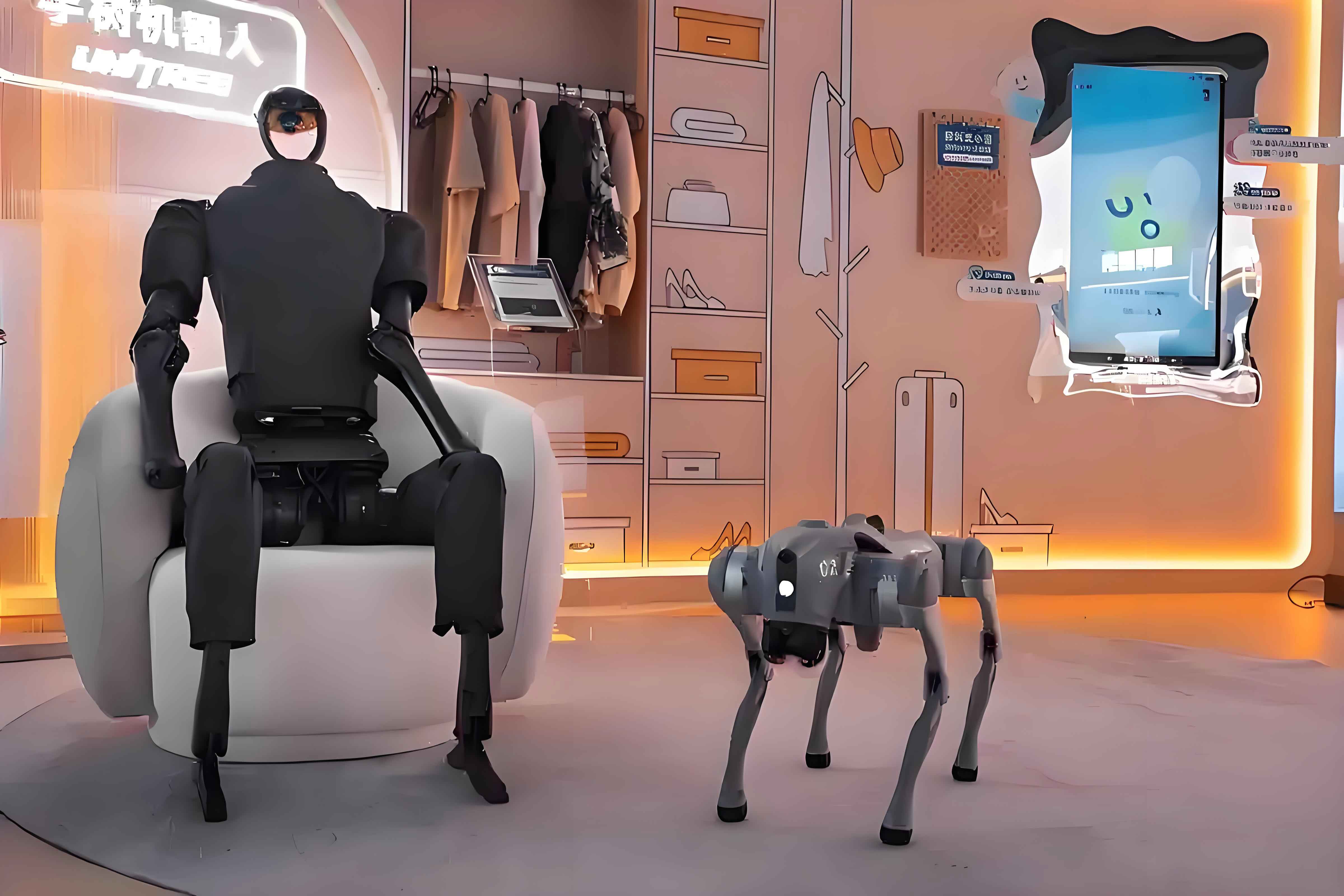
The image above captures the essence of this transformation, depicting humanoid robots and their canine counterparts in action—a visual testament to the blend of tradition and innovation. As I delve deeper, the economic implications of humanoid robots are equally staggering. Industry experts often describe the humanoid robot market as a “tenfold larger opportunity than new energy vehicles,” positioning it as a major driver for实体经济的智能新引擎. Since 2023, governmental policies at both central and local levels have accelerated robot产业 development, with recent reports emphasizing智能机器人 as a next-generation智能终端. This policy support, combined with technological advancements, has made 2025 a landmark year for robot mass production. To quantify this growth, I present a table of investment and financing trends in the humanoid robot sector, based on available data.
| Year | Investment Scale (in billions CNY) | Key Drivers | Projected Market Size (by 2030) |
|---|---|---|---|
| 2024 | Approximately 50 | Early-stage R&D, pilot projects | 1.2 trillion CNY |
| 2025 (first two months) | 44.5 | Policy incentives,量产 initiatives | 1.5 trillion CNY |
| 2026 (forecast) | Over 100 | Consumer adoption, cost reduction | 2.0 trillion CNY |
This table illustrates the explosive growth in humanoid robot investments, with 2025’s early figures nearly matching the entire previous year’s total. Such momentum underscores the sector’s viability and the confidence investors place in humanoid robots as a transformative force. From a macroeconomic perspective, the impact of humanoid robots can be modeled using a modified Cobb-Douglas production function, where I incorporate robotic capital as a distinct input:
$$Y = A \cdot L^\alpha \cdot K_r^\beta \cdot K_t^\gamma$$
Here, \(Y\) represents economic output, \(A\) is total factor productivity, \(L\) is labor, \(K_r\) is capital invested in humanoid robots, \(K_t\) is traditional capital, and \(\alpha, \beta, \gamma\) are output elasticities. As humanoid robots become more prevalent, \(\beta\) increases, leading to higher productivity and output—a testament to their role as an智能新引擎. This mathematical framework helps explain why governments are prioritizing humanoid robots in industrial strategies, viewing them as catalysts for sustainable growth.
Technologically, the advancement of humanoid robots hinges on sophisticated systems like multimodal sensor fusion and AI-driven decision-making. I often analyze these through control theory equations, such as the dynamics of a humanoid robot’s movement, which can be expressed as:
$$M(q)\ddot{q} + C(q, \dot{q})\dot{q} + G(q) = \tau$$
where \(M(q)\) is the mass matrix, \(C(q, \dot{q})\) represents Coriolis and centrifugal forces, \(G(q)\) is the gravitational vector, \(q\) denotes joint angles, and \(\tau\) is the torque applied. This equation governs how humanoid robots achieve precise actions like转手绢 or队形变换, ensuring stability and efficiency. Additionally, the integration of 5G and edge computing enables real-time data processing, allowing humanoid robots to operate seamlessly in dynamic environments. For example, in elderly care scenarios, a humanoid robot might use sensor data to predict and prevent falls, with algorithms optimizing response times. The convergence of these technologies is what makes humanoid robots not only functional but also reliable partners in daily life.
Looking ahead, the proliferation of humanoid robots will undoubtedly reshape consumer markets. I envision a future where every household owns two to three humanoid robots, each tailored to specific roles—from education to healthcare. This shift will create entirely new digital消费场景, such as personalized AI tutors that adapt to children’s learning paces or robotic companions that provide emotional support for the isolated elderly. The economic value generated here is immense, driven by reduced labor costs, increased productivity, and enhanced quality of life. To estimate the consumer surplus from adopting humanoid robots, I employ a utility maximization model:
$$U(x, r) = \sum_{i=1}^{n} \ln(x_i + \theta_i r_i)$$
where \(U\) is household utility, \(x_i\) are conventional goods, \(r_i\) are services provided by humanoid robots, and \(\theta_i\) are preference parameters. As \(r_i\) increases, utility rises, reflecting the added value from robotic assistance. This model underscores why humanoid robots are becoming essential in modern消费 patterns, fostering a smarter, more connected lifestyle.
In conclusion, as I observe the trajectory of humanoid robots, from舞台 performances to居家 applications, it is evident that we are on the cusp of a智能消费新时代. The humanoid robot revolution is not merely about automation; it is about enhancing human capabilities, addressing societal gaps, and driving economic prosperity. With continued innovation and supportive policies, humanoid robots will soon become ubiquitous, transforming homes into intelligent hubs and propelling实体经济 into a new developmental phase. As I finalize this analysis, I am optimistic that humanoid robots will serve as the cornerstone of a future where technology and humanity coexist harmoniously, unlocking unprecedented opportunities for all.