
From my perspective, observing the digital ecosystem evolve is akin to watching a new species emerge in the wild. We are witnessing the rise of the ‘corporate robot dog’. This is not a literal machine, but a metaphorical construct: an autonomous, agile, data-driven entity programmed for growth, survival, and dominance within the competitive landscape. Its core programming is built on algorithms for logistics, user engagement, and capital efficiency. The recent, monumental alliances between internet titans are not mere mergers; they are the complex mating rituals and pack-forming behaviors of these advanced corporate robot dogs, seeking complementary strengths to survive the coming winter and outmaneuver the alpha predator in their shared habitat.
The fundamental equation driving this behavior is the search for synergistic advantage, moving beyond simple market share addition. The value \( V \) of an alliance can be modeled as:
$$
V_{alliance} = \alpha (M_1 + M_2) + \beta (D_1 \cap D_2) + \gamma (T_1 \oplus T_2) – C_{int}
$$
Where:
\( M \) represents market access,
\( D \) represents data assets,
\( T \) represents technological capabilities,
\( \alpha, \beta, \gamma \) are synergy coefficients,
and \( C_{int} \) is the cost of integration.
The goal is to maximize \( \beta \) and \( \gamma \), turning the union into a ‘super robot dog’ with capabilities greater than the sum of its parts.
I. The Genesis of an Ecosystem: From Solitary Hunters to Strategic Packs
The classical internet model favored the solitary, vertically-integrated robot dog. Each company built its own power supply, its own sensors, its own legs. This led to incredible internal optimization but also to massive redundancy across the ecosystem. The landscape was littered with thousands of robot dogs, each trying to dig its own burrow, find its own food, and defend its own tiny territory. Efficiency was local, but systemic waste was enormous. The turning point arrives when one entity develops a foundational, pervasive technology—a new form of ‘pack communication protocol’ or a universally desired ‘energy source’. This technology becomes the new terrain upon which all other robot dogs must operate. Possessing it grants not just power, but the authority to redefine the rules of engagement and the very geography of the hunt.
In this new era, the strategy pivots from building every capability in-house to curating an ecosystem. The dominant platform becomes the ‘pack leader’ or the ‘ecosystem orchestrator’. Its strength is no longer measured solely by the horsepower of its own robot dog, but by the diversity, loyalty, and combined might of the specialized robot dogs in its cohort. This shift is quantified in the transition from a single-entity valuation to a network-empowered valuation.
| Era | Dominant Strategy | Key Metric | ‘Robot Dog’ Analogy | Core Risk |
|---|---|---|---|---|
| Web 1.0 / Early Growth | Siloed Vertical Integration | User Count, GMV, Revenue | A solitary, heavily-armored robot dog guarding its kill. | High fixed costs; vulnerability to disruptive, agile competitors. |
| Platform Emergence | Open APIs & Developer Ecosystems | Platform Activity, API Calls | A robot dog that allows smaller drones to feed off its perimeter, enriching the soil. | Loss of control; potential for platform commoditization. |
| Ecosystem Alliance (Current) | Strategic Equity Stakes & Deep Integration | Ecosystem GMV, Data Shared, Strategic Coverage | A pack of specialized robot dogs (hunter, tracker, defender) linked by a shared neural network. | Integration complexity; cultural clashes; regulatory scrutiny. |
The calculus for a specialized ‘robot dog’—say, one bred for extreme logistics efficiency or one with superior scent-tracking for local services—changes profoundly. The question shifts from “Can I build a communication protocol as good as the pack leader’s?” to “What unique value do I bring to the pack, and what share of the pack’s total bounty is that worth?” The pack leader, in turn, must solve a continuous optimization problem: allocating its ‘energy’ (traffic, capital, data) to pack members to maximize total pack output, which reinforces the value of its core protocol. This is a form of algorithmic governance applied to corporate strategy.
II. The Anatomy of a Deal: Equity as the Synaptic Link
Why equity? In a low-trust, high-competition environment, simple contractual partnerships are the equivalent of two robot dogs communicating via intermittent radio signals—prone to interference and betrayal when a better signal appears. An equity stake creates a hardwired, ‘synaptic’ connection. It aligns financial destinies and, more importantly, it provides a permanent seat at the strategic decision-making table. It signals a commitment that goes beyond quarterly partnership goals. The percentage is a precise instrument, calibrated to achieve specific outcomes without triggering certain failure modes.
The optimal stake \( S^* \) can be seen as a function of several variables:
$$
S^* = f(I_{req}, A_{prot}, C_{ind}, R_{comp})
$$
Where:
\( I_{req} \) is the required level of influence for resource sharing,
\( A_{prot} \) is the level of autonomy protection for the target,
\( C_{ind} \) is the critical need for the target’s independent market credibility (e.g., for IPO),
\( R_{comp} \) is the regulatory and competitive risk of a higher stake.
The magic number often lies not in majority control (which kills \( A_{prot} \) and \( C_{ind} \)), but in a significant minority that is ‘large enough to trust, small enough not to smother’. This creates the ‘robot dog pack’ dynamic: individual hunting tactics are left to the specialist, but the overall direction of the pack and the sharing of the spoils are coordinated.
Let’s model the resource transfer in such an alliance. The platform leader \( P \) possesses an abundant resource \( R_T \) (Traffic, particularly mobile traffic) but lacks a specialized capability \( C_L \) (Logistics, Merchandise). The target company \( T \) has the inverse profile. A simple transfer \( R_T \rightarrow T \) for cash is inefficient, as \( T \) may not fully optimize \( R_T \) for \( P \)’s benefit. A full merger destroys \( T \)’s specialized culture and agility. The solution is a resource-for-equity swap with embedded governance.
| Asset / Capability | Platform Leader (P) | Target Specialist (T) | Post-Alliance Integration Mechanism |
|---|---|---|---|
| Primary Resource (Abundant) | Mobile Traffic & Social Graph (\( R_T \)) | Warehouse Networks & Inventory Systems (\( C_L \)) | \( R_T \) is piped into \( T \)’s ecosystem via privileged access points. \( C_L \) is leveraged to improve \( P \)’s overall service depth. |
| Strategic Liability | Underperforming, “heavy” ancillary units. | High customer acquisition cost; traffic dependency. | Liabilities are bundled and transferred. P’s underperforming unit is merged into T, granting T immediate scale in new regions. T’s traffic cost drops dramatically. |
| Data Streams | Social, interest, payment intent data. | Transactional, logistical, repeat purchase data. | Data lakes are federated. A new joint signal \( J \) is created: \( J = \sigma(R_T) \times \log(C_L) \), enabling hyper-targeted commerce. |
| Competitive Posture | Broad but shallow in commerce. | Deep but narrow in its vertical. | Creates a unified front against the common alpha predator. The pack can now contest in both broad territory and deep burrows. |
The retention of certain sub-brands post-alliance is a critical nuance. It is not sentimentality; it is strategic algorithm preservation. A well-tuned ‘robot dog’ sub-brand has local optimization algorithms (for user experience, for regional supply chains) that are highly effective. Absorbing it completely might overwrite these unique algorithms with the generic ones of the larger entity. Keeping it operationally autonomous but strategically aligned allows the pack to run A/B tests at the corporate level—different breeds of robot dog tackling the same problem, with the pack learning from both.
III. The Founders’ Dilemma: Programming the Pack Instinct
The human element remains the most fascinating and unpredictable variable in this equation of machine-like entities. The founder is the original programmer of the corporate robot dog. Their personality, values, and fears are hard-coded into its core operating system—its culture, its risk appetite, its pace. When two such complex systems decide to interlink, it is less a cold corporate transaction and more a profound act of trust between two master programmers. Each must believe that the other will not upload a virus of bureaucracy, complacency, or misaligned incentive into their life’s work.
The founder of a logistics-focused robot dog is often programmed with a deep-seated obsession with control and efficiency. Every cog in the machine must be visible, every outcome predictable. This founder views their company as a singular, powerful entity that can out-muscle any challenge through sheer force of will and superior systemic engineering. The idea of relying on an external entity for something as critical as ‘customer flow’ feels like a dangerous vulnerability—a relinquishing of control. Their decision to ally is therefore a monumental recalculation, forced by a changing environment where the cost of solo customer acquisition \( CA_{cost} \) begins to threaten the entire enterprise model.
This founder’s utility function \( U_f \) undergoes a seismic shift. It moves from a pure, internalized metric of growth to a more complex function that must now account for shared destiny.
$$
U_{f\_before} = G_{internal} – R_{external}
$$
$$
U_{f\_after} = \phi(G_{pack}) + \omega(A_{internal}) – \delta(D_{shared})
$$
Where \( G \) is growth, \( R \) is external risk, \( A \) is autonomy, \( D \) is dependency, and \( \phi, \omega, \delta \) are the founder’s personal weighting coefficients. The internal struggle is the process of re-weighting these coefficients. The ‘robot dog’ must learn pack-hunting instincts while not forgetting how to hunt alone.
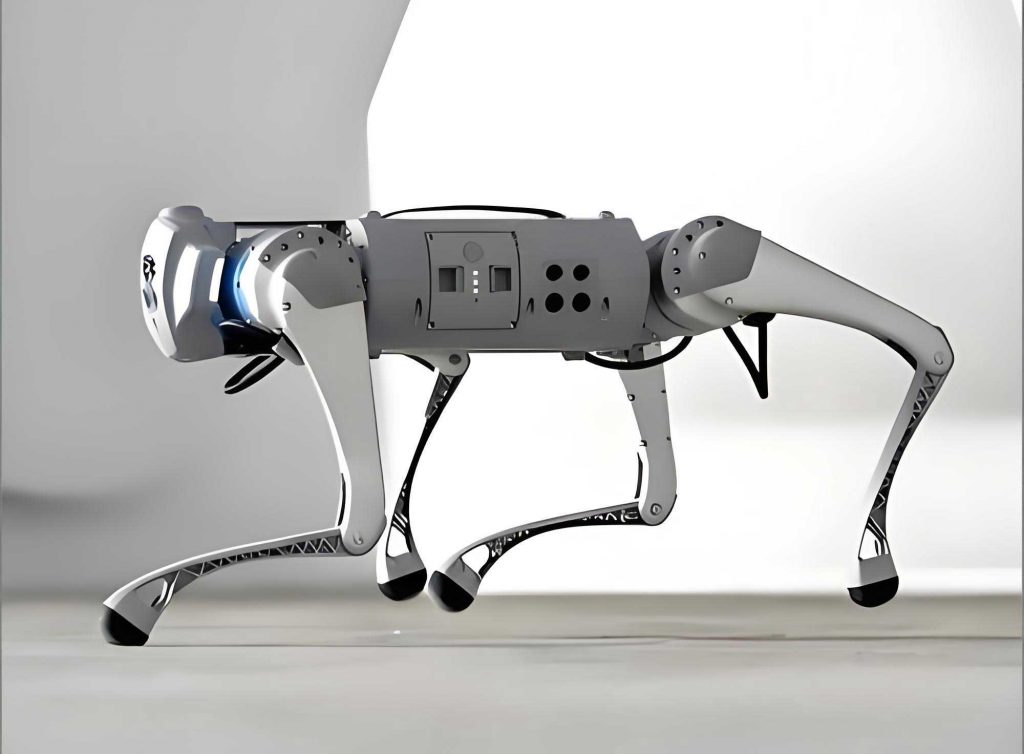
This image of a sleek, agile machine dog perfectly captures the duality of the modern corporate entity. It is a marvel of individual engineering—powerful limbs, advanced sensors, dynamic balance. Yet, its true potential is unlocked when its sensor data is networked, when its movements are coordinated with others, and when it operates not as a lone scout but as the eyes, legs, or jaws of a larger, intelligent swarm. The physical form represents the hard, tangible assets—the logistics networks, the server farms, the inventory. The invisible data links and shared intelligence represent the soft power of the platform—the algorithms, the social graphs, the payment systems. The fusion is what creates the next-generation predator.
The pack leader’s founder faces a different but equally profound challenge. Their programming has historically been expansionist: “build, copy, overwhelm.” The shift to an ecosystem strategy requires a new core directive: “curate, empower, interconnect.” This founder must resist the deep-seated instinct to directly control every valuable robot dog in the pack. Instead, they must become a master of incentives and network effects, designing the ‘pack rules’ that encourage cooperation and maximize total value. It is a transition from being the strongest robot dog to being the designer of the ecosystem in which all robot dogs compete and collaborate. Their key equation becomes the network effect multiplier \( N(t) \):
$$
N(t) = k \cdot \sum_{i=1}^{n} V_i(t) \cdot C_{i,p}(t)
$$
where \( V_i \) is the value of node \( i \) (a pack member), \( C_{i,p} \) is its connectivity to the platform \( p \), \( k \) is a platform-specific constant, and \( n \) is the number of nodes. The founder’s goal is to maximize \( N(t) \) over time by increasing both \( V_i \) and \( C_{i,p} \) for key partners.
IV. The Hardware-Software Symbiosis: Beyond Pure Data
The most potent alliances are not between two software-based robot dogs, but between a software-centric entity and a hardware-heavy one. This is the true ‘robot dog’ partnership: the ‘brain’ merging with the ‘body’. The software platform provides the nervous system—the real-time data, the coordination algorithms, the user interface. The hardware-focused partner provides the musculoskeletal system—the physical reach, the tangible touchpoints, the operational grit of moving atoms, not just bits.
This symbiosis solves fundamental constraints. A pure software robot dog hits a limit in user engagement; it cannot deliver a hot meal or repair a refrigerator. A pure hardware/logistics robot dog hits a limit in scalable, low-cost customer acquisition and data-driven optimization. Together, they form a complete organism. The value creation here is multiplicative, not additive. Integrating a national warehousing network with a hyper-engaged social communications platform creates a new reality: commerce as a conversational, immediate, and ubiquitous service.
The efficiency gains can be modeled by looking at the classic funnel. Let \( L \) represent leads (traffic), \( C \) represent conversion rate, and \( AOV \) represent average order value. For a hardware-heavy robot dog, \( L \) is expensive and \( C \) is moderate. For a software platform, \( L \) is cheap and abundant, but \( C \) to tangible goods is low. The alliance creates a new, optimized funnel.
$$
\begin{aligned}
GMV_{standalone} &= (L_{paid} \cdot C_{standalone} \cdot AOV) – Cost_{acquisition}\\
GMV_{alliance} &= (L_{platform} \cdot C_{enhanced} \cdot AOV) + \Delta AOV_{cross-sell}
\end{aligned}
$$
Where \( L_{platform} \gg L_{paid} \) and \( Cost_{acquisition} \rightarrow 0 \). The ‘enhanced’ conversion rate \( C_{enhanced} \) comes from integrated social proof, seamless login, and trusted payment protocols native to the platform. This is the algorithm of the pack in action: the tracker robot dog (platform) finds the prey (user intent) and guides the hunter robot dog (logistics platform) to the perfect strike position.
| Operational Layer | Software-Dominant ‘Robot Dog’ | Hardware-Dominant ‘Robot Dog’ | Symbiotic Outcome in Alliance |
|---|---|---|---|
| Customer Interface | Digital, social, conversational. High frequency, low friction. | Transactional, fulfillment-focused. Lower frequency, higher consideration. | Commerce embeds into daily conversation. Frictionless transactions from chat to delivery. |
| Asset Base | Data centers, code, user graphs. Scalable with near-zero marginal cost. | Warehouses, trucks, inventory, field personnel. High fixed and variable costs. | Data optimizes physical asset utilization (predictive stocking, dynamic routing). Physical assets provide defensible moat for data services. |
| Core Metric | User Engagement Time, Network Density. | Inventory Turnover, Delivery Speed, Cash Conversion Cycle. | ‘Intent-to-Fulfillment’ Velocity: Minimizing the time \( \Delta t \) from a user’s expressed desire to its physical satisfaction. |
| Innovation Cycle | Rapid, A/B tested, software-driven. Can pivot in weeks. | Slower, capital-intensive, process-driven. Pivots take quarters or years. | The software ‘brain’ rapidly prototypes new services; the hardware ‘body’ provides the rigorous, real-world stress test for scalability and reliability. |
V. The New Landscape: Continuous Adaptation in a Pack-Based World
The conclusion is clear: the age of the solitary, monolithic corporate robot dog is over for most sectors touched by digital networks. The future belongs to packs—fluid, reconfigurable networks of specialized entities linked by shared data, aligned incentives, and strategic equity. Success will be determined not by who has the biggest robot dog, but by who orchestrates the most effective and adaptive pack. This pack will continuously evolve, with members joining, roles shifting, and resources reallocating in response to competitive threats and new opportunities, much like a swarm of autonomous machines recalculating its formation in real time.
The master algorithm for this new era is one of dynamic portfolio management applied to corporate alliances. The pack leader must constantly evaluate the performance and strategic fit of each member, using a suite of metrics far more sophisticated than pure financial return.
This creates a business landscape that resembles a dynamic, competitive ecosystem more than a static chessboard. It is a world of corporate robot dogs, endlessly learning, adapting, and forming new alliances in the relentless pursuit of growth and survival. The most fascinating battles will no longer be between individual giants, but between competing packs, each testing the strength and cohesion of the other’s alliances. In this world, the most important code being written is not for a single machine, but for the protocol that allows an entire pack to move as one.