
Inspired by the perfection achieved through billions of years of natural evolution, the field of bionic robotics seeks to emulate the elegant structures, efficient movements, and remarkable adaptability of living organisms. A bionic robot is an electromechanical system designed according to bionic principles, imitating the structure and motion characteristics of biology to achieve superior performance. These systems show immense promise for operating in environments hostile to humans, such as disaster zones, combat fields, and extraterrestrial exploration. The development of the bionic robot represents an advanced stage in robotics, where lessons from nature inform the design of machines with enhanced robustness, flexibility, and environmental interaction.
Broadly, bionic robot systems can be categorized based on their primary operational domain: terrestrial, aerial, and aquatic. This article explores the historical progression, current state, inherent challenges, and future trajectories of these three classes of bionic machines.
The Historical Progression of Bionic Robotics
The journey of the bionic robot from concept to advanced prototype has traversed distinct phases, each marked by deeper integration of biological principles.
| Phase | Timeframe | Key Characteristics | Example Focus |
|---|---|---|---|
| Primitive Exploration | Pre-20th Century | Direct, often human-powered, imitation of biological form; conceptual designs. | Early designs of mechanical horses and ornithopter sketches. |
| Macroscopic Form & Motion Imitation | Mid-Late 20th Century | Use of electromechanical systems (motors, gears) to replicate gross biological locomotion like walking or flapping; basic remote or pre-programmed control. | Early bipedal walkers, motorized multi-legged robots, and early robotic fish. |
| Partial Fusion of Systems & Biology | Early 21st Century – Present | Integration of some biological properties like compliance, simplified sensory feedback, and basic adaptive control. Use of new materials and hybrid rigid-soft structures begins. | Dynamic quadruped robots, agile humanoids, and robots with basic environmental perception. |
| Towards Lifelike Systems (Emerging) | Future Direction | Deep fusion of structure, material, and actuation; neuromorphic control; high-efficiency energy conversion; systems exhibiting autonomy, learning, and self-repair. | Research in artificial muscles, neuronal network control, and fully soft robots. |
Terrestrial Bionic Robots
Terrestrial organisms exhibit a stunning variety of locomotion strategies, providing a rich tapestry of inspiration for ground-based bionic robot design. Key research areas include humanoid, multi-legged, serpentine, and jumping robots.
Humanoid Bionic Robots
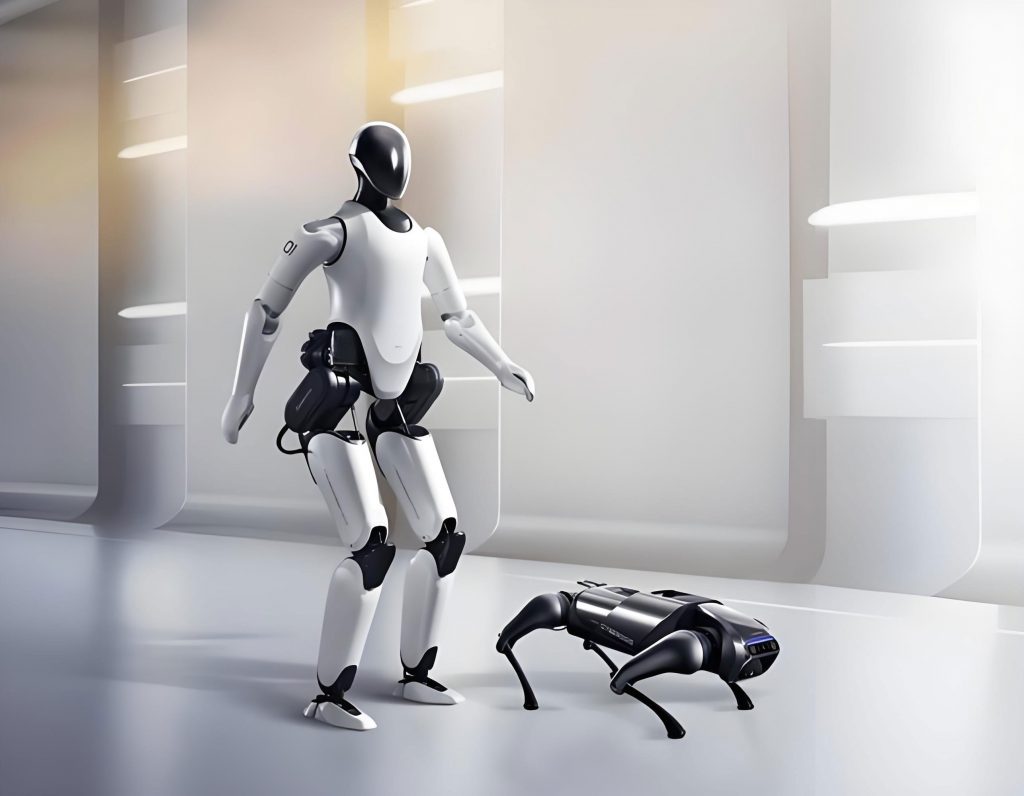
The humanoid bionic robot, aiming to replicate human form and function, is one of the most challenging and integrative domains. Its evolution mirrors advancements in control theory, sensor technology, and artificial intelligence. Early systems focused on achieving stable bipedal locomotion using pre-computed trajectories and high-gain control. The dynamic balance problem for a simple model can be expressed as maintaining the Zero Moment Point (ZMP) within the support polygon:
$$\text{ZMP} = \frac{\sum_{i=1}^{n} m_i (\ddot{z}_i + g) x_i – \sum_{i=1}^{n} m_i \ddot{x}_i z_i – \sum_{i=1}^{n} I_{iy} \dot{\omega}_{iy}}{\sum_{i=1}^{n} m_i (\ddot{z}_i + g)}$$
where \(m_i\), \(x_i, z_i\), and \(I_{iy}\) are the mass, coordinates, and moment of inertia of link \(i\), and \(g\) is gravity. Modern humanoids integrate full-body dynamics, real-time sensor fusion (force, vision, inertial), and model predictive control to achieve dynamic walking, running, and complex manipulation. The ultimate goal is a machine not only “shaped like” a human but capable of analogous cognitive reasoning, learning, and interaction.
Multi-legged Bionic Robots
Inspired by mammals and insects, multi-legged bionic robot platforms offer superior stability and terrain adaptability compared to wheeled or bipedal systems. The core challenge lies in gait generation and stability control across unstructured terrain. Research has progressed from statically stable, slow-walking machines to dynamically stable, trotting, and galloping robots. A simplified model for a single leg in a running gait involves a spring-loaded inverted pendulum (SLIP):
$$ m\ddot{y} = k(l_0 – l)\frac{y}{l} – mg $$
$$ m\ddot{x} = k(l_0 – l)\frac{x}{l} $$
where \(m\) is body mass, \(k\) is leg stiffness, \(l_0\) is the leg’s natural length, and \(l = \sqrt{x^2 + y^2}\) is its instantaneous length. Advanced platforms now use force-control in each actuator, coupled with real-time terrain estimation, to achieve remarkable robustness, such as recovering from pushes or navigating rocky landscapes.
Serpentine Bionic Robots
Snake-inspired bionic robot designs utilize elongated, multi-segmented bodies to achieve locomotion through lateral undulation, rectilinear motion, or sidewinding. This form factor grants unique capabilities for traversing confined, cluttered, or pipe-like environments. The fundamental motion often relies on generating a traveling wave of body curvature. The kinematics for an idealized serpentine curve can be described by:
$$\phi(s,t) = A \sin(\omega t – ks + \delta)$$
where \(\phi\) is the joint angle, \(s\) is the body position along the spine, \(A\) is the amplitude, \(\omega\) is the temporal frequency, \(k\) is the spatial wave number, and \(\delta\) is a phase offset. Control involves coordinating many degrees of freedom to produce this wave, often using central pattern generators (CPGs) or gait tables, while integrating head-mounted sensors for navigation.
Jumping Bionic Robots
Jumping is a highly effective strategy for overcoming large obstacles relative to body size. Bionic robot designs mimic insects like fleas and locusts or mammals like kangaroos. The core mechanical challenge is the storage and rapid release of energy. A basic dynamic model for a single jump involves a mass-spring system:
$$ \frac{1}{2} k x^2 = m g h $$
where \(k\) is the effective stiffness of the energy storage mechanism (e.g., tendon, spring), \(x\) is its compression, \(m\) is the robot mass, and \(h\) is the achieved height. However, real systems must also manage take-off angle, in-flight posture stabilization, and landing impact. Modern research focuses on continuous hopping, controlled aerial maneuvers, and using compliant materials to improve energy recovery.
Aerial Bionic Robots
Aerial bionic robot technology, primarily in the form of flapping-wing micro air vehicles (MAVs), draws inspiration from birds, bats, and insects. Flapping flight offers potential advantages in agility, low-speed maneuverability, and efficiency at very small scales compared to fixed-wing or rotary-wing designs.
The key to designing a functional bionic robot flier lies in understanding unsteady aerodynamics. The lift generation for an insect wing involves complex vortex dynamics, including leading-edge vortices (LEVs) stabilized by spanwise flow. A simplified estimate of average lift \(\bar{L}\) over a stroke can be given by:
$$ \bar{L} \propto \rho S C_L \bar{U}^2 $$
where \(\rho\) is air density, \(S\) is wing area, \(C_L\) is a lift coefficient encapsulating unsteady effects, and \(\bar{U}\) is the mean flapping velocity. Modern flapping-wing bionic robot platforms incorporate lightweight composite structures, sophisticated transmission systems to create complex wing kinematics (like pitching and delayed rotation), and increasingly autonomous control systems for stabilized flight and navigation.
Aquatic Bionic Robots
Aquatic bionic robot systems, or robotic fish, aim to replicate the efficient and stealthy propulsion of marine life. Two primary biological propulsion modes guide design: Body/Caudal Fin (BCF) and Median/Paired Fin (MPF).
| Propulsion Mode | Biological Example | Bionic Robot Characteristics | Typical Performance Trade-off |
|---|---|---|---|
| Body/Caudal Fin (BCF) | Tuna, Dolphin | High-speed, efficient cruising; propulsion from body wave and tail oscillation. | High thrust at speed, lower low-speed maneuverability. |
| Median/Paired Fin (MPF) | Ray, Cuttlefish | High maneuverability, hovering, precise low-speed control; propulsion from undulating or oscillating pectoral/median fins. | Excellent agility and stability, lower top speed. |
The hydrodynamics of a carangiform (BCF) swimmer can be modeled using Lighthill’s elongated-body theory, where the thrust \(T\) is related to the lateral motion of the tail:
$$ T \approx \frac{m}{2} \left[ U^2 – v^2 \right] $$
Here, \(m\) is the virtual mass of water affected by the tail, \(U\) is the forward speed, and \(v\) is the lateral speed of the tail segment. For an undulating fin (MPF), modeling often involves analyzing the traveling wave along the fin and its interaction with the fluid to generate momentum. Current research in aquatic bionic robot design emphasizes soft actuators, flexible fins, and novel materials to closely mimic the compliant and efficient propulsion of real fish.
Core Challenges in Contemporary Bionic Robotics
Despite significant progress, a persistent gap remains between even the most advanced bionic robot and its biological counterpart. The shortcomings are systemic and interconnected.
| Challenge Area | Description | Consequence for Bionic Robot |
|---|---|---|
| Insufficient Biomechanistic Understanding | Biological movement is a complex synergy of skeletal mechanics, muscle physiology, and neural control. Current models are often overly simplified, neglecting multi-scale interactions. | Robots lack the nuanced, adaptive, and efficient motion of animals (“form without essence”). |
| Conventional Actuation & Rigid Structures | Dominant use of electric motors and gearboxes leads to heavy, bulky designs with limited compliance and bandwidth, unlike the lightweight, force-dense, and compliant nature of muscles. | Reduced energy efficiency, impact resistance, and adaptability to uncertain contacts. |
| Limited Use of Advanced Biomimetic Materials | Most robots use traditional metals and plastics, lacking the multifunctional, hierarchical, self-healing, and adaptive properties of biological materials (e.g., bone, cartilage, skin). | Poor damage tolerance, high friction, lack of hydrophobicity/oleophobicity, and missed opportunities for structural sensing. |
| Traditional Control Paradigms | Reliance on centralized, computationally heavy control architectures contrasts with the distributed, robust, and reflexive control seen in biological nervous systems. | Slow adaptation to unforeseen disturbances, high computational load, and fragility. |
| Low Energy Conversion Efficiency | Biological muscle can achieve >50% efficiency in converting chemical to mechanical energy. Robotic actuators and power systems are far less efficient. | Short operational endurance, limiting practical deployment of autonomous bionic robot systems. |
Future Trends: Towards Lifelike Systems
The next generation of bionic robot research is converging on a holistic paradigm that seeks to erase the boundaries between machine and organism, moving towards truly “lifelike” systems.
- From Macro to Micro-Mechanisms: Research will delve deeper into the sub-organ, cellular, and molecular-level principles governing biological function. This includes studying muscle sarcomere dynamics, neural synaptic plasticity, and the role of extracellular matrix in tissue mechanics to inspire new actuator, control, and material concepts.
- Rigid-Soft Hybrid Structures: Future bionic robot architectures will seamlessly integrate rigid load-bearing elements with soft, deformable tissues, mirroring biological skeletons and muscles. This will be enabled by multi-material 3D printing, compliant mechanisms, and variable stiffness actuators. The governing equations for such a system may combine rigid-body dynamics with continuum mechanics:
$$ \mathbf{M}(\mathbf{q})\ddot{\mathbf{q}} + \mathbf{C}(\mathbf{q}, \dot{\mathbf{q}}) = \boldsymbol{\tau}_{rigid} + \boldsymbol{\tau}_{soft}(\mathbf{q}, \dot{\mathbf{q}}, \boldsymbol{\sigma}) $$
where \(\boldsymbol{\sigma}\) represents internal stress states of the soft components. - Structure-Material-Actuation Integration: Inspired by biological tissues where structure, material, and function are inseparable, future components will be multi-functional. Artificial muscles (e.g., dielectric elastomers, shape memory alloys, pneumatic artificial muscles) will serve as both structure and actuator. Materials will embed sensing capabilities (proprioception, touch) and self-healing properties.
- Neuronal Fine Control & Embodied Intelligence: Control will shift from top-down planning to distributed, reflexive neuromorphic systems. Central Pattern Generators (CPGs), spinal reflex models, and bio-inspired sensorimotor loops will provide robust, low-level rhythmic control and reactive stability, while higher-level cognitive models based on neural networks handle planning and learning. The control law may resemble a network of nonlinear oscillators:
$$ \dot{x}_i = f(x_i, \rho_i) + \sum_{j \neq i} w_{ij} g(x_i, x_j) + s_i(t) $$
where \(x_i\) is the state of neuron/oscillator \(i\), \(\rho_i\) controls its intrinsic frequency, \(w_{ij}\) are coupling weights, and \(s_i(t)\) is sensory input. - High-Efficiency Bio-Inspired Energy Conversion: Research will focus on novel energy systems for the bionic robot, including metabolically inspired fuel cells, efficient power electronics mimicking biological ion channels, and mechanisms for harvesting and storing environmental energy (e.g., solar, thermal). The goal is to dramatically increase the specific energy and power density of on-board power, enabling long-term autonomy.
In conclusion, the bionic robot stands at a fascinating frontier. While current systems have successfully captured the macroscopic forms and basic motions of nature, they remain fundamentally “machines.” The future path is clear: to move beyond imitation and begin constructing systems where the lines between biological and artificial intelligence, between organism and machine, become meaningfully blurred. This requires a profoundly interdisciplinary effort, uniting robotics, materials science, biology, neuroscience, and mechanics. The ultimate bionic robot may not merely be a tool shaped like life but a new class of entity that shares its essential qualities of adaptation, efficiency, resilience, and embodied intelligence.