
As I delve into the fascinating world of humanoid robot technology, I am consistently amazed by the rapid advancements that have transformed this field from a speculative concept into a tangible reality. A humanoid robot, often referred to as an android or bionic human, represents the pinnacle of integration among manufacturing, internet, and intelligent technologies. It is designed to mimic human behavior and appearance, possessing a musculoskeletal structure akin to our own. From my perspective, the journey of humanoid robot development is not just about creating machines; it is about bridging the gap between artificial and biological intelligence, opening doors to unprecedented applications across society. In this article, I will explore the key disciplinary areas underpinning humanoid robot technology, reflect on its current state, and project its future trajectory, all while emphasizing the centrality of the humanoid robot in this narrative.
The inception of humanoid robot technology can be traced back to the late 1960s, following the third industrial revolution. I recall that early efforts focused primarily on achieving bipedal locomotion, a fundamental challenge that was surmounted by the early 1970s. This breakthrough paved the way for incorporating visual and auditory capabilities, leading to the birth of autonomous robots. Over the decades, my observations indicate that research has shifted toward enhancing walking fluency, speed, and even running abilities. By the 1990s, humanoid robot technology matured significantly, with innovations in control and intelligence driving progress. Today, the mainstream directions I see involve two core aspects: first, ensuring the humanoid robot’s external resemblance to humans, and second, equipping it with human-like functions such as walking, running, and cognitive decision-making. Despite starting later than some Western nations, I am proud to note that advancements in humanoid robot technology have accelerated, placing it at the forefront of global innovation, as evidenced by displays at international conferences where humanoid robots exhibit expressive, albeit sometimes still rigid, facial features.
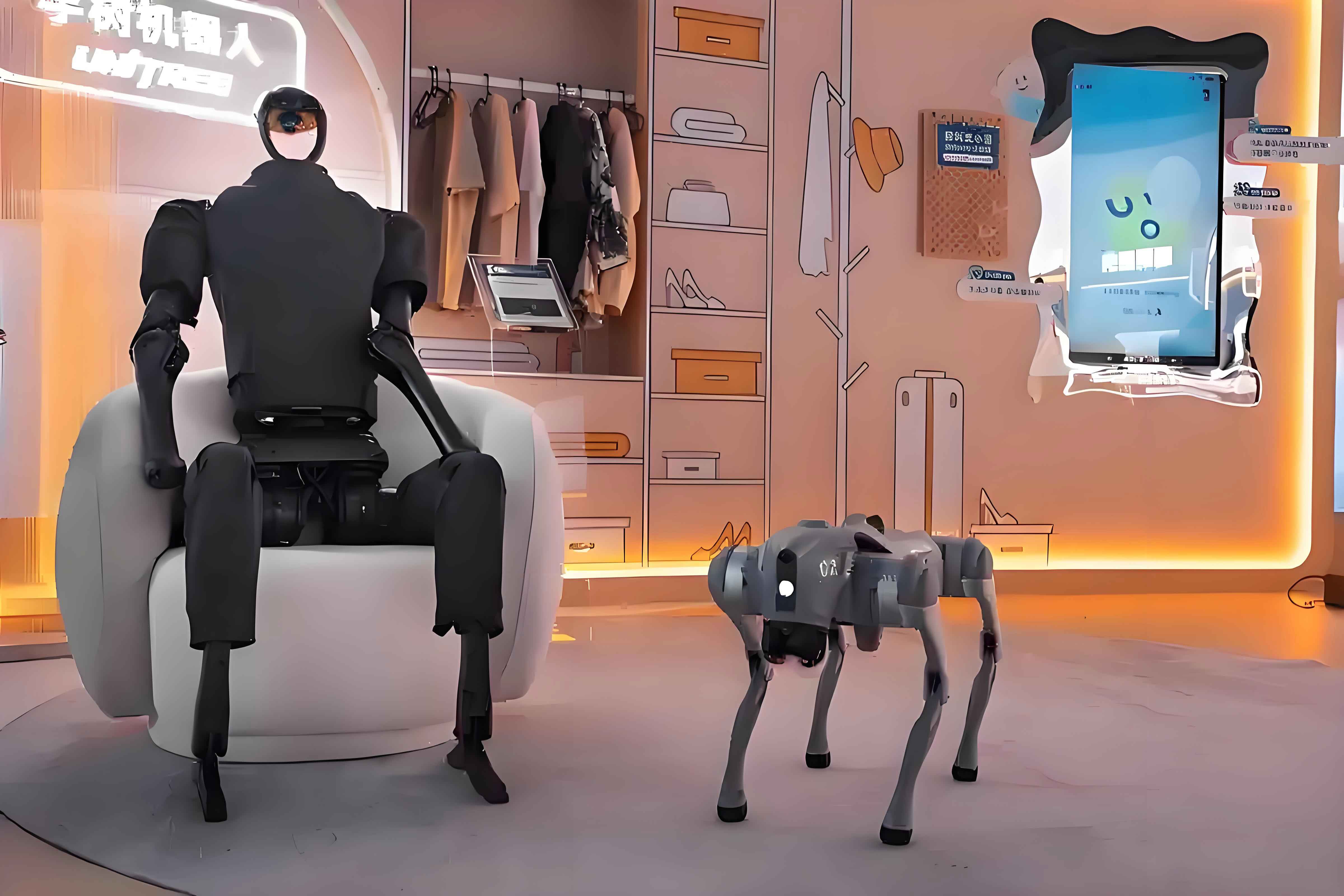
From my standpoint, the development of a humanoid robot is inherently interdisciplinary, relying on several key fields that I consider foundational. These include mechanism design, control technology, sensor technology, and artificial intelligence. Each contributes uniquely to the functionality and sophistication of the humanoid robot. Let me elaborate on these areas, using tables and formulas to encapsulate critical insights.
First, mechanism design serves as the structural backbone of any humanoid robot. I view it as the framework that defines the robot’s physical form and mobility. Over the years, I have seen researchers strive to perfect this aspect, yet gaps remain in achieving the grace and fluidity of human movements. For instance, the kinematic equations governing joint movements can be represented mathematically. Consider a simple model for a leg joint: the position of the foot relative to the hip can be expressed using forward kinematics. For a planar two-link leg, the coordinates (x, y) of the foot are given by:
$$ x = l_1 \cos(\theta_1) + l_2 \cos(\theta_1 + \theta_2) $$
$$ y = l_1 \sin(\theta_1) + l_2 \sin(\theta_1 + \theta_2) $$
where \( l_1 \) and \( l_2 \) are link lengths, and \( \theta_1 \) and \( \theta_2 \) are joint angles. This formula highlights the complexity in coordinating multiple degrees of freedom—a typical humanoid robot may have over 30, as seen in some advanced models. To summarize key components, I present the following table:
| Component | Function in Humanoid Robot | Common Challenges |
|---|---|---|
| Actuators (e.g., motors, pneumatic muscles) | Provide motion and force for limbs | Achieving human-like torque and efficiency |
| Joints and linkages | Enable flexibility and range of motion | Minimizing weight while maintaining strength |
| Structural materials | Form the skeleton for support | Balancing durability and lightweight design |
| Degrees of Freedom (DoF) | Determine agility and dexterity | Coordinating high DoF for smooth movements |
This table underscores the intricacies involved in mechanism design for a humanoid robot, an area I believe will continue to evolve with新材料 and仿生学 inspirations.
Second, control technology is what I deem the “brain” of the humanoid robot, transforming it from a static frame into a dynamic entity. Without advanced control systems, a humanoid robot would be merely a shell. I have studied various control paradigms, from traditional PID controllers to modern adaptive and learning-based methods. For example, a common approach for balance control involves using a feedback loop to adjust joint torques based on sensor data. The torque \( \tau \) at a joint can be computed as:
$$ \tau = K_p e + K_d \dot{e} + K_i \int e \, dt $$
where \( e \) is the error between desired and actual posture, and \( K_p \), \( K_d \), \( K_i \) are proportional, derivative, and integral gains, respectively. This PID formulation helps stabilize the humanoid robot during walking. However, more complex tasks require hierarchical control architectures. I often summarize key control techniques in humanoid robots as follows:
| Control Technique | Application in Humanoid Robot | Advantages |
|---|---|---|
| PID Control | Basic motion stabilization | Simplicity and robustness for linear systems |
| Model Predictive Control (MPC) | Dynamic walking and obstacle avoidance | Optimizes future actions based on predictions |
| Reinforcement Learning | Adaptive behavior in unstructured environments | Enables learning from experience without explicit programming |
| Zero-Moment Point (ZMP) Control | Bipedal locomotion stability | Ensures dynamic balance by adjusting foot placement |
From my experience, the integration of these control strategies is crucial for enabling a humanoid robot to perform complex tasks like running or dancing, which I have witnessed in recent demonstrations.
Third, sensor technology acts as the perceptual system of the humanoid robot, akin to human senses. I consider it vital for enabling the humanoid robot to interact with its environment. Sensors provide multimodal information—visual, auditory, tactile—that allows the humanoid robot to react appropriately. For instance, computer vision algorithms process image data to recognize objects, while inertial measurement units (IMUs) track orientation. A fundamental equation in sensor fusion is the Kalman filter, which estimates the state \( \hat{x}_k \) of the humanoid robot by combining noisy sensor readings:
$$ \hat{x}_k = F_k \hat{x}_{k-1} + B_k u_k + K_k (z_k – H_k \hat{x}_{k-1}) $$
where \( F_k \) is the state transition model, \( B_k \) controls input \( u_k \), \( H_k \) is the observation model, \( z_k \) is the measurement, and \( K_k \) is the Kalman gain. This enhances accuracy in localization and motion tracking. To illustrate the sensor ecosystem in a humanoid robot, I provide this table:
| Sensor Type | Role in Humanoid Robot | Key Metrics |
|---|---|---|
| Cameras (RGB-D, stereo) | Visual perception for navigation and object recognition | Resolution, frame rate, depth accuracy |
| IMUs (accelerometers, gyroscopes) | Balance and orientation sensing | Drift rate, sensitivity, update frequency |
| Force/Torque Sensors | Measure interaction forces with environment | Range, precision, hysteresis |
| Microphones and Speakers | Auditory input and output for human-robot interaction | Frequency response, signal-to-noise ratio |
| Tactile Sensors (skin-like arrays) | Touch and pressure detection for delicate handling | Spatial resolution, response time |
In my view, advances in sensor technology will empower the humanoid robot to operate in more nuanced and unpredictable settings, such as disaster zones or homes.
Fourth, artificial intelligence (AI) is the cognitive core that endows the humanoid robot with decision-making and learning capabilities. I see AI as the differentiating factor between a pre-programmed machine and an adaptive agent. Through AI, a humanoid robot can interpret sensory data, plan actions, and even exhibit social behaviors. Machine learning algorithms, particularly deep learning, have revolutionized this domain. For example, a neural network for gesture recognition might use a softmax function to classify inputs:
$$ P(y=j \mid x) = \frac{e^{x^T w_j}}{\sum_{k=1}^{K} e^{x^T w_k}} $$
where \( x \) is the input feature vector, \( w_j \) are weights, and \( P(y=j \mid x) \) is the probability of class \( j \). This allows the humanoid robot to understand human gestures. Moreover, AI enables autonomous navigation through path-planning algorithms like A*, which minimizes a cost function \( f(n) = g(n) + h(n) \) for nodes in a grid. To encapsulate AI’s role, I present this table:
| AI Subfield | Contribution to Humanoid Robot | Example Applications |
|---|---|---|
| Computer Vision | Object detection, facial recognition, scene understanding | Identifying tools or people in a room |
| Natural Language Processing (NLP) | Speech understanding and generation for communication | Conversing with users or following voice commands |
| Reinforcement Learning | Learning optimal policies through trial and error | Mastering complex tasks like playing soccer |
| Cognitive Architecture | Integrating multiple AI modules for holistic intelligence | Making context-aware decisions in dynamic environments |
From my perspective, the fusion of AI with other technologies will make the humanoid robot increasingly autonomous and relatable, blurring the lines between machine and companion.
Reflecting on the global landscape, I observe distinct trajectories in humanoid robot development across regions. Internationally, the focus has often been on service, medical, and entertainment humanoid robots. I have seen entertainment humanoid robots that dance, sing, or play soccer, leveraging facial sensors for interaction. Medical humanoid robots, in my opinion, show great promise in assisting the elderly or disabled, performing tasks beyond human physical limits. Domestically, though starting later in the 1980s, progress has been swift. I recall that by now, humanoid robots with 32 degrees of freedom have been developed, capable of performing Tai Chi and walking steadily on uneven terrain. Multiple generations of prototypes have been iterated, narrowing the technological gap. To compare these developments, I offer this table:
| Region | Key Advances in Humanoid Robot | Notable Applications |
|---|---|---|
| International (e.g., Japan, USA) | Early bipedal walking, expressive robots, AI integration | Entertainment (robotic pets), healthcare (assistive devices), research platforms |
| Domestic | High-DoF designs, stable locomotion algorithms, cost-effective manufacturing | Educational tools, industrial assistants, public demonstrations (e.g., robot performances) |
This comparative view highlights how the humanoid robot has become a global endeavor, with each region contributing unique strengths.
Looking ahead, I am optimistic about the application prospects of humanoid robot technology. As these machines become more refined, I foresee their deployment in diverse sectors. In hazardous environments, such as nuclear facilities or disaster sites, the humanoid robot can undertake risky tasks, reducing human exposure. In education, I imagine humanoid robots serving as interactive tutors, enhancing learning through personalized engagement. Healthcare is another domain where I believe humanoid robots will revolutionize caregiving, from surgical assistance to rehabilitation. To systematically explore these possibilities, I summarize potential applications below:
| Application Domain | Role of Humanoid Robot | Expected Benefits |
|---|---|---|
| Industrial Manufacturing | Assembly, quality inspection, logistics in human-centric spaces | Increased flexibility, reduced ergonomic risks, 24/7 operation |
| Healthcare and Elderly Care | Patient monitoring, physical therapy, companionship | Addressing labor shortages, improving quality of life, precise medical aid |
| Education and Research | Teaching STEM concepts, serving as experimental platforms | Engaging students, accelerating robotics research, low-cost prototyping |
| Entertainment and Hospitality | Performance artists, guides, customer service agents | Novel experiences, operational efficiency, multilingual support |
| Space Exploration | Maintenance and exploration in extraterrestrial habitats | Reducing mission costs, performing tasks in extreme conditions |
| Domestic Assistance | Household chores, security, personal aide for disabled individuals | Enhancing independence, convenience, and safety at home |
From my vantage point, the humanoid robot will gradually permeate daily life, becoming as ubiquitous as smartphones are today. However, I acknowledge that technical hurdles persist, particularly in energy efficiency, cost reduction, and ethical considerations around autonomy.
In conclusion, as I contemplate the future of humanoid robot technology, I am convinced that continued interdisciplinary innovation will propel it to new heights. The humanoid robot is not merely a technological marvel; it is a testament to human ingenuity, mirroring our own form and capabilities. With advancements in mechanism design, control systems, sensor networks, and artificial intelligence, the humanoid robot will evolve to exhibit greater fluidity, intelligence, and adaptability. I envision a world where humanoid robots collaborate seamlessly with humans, augmenting our abilities in fields ranging from medicine to exploration. Yet, this journey requires addressing lingering challenges in natural movement, power management, and societal integration. As I reflect on the progress so far, from tentative bipedal steps to expressive and functional machines, I am filled with anticipation for what lies ahead. The humanoid robot, in my view, stands poised to transform our reality, embodying the convergence of science and imagination. Through sustained research and ethical stewardship, we can unlock its full potential, ensuring that the humanoid robot serves as a benevolent force in shaping tomorrow’s world.