
As I delve into the realm of medical robotics, I am continually amazed by how these technological marvels have transformed healthcare. From their inception as simple mechanical arms in industrial settings to today’s sophisticated artificial intelligence-driven systems, medical robots have become indispensable extensions of human capabilities. In this article, I will explore the application advantages of medical robots and their innovative designs, particularly in the oral cavity field, emphasizing how they enhance precision, safety, and efficiency. Throughout, I will integrate tables and formulas to summarize key concepts, ensuring a comprehensive understanding of this rapidly evolving domain.
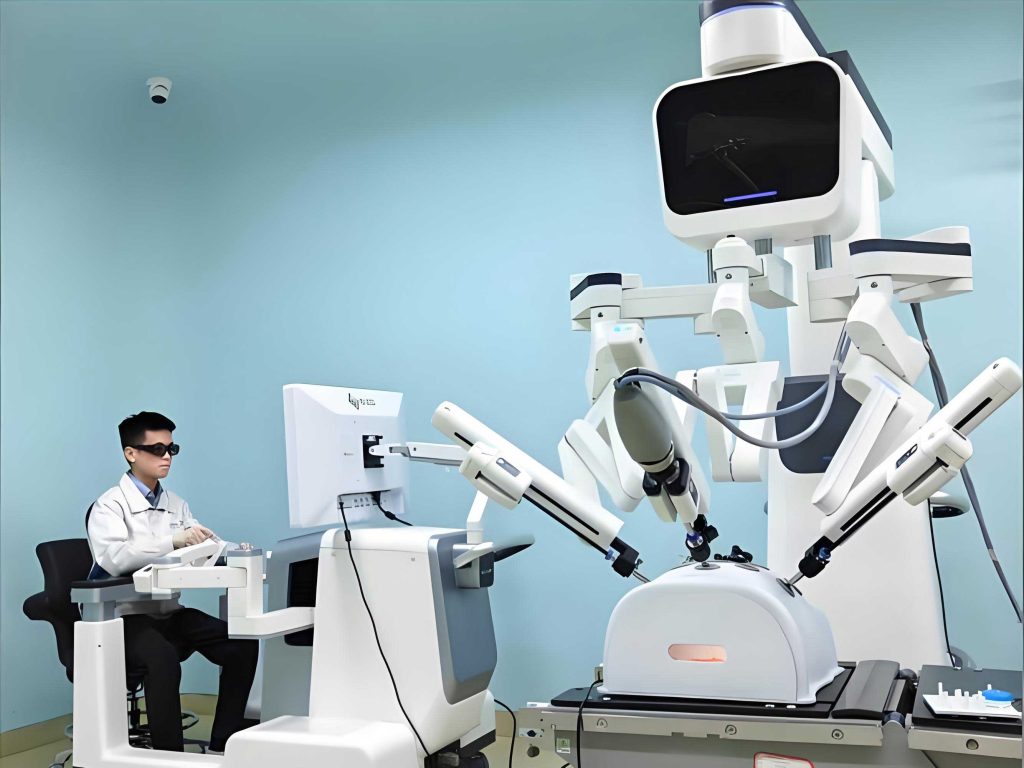
The concept of a “robot” has evolved significantly over time. Initially, robots were perceived as humanoid machines from science fiction, but in reality, they encompass a broader spectrum. A medical robot is a product of robotics technology, which integrates science, engineering, and art to simulate human behavior or thought. Today, medical robots are not merely copies of humans; they are defined as any mechanical entity that replicates biological functions, driven by advancements in AI and machine learning. This shift has enabled medical robots to permeate various aspects of healthcare, offering unprecedented support to medical professionals.
In the medical industry, the advantages of medical robots are manifold. Firstly, they significantly reduce medical errors. Studies indicate that medical mistakes are a leading cause of death, but medical robots, with their超人 vision and micron-level control, minimize such risks. For instance, a medical robot can perform thousands of surgeries without fatigue, leveraging big data for predictive analysis. This capability is quantified by the error reduction formula: $$ \text{Error Rate Reduction} = 1 – \frac{E_{\text{robot}}}{E_{\text{human}}} $$ where \( E_{\text{robot}} \) and \( E_{\text{human}} \) represent error rates for robots and humans, respectively. Typically, \( E_{\text{robot}} \) approaches zero due to precision enhancements.
Secondly, medical robots create superior sterile environments. Robots like Xenex employ ultraviolet disinfection to eradicate microbes more effectively than human methods, operating continuously without breaks. This efficiency can be modeled as: $$ \text{Disinfection Efficiency} = \frac{N_{\text{initial}} – N_{\text{final}}}{N_{\text{initial}}} \times 100\% $$ where \( N \) denotes microbial count. Medical robots often achieve near-100% efficiency, reducing infection risks in hospitals.
Thirdly, medical robots enhance hospital workflow efficiency across multiple domains. To illustrate, I have compiled a table summarizing key medical robot types and their roles:
| Medical Robot Type | Primary Function | Efficiency Gain |
|---|---|---|
| Triage Robots (e.g., Pepper) | Patient assessment and guidance | Up to 40% faster triage |
| Rehabilitation Exoskeletons (e.g., ReWalk) | Mobility assistance for patients | Improves recovery time by 30% |
| Logistics Robots (e.g., TUG) | Transport of medical supplies | Reduces manual labor by 50% |
| Surgical Robots (e.g., DaVinci) | Minimally invasive procedures | Enhances precision by 10x magnification |
In triage, medical robots like Pepper use language recognition to direct patients, boosting throughput. The efficiency improvement is given by: $$ \text{Throughput Increase} = \frac{T_{\text{robot}}}{T_{\text{human}}} $$ where \( T \) represents time per patient. Often, \( T_{\text{robot}} \) is half of \( T_{\text{human}} \), doubling efficiency.
Rehabilitation robots, such as ReWalk, employ sensor-driven motors to aid movement. Their performance can be expressed as: $$ \text{Mobility Score} = \sum_{i=1}^{n} w_i \cdot s_i $$ where \( w_i \) are weights for parameters like step frequency, and \( s_i \) are sensor readings. This formula helps tailor therapy, improving outcomes.
Logistics robots like TUG handle heavy loads, reducing staff burden. Their impact is quantified by: $$ \text{Load Capacity Ratio} = \frac{C_{\text{robot}}}{C_{\text{human}}} $$ with \( C_{\text{robot}} \) up to 453 kg, far exceeding human limits.
Surgical robots, exemplified by DaVinci, integrate 3D vision and robotic arms for precision. The accuracy is modeled as: $$ \text{Surgical Accuracy} = \frac{1}{\sqrt{(\Delta x)^2 + (\Delta y)^2 + (\Delta z)^2}} $$ where \( \Delta x, \Delta y, \Delta z \) are positional errors. Medical robots often reduce errors to sub-millimeter levels, enhancing patient safety.
Turning to the oral cavity field, medical robots address critical issues like tooth loss, which affects billions globally. Traditional dental implant surgery relies on manual skill, leading to variability in outcomes. The risk associated with human error is high, as implants require exact placement to avoid nerve damage or infection. This is where medical robots shine, offering consistent precision. The traditional risk score can be defined as: $$ R_{\text{traditional}} = \alpha \cdot E_{\text{human}} + \beta \cdot T_{\text{surgery}} $$ where \( \alpha \) and \( \beta \) are risk factors for error and time, respectively. Medical robots minimize this by automating processes.
The advent of dental implant robots marks a significant innovation. These medical robots combine robotics, computer vision, and haptic feedback to assist or autonomously perform implants. For example, Yomi and Yakebot are prominent systems that enhance planning, visualization, and execution. Their advantages are summarized in another table:
| Dental Implant Robot Feature | Benefit | Quantitative Impact |
|---|---|---|
| Pre-operative Planning | 3D modeling for optimal implant placement | Reduces planning time by 60% |
| Real-time Guidance | Haptic feedback and visual cues during surgery | Improves accuracy to within 0.2-0.5 mm |
| Minimally Invasive Technique | Smaller incisions and faster recovery | Cuts recovery time by 40% |
| Autonomous Operation | Reduces dependence on surgeon experience | Lowers cost by 30% |
The precision of a medical robot in dental implants is critical. Using force and position sensors, the robot adjusts in real-time. The error control formula is: $$ \text{Precision Error} = \max(\Delta p, \Delta a) $$ where \( \Delta p \) is position deviation and \( \Delta a \) is angular deviation. For Yakebot, \( \Delta p \leq 0.5 \, \text{mm} \) and \( \Delta a \leq 1^\circ \), ensuring stable outcomes.
Furthermore, medical robots in dentistry leverage data fusion from CBCT scans and oral models. The decision-making process involves: $$ \text{Decision Score} = \sum_{i} f_i \cdot d_i $$ where \( f_i \) are feedback parameters from sensors, and \( d_i \) are weights from prior data. This allows adaptive planning, even in complex cases.
In terms of design innovation, medical robots in oral care emphasize ergonomics and integration. The robotic arm dynamics can be described by: $$ \tau = J^T \cdot F $$ where \( \tau \) is torque, \( J \) is the Jacobian matrix, and \( F \) is force applied. This ensures smooth movement in confined spaces. Additionally, efficiency gains from medical robots are evident in workflow optimization. For instance, the overall hospital efficiency with medical robots is: $$ \eta_{\text{total}} = \prod_{i=1}^{n} \eta_i $$ where \( \eta_i \) are efficiencies of triage, surgery, etc., each boosted by robot integration.
Looking ahead, the potential of medical robots is vast. As AI advances, these systems will become more autonomous and collaborative. The future growth rate of medical robot adoption can be estimated using: $$ G(t) = G_0 \cdot e^{kt} $$ where \( G_0 \) is initial adoption, \( k \) is growth constant, and \( t \) is time. With medical robots expanding into new areas, they promise to alleviate healthcare disparities, especially in aging societies.
In conclusion, medical robots represent a paradigm shift in healthcare. From reducing errors to enhancing specialized procedures like dental implants, they exemplify the fusion of technology and medicine. As I reflect on their impact, it is clear that medical robots are not just tools but partners in advancing human well-being. Their design innovations, driven by interdisciplinary efforts, will continue to push boundaries, making healthcare more accessible and effective for all. The journey of medical robots is just beginning, and I am excited to witness their future transformations.