
As an AI researcher deeply immersed in the evolution of intelligent systems, I have witnessed the rapid advancement of AI human robot technology, which leverages big data, high computing power, and strong algorithms to enable seamless human-machine-environment interactions. These AI human robot systems are poised to revolutionize sectors like special operations, smart manufacturing, and daily life assistance, serving as companions and helpers. However, the development of AI human robot platforms is fraught with risks, including functional safety issues, network vulnerabilities, personal data breaches, and ethical dilemmas. Striking a balance between innovation and security is paramount; overemphasizing safety could stifle progress, while neglecting it may lead to catastrophic outcomes. In this article, I explore the intricate dance between development and safety in AI human robot ecosystems, advocating for a harmonious approach that fosters growth while mitigating hazards through rational governance, risk assessments, and ethical frameworks.
The foundation of AI human robot technology lies in the integration of massive datasets, robust computational resources, and sophisticated algorithms. This triad enables these systems to perceive, plan, and act with remarkable efficiency, much like human cognition. For instance, the perceptual capabilities of an AI human robot can be modeled using algorithms that process multimodal inputs, such as visual and auditory data, to make real-time decisions. A key formula representing this process is the perception-action cycle: $$ P(a|s) = \frac{e^{\beta Q(s,a)}}{\sum_{a’} e^{\beta Q(s,a’)}} $$ where \( P(a|s) \) is the probability of taking action \( a \) given state \( s \), \( Q(s,a) \) is the value function learned from data, and \( \beta \) is a parameter controlling exploration versus exploitation. This equation highlights how AI human robot systems optimize interactions based on accumulated knowledge, driving their ability to serve in diverse roles from industrial assistants to emotional partners.
However, the ascent of AI human robot technology brings a spectrum of risks that cannot be ignored. In my analysis, I categorize these hazards to better understand their implications. Below is a table summarizing the primary risk types associated with AI human robot deployments, along with their potential impacts and mitigation strategies. This comprehensive overview underscores the need for proactive measures in AI human robot development.
| Risk Category | Description | Potential Impact | Mitigation Approach |
|---|---|---|---|
| Functional Safety | Hardware or software failures leading to malfunctions, such as unintended movements or errors in critical tasks. | Physical harm to humans, property damage, or operational disruptions in fields like emergency response. | Implement rigorous testing protocols and redundancy systems; use formulas like $$ R(t) = e^{-\lambda t} $$ for reliability analysis, where \( R(t) \) is reliability over time \( t \), and \( \lambda \) is the failure rate. |
| Network Security | Vulnerabilities from internet connectivity, including hacking, data poisoning, or unauthorized access. | Theft of sensitive information, remote control for malicious acts, or systemic attacks on infrastructure. | Employ encryption and intrusion detection systems; apply risk models such as $$ Risk = P \times C $$ where \( P \) is probability of attack and \( C \) is consequence severity. |
| Personal Information Security | Breaches involving biometric, financial, or health data collected during interactions. | Identity theft, privacy violations, or social manipulation. | Enhance data anonymization and access controls; utilize differential privacy techniques mathematically expressed as $$ \epsilon \text{-differential privacy} $$ to limit data exposure. |
| Data Security | Risks related to public or enterprise data handling, including leaks or misuse during AI training phases. | Economic losses, compromised商业秘密, or threats to national interests. | Adopt secure data lifecycle management; implement certification schemes based on standards like ISO/IEC 27001. |
| National Security | Exploitation for espionage, misinformation campaigns, or attacks on critical infrastructure. | Political instability, economic sabotage, or social unrest. | Develop sovereign AI human robot frameworks with strict oversight; use threat assessment matrices. |
| Illegal “Proxy” Actions | Unauthorized activities performed by AI human robot systems, such as fraudulent transactions or representations. | Legal disputes, financial liabilities, or erosion of trust. | Define clear accountability chains; incorporate legal compliance algorithms. |
| Infringement Risks | Violations of intellectual property, privacy rights, or other legal boundaries during data usage or output generation. | Lawsuits, reputational damage, or stifled innovation. | Establish fair use policies and audit trails; apply copyright detection formulas like $$ Similarity = \frac{|A \cap B|}{|A \cup B|} $$ for content analysis. |
| Ethical Risks | Moral dilemmas, such as dehumanization, bias in decision-making, or unintended social consequences. | Erosion of human values, discrimination, or psychological harm. | Integrate ethical guidelines into AI design; use frameworks like utilitarianism quantified as $$ U = \sum_{i} u_i $$ where \( U \) is total utility and \( u_i \) is individual well-being. |
In my view, the progression of AI human robot technology must not be hindered by an excessive focus on safety, as this could curb innovation and delay societal benefits. Development serves as the bedrock of security; without advances in AI human robot capabilities, we cannot devise effective safeguards. Conversely, security is a prerequisite for sustainable growth—ignoring risks may lead to widespread distrust and regulatory backlash. This interdependence is captured by the equation: $$ G = \alpha D + \beta S $$ where \( G \) represents overall progress, \( D \) denotes development metrics, \( S \) symbolizes safety levels, and \( \alpha \) and \( \beta \) are weighting factors that must be balanced. Through my research, I advocate for a dynamic equilibrium where AI human robot ecosystems evolve through iterative refinement, guided by principles that prioritize both innovation and protection.
To achieve this balance, I propose the adoption of inclusive and prudent regulatory frameworks. Such an approach allows AI human robot technologies to mature in a controlled environment, where experimentation is permitted within bounds. For example, sandbox environments can be established for testing new AI human robot applications, with regulators stepping in only when risks exceed acceptable thresholds. This method aligns with the concept of agile governance, which can be modeled using a feedback loop: $$ R_{new} = R_{old} + \eta (T – R_{old}) $$ where \( R \) represents regulatory measures, \( T \) is the target risk level, and \( \eta \) is the adaptation rate. By implementing this, we can ensure that AI human robot development proceeds without unnecessary constraints, fostering a culture of responsible innovation. In practice, this means allowing startups and researchers to pilot AI human robot projects in real-world settings, while continuously monitoring for emergent hazards and adjusting policies accordingly.
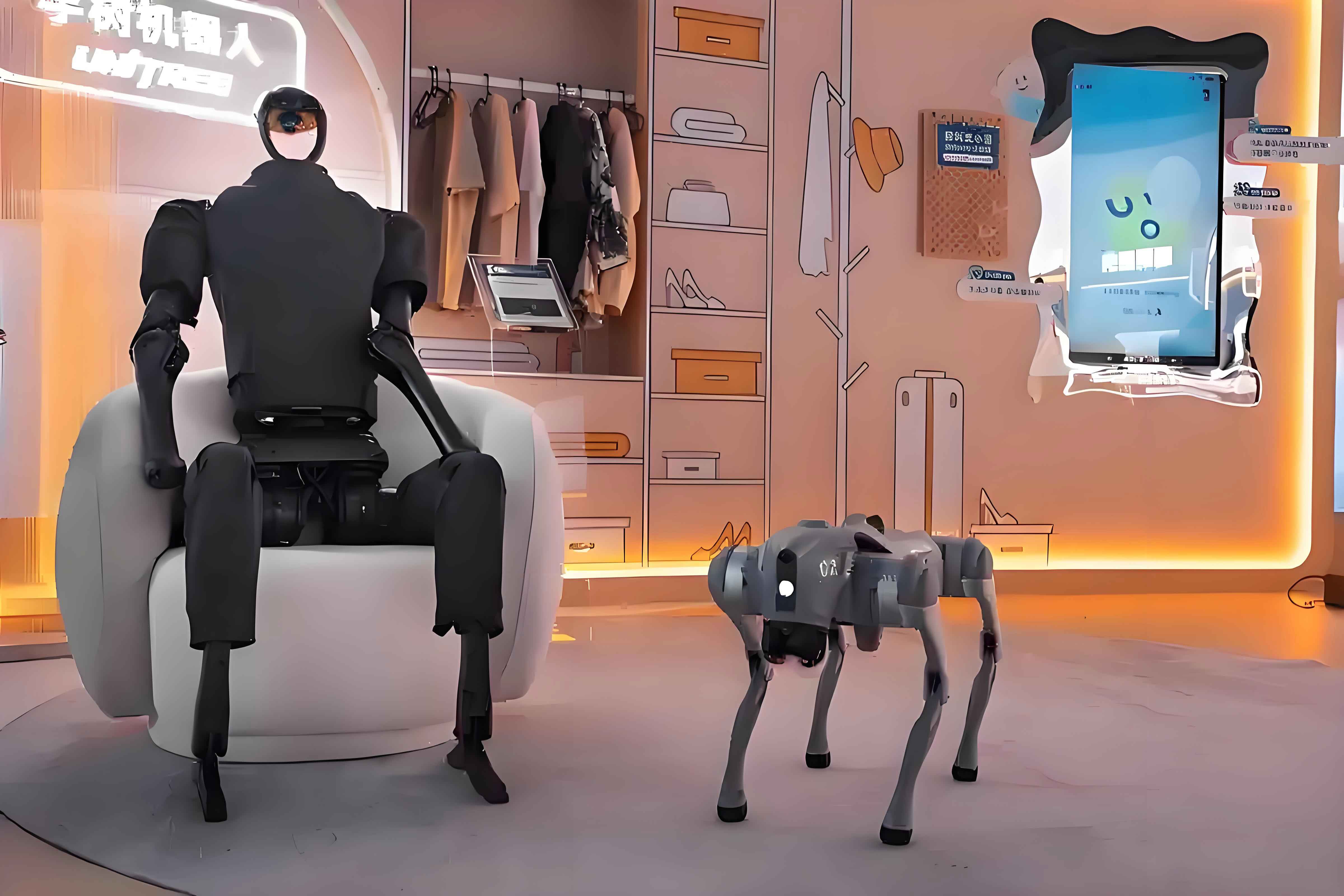
Scientific risk assessment is crucial for managing the uncertainties inherent in AI human robot systems. I emphasize the need for methodologies that evaluate potential dangers quantitatively, enabling stakeholders to make informed decisions. One effective tool is the Algorithmic Impact Assessment (AIA), which scrutinizes AI human robot algorithms for biases, errors, and societal impacts. This can be expressed through a risk score formula: $$ Risk\_Score = \sum_{i=1}^{n} w_i \cdot I_i $$ where \( w_i \) is the weight of risk factor \( i \), and \( I_i \) is its impact value. Factors might include data integrity, algorithmic transparency, and environmental adaptability. By categorizing risks into levels—such as negligible, low, medium, high, or unacceptable—we can tailor responses appropriately. For instance, if an AI human robot designed for healthcare scores high on functional safety risks, additional safeguards like manual overrides or redundant systems can be mandated. This proactive stance ensures that AI human robot deployments remain within tolerable risk boundaries, preventing catastrophic failures while encouraging continuous improvement.
Certification and standardization play pivotal roles in bolstering trust in AI human robot technologies. As an advocate for third-party evaluations, I support the establishment of data security and personal information protection certifications that verify compliance with best practices. These certifications act as reputational signals, assuring users that AI human robot products meet stringent safety criteria. A hierarchical standard-setting process can be outlined in a table to illustrate how different levels of AI human robot applications require tailored specifications. This分级分类 approach ensures that resources are allocated efficiently, avoiding one-size-fits-all regulations that might impede smaller innovators.
| AI Human Robot Application Level | Risk Profile | Recommended Standards | Certification Requirements |
|---|---|---|---|
| Basic Assistants (e.g., home helpers) | Low to medium; limited data exposure and physical interaction. | Basic data encryption, user consent protocols, and functional safety checks. | Voluntary certification focusing on privacy and reliability; use of formulas like $$ Compliance\_Score = \frac{Met\_Criteria}{Total\_Criteria} $$ to assess adherence. |
| Industrial Operators (e.g., manufacturing robots) | Medium to high; involvement in critical processes and data handling. | Robust cybersecurity measures, real-time monitoring, and fail-safe mechanisms. | Mandatory certification with periodic audits; implementation of risk models such as $$ FMEA (Failure Mode and Effects Analysis) $$ to identify potential failures. |
| Advanced Partners (e.g., emotional companions or medical aides) | High to very high; deep personal interactions and sensitive data processing. | Ethical AI guidelines, advanced anomaly detection, and human-in-the-loop controls. | Rigorous third-party assessments including ethical reviews; application of Bayesian networks for probability assessments: $$ P(H|E) = \frac{P(E|H) P(H)}{P(E)} $$ where \( H \) is a hypothesis (e.g., safe operation) and \( E \) is evidence. |
Liability allocation is another critical aspect I have pondered extensively. To avoid the “humanoid robot trap”—where over-anthropomorphizing AI human robot systems leads to blurred accountability—it is essential to clearly assign responsibilities to developers, manufacturers, and users. AI human robot entities should not be granted legal personhood, as they lack genuine autonomy and moral agency. Instead, a distributed liability model can be employed, where those who benefit from AI human robot innovations bear the costs of failures. For example, developers could be held accountable for design flaws, even if they arise from machine learning adaptations, using a proportional responsibility formula: $$ Liability = k \cdot D + m \cdot U $$ where \( D \) is developer contribution to risk, \( U \) is user misuse factor, and \( k \) and \( m \) are constants determined by context. Additionally, insurance mechanisms can spread risks, fostering a safer environment for AI human robot adoption. By embedding these principles into legal frameworks, we can prevent evasion of duty and ensure that AI human robot technologies enhance human welfare without creating legal vacuums.
Ethical considerations must be woven into the fabric of AI human robot development from the outset. As I reflect on this, I believe that instilling “artificial morality” into these systems is not about granting them consciousness but about encoding values that promote human flourishing. Drawing from frameworks like Asimov’s laws or contemporary AI ethics guidelines, we can derive principles such as beneficence, justice, and transparency. For instance, an AI human robot’s decision-making can be guided by a utility function that maximizes overall well-being: $$ U_{total} = \sum_{i} [w_1 \cdot Safety_i + w_2 \cdot Privacy_i + w_3 \cdot Fairness_i] $$ where \( w \) weights reflect ethical priorities. Moreover, establishing ethics review boards and embedding ethicists in AI human robot teams can preempt moral hazards. Through continuous dialogue and iterative refinement, we can cultivate AI human robot systems that are not only intelligent but also aligned with societal values, ensuring they remain trustworthy partners in our journey toward a technologically advanced future.
In conclusion, the evolution of AI human robot technology represents a paradigm shift with immense potential, yet it demands a nuanced approach to balance development and security. By embracing inclusive regulation, scientific risk assessments, robust certifications, clear liability structures, and ethical embeddings, we can navigate the complexities of this frontier. As an AI enthusiast, I am committed to fostering an ecosystem where AI human robot innovations thrive responsibly, contributing to economic growth and human well-being without compromising safety. The path forward requires collaboration among researchers, policymakers, and the public to ensure that AI human robot systems become integral, benevolent components of our daily lives.