
The advent of embodied artificial intelligence represents a profound paradigm shift, moving beyond the abstract, symbolic processing of traditional “disembodied” AI towards systems that perceive, learn, and act within the physical world. This evolution, characterized by the dynamic coupling of body, environment, and cognition, promises a future of “knowing through doing.” However, this very promise forces a critical re-examination of the human subject. When an embodied AI robot can autonomously navigate a warehouse, assist in surgery, or interact socially, fundamental questions arise: What becomes of human agency, creativity, and our unique position as the sole practical subject? This analysis contends that the challenges posed by embodied intelligence are not inherent to the technology itself but are manifestations of deeper socio-economic contradictions. The path to human liberation in the intelligent age, therefore, lies not in halting progress but in consciously reshaping the productive relations within which these technologies are developed and deployed.
The Technical Leap: From Disembodied Abstraction to Embodied Coupling
The history of AI began with a “disembodied” paradigm. This approach, rooted in a Cartesian mind-body dualism, treated intelligence as a purely computational phenomenon occurring in a symbolic realm separate from the physical body. Systems excelled at rule-based reasoning and pattern recognition within constrained datasets but remained fundamentally disconnected from the messy, unpredictable reality of the physical world. They could “know” but not “act” upon the world in a direct, situated manner.
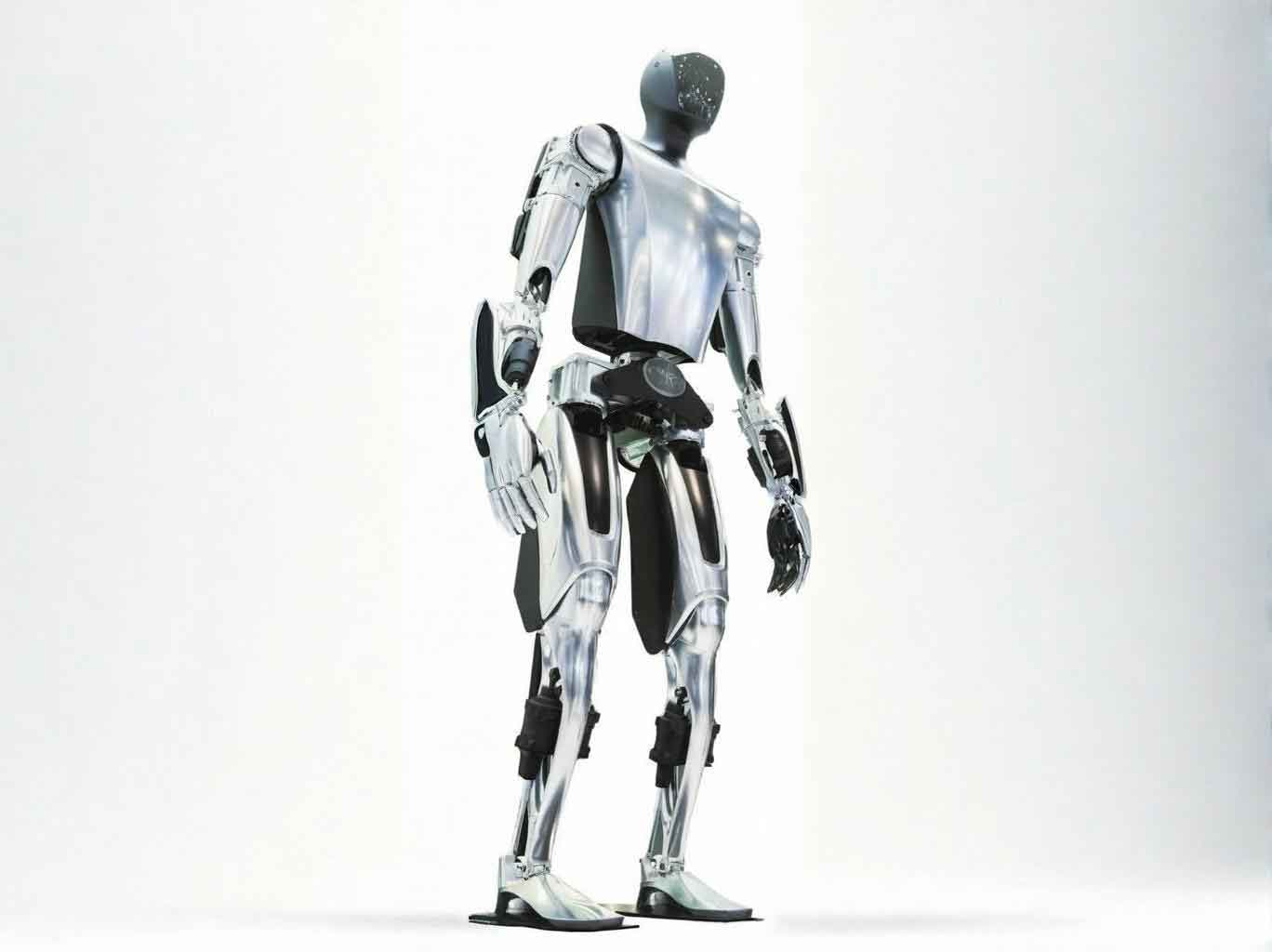
Embodied intelligence breaks this dichotomy. Inspired by phenomenological insights (e.g., Merleau-Ponty) and biological principles, it posits that intelligence emerges from the continuous, sensori-motor interaction between an agent and its environment. An embodied AI robot is not merely a brain in a vat; it is a physical entity equipped with sensors (cameras, LIDAR, tactile sensors) and actuators (arms, wheels, grippers). Its cognition is not pre-programmed but is generated and refined through this real-time loop of perception, decision, and action.
The core mechanism can be conceptualized as a dynamic feedback system. We can model the cognitive process $C_t$ at time $t$ as a function of its physical state $B_t$, environmental input $E_t$, and its prior cognitive model $C_{t-1}$:
$$
C_t = f(B_t, E_t, C_{t-1})
$$
Where the action $A_t$ taken by the embodied AI robot is determined by its current cognition: $A_t = g(C_t)$. This action alters the environment ($E_{t+1}$) and the robot’s own bodily state ($B_{t+1}$), closing the loop and enabling continuous adaptation. This stands in stark contrast to the disembodied model, which lacks the $B$ and the dynamic feedback with $E$.
| Aspect | Traditional (Disembodied) AI | Embodied AI |
|---|---|---|
| Core Premise | Mind/Body Dualism; Intelligence as computation | Unity of perception, action, and cognition |
| Knowledge Source | Static datasets, symbolic rules | Real-time sensorimotor interaction with environment |
| Action | Separated from “thinking”; outputs data | Integral to “thinking”; performs physical tasks |
| Adaptability | Limited to training data distribution | High; can learn and adapt to novel physical scenarios |
| Example | Language model, chess engine | Autonomous warehouse robot, surgical assistant robot |
Phenomenological Challenges: The Tripartite Pressure on Human Subjectivity
From a philosophical perspective, the human subject is traditionally defined by autonomy of consciousness, creative capacity, and existence within a web of social relations. The advanced capabilities of embodied AI robot systems exert pressure on all three pillars.
1. The Cognitive Challenge: The Illusion of Autonomous Consciousness
The ability of an embodied AI robot to complete a “perception-decision-action” loop without human intervention creates a powerful illusion of autonomous agency. In controlled environments, its decisions can appear more efficient and accurate than human ones. This can lead to an uncritical delegation of decision-making authority, where the “logic of the algorithm” is mistaken for objective rationality. Over time, this risks the erosion of human critical thinking and complex decision-making skills, as we become increasingly conditioned to trust and follow algorithmic guidance. The human cognitive subject risks being subordinated to a form of “data power.”
2. The Creativity Challenge: Data-Driven Recombination vs. Human Innovation
AI systems, including large language and multimodal models, now demonstrate a startling ability to generate novel text, images, and even scientific hypotheses. An embodied AI robot artist could, in theory, paint a physical canvas based on real-time environmental stimuli. However, this “creativity” is fundamentally different. Human creativity springs from lived experience, intentionality, and a deep understanding of context and meaning. AI “creativity” is, at its core, a sophisticated statistical recombination of its training data. It optimizes for pattern completion, not for expressing genuine insight or emotional truth. The danger is that the proliferation of such convincing synthetic output may devalue human creative labor and, more insidiously, cause our own creative muscles to atrophy through disuse and over-reliance on machine-generated content.
3. The Socio-Economic Challenge: Tool Transcendence and the Specter of Obsolescence
This is the most tangible and pressing challenge. The physical competence of embodied AI robot systems makes them direct competitors in the labor market for a vast range of tasks, from manufacturing and logistics to specialized fields like surgery or eldercare. Unlike software, they can perform the physical act of labor. Under a capitalist logic that prioritizes efficiency and cost reduction, this creates a powerful incentive for automation that displaces human workers. This is not merely “machines replacing tools,” but what can be termed a “tool transcendence,” where the machine becomes an autonomous agent within production, potentially rendering human labor superfluous for many functions. The social consequence is the risk of creating a so-called “useless class”—individuals whose labor is no longer required by the economic system, leading to profound crises of meaning, distribution, and social cohesion.
The Substantive Crisis: The Complicity of Capital Logic and Algorithmic Hegemony
To attribute these challenges solely to technology is to fall prey to technological determinism. The root cause lies in the specific socio-economic framework—capitalism—that shapes technological development and deployment. Under capitalist relations, technology is primarily developed as a vehicle for valorization and capital accumulation.
The “consciousness” and “creativity” of AI are, in Marxist terms, the reification of “general intellect”—the collective scientific and social knowledge of humanity. This intellect is objectified into algorithms and data models, which are then privately owned and deployed to maximize profit. The embodied AI robot on the factory floor is not a neutral tool; it is a crystallization of past human labor and knowledge, now wielded as a weapon to discipline living labor, intensify exploitation, and appropriate an ever-larger share of value.
The alienation witnessed in the cognitive, creative, and economic spheres is a new form of the classic Marxist concept. Human faculties (thought, creativity, productive capacity) are externalized, objectified in the AI system, and then confront the human as an alien and dominating power. Our emotions become “emotional commodities” for social AI; our labor becomes a data point for optimization algorithms; our judgment is supplanted by predictive models. This process can be formalized as a cycle of alienation $ \mathcal{A} $:
$$
\mathcal{A}: H \xrightarrow{\text{Labor}} (Data, Alg) \xrightarrow{\text{Capital}} AI \xrightarrow{\text{Control}} H’
$$
Where human (H) labor produces data and algorithms, which are appropriated by Capital to create AI systems, which in turn are used to control and alienate a transformed human (H’).
| Human Facet | Capitalist Appropriation via Embodied AI | Resulting Alienation Form |
|---|---|---|
| Consciousness & Cognition | Reduced to quantifiable, predictable data models for behavioral nudging and control. | Erosion of autonomous thought; subjugation to “algorithmic rationality.” |
| Creativity & General Intellect | Harvested as training data; output is commodified, divorcing creation from creator’s intent and livelihood. | Devaluation of creative labor; creativity becomes a parameter to optimize. |
| Productive Labor | Body and skills are modeled, then replaced or strictly subordinated to machine-paced workflows. | Displacement from production; deskilling; loss of agency in work. |
| Social & Emotional Being | Emotional responses are mined as data and simulated by machines to create addictive, commodified “relationships.” | Colonization of emotional life; degradation of authentic social bonds. |
Pathways to Liberation: Reclaiming Subjectivity in the Intelligent Age
The diagnosis is not a counsel of despair. Embodied intelligence, like all potent technology, contains a dual potential: it can be a tool for profound human liberation or an instrument of unprecedented alienation. The outcome depends on the social struggle to direct its development.
1. Re-framing the Relationship: From Substitution to Symbiosis
The first step is to consciously reject the narrative of simple human-versus-machine replacement. The goal should be to design embodied AI robot systems as symbiotic partners that augment human capabilities, not replace them. This requires human-centered design where the AI handles precise, repetitive, or data-intensive tasks, freeing humans to focus on tasks requiring holistic judgment, ethical reasoning, empathy, and true creativity. The human must remain “in-the-loop,” not as a mere supervisor, but as the guiding intelligence setting goals, providing context, and making final value-based judgments.
2. Reconstructing the Productive Base: Socializing the Means of (Intelligent) Production
Technological solutionism is insufficient. The core driver of alienation is the private ownership and profit-driven deployment of AI. Therefore, structural change is necessary. This involves:
- Democratic Governance of Technology: Establishing strong public oversight and “red lines” for ethical AI development, particularly for embodied AI robot applications in sensitive areas like care, law enforcement, and social interaction.
- Breaking Knowledge Monopolies: Promoting open-source AI initiatives, public data trusts, and knowledge commons to prevent the concentration of “general intellect” in a few corporate hands.
- Reimagining Distribution: As productivity soars due to automation, we must decouple income and livelihood from traditional wage labor. Models like Universal Basic Income, shorter work weeks, and profit-sharing from automation can ensure the material benefits of AI are distributed equitably.
3. Re-purposing Labor and Time: From Necessary Labor to Free Development
The greatest promise of embodied AI is the radical reduction of socially necessary labor time. Marx saw this as the fundamental precondition for human freedom: “The saving of labour time [is] equal to an increase of free time, i.e., time for the full development of the individual.” The key is to prevent capital from colonizing this newly freed time. The goal must be to transform society so that this time is used for education, arts, community engagement, and personal growth—for the “free development of individualities.” This requires a cultural and political project that values human flourishing over mere consumption and productivity metrics.
The formal relationship can be expressed as a re-appropriation function $ \mathcal{R} $, aiming to invert the alienation cycle:
$$
\mathcal{R}: AI \xrightarrow{\text{Social Control}} (Commons, Tool) \xrightarrow{\text{Human Purpose}} H^*
$$
Where AI is brought under social control and transformed into a common resource and tool, which is then deliberately used by humans to achieve an emancipated state (H*).
Conclusion: Towards a Dialectical Synthesis
The rise of the embodied AI robot is more than a technical milestone; it is a mirror held up to our society, reflecting and amplifying its contradictions. The crisis of the human subject it provokes is not about the machine’s capabilities, but about our own social organization. By analyzing the challenges through a critical, socio-economic lens, we move beyond fear or naive celebration. The path forward lies in a dialectical synthesis: embracing the immense productive and liberatory potential of embodied intelligence while simultaneously engaging in the necessary political and economic struggle to ensure it serves humanity as a whole. Only by consciously constructing new productive relations—oriented towards cooperation, democracy, and human flourishing—can we ensure that the intelligent machines we build become partners in our liberation, rather than the architects of a new, more subtle form of subjugation. The future of the human subject in the age of AI is not predetermined; it is a battle of ideas and institutions that we must wage with clarity and purpose.