
The transition from a promising laboratory prototype to a reliable, mass-producible product is arguably the most treacherous phase in the technological lifecycle. This gap, often termed the “Valley of Death,” is where countless innovations falter due to engineering complexities, unverified manufacturability, and unproven real-world performance. For humanoid robots, this valley is exceptionally deep and wide. As a critical infrastructure initiative, we, the Humanoid Robot Pilot Line and Application Promotion Center, were established precisely to construct a bridge across this chasm. Our mission is to systematize the pilot-scale production (pilot line) process, providing the essential validation, refinement, and scaling capabilities needed to transform groundbreaking humanoid robot concepts into industrial and commercial realities.
The necessity for a dedicated pilot line stems from the unique challenges of the humanoid robot domain. Unlike single-function machines, a humanoid robot is an integrated system of subsystems—perception, cognition, decision-making, and actuation—all constrained by a human-like morphology. This complexity introduces interdependencies that are difficult to simulate fully in a lab. Key bottlenecks include the durability and precision of actuator modules (joints), the stability of bipedal locomotion under dynamic loads, the power efficiency of the entire system, and the seamless integration of AI with physical control. Our role is to confront these challenges head-on, employing a rigorous, stage-gate process that moves technology from Technology Readiness Level (TRL) 4-5 to TRL 7-8, ready for industrial investment.
$$ \text{TRL}_{\text{post-pilot}} = \text{TRL}_{\text{pre-pilot}} + \Delta_{\text{process}} + \Delta_{\text{test}} + \Delta_{\text{data}} $$
Where $\Delta_{\text{process}}$ represents maturity gained from manufacturability analysis, $\Delta_{\text{test}}$ from rigorous environmental and lifecycle testing, and $\Delta_{\text{data}}$ from real-world scenario training.
The Strategic Imperative: Policy and Market Forces
The establishment of our pilot line is not an isolated event but a strategic response to converging macro-trends. At the national level, humanoid robots are recognized as a pivotal frontier for cultivating new quality productive forces and advancing high-end manufacturing. This is echoed in regional industrial policies aimed at creating advanced manufacturing clusters. The explicit call for building international-standard pilot verification platforms in national guidance documents provides the direct policy mandate for initiatives like ours.
Concurrently, the market projection creates a powerful economic imperative. The global R&D investment in humanoid robots is on a steep growth trajectory. A significant portion of this investment—estimated between 30% and 50%—is consumed by the pilot and validation phases. This translates into a burgeoning multi-billion dollar market for professional pilot services. The demand is multifaceted, originating from academic institutions seeking to commercialize research, startups iterating on product design, traditional manufacturers exploring automation, and end-users requiring performance certification.
| Demand Source | Primary Need | Pilot Line Service Example |
|---|---|---|
| Universities & Research Institutes | Technology/Proof-of-Concept Commercialization | Functional prototyping, basic durability testing, IP analysis for production. |
| Tech Start-ups & SMEs | Product Iteration & Investor Readiness | Design for Manufacture (DFM) analysis, small-batch assembly, reliability qualification. |
| Traditional Manufacturing | Process Integration & ROI Validation | Workstation integration testing, task-specific performance benchmarking, safety certification. |
| End-Users (Industrial/Commercial) | Performance Verification & Standard Compliance | Application-specific scenario testing, compliance testing (safety, EMC), lifetime cost modeling. |
Architectural Models for a Pilot Line: Choosing the Optimal Path
Several organizational models exist for operating a pilot line facility, each with distinct advantages and limitations. The choice of model profoundly impacts the service’s effectiveness, neutrality, and sustainability.
| Model Type | Key Advantages | Potential Limitations | Suitability for Humanoid Robots |
|---|---|---|---|
| Enterprise-Led | Fast market response, deep industry knowledge, strong drive for technical iteration, facilitates supply chain synergy. | Risk of limited service scope or bias towards internal needs; requires substantial corporate commitment. | High. Aligns with fast-paced tech evolution and need for deep system integration know-how. |
| Third-Party Institution-Led | High impartiality and credibility, expertise in standardized testing and certification. | May lack cutting-edge R&D insight; cross-disciplinary integration capability can be limited. | Medium. Ideal for standardized component testing but may struggle with full-system, frontier integration. |
| Academia-Led | Access to foundational research, advanced instrumentation, and deep talent pool. | Can be slow and lack strong market/commercialization focus; engineering efficiency may be lower. | Medium-Low. Excellent for early-TRL exploration but less optimal for late-TRL industrialization push. |
| Government-Funded | Strong public service mandate, aligns with regional development goals, can lower barriers to entry. | Risk of lower operational efficiency; sustainability dependent on continued public funding. | Medium. Effective as a public utility but may lack the competitive edge for rapid technology co-evolution. |
For the humanoid robot sector, which is characterized by rapid technological flux and unresolved system architectures, the enterprise-led model presents the most robust solution. A leading entity within the ecosystem possesses the necessary engineering velocity, sensitivity to market-driven requirements, and the intrinsic competitive motivation to maintain technological leadership. This model allows the pilot line to evolve in lockstep with product development, ensuring its relevance and cutting-edge capability. Furthermore, an anchor enterprise can effectively orchestrate upstream and downstream partners, helping to define the standards and specifications that will govern the future humanoid robot industry.
Our Integrated Service Architecture: A Deep Dive
Guided by this strategic understanding, our pilot line is built upon an integrated service architecture designed to address the full spectrum of industrialization challenges. We operate on a “Four Centers, One Platform, One Alliance” model, creating a synergistic ecosystem for innovation.
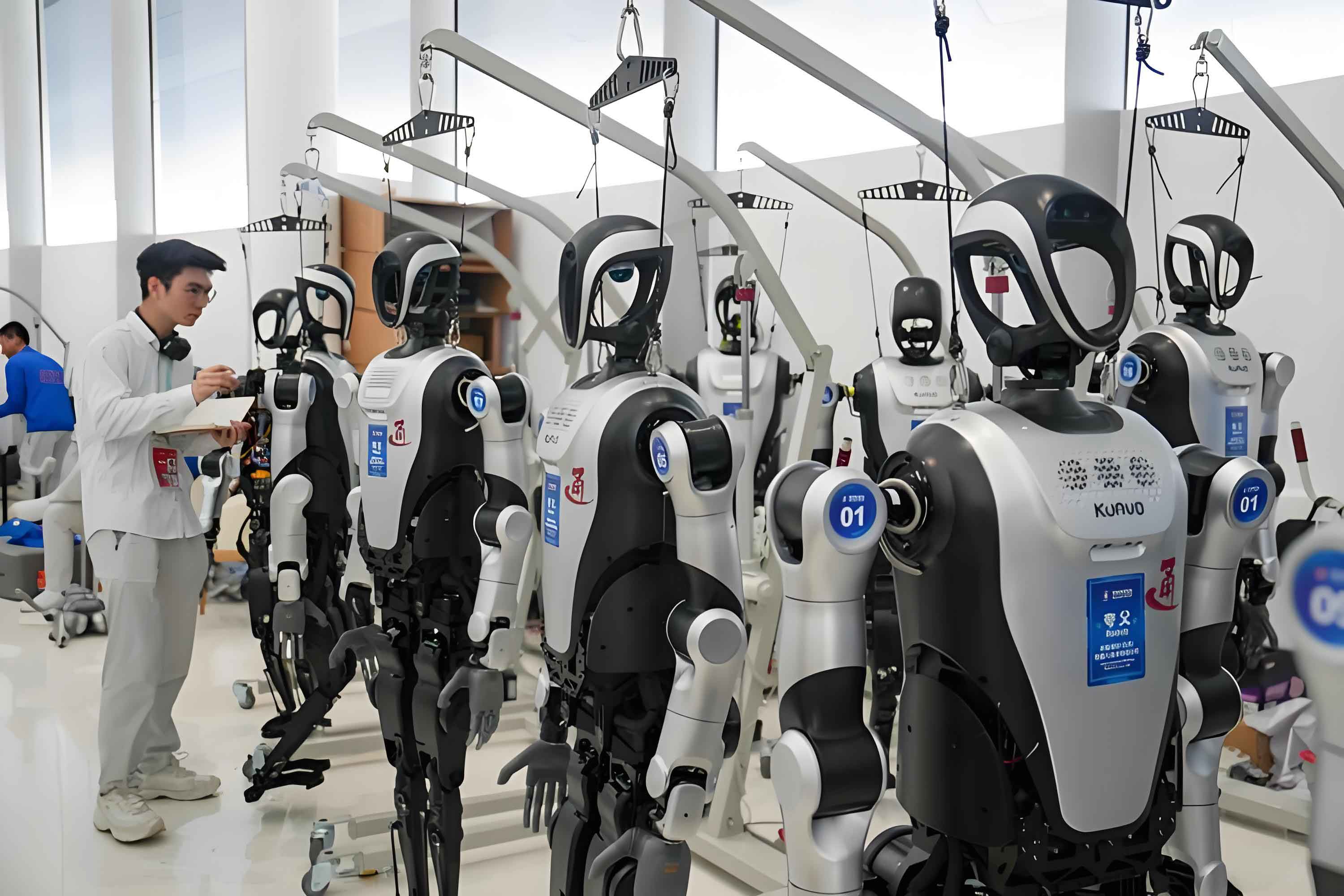
The above image reflects a critical phase within our Testing and Validation Center—the meticulous inspection and calibration of humanoid robot joints and limbs. This hands-on, precise engineering work is fundamental to moving from a theoretical design to a dependable physical system.
The Four Core Service Centers:
- Testing and Validation Center: This is the cornerstone of our risk mitigation function. It houses specialized labs for performance, reliability, environmental (temperature, humidity, EMI), and safety testing. We conduct accelerated lifecycle testing, where a joint’s durability is validated under stressed conditions, compressing years of wear into weeks of testing. Key metrics include mean time between failures (MTBF) and performance degradation curves.
$$ \text{Degradation}(t) = A \cdot (1 – e^{-\lambda t}) + B \cdot t $$
Where $A$ represents initial “burn-in” failure rate, $\lambda$ its decay constant, and $B \cdot t$ models the long-term wear-out linear degradation. - Product Pilot Manufacturing Center: Here, concepts meet factory reality. We operate flexible pilot lines for joint modules and full humanoid robot assembly, capable of small-batch production. The focus is on Design for Manufacture and Assembly (DFMA), process optimization, and supply chain validation. We transition from handmade prototypes to process-defined pre-production units, establishing critical metrics like cycle time, first-pass yield, and component cost breakdown.
- AI and Embodied Intelligence Training Center: This center addresses the “mind” of the humanoid robot. It combines high-fidelity simulation platforms with expansive indoor and outdoor real-world testing arenas. We facilitate reinforcement learning and large-scale scenario training, allowing algorithms for locomotion, grasping, and navigation to learn and adapt in complex, unstructured environments. The data pipeline from simulation-to-real (Sim2Real) is a key asset.
$$ \mathcal{J}(\theta) = \mathbb{E}_{\tau \sim \pi_\theta} \left[ \sum_{t} r(s_t, a_t) \right] \quad \text{s.t.} \quad \text{sim2real gap} < \epsilon $$
The objective is to maximize the expected cumulative reward $\mathcal{J}$ for policy $\pi_\theta$, while minimizing the performance gap between simulation and physical deployment. - Technology and Product Showcase Center: This center serves as the interface with the broader ecosystem. It demonstrates mature technologies, facilitates investor and partner engagement, and hosts technical workshops. It transforms engineering success into market visibility and collaboration opportunities.
The Enabling Platform and Alliance:
- Public Service Platform: This digital and physical gateway provides standardized access to our resources, lowering the entry barrier for innovators. It manages project onboarding, resource scheduling, and delivers shared technical services like simulation time or standardized test suites.
- Pilot Service Alliance: To amplify our impact, we co-founded and manage an alliance of industrial partners, academic institutions, and testing agencies. This network fosters “industry-academia-research-application” collaboration, shares best practices, and works collectively on defining industry-wide standards for humanoid robot testing and evaluation.
Core Technical Functions: De-risking the Industrialization Journey
Our daily operations are focused on executing three core technical functions that directly attack the “Valley of Death.”
1. Engineering Development and Pilot-Run for Scalable Manufacturing: We deconstruct the humanoid robot into manufacturable subsystems. For actuator modules, we analyze tolerance stacks, thermal management, and assembly sequences. We develop pilot production workflows and generate essential manufacturing documentation. A critical output is a comprehensive manufacturability report, detailing cost drivers, potential supply chain bottlenecks, and recommendations for design simplification.
| Analysis Dimension | Metrics Evaluated | Typical Output/Recommendation |
|---|---|---|
| Mechanical Design | Part Count, Tolerance Stack-up, Assembly Complexity | Suggest part consolidation; recommend tolerance relaxation on non-critical features. |
| Thermal & Power | Peak/Motor Power Dissipation, Heat Sink Efficacy | Validate thermal design; suggest alternative materials or cooling strategies. |
| Supply Chain | Component Availability, Single/Alternate Source Risk, Cost | Identify critical long-lead items; suggest alternate components for cost/availability. |
| Assembly Process | Manual vs. Automated Steps, Cycle Time, Tooling Requirements | Design jigs and fixtures; propose assembly sequence optimization to reduce time. |
2. Full-Development-Cycle Defect Discovery and Test Validation: We implement a V-model testing approach, ensuring each requirement from the system level down to the component level is validated. Our testing is both standardized (for safety, EMC) and highly customized (for novel locomotion algorithms). We perform Failure Modes and Effects Analysis (FMEA) and Highly Accelerated Life Testing (HALT) to uncover hidden flaws before mass production. The statistical data from these tests is crucial for setting warranty periods and predicting field maintenance needs.
$$ R_{\text{system}}(t) = \prod_{i=1}^{n} R_i(t) \cdot F_{\text{integration}} $$
Where $R_{\text{system}}$ is overall reliability, $R_i(t)$ is the reliability of the $i$-th subsystem, and $F_{\text{integration}}$ is a factor (<1) accounting for integration-induced failure modes, which our testing aims to identify and minimize.
3. Real-Scene Data Acquisition and Algorithm Optimization: This is where embodied intelligence matures. Our outdoor testing grounds, featuring varied terrain and weather conditions, serve as a data goldmine. We instrument these environments and the robots themselves to collect petabytes of sensor data (LiDAR, vision, IMU, torque) during task execution. This data feeds back into the training cycles in our AI center, closing the loop between virtual training and physical performance. We help innovators build robust perception-action cycles that can handle the noise and uncertainty of the real world.
Future Trajectory: Towards a National Benchmark
Our vision extends far beyond our current capabilities. The roadmap for the coming 3-5 years is structured around three strategic pillars: enhancing service capacity, deepening technical prowess, and expanding ecological synergy.
Service Capacity Enhancement: We are expanding our physical and credential footprint. This includes pursuing national and international accreditations (CNAS, CMA) for our testing laboratories, which will lend global credibility to our certification reports. A major initiative is the development of a graded evaluation system (e.g., L1-L5) for humanoid robot autonomy and capability, providing a much-needed benchmarking framework for the industry. We are also integrating specialized testing for functional safety (ISO 13849, ISO 26262 adapted for robots) and cybersecurity, addressing critical concerns for commercial deployment.
Deepening Technical Prowess: Investment is flowing into next-generation pilot tools. We are building a comprehensive digital twin system for the entire pilot manufacturing process, allowing for virtual process validation and layout optimization before any physical change is made. Our pilot assembly lines are being upgraded with more automation and IoT connectivity to create a true smart pilot workshop. Concurrently, we are actively contributing to the standardization landscape, participating in working groups to define test methods, performance metrics, and safety standards for humanoid robots, aiming to shape the very foundations of the industry.
Expanding Ecological Synergy: The Alliance will evolve from a forum into a potent project-generating and resource-matching engine. We plan to establish several thematic sub-centers focused on key vertical applications like logistics, healthcare, or domestic services. Furthermore, we are piloting an “pilot line + incubation + investment” model, where exceptional projects that successfully pass through our validation funnel can receive support for spin-off creation and early-stage funding, ensuring the most promising humanoid robot technologies find a clear path to market.
In conclusion, the journey of a humanoid robot from a lab marvel to an everyday tool is arduous. The “Valley of Death” is real and formidable. Our purpose is to serve as the dedicated engineering brigade that charts a safe, efficient, and reliable path through this valley. By providing systematic pilot-scale production services, rigorous validation, and a collaborative ecosystem, we are not just testing robots; we are stress-testing the future of automation itself. Our ultimate goal is to become the nationally recognized, indispensable platform that ensures the next generation of humanoid robot innovations are born not just brilliant, but also robust, manufacturable, and ready for the world. The bridge across the valley is now open for business.