
In the field of precision motion control, particularly within servo systems for aerospace, robotics, and high-end manufacturing, the demand for compact, high-ratio, and high-precision speed reducers is paramount. Among the available technologies, strain wave gearing, also known as harmonic drive, stands out for its exceptional performance characteristics. The unique operating principle of a strain wave gear involves a wave generator that elliptically deforms a flexible spline (the flexspline), causing it to mesh with a rigid circular spline (the circular spline or rigidspline). This mechanism allows for a high reduction ratio in a single stage, zero-backlash operation (when properly designed), high torque capacity, and compact coaxial design.
While the classic cup-type flexspline design is common, it suffers from significant axial length and stress concentrations at the diaphragm and cup bottom, which can lead to fatigue failure. A more compact and advantageous design for many applications is the “hat” or ring-type flexspline, which offers a shorter axial profile. A simplified cross-section of a reducer using this configuration is shown below, highlighting the key components and their arrangement.
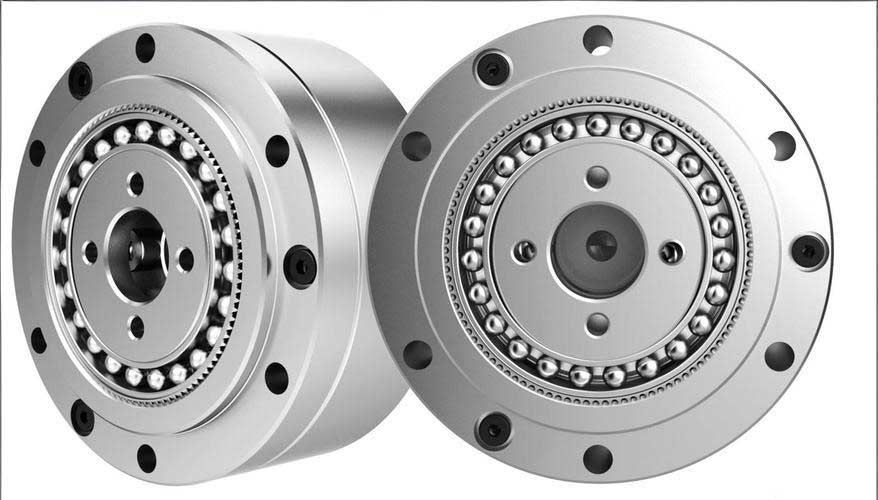
Despite their advantages, strain wave gear reducers can exhibit problematic behavior under load, such as increased friction, reduced efficiency, and in severe cases, complete seizure or jamming. These issues are often not due to the fundamental design of the gearing itself but are consequences of systemic errors in the surrounding structure and assembly. This analysis focuses on the integrated errors—comprising load-induced deformations, manufacturing tolerances, and assembly misalignments—that critically affect the meshing condition between the flexspline and the fixed circular spline in a ring-type configuration. We will perform a theoretical static analysis, derive governing equations, and establish guidelines for optimal structural design to mitigate these detrimental effects.
Analysis of the Output Shaft as a Statically Indeterminate System
The output assembly of a ring-type strain wave gear reducer is a complex, hyperstatic (statically indeterminate) structure. The flexspline and the output member (often an output spline or rigid component) are mounted together on the output shaft, typically separated by a bearing. When an external transverse load $$ F $$ is applied at a distance $$ c $$ from the bearing supports (e.g., from a pulley, pinion, or direct coupling), the shaft deflects.
This deflection disrupts the ideal coaxial alignment. Crucially, the fixed circular spline does not tilt with the shaft, while the flexspline does. This relative tilt causes an asymmetric meshing load distribution: the gear teeth become tighter on one side and looser on the opposite side along the face width. This asymmetry generates a net radial reaction force $$ F_3 $$ at the meshing interface, acting on the flexspline and transmitted through its bearing to the output shaft. The system, with three unknown support reactions (two bearing forces and the meshing force $$ F_3 $$) and only two equilibrium equations (sum of forces and moments), is statically indeterminate.
To solve this, we employ the method of superposition and energy methods (Castigliano’s theorem). We consider two scenarios whose superposition equals the original problem:
- The shaft under the external load $$ F $$, with the meshing point free to deflect ($$ F_3 = 0 $$).
- The shaft under the unknown radial meshing force $$ F_3 $$, with the external load removed ($$ F = 0 $$).
The key is the compatibility condition: the net radial displacement $$ \Delta $$ of the shaft at the meshing point (distance $$ a $$ from the left bearing and $$ b $$ from the right bearing) must be the same in both the real and the decomposed scenarios. This condition allows us to solve for $$ F_3 $$.
The geometry and moment diagrams are essential for calculating these deflections. The deflection at the meshing point due to the external load $$ F $$, denoted $$ \Delta_1 $$, is found by integrating the product of the real moment $$ M(x) $$ and a virtual unit load moment $$ m(x) $$ along the shaft’s length:
$$
\Delta_1 = \sum \int_{0}^{l_i} \frac{M(x) m(x)}{E I_i} \, dx
$$
Where $$ E $$ is the modulus of elasticity and $$ I_i $$ is the area moment of inertia for each shaft segment. For a uniform-diameter shaft, this simplifies. The moments are:
- From $$ F $$: $$ M_1 = \frac{a}{a+b}Fc $$ at the meshing point, and $$ M_2 = Fc $$ at the right bearing.
- From a unit load at the meshing point: $$ m = \frac{ab}{a+b} $$.
Applying the energy method yields:
$$
\Delta_1 = \frac{Fc}{6EI} \cdot \frac{2a^2b + ab^2}{(a+b)}
$$
Similarly, the deflection at the same point due solely to the radial meshing force $$ F_3 $$ is:
$$
\Delta_2 = \frac{F_3}{3EI} \cdot \frac{a^2b^2}{(a+b)}
$$
The compatibility equation requires that the deflection caused by $$ F $$ is exactly countered by the deflection caused by $$ F_3 $$ at that point: $$ \Delta_1 = \Delta_2 $$. Solving this equation provides the critical expression for the induced meshing radial force:
$$
F_3 = \frac{Fc}{2} \cdot \frac{2a + b}{ab} = \frac{Fc}{2} \cdot \frac{1 + \alpha}{\alpha (1 – \alpha)} \cdot \frac{1}{L}
$$
where $$ \alpha = a/(a+b) $$ and $$ L = a+b $$ is the total bearing span. The bearing reaction forces $$ F_1 $$ (left) and $$ F_2 $$ (right) are then found by superposition of the forces from each case:
$$
\begin{aligned}
F_1 &= \left(1 + \frac{c}{L}\right)F + \alpha F_3 \\
F_2 &= -\frac{c}{L}F + (1 – \alpha) F_3 = \frac{Fc}{L} \cdot \frac{1 – \alpha}{2\alpha}
\end{aligned}
$$
These results lead to several fundamental insights for the structural design of a strain wave gear output stage:
| Parameter | Relationship | Design Implication |
|---|---|---|
| Shaft Stiffness | $$ \Delta \propto 1/EI \propto 1/d^4 $$ (for solid shaft) | Shaft deflection is inversely proportional to the fourth power of its diameter. Maximizing shaft diameter is the most effective way to reduce deflection. |
| Bearing Span (L) | $$ F_3, F_1, F_2 \propto 1/L $$ | The induced meshing force $$ F_3 $$ and bearing reactions are inversely proportional to the bearing span. Increasing the distance between support bearings reduces all parasitic radial forces. |
| Flexspline Position (α) | $$ F_3 \propto (1+\alpha)/[\alpha(1-\alpha)] $$ | The position of the strain wave gear assembly along the shaft non-linearly affects $$ F_3 $$. Central placement (α ≈ 0.5) generally helps minimize this force. |
Finite Element Analysis (FEA) of typical output shaft assemblies confirms these theoretical trends. For instance, with a sufficiently large shaft diameter (e.g., 15 mm), the absolute deflection becomes negligible (on the order of $$ 10^{-4} $$ mm), allowing the shaft to be treated as rigid for subsequent error analyses. The primary concern then shifts from elastic deflection to kinematic errors induced by manufacturing and assembly.
Analysis of Manufacturing and Assembly Errors
When the output shaft can be considered rigid, the primary source of misalignment in a strain wave gear system stems from tolerances and fits. These errors cause the entire output assembly (shaft, bearings, flexspline, and output spline) to tilt as a rigid body relative to the fixed housing and circular spline. This tilt is catastrophic for the meshing condition because it leads to a severe load concentration across the face width of the flexspline-circular spline interface.
The critical error stack-up includes:
1. Radial clearance in bearings (internal and external fits).
2. Radial runout of the shaft journals and bearing seats.
3. Radial play within the bearings themselves.
4. Misalignment of bearing housing bores.
We model this by considering clearances at the bearing supports. Let $$ \delta $$ be the effective radial clearance at the right bearing and $$ \epsilon $$ be the clearance at the left bearing. Under an external transverse load $$ F $$, the rigid output shaft will tilt and contact the inner races of the bearings at the opposite extremes of the clearances.
The analysis goal is to find the resulting radial growth $$ \Delta h $$ of the flexspline at its critical meshing point with the fixed circular spline. This radial growth, varying along the face width, is what leads to binding and high stress. We define:
– $$ d_{ar} $$: Flexspline addendum (tip) diameter.
– $$ B $$: Face width of the flexspline gear teeth.
– A “datum line” connecting the two bearing contact points after tilt.
We first analyze two simple cases before combining them.
Case 1: Clearance only at right bearing ($$ \epsilon=0, \delta > 0 $$).
The shaft pivots about the left bearing contact point. The small tilt angle is $$ \alpha \approx \tan \alpha = \delta / L $$. Using geometry, the radial displacement of a point on the flexspline relative to its original position is derived. For a point at the top-left extremity of the flexspline (worst-case for tight meshing), the radial growth simplifies to:
$$
\Delta_{h,\delta} = \frac{a – B/2}{L} \cdot \delta
$$
Case 2: Clearance only at left bearing ($$ \delta=0, \epsilon > 0 $$).
The shaft pivots about the right bearing. The tilt angle is $$ \alpha’ \approx \epsilon / L $$. The radial growth at the same point on the flexspline is:
$$
\Delta_{h,\epsilon} = \frac{b + B/2}{L} \cdot \epsilon
$$
General Case: Clearance at both bearings ($$ \delta > 0, \epsilon > 0 $$).
By superposition of the two tilts, the shaft assumes a new position. The vertical offset $$ h $$ of the flexspline’s geometric center from the original datum line is:
$$
h = \frac{a\delta – b\epsilon}{L}
$$
The tilt angle is now $$ \alpha \approx (\delta + \epsilon)/L $$. The radial growth at the “tight” side (point 1) and “loose” side (point 2) of the flexspline gear mesh are given by:
$$
\begin{aligned}
\Delta_1 &= \frac{1}{L} \left[ \frac{B}{2}(\delta + \epsilon) – (a\delta – b\epsilon) \right] \\
\Delta_2 &= \frac{1}{L} \left[ (a\delta – b\epsilon) – \frac{B}{2}(\delta + \epsilon) \right] = -\Delta_1
\end{aligned}
$$
The expressions for $$ \Delta_1 $$ and $$ \Delta_2 $$ are equal in magnitude but opposite in sign, confirming a pure tilting effect. The critical observation is that to minimize the maximum radial interference (which causes binding and high stress), we should aim to balance the growth on both sides. Ideally, we want $$ \Delta_1 = -\Delta_2 = 0 $$. Setting $$ \Delta_1 = 0 $$ yields the optimal design condition for the axial placement of the strain wave gear assembly:
$$
a\delta – b\epsilon = \frac{B}{2}(\delta + \epsilon)
$$
This equation provides a powerful guideline. The clearances $$ \delta $$ and $$ \epsilon $$ can be estimated from the tolerance stack-up analysis of the assembly. The face width $$ B $$ is determined from gear strength requirements. Therefore, the designer can solve for the optimal ratio $$ a/b $$, and thus the optimal axial location of the flexspline, to inherently compensate for the expected assembly errors and minimize their impact on meshing uniformity.
Design Guidelines and Conclusion
The comprehensive analysis of integrated errors in a strain wave gear reducer leads to concrete, actionable design principles. The following table summarizes the key findings and their structural implications:
| Design Factor | Key Finding | Recommended Action |
|---|---|---|
| Output Shaft Diameter | Shaft stiffness is proportional to the 4th power of its diameter ($$ I \propto d^4 $$). Deflection under load is a primary driver of uneven meshing. | Maximize the output shaft diameter within spatial constraints to approach rigid-body behavior and minimize load-induced tilt. |
| Bearing Support Span | The hyperstatic meshing force $$ F_3 $$ and bearing reactions are inversely proportional to the span $$ L $$. | Maximize the distance between the two support bearings for the output shaft. This reduces parasitic radial forces and improves system stiffness. |
| Bearing and Housing Stiffness | High bearing reaction forces necessitate rigid supports. | Ensure the housing structures for both bearing outer rings are designed with high localized stiffness to prevent additional deformation under these reactions. |
| Tolerance-Induced Tilt | Clearances cause rigid-body tilt of the output assembly, leading to severe linear load concentration across the gear face. | Perform a detailed tolerance stack-up analysis to estimate effective radial clearances $$ \delta $$ and $$ \epsilon $$. Apply the optimal placement formula to determine the flexspline position. |
| Optimal Flexspline Position | The condition $$ a\delta – b\epsilon = \frac{B}{2}(\delta + \epsilon) $$ balances radial growth from tilt. | Use this equation as a design target. Solve for the axial distances $$ a $$ and $$ b $$ during the layout phase to passively compensate for expected assembly errors in the strain wave gear system. |
| Fixed Circular Spline Housing | The fixed spline does not tilt with the system, absorbing the full effect of the misalignment. | The housing for the fixed circular spline must be exceptionally rigid to prevent any local deformation that would exacerbate the uneven contact. |
In conclusion, the high performance of a strain wave gear is critically dependent on the integrity of its surrounding mechanical structure. The problems of friction, efficiency loss, and jamming under load are seldom purely a gearing issue but are systemic. A successful design must treat the reducer as an integrated system where the output stage is analyzed as a hyperstatic structure. By rigorously applying the principles derived here—maximizing shaft diameter and bearing span, and strategically placing the gear assembly based on a tolerance balance equation—designers can significantly mitigate the effects of load deflection and manufacturing errors. This approach ensures that the inherent advantages of the strain wave gear mechanism, such as precision and compactness, are fully realized in a robust and reliable application.