
The ability to exert and precisely control interaction forces is paramount for any dexterous robotic hand tasked with manipulating objects in unstructured environments. This capability defines the stability of a grasp, the safety of interaction with fragile items, and the success of complex in-hand manipulation. Traditional rigid multi-fingered hands, while offering high positional accuracy and stiffness, face a fundamental challenge: the inherent conflict between the need for high servo stiffness in free-space motion and the requirement for compliance and force sensitivity during contact. While control strategies like impedance control can impart some active compliance, they often add significant algorithmic complexity. This work explores an alternative paradigm—a dexterous robotic hand built upon inherently compliant actuators, offering passive mechanical compliance as a foundational property, simplifying the path to stable and gentle force-controlled interactions, particularly suited for applications like agricultural harvesting where objects are delicate and easily damaged.
Foundation: The Flexible Pneumatic Actuator (FPA)
The core enabling technology of the presented dexterous robotic hand is a custom-designed Flexible Pneumatic Actuator (FPA). The FPA’s operation principle is elegantly simple yet effective, leveraging the elasticity of materials and the compressibility of air to generate motion. Its primary components include a rubber tube, a closely wound helical spring embedded within the tube wall, two end caps, and an air inlet connector. The helical spring is crucial as it constrains the radial expansion of the rubber tube under internal pressure, channeling the deformation primarily into axial elongation. When pressurized air is introduced into the internal chamber, the rubber tube expands. The embedded spring restricts this expansion radially, forcing the actuator to extend along its longitudinal axis. Conversely, depressurization allows the combined elastic recovery forces of the rubber and the spring to return the FPA to its original length. By modulating the internal air pressure, one can achieve precise control over the actuator’s axial displacement and, consequently, the force it exerts. This mechanism forms the basic muscle of the subsequent dexterous robotic hand.
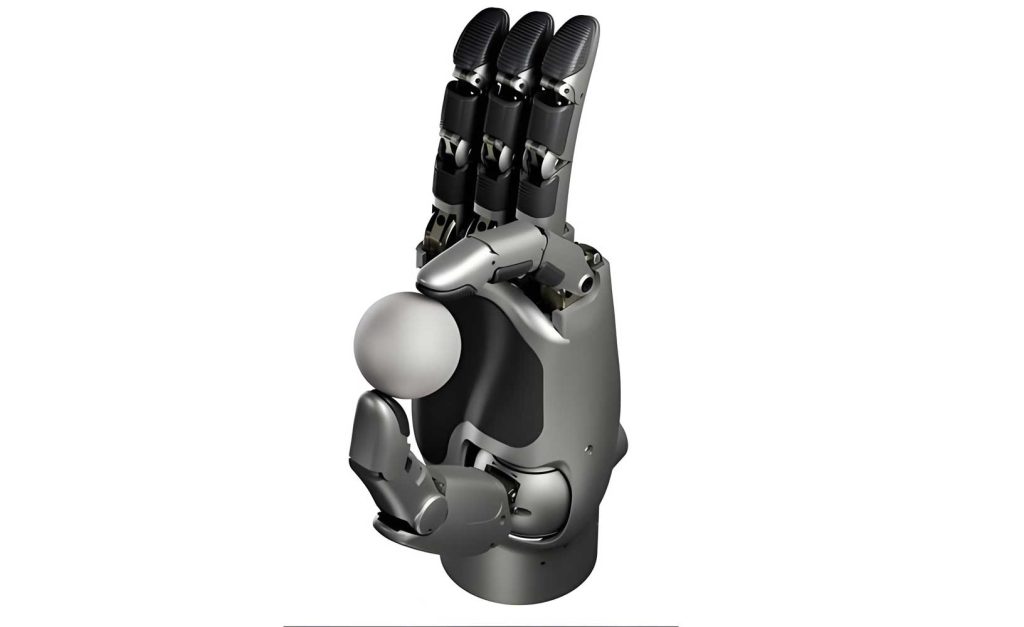
Embodiment: The ZJUT Dexterous Robotic Hand
Building upon the FPA, a full five-fingered, anthropomorphic dexterous robotic hand, designated here as the ZJUT Hand, was developed. The hand adopts a modular design philosophy. Each finger is structurally identical, comprising four independently driven joints: three bending joints and one abduction/adduction (side-sway) joint. All joints are directly actuated by FPAs, eliminating gears or complex linkages and contributing to the hand’s light weight and inherent back-drivability. Each joint is equipped with a non-contact magnetic angle sensor for proprioceptive feedback. Critically, a five-axis force/torque sensor is mounted at the tip of each finger, providing essential exteroceptive feedback about interaction forces. The key structural parameters of the hand are summarized in the table below.
| Parameter | Value |
|---|---|
| Number of Fingers | 5 |
| Total Degrees of Freedom (DOF) | 20 |
| Link Length a1 (Proximal) | 20 mm |
| Link Length a2 (Medial) | 35 mm |
| Link Length a3 (Distal) | 35 mm |
| Link Length a4 (Fingertip) | 25 mm |
| Bending Joint Range | [0°, 90°] |
| Abduction Joint Range | [-15°, 15°] |
| Hand Mass (Approx.) | 400 g |
Modeling: Static Force Analysis of the Finger
To understand and control the force output of this dexterous robotic hand, a static model of its finger is essential. This model establishes the relationship between the forces and moments at the fingertip and the torques required at the joints to maintain static equilibrium. The Denavit-Hartenberg (D-H) convention is used to define the coordinate frames for the finger’s four links. The static relationship is derived from the principle of virtual work and is fundamentally linked to the differential kinematics of the finger.
The force and moment vector at the fingertip, expressed in the fingertip coordinate frame {4}, is denoted as 4F = [4fx, 4fy, 4fz, 4mx, 4my, 4mz]T. Given the joint structure, the moment about the fingertip’s x-axis (4mx) is typically zero, justifying the use of a five-axis sensor. The static model is given by:
$$ \boldsymbol{\tau} = \, ^4\mathbf{J}^T \, \, ^4\mathbf{F} $$
where τ = [τ1, τ2, τ3, τ4]T is the vector of joint torques, and 4J is the geometric Jacobian matrix relating fingertip velocity to joint velocities, expressed in the fingertip frame. For the specific finger linkage, the Jacobian is computed as:
$$
^4\mathbf{J} = \begin{bmatrix}
0 & 0 & -W & s_{234} & c_{234} & 0\\
a_3 s_4 + a_2 s_{34} & a_4 + a_3 c_4 + a_2 c_{34} & 0 & 0 & 0 & 1\\
a_3 s_4 & a_4 + a_3 c_4 & 0 & 0 & 0 & 1\\
0 & a_4 & 0 & 0 & 0 & 1
\end{bmatrix}
$$
where $W = a_4 c_{234} + a_3 c_{23} + a_2 c_2 + a_1$, $c_i = \cos\theta_i$, $s_i = \sin\theta_i$, $c_{ij} = \cos(\theta_i+\theta_j)$, $s_{ij} = \sin(\theta_i+\theta_j)$, etc., and $\theta_i$ are the joint angles.
Since the joints are directly driven by FPAs, the joint torque is linearly related to the pressure inside the actuator for a given posture (assuming small radial deformation). Therefore, the mapping from commanded pressure increments to output fingertip force is:
$$
\boldsymbol{\tau} =
\begin{bmatrix}
\tau_1 \\ \tau_2 \\ \tau_3 \\ \tau_4
\end{bmatrix}
=
\begin{bmatrix}
K_b \Delta p_1 \\ K_b \Delta p_2 \\ K_b \Delta p_3 \\ K_s (\Delta p_l – \Delta p_s)
\end{bmatrix}
= \, ^4\mathbf{J}^T \, \, ^4\mathbf{F}
$$
Here, $\Delta p_1, \Delta p_2, \Delta p_3$ are the pressure changes in the three bending joint FPAs, and $\Delta p_l, \Delta p_s$ are the changes in the two opposing FPAs of the abduction joint. $K_b$ and $K_s$ are constant coefficients relating pressure to torque for the bending and side-sway joints, respectively. This equation is the cornerstone for model-based static force control of the dexterous robotic hand finger.
Control Strategy: Adaptive Force Tracking in Unknown Environments
While static force control is valuable, most practical tasks for a dexterous robotic hand involve dynamic interaction with an environment whose exact location and stiffness are unknown. A control strategy that can adapt to such uncertainties is therefore critical. The goal is to have the fingertip contact force track a desired trajectory or maintain a constant value upon contact, minimizing impact forces.
Environment and System Modeling
The contact interaction is modeled as a mass-spring system. The contact force F is modeled as an elastic force: $\mathbf{F} = \mathbf{K}_e (\mathbf{X} – \mathbf{X}_e)$, where $\mathbf{K}_e$ is the environmental stiffness matrix, $\mathbf{X}_e$ is the true environment position, and $\mathbf{X}$ is the actual fingertip position. In an unknown environment, both $\mathbf{K}_e$ and $\mathbf{X}_e$ are uncertain or completely unknown, making model-based force control infeasible.
Core Adaptive Algorithm
The proposed algorithm circumvents the need for explicit environment models. Its core idea is to adaptively adjust the fingertip’s reference position $\mathbf{X}_r$ based on real-time force sensor feedback, thereby indirectly driving the contact force toward the desired reference force $\mathbf{F}_r$. The algorithm operates in two phases: free motion and constrained motion. Starting with an initial estimate of the environment location $\mathbf{X}’_e$, the finger moves toward it. Upon contact detection via force feedback, the algorithm continuously modifies the target position. The update law for a single decoupled direction (e.g., the z-axis) is:
$$ x_r(t) = x(t – T) + \delta(t) $$
$$ \delta(t) = \eta(t) (f_r – f(t – T)) $$
where $x_r(t)$ is the reference position at time $t$, $x(t-T)$ is the measured position one control period $T$ earlier, $f_r$ is the desired force, $f(t-T)$ is the measured force, $\delta(t)$ is the adaptive position compensation, and $\eta(t)$ is a time-varying adaptive gain (with units of m/N or mm/N). This gain is crucial: a large $\eta$ leads to fast force convergence but risks instability and overshoot; a small $\eta$ ensures stability but results in slow response.
Fuzzy Self-Tuning of the Adaptive Gain
To dynamically optimize the response, a fuzzy logic controller is employed to online tune $\eta(t)$. The fuzzy controller has two inputs: the force error $f_e(t) = f_r – f(t-T)$ and the rate of change of the force $f_{ec}(t) = (f(t-T) – f(t-2T))/T$. The output is the adjustment to $\eta(t)$.
The linguistic variables for $f_e$, $f_{ec}$, and $\eta$ are defined as FE, FEC, and H, respectively. Each variable’s universe of discourse is partitioned into five fuzzy sets: Negative Big (NB), Negative Small (NS), Zero (ZE), Positive Small (PS), and Positive Big (PB). Membership functions are Gaussian. The control rules are designed based on the principle of achieving fast, smooth, and non-overshooting force tracking, encapsulated in the following rule table:
| η (H) | Force Change Rate (FEC) | |||||
|---|---|---|---|---|---|---|
| NB | NS | ZE | PS | PB | ||
| Force Error (FE) | NB | NB | NS | PS | PS | PB |
| NS | NB | NS | ZE | PS | PS | |
| ZE | NB | NB | ZE | ZE | PS | |
| PS | NB | NB | NS | ZE | PS | |
| PB | NB | NB | NS | NS | ZE | |
For example, the rule “IF FE is PB AND FEC is PS, THEN H is NS” means: if the force error is large positive (measured force is much smaller than desired) but the force is already increasing quickly, slightly reduce the adaptive gain to prevent overshoot. The output is defuzzified using the weighted average method to obtain the crisp value $\eta(t)$ for each control cycle.
Integrated Force Tracking Controller Architecture
The overall fuzzy adaptive force tracking controller integrates the above elements within a nested control structure. The outer loop is the force control loop. The force error, processed through the fuzzy self-tuning mechanism, generates an adaptive position reference $x_r(t)$. This reference is transformed into desired joint angles via the finger’s inverse kinematics. The inner loop consists of a high-performance joint position controller (typically employing a dual-loop strategy for joint angle and FPA pressure). This architecture ensures that the dexterous robotic hand finger can precisely track desired forces while relying on its inherent passive compliance and the active adaptation of the reference trajectory.
Experimental Validation and Results
The performance of the dexterous robotic hand finger, both in static force exertion and dynamic adaptive force tracking, was validated through comprehensive experiments.
Static Force Semi-Closed Loop Control
In this experiment, the fingertip was rigidly constrained at a fixed pose (joint angles Θ = [5°, 30°, 30°, 30°]). A desired fingertip force trajectory in the x-direction of the fingertip frame was commanded: 4fxr = [0, -2, -4, -6, -9, -12] N, holding each step for 2 seconds. Using the static model $\boldsymbol{\tau} = \, ^4\mathbf{J}^T \, \, ^4\mathbf{F}$, the required joint pressure increments were calculated and applied via closed-loop pressure control. The fingertip force sensor measured the actual output.
Results: The finger demonstrated rapid static force response, with settling times under 0.3 seconds for each step, primarily limited by the pneumatic valve dynamics. The steady-state error ranged between [-0.1, +0.38] N. A consistent positive bias was observed for forces above 2 N, attributed to the model’s assumption of constant FPA cross-sectional area. In reality, increased pressure causes radial expansion, increasing the effective area and thus the output torque for a given pressure, leading to a slightly higher force than predicted. The experiment confirmed the fundamental ease of controlling output force with a directly FPA-driven dexterous robotic hand joint.
Dynamic Adaptive Force Tracking in an Unknown Environment
This experiment tested the fuzzy adaptive algorithm. The finger started from an initial position P0 and moved along the world z-axis towards a soft foam object (unknown stiffness and exact position). The desired contact force was fz = 12 N. The environment position was roughly estimated to be at P’z = 66 mm (the actual contact occurred near Pz = 80 mm). The control period T was 0.05 s.
Results: The controller successfully managed the transition from free space to constrained motion. During free motion, the algorithm increased the position compensation, driving the finger quickly toward the estimated contact point. Upon contact, thanks to the finger’s passive compliance and the fuzzy gain scheduling, no significant impact force or oscillation was observed. The contact force smoothly and rapidly converged to the desired 12 N, with a settling time of approximately 1 second. The steady-state force error was maintained within ±0.15 N, while the fingertip position stabilized around the true environment location of 80 mm. This experiment conclusively demonstrated the effectiveness of the proposed fuzzy adaptive strategy in achieving stable, accurate, and smooth dynamic force tracking for a dexterous robotic hand in an a priori unknown environment.
Discussion and Comparative Analysis
The development and control of this pneumatic dexterous robotic hand highlights a significant architectural shift from traditional rigid designs. The following table summarizes the key comparative aspects.
| Aspect | Traditional Rigid Dexterous Robotic Hand | Pneumatic FPA-based Dexterous Robotic Hand (This Work) |
|---|---|---|
| Actuation Compliance | Low (high gear ratios, stiff motors). Active compliance must be imposed via control. | High (inherent material elasticity & air compressibility). Possesses intrinsic passive compliance. |
| Force Control Complexity | High. Requires sophisticated strategies (e.g., impedance, hybrid force/position) to manage contact stability and avoid large interaction forces. | Simplified. Intrinsic compliance naturally absorbs impacts. Adaptive position-based force tracking can be effective and simpler to implement. |
| Weight & Power-to-Weight Ratio | Often heavy due to motors and reducers. Onboard electronics for all drivers add mass. | Very lightweight (400g for entire 20-DOF hand). Power source (air compressor) can be remote. |
| Back-drivability & Safety | Typically low, especially with geared motors. Can pose safety risks in human collaboration. | Inherently high. Easily back-driven by external forces, making it inherently safer for interaction. |
| Key Challenge | Managing the impedance/stiffness trade-off across different task phases. | Modeling actuator hysteresis and dynamics, managing slower force response compared to electric actuators. |
The force control results underscore the advantages of the paradigm. The static force experiment reveals a very direct mapping from pressure to torque to fingertip force, a consequence of the direct drive arrangement. The dynamic tracking experiment’s success (1s settling, ±0.15N error) in an unknown soft environment is particularly noteworthy. The fuzzy self-tuning mechanism effectively balances convergence speed and stability without needing a model of the foam’s stiffness or exact location. This is a highly desirable trait for a dexterous robotic hand operating in real-world, unstructured settings like fruit harvesting, where object properties and positions vary.
Mathematically, the performance can be analyzed by considering the closed-loop behavior. The adaptive law $x_r(t) = x(t-T) + \eta(t)(f_r – f(t-T))$, when combined with a sufficiently fast and accurate inner position servo, effectively creates a force regulator. Assuming the environment is linear elastic ($f = k_e (x – x_e)$) and the position loop has a gain of $K_p$, the discrete-time closed-loop force error dynamics can be approximated. The fuzzy controller modulates $\eta(t)$ to place the poles of this implicit system for desired performance. When $f_e$ is large and $f_{ec}$ is small, $\eta$ is increased, raising the loop gain for fast error reduction. When $f_e$ is small and $f_{ec}$ is large, $\eta$ is decreased to add damping and prevent overshoot. This nonlinear gain scheduling is what enables both rapid convergence from a state of no contact and precise regulation upon contact.
Conclusion and Future Perspectives
This work has presented a comprehensive study on output force control for a novel pneumatic dexterous robotic hand. The foundation is a Flexible Pneumatic Actuator (FPA) that provides safe, compliant, and direct-drive actuation. Integrating these actuators into a multi-fingered hand (ZJUT Hand) results in a lightweight, 20-DOF system with intrinsic mechanical compliance. A static model derived from differential kinematics provides the basis for model-based force control, validated through experiments showing fast (0.3s) and accurate static force exertion.
The primary contribution is the development and experimental validation of a fuzzy adaptive force tracking control strategy. This strategy is specifically designed for operation in unknown environments, where object location and stiffness are not available to the controller. By adaptively adjusting the position reference based on force error and its rate of change, and using a fuzzy logic system to intelligently tune the adaptation gain, the controller enables the dexterous robotic hand finger to achieve smooth contact and dynamic force tracking with a response time of about 1 second and a steady-state error within ±0.15 N. This demonstrates a practical and effective solution for compliant manipulation tasks.
Future research will focus on several key areas to advance this technology further. Firstly, enhancing the modeling of the FPA to include dynamic effects like hysteresis and viscoelasticity will improve model-based control accuracy. Secondly, extending the single-finger force controller to a coordinated multi-finger grasp controller is essential for whole-hand manipulation. This involves solving the force distribution problem among multiple fingers while maintaining stability. Thirdly, integrating tactile sensing beyond force/torque, such as high-density skin sensors, will provide richer contact information for manipulating slippery or deformable objects. Finally, exploring applications in real-world agricultural harvesting scenarios will provide critical field validation and drive design improvements for robustness and reliability. The journey towards a truly robust, adaptive, and compliant dexterous robotic hand continues, with pneumatic compliance offering a compelling and fruitful path forward.