
The human hand is a marvel of evolutionary engineering, a multi-functional end-effector whose dexterous manipulation and tool-use capabilities have fundamentally shaped our interaction with the world and driven technological and cultural progress. The development of advanced tools, in turn, has enhanced human efficiency, fostered complex societal cooperation, and even influenced our own physiological evolution, such as the refinement of hand musculature and neural control systems. This symbiotic relationship between biological capability and technological creation defines a core aspect of human intelligence.
Inspired by this, the field of robotics seeks to emulate and extend this capability. The critical interface between an embodied AI robot and its environment is the end-effector. As the final link in the execution chain, its operational flexibility and perceptual accuracy are paramount to task success. Historically, end-effectors have evolved from simple, rigid grippers to complex, sensor-rich systems. Today, the convergence of advanced materials, novel actuators, sophisticated sensors, and, most importantly, artificial intelligence is birthing a new paradigm: End Intelligence. This refers to the integrated capability of an end-effector, formed through the fusion of biomimicry, materials science, advanced mechanics, sensing, computation, control, planning, and system integration, to perform adaptive, intelligent, and dexterous manipulation. The advent of embodied AI, particularly through advancements in large foundation models, provides unprecedented opportunities and challenges for developing such intelligent ends, pushing robotic manipulation closer to real-world, general-purpose applications.
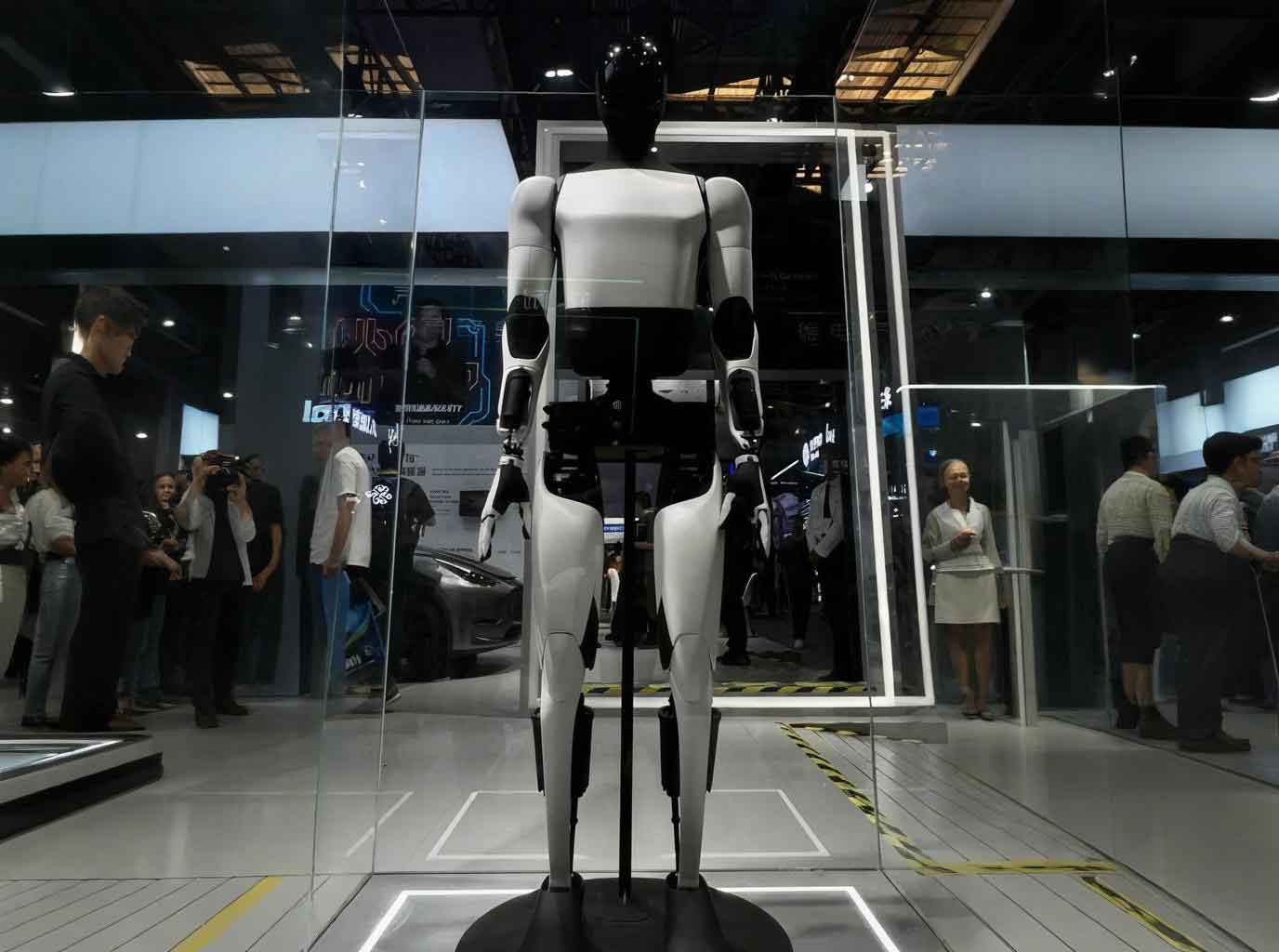
The journey of robotic end-effectors reflects a path from simplicity and specialization towards versatility and intelligence. This evolution can be mapped across distinct phases, each expanding the operational envelope of the embodied AI robot.
| Evolutionary Phase | Core Description | Key Characteristics | Primary Limitations |
|---|---|---|---|
| Rigid Gripping | Use of rigid materials and mechanisms (motors, pneumatic cylinders) for simple open-close actions. | High precision for structured tasks, robust, simple control. | Poor adaptability to irregular shapes or fragile objects; requires precise pose estimation. |
| Flexible & Adaptive Gripping | Utilization of compliant, often soft materials that conform to object geometry. | Passive shape adaptation, safe for fragile items, handles uncertainty. | Limited force application, potential stability issues, often slower actuation. |
| Sensor Integration | Incorporation of force, torque, tactile, and proximity sensors into the end-effector. | Closed-loop force/position control, rich environmental feedback, enhanced safety. | Integration complexity, data processing requirements, potential durability concerns. |
| Intelligent Control | Fusion of multi-modal sensing with AI for perception, decision-making, and learning. | Task-level understanding, autonomous adaptation to novel objects/scenes, learning from demonstration. | High computational demand, need for extensive training data, robustness in unstructured environments. |
The integration of vision systems, as a precursor to full embodied AI perception, marked a significant leap. A typical architecture involves a vision system identifying target pose, an upper-level planner computing a grasp strategy, and the actuator executing the motion. This allows an embodied AI robot to handle cluttered environments. However, true dexterity and generalization require a more biomimetic approach, leading to the development of anthropomorphic dexterous hands.
Anatomy of a Dexterous End: Toward Human-like Manipulation
A human’s ability to perform tasks from wielding a drill to gently holding an egg stems from an intricate combination of skeletal structure, tendon-driven actuation, and a dense network of tactile receptors. The goal for an advanced embodied AI robot is to replicate this integration. The dexterity ($D$) of an end-effector can be conceptually modeled as a function of its Degrees of Freedom (DoF), sensing richness ($S$), and control intelligence ($C_I$):
$$ D = f(\text{DoF}, S, C_I) $$
where a higher $D$ enables more complex in-hand manipulation and tool use. Modern dexterous hands strive to maximize $D$ through innovative design in actuation, transmission, and multi-modal capabilities.
Structural Architectures for Dexterity
The placement of actuators critically impacts design. Three primary configurations exist:
| Configuration | Description | Advantages | Disadvantages |
|---|---|---|---|
| Remote Actuation | Actuators located in the forearm/arm, transmitting force via tendons/cables. | Slender, human-like finger design; allows for powerful actuators; reduces hand mass. | Tendon friction, hysteresis, and maintenance; control complexity; less direct joint torque measurement. |
| Integrated Actuation | Actuators (e.g., micro motors) embedded within the hand or finger links. | High structural stiffness, precise joint control, modular design, easier direct sensing. | Increased hand bulk, limited actuator size/power, heat dissipation challenges. |
| Hybrid Actuation | Combination of remote (for power) and integrated (for precision) actuators. | Balances power and dexterity; allows for partial direct sensing. | Maximum design complexity; inherits some drawbacks from both remote and integrated systems. |
The trend is toward highly integrated, modular designs that pack numerous DoFs into a compact form factor, essential for the embodied AI robot operating in human-centric environments.
Actuation Modalities: Powering Manipulation
The choice of actuator defines the hand’s character—its strength, speed, compliance, and weight. The output force $F_{out}$ at the fingertip is a function of the actuator’s intrinsic force/torque, the transmission efficiency $\eta_t$, and the mechanical advantage $MA$ of the linkage or tendon routing:
$$ F_{out} = \eta_t \cdot MA \cdot F_{actuator} $$
Different modalities optimize for different variables in this equation.
| Actuation Type | Principle & Description | Advantages | Disadvantages | Typical Use Case |
|---|---|---|---|---|
| Electric Motor | Rotary or linear motors, often with gearboxes. The most common approach. | High precision, fast response, excellent controllability, wide availability. | Can be bulky/heavy for high torque; typically rigid without explicit compliance. | Precision industrial grippers, high-DoF dexterous hands. |
| Pneumatic/Hydraulic | Use of pressurized air or fluid to inflate soft chambers or drive pistons. | High power-to-weight ratio, natural compliance (soft variants), safe interaction. | Requires external compressor/pump, control latency, potential leakage. | Soft robotic grippers, robust grasping in unstructured environments. |
| Tendon/Cable Drive | Motor pulls cables/tendons routed through sheaths to flex joints. | Excellent power transmission from remote actuators, allows for compact hand design. | Non-linear elasticity and friction, cable wear and stretch, complex tension management. | Anthropomorphic hands, where aesthetics and weight are critical. |
| Shape Memory Alloy (SMA) | Alloys that contract when heated (electrically) and return to shape when cooled. | Extremely high energy density, silent operation, can be used as direct “muscles”. | Slow cycle time (cooling limitation), low efficiency, hysteresis, precise control challenges. | Lightweight, bio-inspired designs for specific gestures or compliant gripping. |
The Multi-Modal Paradigm: One End for Many Tasks
A key aspiration for the embodied AI robot is general-purpose utility. A multi-modal end-effector combines different physical principles within a single unit to handle a vast array of objects and tasks. This can involve variable stiffness mechanisms, hybrid gripper-suction systems, or reconfigurable finger structures. The adaptability $A$ of such an end can be seen as its ability to switch between $N$ distinct operational modes $M_i$, each optimal for a set of object properties $O_j$ (e.g., size, weight, fragility, texture):
$$ A = \sum_{i=1}^{N} \int_{O_j \in \text{Domain}(M_i)} P(\text{Success} | M_i, O_j) \, dO_j $$
where $P$ is the probability of successful manipulation. Higher $A$ means a single embodied AI robot can perform more tasks without tool changes.
| Multi-Modal Strategy | Mechanism | Capabilities Enabled |
|---|---|---|
| Variable Stiffness | Jamming of granular media, low-melting-point alloys, or layer jamming. | Switch between soft conforming grasp and rigid, forceful pinch. |
| Hybrid Gripping | Combining soft fingers with a central suction cup or electroadhesion pad. | Handle flat, smooth objects (suction) and complex, porous objects (fingers) simultaneously. |
| Reconfigurable Geometry | Mechanisms that change finger posture or palm shape. | Switch between parallel jaw, enveloping, and scissor-like grasps. |
Challenges and Opportunities at the Frontier of End Intelligence
The vision of a truly intelligent, general-purpose embodied AI robot places immense demands on its end-effector. While opportunities abound, significant scientific and engineering challenges remain.
Formidable Challenges on the Path to Intelligence
1. Structural and Material Hurdles: The pursuit of high dexterity ($D$) and adaptability ($A$) within a constrained volume and weight budget creates fundamental trade-offs. The design complexity escalates with every added DoF and integrated sensor. Materials must be simultaneously strong, lightweight, durable, and, in many cases, compliant or embeddable with sensing elements. No single existing material meets all needs for a universal embodied AI robot end-effector. Furthermore, the trade-off between specialized efficiency and general-purpose utility remains unresolved. A highly dexterous hand often sacrifices the speed and raw force of a simple two-finger gripper.
2. The Perception-Action Loop in Embodied AI: For an embodied AI robot, intelligent action is grounded in rich, multi-modal perception. The end is the primary site for this perception.
- Heterogeneous Data Fusion: Fusing high-dimensional, asynchronous data from vision (e.g., cameras), proprioception (joint angles), and tactile sensors (pressure, shear, texture) is non-trivial. The data formats, noise characteristics, and update rates differ vastly. Creating a unified, real-time perceptual state $S_t$ is a core challenge:
$$ S_t = \mathcal{F}(V_t, T_t, P_t, \Theta_t) $$
where $\mathcal{F}$ is the fusion function, $V$ is visual data, $T$ is tactile data, $P$ is force/torque data, and $\Theta$ is proprioceptive data. - Generating Generalizable Policies: Moving from perceiving an object to executing a dexterous manipulation policy (e.g., rotating a key, peeling a banana) requires understanding physics, context, and affordances. While large models can plan task sequences, translating them into low-level, compliant motor commands for a complex hand under uncertainty is an open problem. The policy $\pi$ must map state $S_t$ to actions $A_t$ (joint torques or positions) that are robust to disturbances:
$$ A_t = \pi(S_t | \mathcal{M}) $$
where $\mathcal{M}$ represents the embodied AI model’s understanding of the task and world physics. - Sustained Operation Under Uncertainty: Real-world tasks are long-horizon and partially observable. An embodied AI robot must maintain a consistent internal model of the object in-hand despite occlusions, slippage, and sensor noise over time. This requires sophisticated world models and memory architectures within the embodied AI framework.
The Unprecedented Opportunity
The convergence of several technological waves creates a fertile ground for breakthroughs in End Intelligence. The rise of embodied AI itself is the primary catalyst. Large foundation models provide the cognitive backbone for task understanding, causal reasoning, and few-shot learning, which can be coupled with the physical intelligence of an advanced end-effector. This synergy can transform industries:
- Healthcare: Robotic assistants with intelligent, sensitive ends could perform delicate surgery or provide nuanced physical therapy.
- Advanced Manufacturing: Embodied AI robots could handle custom, small-batch assembly with the flexibility of a human worker.
- Personal and Service Robotics: Robots could safely and effectively assist in daily tasks in homes and workplaces, from cooking to logistics.
This drives economic growth, spurring innovation in materials (e.g., self-healing polymers, embedded nanocomposite sensors), micro-mechatronics, and simulation tools for training embodied AI control policies.
Conclusion
The evolution from simple grippers to intelligent, multi-modal end-effectors marks a critical trajectory in robotics. The concept of End Intelligence encapsulates the holistic integration of mechanics, sensing, and AI required for dexterous, adaptive manipulation. As embodied AI matures, it provides both the imperative and the tools to tackle the enduring challenges of structural design, material science, and, most critically, the seamless integration of perception and action. The future of the embodied AI robot is inextricably linked to the intelligence of its end-effectors. By overcoming these challenges, we will unlock a new era of robotics where machines can interact with the physical world with a sophistication approaching human dexterity, transforming our industries, augmenting our capabilities, and redefining human-machine collaboration.