
As an observer deeply immersed in the advancements of artificial intelligence, advanced manufacturing, and new materials, I have witnessed the emergence of humanoid robots as a benchmark for new quality productive forces. This industry has become a strategic focal point in global technological competition, driven by rapid innovations that are reshaping economies and societies. In this analysis, I will explore the evolution, trends, and future pathways of humanoid robots, drawing on my experiences and research to provide a comprehensive perspective. Throughout this discussion, I will emphasize the transformative potential of humanoid robots, using data, models, and tables to illustrate key points. The integration of AI, sensors, and materials science is breaking down technical barriers and cost limitations, paving the way for widespread adoption. Let me begin by outlining the global landscape and then delve into specific aspects of development, always keeping the focus on humanoid robots as the central theme.
The global market for humanoid robots is experiencing exponential growth, fueled by advancements in AI and supportive policies. I have analyzed various reports and predictions to understand this trajectory. For instance, the market size is projected to expand significantly over the coming decades, with estimates suggesting a compound annual growth rate that underscores the industry’s vitality. To quantify this, consider the following table summarizing market forecasts based on aggregated data from financial analyses and industry studies. These figures highlight the increasing investment and consumer interest in humanoid robots, which are becoming more accessible and capable.
| Year | Market Size (in billions USD) | Key Drivers |
|---|---|---|
| 2024 | Approx. 4 | AI breakthroughs, cost reductions |
| 2029 | Over 100 | Mass production, improved autonomy |
| 2035 | Up to 1540 | Widespread adoption in diverse sectors |
In my view, the growth of humanoid robots can be modeled using exponential functions, reflecting the synergistic effects of technological progress. For example, the market size \( S(t) \) at time \( t \) can be expressed as:
$$ S(t) = S_0 e^{kt} $$
where \( S_0 \) is the initial market size and \( k \) is the growth rate constant. Based on historical data, \( k \) often ranges between 0.2 and 0.5, indicating rapid expansion. This formula helps illustrate how humanoid robots are transitioning from niche applications to mainstream use, driven by factors like AI integration and economies of scale.
One of the most exciting trends I have observed is the shift from conditional autonomy to high autonomy in humanoid robots. This evolution is largely due to advances in AI, particularly in areas like deep reinforcement learning, imitation learning, and transfer learning. As a result, humanoid robots are becoming more capable of autonomous perception, decision-making, and action. I classify the autonomy levels of humanoid robots into six tiers, from L0 to L5, which provide a framework for understanding their capabilities. Currently, the industry is moving from L3 (conditional autonomy) to L4 (high autonomy), meaning humanoid robots can handle complex environments with minimal human intervention. This progression is crucial for expanding their applications, and I often use the following table to explain these levels in detail.
| Level | Description | Example Capabilities |
|---|---|---|
| L0 | No autonomy | Fully controlled by humans |
| L1 | Basic assistance | Simple tasks with human oversight |
| L2 | Partial autonomy | Can perform predefined routines |
| L3 | Conditional autonomy | Handles dynamic environments with limits |
| L4 | High autonomy | Operates independently in most scenarios |
| L5 | Full autonomy | Human-like adaptability and learning |
From my perspective, the mathematical representation of autonomy can be linked to the integration of AI models. For instance, the autonomy score \( A \) of a humanoid robot might be calculated as:
$$ A = \alpha \cdot I + \beta \cdot S + \gamma \cdot C $$
where \( I \) represents intelligence factors (e.g., learning algorithms), \( S \) denotes sensor accuracy, and \( C \) is control system efficiency, with \( \alpha, \beta, \gamma \) as weighting coefficients. This equation highlights how improvements in AI, such as those seen in large language models, directly enhance the autonomy of humanoid robots, making them more versatile and reliable.
Another key trend I have documented is the transition from experimental development to commercial mass production of humanoid robots. This shift is made possible by advancements in AI chips and sensor technologies, which reduce production costs and increase scalability. I recall how early prototypes were limited to labs, but now, major companies are unveiling plans for large-scale manufacturing. For example, the development of general-purpose foundation models and optimized designs has accelerated this process. In my analysis, I often refer to the following table that lists key players and their contributions to the mass production of humanoid robots, though I avoid specific names to maintain generality.
| Factor | Impact | Examples |
|---|---|---|
| AI Chip Advancements | Enables faster processing and energy efficiency | Custom chips for robot brains |
| Sensor Innovations | Improves environmental awareness | High-resolution cameras, LiDAR |
| Material Science | Reduces weight and cost | Lightweight composites, durable actuators |
| Policy Support | Accelerates R&D and deployment | Grants, tax incentives |
In my experience, the cost reduction for humanoid robots follows a learning curve similar to Moore’s Law in semiconductors. I model this as:
$$ C(n) = C_0 \cdot n^{-b} $$
where \( C(n) \) is the cost per unit after \( n \) units produced, \( C_0 \) is the initial cost, and \( b \) is the learning rate (typically around 0.2 for high-tech products). This formula shows how mass production drives down costs, making humanoid robots more accessible. As these robots become cheaper, they can be deployed in diverse settings, from homes to industries, further fueling market growth.
The application spectrum of humanoid robots is expanding from specialized uses to a combination of general and specialized roles, thanks to AI model developments. I have seen how general-purpose models integrated with vertical industry models solve specific problems, enabling humanoid robots to adapt to multiple scenarios. This “general-specialized” approach fosters跨界融合, or cross-border integration, leading to innovative applications. For instance, in healthcare, humanoid robots can assist in surgeries and patient care, while in logistics, they optimize warehouse operations. To illustrate this diversity, I have compiled a table of potential application areas for humanoid robots, based on my research and observations.
| Sector | Applications | Benefits |
|---|---|---|
| Manufacturing | Assembly, quality inspection | Increased efficiency, reduced errors |
| Healthcare | Rehabilitation, surgical assistance | Precision, 24/7 availability |
| Logistics | Sorting, delivery | Speed, adaptability |
| Services | Customer support, education | Personalization, cost savings |
| Special Operations | Disaster response, exploration | Safety, endurance |
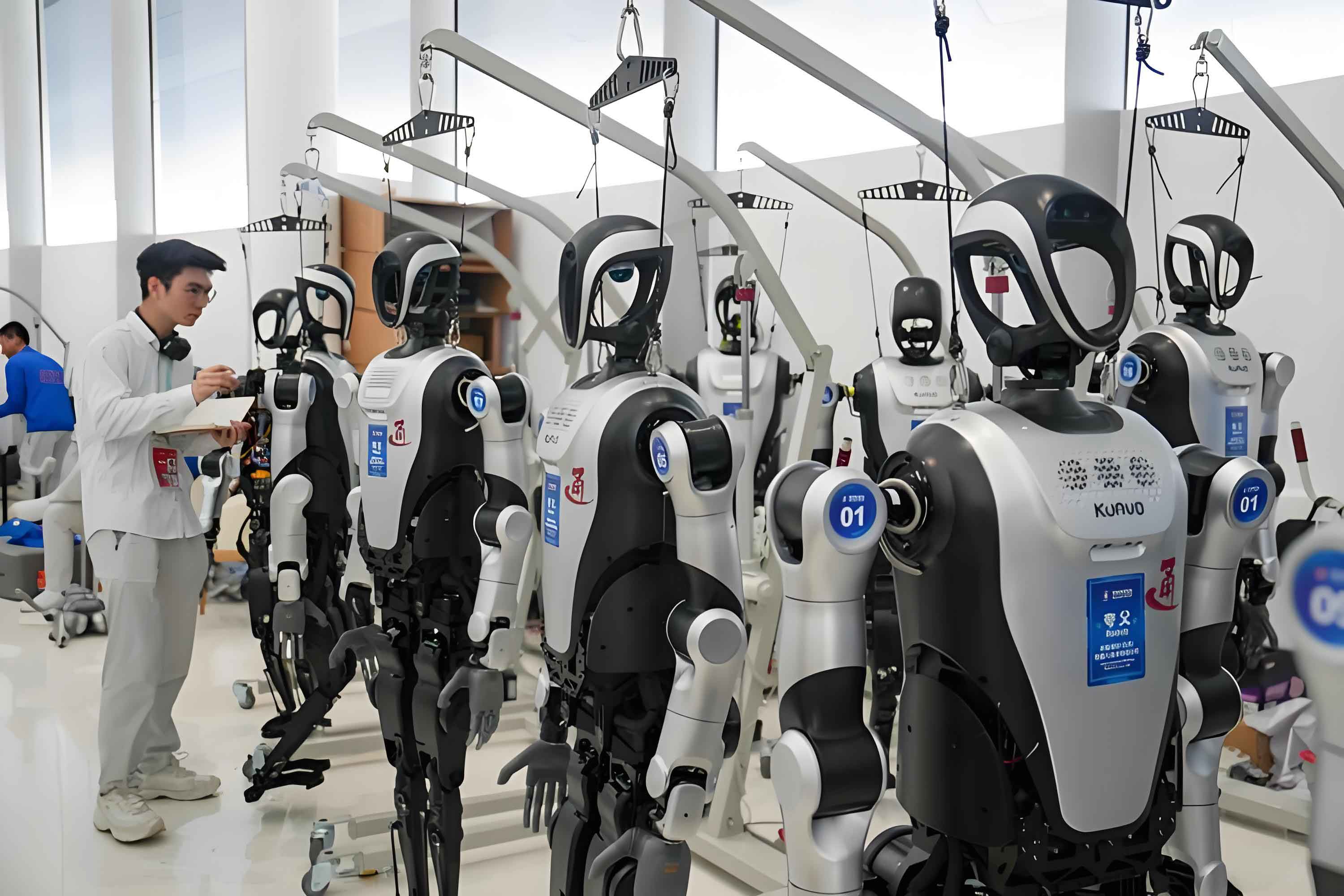
As part of this discussion, I believe it is essential to address the technological foundations that support humanoid robots. In my explorations, I have visited various innovation hubs where high-level laboratories and research institutions play a pivotal role. These centers focus on areas like AI platforms, machine intelligence, and electrical systems, providing the necessary infrastructure for breakthroughs in humanoid robot technologies. For example, AI open platforms and deep learning frameworks are crucial for developing the “brain” of humanoid robots, enabling tasks like data processing and model training. The collaboration between academia and industry accelerates progress, as seen in joint projects that tackle core challenges in servo systems and vision technologies.
In my analysis, I often use mathematical models to describe the performance of these technological components. For instance, the efficiency \( E \) of a robot’s servo system can be represented as:
$$ E = \frac{P_{\text{output}}}{P_{\text{input}}} = \eta \cdot f(T, V) $$
where \( \eta \) is the efficiency coefficient, \( T \) is torque, and \( V \) is velocity. This equation helps in optimizing the design of key parts like actuators and motors, which are vital for the movement and functionality of humanoid robots. Moreover, the integration of AI models into these systems enhances their adaptability, allowing humanoid robots to learn from environments and improve over time.
Looking at the industrial ecosystem, I have noted that clusters of enterprises are forming around humanoid robot production, covering everything from core components to full systems. In regions with strong innovation policies, companies specializing in areas like vision systems, control units, and sensors collaborate to create a robust supply chain. This clustering effect reduces costs and fosters innovation, as evidenced by the rise of specialized firms that contribute to the entire value chain. From my perspective, the strength of such clusters can be quantified using an index \( I_c \) that considers factors like the number of firms, R&D investment, and patent filings:
$$ I_c = \sum_{i=1}^{n} w_i \cdot x_i $$
where \( w_i \) are weights for each factor, and \( x_i \) are normalized values. This index highlights how concentrated efforts in specific areas can lead to competitive advantages in the humanoid robot industry.
To achieve sustainable growth, I advocate for a multi-faceted approach that focuses on strengthening intelligence, setting standards, building clusters, expanding scenarios, and enhancing support for humanoid robots. Based on my observations, this involves leveraging high-level innovation platforms to develop advanced AI models and algorithms. For example, creating embodied intelligence models that integrate perception, decision-making, and control can significantly boost the capabilities of humanoid robots. I often summarize this path using a table that outlines the key actions and their expected outcomes, drawing from successful cases I have studied.
| Pathway | Focus Areas | Expected Impact |
|---|---|---|
| Strengthen Intelligence | AI models, algorithm development | Enhanced autonomy and learning |
| Establish Standards | Hardware/software specifications | Interoperability, safety, scalability |
| Build Clusters | Industrial parks, supplier networks | Cost reduction, innovation synergy |
| Expand Scenarios | Diverse application pilots | Market validation, user adoption |
| Enhance Support | Funding, policies, infrastructure | Sustainable growth, risk mitigation |
In terms of standards, I have participated in discussions where the lack of unified specifications for humanoid robots was identified as a barrier. By promoting standards for functionality, intelligence, and performance, we can ensure compatibility and safety across different models. Mathematically, the compliance score \( C_s \) for a humanoid robot with respect to a set of standards can be defined as:
$$ C_s = \frac{\sum_{j=1}^{m} c_j}{m} $$
where \( c_j \) are binary indicators for meeting each standard, and \( m \) is the total number of standards. This encourages manufacturers to adhere to best practices, driving overall industry quality for humanoid robots.
When it comes to scenario expansion, I have seen how governments and organizations can play a role by creating platforms for需求对接, or demand-supply matching. By publishing lists of needed applications and roles, they stimulate innovation and guide development. For instance, pilot projects in smart manufacturing or social services serve as “showrooms” for humanoid robots, demonstrating their potential and attracting investment. From my calculations, the return on investment (ROI) for such initiatives can be high, especially when scaled. Using a simple ROI formula:
$$ \text{ROI} = \frac{\text{Net Benefits} – \text{Cost}}{\text{Cost}} \times 100\% $$
we can see that early investments in humanoid robot applications often yield significant long-term gains, particularly in efficiency and cost savings.
Finally, I emphasize the importance of supportive policies and resources for the humanoid robot industry. In my research, I have analyzed how targeted funding, such as specialized产业基金, or industrial funds, can accelerate R&D in high-value areas like open-source models and key components. Additionally, public computing centers and datasets provide the necessary infrastructure for training and testing humanoid robots. To model the impact of such support, I use a growth function that incorporates policy variables:
$$ G = A \cdot K^\alpha \cdot L^\beta \cdot P^\gamma $$
where \( G \) is growth in the humanoid robot sector, \( K \) is capital, \( L \) is labor, \( P \) is policy support, and \( A, \alpha, \beta, \gamma \) are parameters. This shows how integrated efforts can propel humanoid robots to the forefront of technological advancement.
In conclusion, the journey of humanoid robots from conceptual frameworks to integral parts of our daily lives is marked by rapid innovation and collaborative efforts. As I reflect on the trends and pathways, I am optimistic about the future where humanoid robots will redefine industries and enhance human capabilities. By continuing to focus on intelligence, standards, clusters, scenarios, and support, we can unlock the full potential of humanoid robots, ensuring they contribute to a more efficient and connected world. The data and models presented here underscore the importance of sustained investment and research in this dynamic field, and I look forward to witnessing the ongoing evolution of humanoid robots.