
In my extensive experience designing and analyzing precision motion systems, few mechanisms have proven as uniquely capable as the strain wave gear. Also widely known as the harmonic drive, this innovative gearing principle represents a paradigm shift from traditional rigid-body kinematics to one that ingeniously harnesses controlled elastic deformation. Its journey from specialized aerospace applications to becoming a critical component in high-end industrial equipment like CNC machine tools is a testament to its unparalleled advantages. In this detailed exploration, I will dissect the strain wave gear‘s operating principles, design intricacies, kinematic formulations, and its pivotal role in enabling the ultra-precision demanded by modern manufacturing.
The fundamental genius of the strain wave gear lies in its three primary components: the wave generator, the flexspline (or柔轮), and the circular spline (or刚轮). Unlike planetary or spur gear systems, one of these elements is deliberately flexible. The wave generator, typically an elliptical cam or a bearing assembly mounted on an elliptical hub, serves as the input. The flexspline is a thin-walled, externally toothed cylindrical cup or ring made from high-strength alloy steel. The circular spline is a rigid, internally toothed ring with a slightly greater number of teeth than the flexspline. The magic begins during assembly: the wave generator is inserted into the flexspline, forcing it to assume an elliptical contour. This elastic deformation meshes the teeth of the flexspline with those of the circular spline at two opposing regions along the major axis of the ellipse.
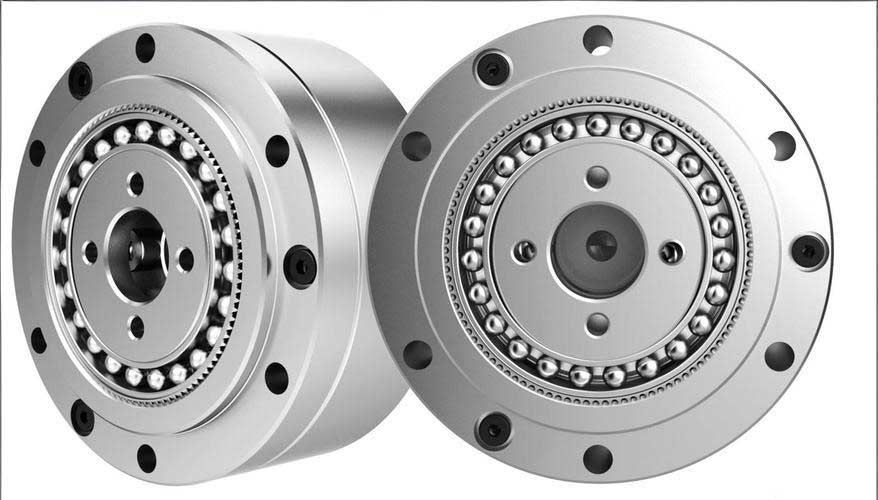
When the wave generator rotates, the elliptical deformation pattern rotates with it. This causes the mesh points between the flexspline and circular spline to travel circumferentially. Because the circular spline has more teeth, for every full rotation of the wave generator, the flexspline rotates backward (or forward, depending on the configuration) by a small amount equal to the difference in tooth count. This interaction is not a simple rolling contact but a smooth, progressive engagement of teeth along the traveling wave of deformation, which minimizes backlash and distributes load across many teeth simultaneously.
The classification of strain wave gear drives is based on their arrangement and which component is fixed. The most common types are cup-type and pancake-type configurations. Furthermore, they can be categorized kinematically, as shown in the table below, which dictates their gear ratio and rotational direction.
| Component | Description | Role | Typical Material |
|---|---|---|---|
| Wave Generator (H) | Elliptical bearing assembly or cam. | Input element. Creates controlled elastic wave in the flexspline. | Steel, Ceramic (for bearings) |
| Flexspline (R) | Thin-walled, externally toothed flexible ring. | Output (common) or fixed element. Undergoes elastic strain. | High-Strength Alloy Steel (e.g., 40CrNiMoA) |
| Circular Spline (G) | Rigid, internally toothed ring. | Usually fixed to the housing. Provides reaction force. | Steel, Aluminum Housing |
The kinematics of a strain wave gear can be elegantly derived using the principles of planetary gear trains, where the wave generator is analogous to the planet carrier. The fundamental relationship is governed by the difference in tooth counts. Let \( Z_R \) be the number of teeth on the flexspline and \( Z_G \) be the number of teeth on the circular spline, with \( Z_G > Z_R \). The basic kinematic equation is:
$$ \omega_R (Z_G – Z_R) = Z_G \omega_H – Z_R \omega_G $$
Where \( \omega_R \), \( \omega_G \), and \( \omega_H \) are the angular velocities of the flexspline, circular spline, and wave generator, respectively. From this, we can calculate the transmission ratios for standard configurations.
| Configuration (Fixed Element) | Transmission Ratio (\( i \)) | Formula | Typical Range |
|---|---|---|---|
| Circular Spline Fixed (\( \omega_G = 0 \)) Wave Generator Input, Flexspline Output |
\( i_{HR} = \frac{\omega_H}{\omega_R} \) | $$ i_{HR} = -\frac{Z_G}{Z_G – Z_R} $$ | -50 to -320 (High Reduction) |
| Flexspline Fixed (\( \omega_R = 0 \)) Wave Generator Input, Circular Spline Output |
\( i_{HG} = \frac{\omega_H}{\omega_G} \) | $$ i_{HG} = +\frac{Z_R}{Z_G – Z_R} $$ | +50 to +320 (High Reduction) |
| Wave Generator Fixed (\( \omega_H = 0 \)) Flexspline Input, Circular Spline Output |
\( i_{RG} = \frac{\omega_R}{\omega_G} \) | $$ i_{RG} = -\frac{Z_R}{Z_G} $$ | Slightly less than 1 (Speed Increase) |
The negative sign in \( i_{HR} \) indicates reversed rotation between input and output, a common trait. The reduction ratio is primarily determined by the tooth difference \( (Z_G – Z_R) \), which is often 2 for standard units, leading to ratios like 100:1 or 160:1. This ability to achieve high single-stage reduction ratios in an extremely compact envelope is a hallmark of the strain wave gear design.
Moving beyond kinematics, the design and performance of a strain wave gear are dictated by several critical engineering parameters. The tooth profile is not involute but a special “S”-shaped or “arc” profile optimized for conjugate action during the flexing cycle. The material selection for the flexspline is paramount, requiring high fatigue strength, endurance limit, and favorable elasticity. The wave generator bearing’s life directly dictates the overall drive’s reliability. Key design choices are summarized below.
| Parameter | Symbol | Design Consideration & Impact |
|---|---|---|
| Tooth Difference | \( \Delta Z = Z_G – Z_R \) | Defines the basic reduction ratio. \(\Delta Z = 2\) is most common for high reduction. Larger \(\Delta Z\) gives higher ratio but affects mesh geometry and stress. |
| Module / Diametral Pitch | \( m \) / \( P_d \) | Defines tooth size. Finer pitches allow more teeth in a given diameter, smoothing transmission but requiring higher manufacturing precision. |
| Flexspline Wall Thickness | \( t \) | Critical for stress and fatigue life. Thinner walls reduce stiffness but increase stress. Optimized via finite element analysis (FEA). |
| Wave Generator Deflection | \( w_0 \) | The radial deformation imposed on the flexspline. Governs the depth of mesh and directly affects tooth loading, stress, and torsional stiffness. |
| Number of Simultaneous Tooth Pairs in Mesh | \( N_m \) | Typically 15-30% of total teeth are engaged. High \( N_m \) distributes load, increasing torque capacity and reducing tooth stress. |
The application of strain wave gear reducers in advanced CNC machine tools, such as universal tool and cutter grinders, is a perfect case study of their benefits. In these machines, micron-level accuracy and sub-arc-minute rotational precision are required for axes like the workpiece spindle (often called the A-axis) or rotary tables. Traditional worm gear or planetary reducers may introduce unacceptable levels of backlash, friction, or spatial inefficiency.
In a high-precision CNC tool grinder, the A-axis is responsible for rotating the cutting tool blank during grinding operations for helical flutes, relief angles, and complex geometries. The drive system for this axis must provide smooth, continuous, and absolutely precise rotation with near-zero backlash to avoid “grinding chatter” or profile errors. Here, a compact strain wave gear reducer is directly coupled to a high-resolution servo motor. Its inherent near-zero backlash ensures positional fidelity is not lost in the transmission. The high single-stage reduction ratio (e.g., 100:1 or 160:1) allows the use of a smaller, faster motor while providing the high output torque needed for indexing and contouring. The compactness of the strain wave gear assembly allows for a more streamlined and rigid spindle head design, improving the machine’s dynamic response and natural frequency.
The advantages can be quantitatively compared against traditional alternatives used in precision machine tools.
| Performance Metric | Strain Wave Gear Reducer | Precision Planetary Reducer | High-Grade Worm Gear Reducer |
|---|---|---|---|
| Backlash | Extremely low, can be < 1 arcmin, often pre-adjusted to zero. | Low, typically 3-10 arcmin, difficult to eliminate fully. | Moderate to high, subject to wear-increase over time. |
| Single-Stage Reduction Ratio | Very High (50 to 320:1). | Moderate (3 to 10:1 per stage). | High (5 to 100:1). |
| Torsional Stiffness | Very High, due to large number of teeth in mesh. | High. | Moderate, depends on gear size and design. |
| Efficiency | High (typically 80-90% per stage). | Very High ( > 95% per stage). | Low to Moderate (50-90%), prone to self-locking. |
| Axial/Radi al Footprint | Very Compact for its ratio. | Compact, but multiple stages increase length. | Compact in radial, long in axial for high ratios. |
| Hollow Shaft Capability | Excellent, large through-hole possible. | Good, but limited by stage arrangement. | Poor, typically solid output. |
However, implementing a strain wave gear is not without its design challenges. The primary limitation is the finite fatigue life of the flexspline, which undergoes cyclic elastic strain. This life is typically defined in millions of cycles under a specific torque load. Proper selection for the application’s duty cycle is crucial. Heat generation, primarily from the wave generator bearing and flexing hysteresis, must be managed through proper lubrication and sometimes integrated cooling. Furthermore, the strain wave gear exhibits a small but non-zero torsional wind-up under load, which must be characterized and compensated for in ultra-precision systems. Finally, sensitivity to mounting tolerances and thermal expansion requires careful housing design.
| Challenge | Root Cause | Mitigation Strategies in Machine Tool Design |
|---|---|---|
| Flexspline Fatigue | Cyclic bending stress at the tooth root and membrane stress in the wall. | 1. Oversizing for application torque (safety factor). 2. Using premium vacuum-remelted steels. 3. Surface treatments like shot peening to induce compressive residual stresses. 4. Accurate life prediction models based on FEA and S-N curves. |
| Thermal Management | Friction in wave generator bearing and material hysteresis during flexing. | 1. Use of high-quality, low-friction bearings. 2. Efficient grease or oil lubrication schemes. 3. Thermal modeling of the housing to ensure heat dissipation. 4. For high-duty cycles, consider integrated cooling channels in the housing. |
| Torsional Compliance | Elastic deformation of the flexspline wall under load. | 1. Characterize stiffness (N-m/arcmin) from manufacturer data. 2. Implement servo gain scheduling or feedforward torque control to compensate for wind-up during acceleration/deceleration. 3. Use stiffer (thicker wall) flexspline designs where space allows. |
| Precision Mounting | Misalignment induces uneven load distribution, increasing stress and reducing life. | 1. Precision-machined mounting surfaces with tight flatness and perpendicularity tolerances. 2. Use of precision pilot diameters and coupling methods. 3. Avoidance of mounting bolts as primary locators; use shear rings or clamps. |
Looking forward, the role of the strain wave gear in precision automation is set to expand further. Advancements in materials science, such as carbon fiber-reinforced composites for the flexspline or advanced ceramic bearings, promise higher torque-to-weight ratios and longer life. Integration with direct-drive motors into single, compact “actuator modules” is simplifying machine design. Furthermore, the application of strain wave gear principles is extending beyond rotary reducers to linear actuators and even novel robotic joints, demonstrating the versatility of the underlying strain wave mechanics.
In conclusion, the strain wave gear is far more than just a compact speed reducer. It is a sophisticated electromechanical system whose performance hinges on the precise interplay of elasticity, kinematics, and material science. Its ability to deliver high reduction ratios with exceptional positional accuracy, near-zero backlash, and commendable stiffness in a minimal footprint makes it an indispensable component in the drive trains of modern high-precision CNC machine tools. As machine tools evolve towards ever-greater accuracy, speed, and intelligence, the strain wave gear will undoubtedly remain at the heart of the motion systems that make such precision possible. The continued refinement and innovative application of strain wave gear technology will be a key driver in the next generation of advanced manufacturing equipment.