
Looking back, the field of humanoid robotics has been bustling with activity. Driven by supportive policies, breakthroughs in AI, and a surge in investment, numerous players have entered the arena, pouring resources into development. This collective fervor has rapidly propelled the industry into the spotlight. In many ways, this ascent is not a coincidence but the inevitable result of various technological maturations converging over many years.
The dream of a humanoid robot is not new. The world’s first full-scale humanoid intelligent robot, WABOT-1, was developed as early as 1973. Yet, half a century later, the commercialization of humanoid robots remains a distant horizon. The fundamental core obstacles still boil down to performance and, critically, cost.
A robot is essentially composed of three key technological modules: the locomotion module, the sensing module, and the artificial intelligence module. For conventional, specialized robots, mastering just one of these areas often provides utility. For instance, industrial robots primarily focus on precise motion control technology, while robotic vacuum cleaners emphasize navigation and sensing. The humanoid robot, however, demands much more. Its promise of generality requires it to transcend the limitations of single-scene applications. To be deployed across diverse, unstructured environments, its technological complexity increases exponentially. It requires not only robust physical data modeling and control but also a powerful understanding of language and instructions.
The breakthrough in large AI models is providing novel solutions to problems once deemed intractable. From the Transformer architecture to models like GPT-4, as the parameter count undergoes exponential leaps, these models have evolved from pure text to multi-modal systems integrating vision, speech, and more. This evolution towards general-purpose AI enables the fusion of language, vision, decision-making, and control within the humanoid robot, making a significant leap in its capabilities possible.
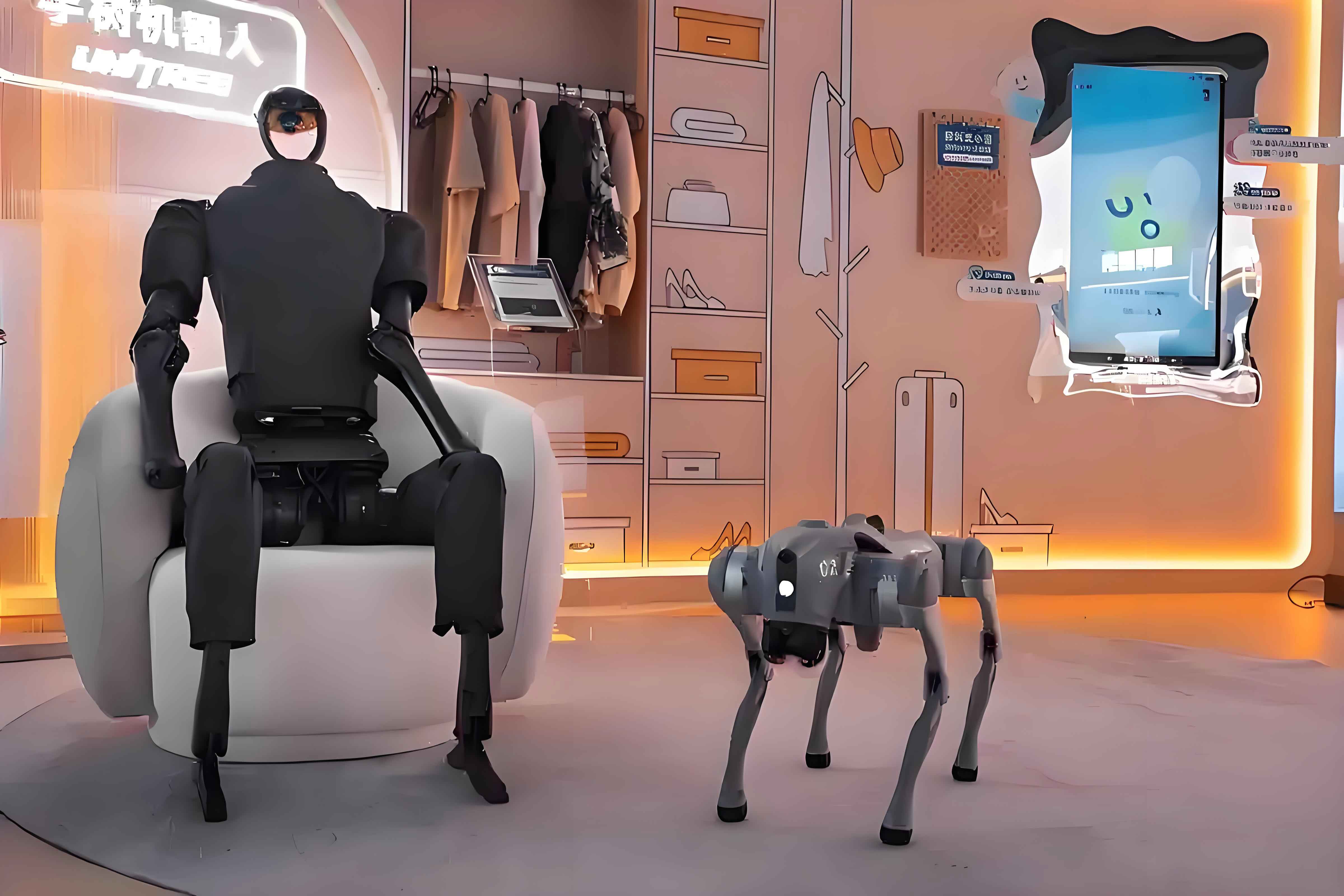
This represents a key facet of how AI is accelerating core technological breakthroughs in robotics, primarily by empowering the embodiment of intelligence. The contributions can be summarized in three key areas, often expressed through objectives in reinforcement learning and control paradigms:
1. Generalization through Embodied AI: By leveraging AI’s generalization power and learning from human demonstration (imitation learning), the humanoid robot gains autonomous decision-making and self-improving capabilities. The goal is to find an optimal policy $\pi$ that maximizes the expected cumulative reward for completing tasks. This can be framed as:
$$\pi^* = \arg\max_{\pi} \mathbb{E}\left[\sum_{t=0}^{T} \gamma^t R(s_t, a_t)\right]$$
where $s_t$ is the state (from sensors), $a_t$ is the action taken by the robot, $R$ is the reward function for task completion, and $\gamma$ is a discount factor. This moves beyond pre-programmed routines, enhancing task completeness and coherence.
2. Precision in End-Effector Control: This emphasizes the operational accuracy of dexterous robotic hands. Under the computation and decision-making of the central “brain,” the action output must be precise. The control objective often minimizes a tracking error $e(t)$:
$$ \min \int_{0}^{T} ||e(t)||^2 dt, \quad e(t) = x_{desired}(t) – x_{actual}(t) $$
This reduces error rates and improves the correctness and accuracy of task execution.
3. Perception-Driven Locomotion: Similar to autonomous driving, this requires full-terrain mobility. The humanoid robot must perceive its surroundings and control its own motion accordingly. This involves state estimation and robust control to maintain balance and navigate, often modeled using dynamics equations like:
$$ M(q)\ddot{q} + C(q, \dot{q})\dot{q} + G(q) = \tau_{joint} + J^T F_{ext} $$
where $M$ is the inertia matrix, $C$ accounts for Coriolis forces, $G$ for gravity, $q$ are joint angles, $\tau_{joint}$ are joint torques, and $F_{ext}$ are external forces. This enhances whole-body mobile manipulation and the timeliness of task completion.
In summary, AI technology is systematically dismantling the traditional barriers that have long hindered the development of capable humanoid robots.
New Challenges Emerge
The rapid evolution of underlying technology has forced a re-evaluation of this familiar-yet-unfamiliar field. However, regarding the genuine industrialization of humanoid robots, the path to entering millions of households remains long.
First, there are significant limitations concerning the data crucial for humanoid robot intelligence. Models like ChatGPT could iterate rapidly because the internet provided a vast reservoir of public-domain data for direct scraping. The situation for humanoid robots is fundamentally different. The real-world population of such robots is minuscule, and even fewer are equipped to collect rich, embodied interaction data. This makes data acquisition a primary bottleneck. Compounding this, robot manufacturers often erect data silos to protect their proprietary information, hindering shared progress and slowing down collective iteration. While initiatives like Google’s Open X-Embodiment dataset, which aggregates data from numerous robots and tasks, serve as a beacon, they still primarily focus on common manipulations. Data for complex whole-body coordination, dynamic walking balance, and long-horizon tasks remain scarce.
Second, constrained by computational power, current humanoid robots struggle with real-time command response. A general-purpose humanoid robot requires a control cycle frequency of around 500 Hz for stable, dynamic operation. In contrast, state-of-the-art large models for robotic control, like Google’s RT-2, typically operate at control frequencies around 3 Hz—a gap of more than two orders of magnitude. This latency is a critical barrier to fluid, responsive interaction.
Finally, and most importantly, is cost. With price tags often reaching tens of thousands of dollars, widespread consumer adoption is currently impossible.
The following table summarizes these core challenges:
| Challenge Category | Specific Issue | Quantitative Gap / Status |
|---|---|---|
| Data | Scarcity of embodied, multi-modal interaction data; Data silos. | Existing large datasets (e.g., Open X-Embodiment) lack sufficient data for full-body dynamics and complex locomotion. |
| Compute & Real-time Control | Insufficient control frequency for dynamic stability. | Required: ~500 Hz. Current SOTA AI models: ~3 Hz. Gap: > 100x. |
| Cost | High Bill of Materials (BoM) prevents mass-market adoption. | Current prototype costs: $50,000 – $200,000+. Target for early commercialization: < $50,000. |
Given these factors, the practical progress of humanoid robots remains constrained.
Domestic Substitution Accelerates
The fervor in the domestic market has catalyzed a powerful trend towards import substitution in the humanoid robot industry, accelerating at an increasing pace.
From the demand side, the gradual rise in domestic labor costs has increased the demand for automation, stimulating enterprise enthusiasm for robotics. While developed countries drove early robotic development due to high labor costs, the subsequent entry of major developing nations into the global economy temporarily altered the landscape. Now, as countries like China experience rising labor costs themselves, a global wave of robotic innovation is becoming a clear trend. Although some low-end manufacturing has relocated, the results have been mixed, lacking the combined scale, skilled workforce, and social stability found domestically. This reality has led many suppliers to focus intently on robotics, objectively propelling the domestic industry forward.
From technology and industry perspectives, the presence of numerous capable potential suppliers and vast application scenarios is the core driver of domestic substitution. The core components of a humanoid robot—reducers, servos, and controllers—typically constitute over 70% of an industrial robot’s cost. Given the higher number of joints and degrees of freedom in a humanoid robot, this percentage is likely even greater. In these critical areas, domestic suppliers are already emerging:
| Core Component | Key Domestic Players | Status & Metrics |
|---|---|---|
| Reducer (Harmonic Drive) | Leader Harmonious, Laifu Harmonic, Tongchuan Tech, Zhongda Lide, etc. | Leader Harmonious has achieved a net profit margin >30%, indicating a virtuous cycle of R&D and scale. |
| Servo System | Inovance Technology | Holds an estimated 21.5% domestic market share in servos, showing strong competitive expectation. |
| Controller | Multiple contenders | No dominant leader yet, but a growing ecosystem of capable alternative providers exists. |
The application scenario advantage is profound. With a massive population and a deeply developed manufacturing sector, both B-end (industrial, commercial) and C-end (consumer) markets present enormous potential applications for humanoid robots. This provides a native, fertile ground for domestic substitution and innovation.
In essence, propelled by this combination of factors, the domestic substitution cycle for humanoid robot components and systems has entered a phase of rapid acceleration.
2024: Has the Spring for Humanoid Robots Arrived?
Amidst rapid industry development, the notion of 2024 being the “Year of the Robot” has gained traction. However, a clear-eyed view suggests that 2024 is more accurately a year of small-scale, pilot deployments for humanoid robots, with a tangible gap remaining to a true industrial tipping point.
First, the industry itself recognizes the profound technical complexity involved, which cannot be overcome overnight. The past year has seen accelerated change, but fundamental, paradigm-shifting breakthroughs remain elusive. The humanoid robot sits at the intersection of advanced manufacturing, materials science, and artificial intelligence, demanding exceptional breadth and depth of expertise. Even pioneering companies that have been developing humanoid robots for over a decade continue to invest heavily in both core technology and the path to industrialization. For the industry, the current priority is to diligently iterate on technology and product design, channeling resources into fundamental R&D and key bottlenecks. The critical goal is to establish a complete commercial闭环 (closed-loop) from R&D to product, to application, and to service.
Second, from the perspective of large AI models, the intertwined issues of data scarcity, hardware cost, and computational demands require substantial time to resolve. As noted, high-quality, diverse embodied data is limited. Both cloud training and on-board (edge) inference involve significant computational costs. Developing robust, generalizable understanding for open-world scenarios is a long-term endeavor. Furthermore, achieving maturity and cost reduction in critical hardware—such as actuators, reducers, joint modules, and dexterous hands—requires iterative collaboration with suppliers, a process still in its early stages.
In the foreseeable future, hardware standardization is likely to be the core lever for driving down costs. A move towards modular, standardized joint and actuator designs could dramatically reduce BoM costs. We can model the potential cost reduction as a function of production volume $N$ and standardization factor $\alpha$ (where $0 < \alpha \leq 1$ represents the degree of part commonality):
$$ C(N) = C_0 \cdot N^{-\beta} \cdot \alpha $$
Here, $C_0$ is the initial cost, and $\beta$ is the experience curve exponent. Standardization ($\alpha \rightarrow 0$) multiplies the volume-driven learning curve effect.
The technical hurdles currently facing the industry are concentrated on two fronts: the standardization of hardware interfaces and the establishment of unified algorithmic paradigms for manipulation and control. While the ideal of a capable, affordable humanoid robot feels closer than ever, a distinct line still separates that ideal from widespread reality. This inherent tension ensures that the road to full-scale industrialization will be iterative, not instantaneous.
Ultimately, the convergence of AI and robotics marks not a sudden explosion, but the true beginning of a arduous, systematic climb. The “first year” is not a single calendar event, but the ongoing transition from isolated prototypes to integrated systems solving real-world economic problems. The journey of the humanoid robot is finally on a concrete, if challenging, path forward.