
As a key component in industrial robots and precision positioning systems, the harmonic drive gear is renowned for its compact size, high transmission ratio, efficiency, and accuracy. To ensure exceptional transmission performance, stringent requirements are imposed on angular transmission precision, strength, and stiffness of harmonic gears. Achieving these high-performance demands hinges critically on tooth profile design. This article elaborates on a design method for a non-interfering, wide-range meshing tooth profile applied in harmonic drive gears, drawing from established theoretical principles. The harmonic drive gear’s unique operation relies on the elastic deformation of a flexible spline, and optimizing its tooth profile is paramount for enhancing overall mechanism performance.
The core of this design approach is the curve mapping theory, which facilitates a tooth form that maintains continuous contact without interference throughout the meshing cycle. This leads to a significant increase in the number of simultaneously engaged teeth, directly boosting the harmonic drive gear’s rigidity, transmission accuracy, and torque capacity. In the following sections, I will detail the theoretical foundation, the step-by-step design procedure involving initial approximation and subsequent corrections, and the validated advantages of the resulting harmonic drive gear profile.
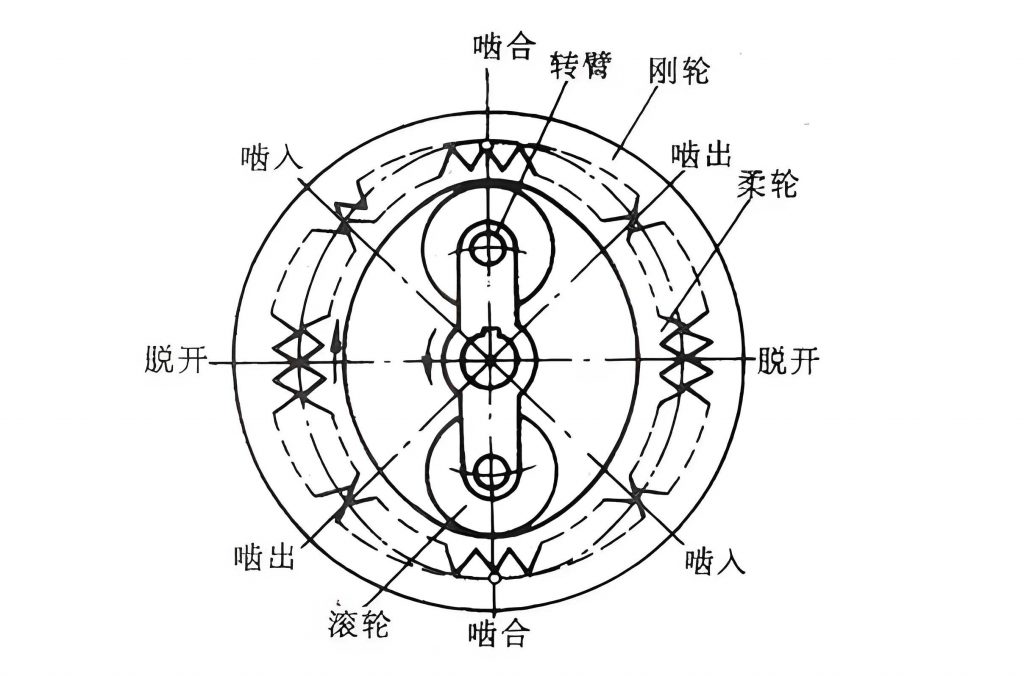
Foundational Theory: Curve Mapping
The design methodology for this advanced harmonic drive gear profile is rooted in the geometric principle of curve mapping. Conceptually, the motion trajectory of points on the neutral curve of the flexspline is used to generate the conjugate tooth profiles of the circular spline and the flexspline. Consider the neutral curve of the undeformed flexspline. When a wave generator, typically a cosine cam, is inserted, this neutral curve deforms. The path traced by a point on this deformed curve relative to the circular spline is central to the design.
Let the trajectory of a point on the flexspline’s neutral line be represented by a curve segment $a_0b_0$. Through a geometric mapping operation—specifically a scaling transformation with a factor of 0.5—the upper tooth profile curve $a_1b_1$ for the circular spline is derived from $a_0b_0$. Subsequently, rotating $a_1b_1$ by 180° around point $a_1$ yields the corresponding upper tooth profile curve $a_2b_2$ for the flexspline. A remarkable property of this mapping is that during the flexspline’s motion, corresponding points on the flexspline tooth profile and the circular spline tooth profile coincide and remain tangent to each other. This ensures continuous, non-interfering contact across a wide range of motion, which is the fundamental goal for any high-performance harmonic drive gear.
The mathematical representation of this mapping is crucial. If $c_0$ is an arbitrary point on $a_0b_0$, and its mapped points on $a_1b_1$ and $a_2b_2$ are $c_1$ and $c_2$ respectively, then as the flexspline deforms and rotates, the point $c_2$ on the flexspline tooth moves to a new position $c_2’$. Due to the scaling and rotational symmetry of the mapping, $c_2’$ coincides precisely with $c_1$ on the circular spline tooth, and their tangents are aligned. This relationship holds for all points along the profile, guaranteeing the desired meshing characteristics for the harmonic drive gear.
Design of the Approximate Tooth Profile
To derive a workable tooth profile for the harmonic drive gear, we start with an approximate design based on the assumed motion of the flexspline’s neutral line. For a harmonic drive employing a cosine cam wave generator, the radial and circumferential displacements of a point on the flexspline’s neutral line are given by:
$$
\omega = m \cdot \cos(2\theta)
$$
$$
\upsilon = -\frac{1}{2}m \cdot \sin(2\theta)
$$
Here, $\omega$ is the radial displacement, $\upsilon$ is the circumferential displacement, $m$ is the neutral line modulus (a parameter related to the wave generator’s amplitude), and $\theta$ is the rotation angle of the non-deformed end of the flexspline relative to the wave generator.
To simplify the initial derivation, we model the flexspline and circular spline as equivalent gear racks. In this simplified model, the relative motion trajectory of a point on the flexspline’s neutral line with respect to the circular spline (rack) is described by the following parametric equations, often referred to as the “rack approximation” for the harmonic drive gear:
$$
x_1 = \frac{1}{2}m \cdot (2\theta – \sin(2\theta))
$$
$$
y_1 = m \cdot (1 – \cos(2\theta))
$$
Applying the curve mapping theory and performing appropriate coordinate transformations, we obtain the equations for the approximately designed upper tooth profile curve. These equations form the initial blueprint for the harmonic drive gear tooth:
$$
x_0 = m_g \left[ \frac{\pi}{4} – (\pm \tau) \right] – \frac{1}{4}m \cdot (2\theta – \sin(2\theta))
$$
$$
y_0 = \frac{1}{2}m \cdot (1 – \cos(2\theta))
$$
In these equations, $m_g$ represents the standard gear module of the harmonic drive gear, and $\tau$ is the tooth thickness variation coefficient. The parameter $\theta$ serves as the curve parameter, and the $\pm$ sign accounts for the left and right flanks of the tooth. This approximate profile provides a foundation but requires refinement to account for real-world geometric complexities inherent in the harmonic drive gear assembly.
Tooth Profile Corrections for Practical Implementation
The approximate profile derived above is based on a rack model. However, in an actual harmonic drive gear, both the flexspline and circular spline are cylindrical gears. This introduces two significant effects that must be corrected for: the inclination of the flexspline tooth during meshing and the alteration of the point trajectory due to the circular geometry. Before applying these corrections, it is essential to establish the coordinate relationships between the flexspline and the circular spline.
We define several coordinate systems, as summarized in the table below, which are crucial for understanding the kinematics of the harmonic drive gear.
| Coordinate System | Description | Key Axes |
|---|---|---|
| $OXY$ (Fixed) | Fixed to the wave generator. | $Y$-axis coincides with the wave generator’s long axis. |
| $O_FX_FY_F$ (Moving) | Fixed to the flexspline. | $Y_F$-axis coincides with the symmetry axis of the flexspline tooth. |
| $O_CX_CY_C$ (Moving) | Fixed to the circular spline. | $Y_C$-axis coincides with the symmetry axis of the circular spline tooth space. |
When the non-deformed end of the flexspline rotates by an angle $\theta$, the following angular relationships are established for the harmonic drive gear:
- The rotation angle of the $Y_C$-axis relative to the $Y$-axis: $\Phi_1 = (Z_F / Z_C) \cdot \theta$.
- The rotation angle of the vector $\boldsymbol{\rho}$ (from wave generator center $O$ to flexspline point $O_F$) relative to the $Y$-axis: $\Phi_2 = \theta – (0.5 \cdot m \cdot \sin(2\theta))/r_n$.
- The rotation angle of the $Y_F$-axis relative to the vector $\boldsymbol{\rho}$: $\mu = \arctan\left\{ (2 \cdot m \cdot \sin(2\theta)) / (r_n + \omega) \right\}$.
- The total inclination angle of the flexspline tooth, i.e., the angle of the $Y_F$-axis relative to the $Y_C$-axis: $\Phi = \gamma + \mu$, where $\gamma = \Phi_2 – \Phi_1$.
Here, $Z_F$ and $Z_C$ are the number of teeth on the flexspline and circular spline of the harmonic drive gear, respectively, and $r_n$ is the radius of the flexspline’s neutral line before deformation.
The first correction, $g_1$, accounts for the inclination of the flexspline tooth. It effectively shifts the profile to compensate for the tilting that occurs during meshing in the harmonic drive gear. The expression for $g_1$ is:
$$
g_1 = h \cdot \Phi
$$
where $h$ represents the effective height from the neutral line to the point on the tooth flank being considered. It is calculated as:
$$
h = 0.5 \cdot t + m_g \cdot (h_a^* + c^*) + f
$$
$$
f = 0.5 \cdot m \cdot [1 – \cos(2\theta)] – 0.5 \cdot \tan(\theta) \cdot \left\{ m_g \cdot \left[ \frac{\pi}{4} – (\pm \tau) \right] – \frac{1}{4}m \cdot (2\theta – \sin(2\theta)) \right\}
$$
In these formulas, $t$ is the rim thickness of the flexspline, $h_a^*$ is the addendum coefficient, and $c^*$ is the clearance coefficient for the harmonic drive gear.
The second correction, $g_2$, addresses the change in the motion trajectory because the gears are not racks. It ensures the profile accurately reflects the true relative motion within the cylindrical harmonic drive gear assembly. The correction $g_2$ is given by:
$$
g_2 = \left\{ \frac{1}{2} \cdot m \cdot [2\theta – \sin(2\theta)] – x_N \right\} + 0.5 \cdot \tan(\theta) \cdot \left\{ y_N – m[1 – \cos(2\theta)] \right\}
$$
where $x_N$ and $y_N$ are the coordinates of the neutral line point in the circular spline coordinate system, accounting for the circular geometry:
$$
x_N = (r_n + m \cdot \cos(2\theta)) \cdot \sin(\gamma)
$$
$$
y_N = (r_n + m) – (r_n + m \cdot \cos(2\theta)) \cdot \cos(\gamma)
$$
The Final Tooth Profile Equations
Incorporating the two correction terms $g_1$ and $g_2$ into the approximate tooth profile equations yields the final, accurate design equations for the upper tooth flank of the harmonic drive gear. These equations define the optimal profile for achieving wide-range, non-interfering meshing.
$$
x = m_g \left[ \frac{\pi}{4} – (\pm \tau) \right] – \frac{1}{4}m \cdot (2\theta – \sin(2\theta)) – \frac{1}{2}(g_1 – g_2)
$$
$$
y = \frac{1}{2}m \cdot (1 – \cos(2\theta))
$$
The parameter $\theta$ varies over a specific range corresponding to the active meshing zone. For the lower tooth flank (the opposite side of the tooth), the profile can be designed more freely, often as a symmetric reflection or a simpler curve, provided it does not cause interference during the reverse motion or assembly of the harmonic drive gear. The primary focus is on optimizing the working flank defined by the equations above to maximize the performance of the harmonic drive gear.
Verification and Advantages of the Designed Profile
The efficacy of this tooth profile design method for harmonic drive gears can be verified through geometric simulation and performance comparison. By substituting typical design parameters into the final equations, the resulting flexspline and circular spline tooth profiles can be plotted and their meshing action simulated throughout the engagement cycle.
For instance, using the parameters: $m = 0.5 \text{ mm}$, $Z_F = 200$, $Z_C = 202$, $t = 1 \text{ mm}$, $h_a^* = 0.8$, $c^* = 0.25$, $\tau = 0.2$, $m_g = 0.2 \text{ mm}$, and $r_n = 50 \text{ mm}$, the profiles are generated. Simulation confirms that the flexspline tooth maintains continuous tangency with the circular spline tooth across the entire path of engagement without any geometric interference. This is a direct validation of the curve mapping theory applied to the harmonic drive gear.
The most significant advantage of this profile is the dramatic increase in the number of teeth in simultaneous contact. For a harmonic drive gear with this optimized design, the number of teeth sharing the load can reach up to 30% of the total number of teeth on the flexspline. The table below contrasts this with traditional designs.
| Tooth Profile Type | Approximate Simultaneous Contact Ratio | Key Implications |
|---|---|---|
| Traditional Involute Profile for Harmonic Drive Gears | Up to 15% of total teeth | Limited load sharing, higher stress per tooth. |
| Curve-Mapped Non-Interfering Profile | Up to 30% of total teeth | Superior load distribution, lower stress concentration. |
This increase in simultaneously engaged teeth translates into substantial performance enhancements for the harmonic drive gear:
- Rigidity: The torsional stiffness of the harmonic drive gear can be improved by over 30% due to the larger effective contact area resisting deformation.
- Transmission Accuracy: Higher kinematic accuracy and reduced angular backlash result from the multi-tooth averaging effect and precise conjugate action.
- Torque Capacity: The load is distributed across nearly twice as many teeth, allowing for a proportional increase in the permissible output torque for a given size of harmonic drive gear.
- Durability and Life: Reduced contact stress on individual tooth flanks leads to lower wear and longer operational life for the harmonic drive gear assembly.
These improvements are critical for demanding applications like robotic joints and aerospace actuators, where the harmonic drive gear is a pivotal component. The design directly addresses the core challenges of achieving high precision, compactness, and reliability in power transmission.
Extended Analysis and Design Considerations
While the final equations provide the ideal tooth form, practical manufacturing of a harmonic drive gear introduces tolerances and errors. Therefore, the design process often includes a further step of tolerance analysis and micro-geometry optimization. Techniques like tooth profile modification (tip and root relief) or lead crowning can be applied to the theoretically perfect profile to compensate for assembly deflections, manufacturing inaccuracies, and thermal effects, ensuring robust performance in real-world harmonic drive gear applications.
The choice of parameters significantly influences the final harmonic drive gear performance. A sensitivity analysis can be conducted by varying key inputs. The table below shows how changes in the neutral line modulus $m$ and the tooth thickness coefficient $\tau$ affect the contact pattern and stress.
| Parameter | Increase | Effect on Harmonic Drive Gear |
|---|---|---|
| Neutral Line Modulus ($m$) | Higher | Larger deformation range, potentially wider mesh zone but higher bending stress in flexspline. |
| Tooth Thickness Coeff. ($\tau$) | Higher | Thicker teeth, higher bending strength but reduced space for lubrication, may affect mesh compliance. |
| Rim Thickness ($t$) | Higher | Increased flexspline rigidity, but may reduce the compliance needed for smooth meshing in the harmonic drive gear. |
Furthermore, the wave generator profile, assumed here as a perfect cosine cam, can also be optimized. While the cosine cam is standard, other profiles (elliptical, three-wave) can be used in harmonic drive gears, and the curve mapping theory can be adapted accordingly by changing the initial displacement equations $\omega$ and $\upsilon$. The general design workflow for a high-performance harmonic drive gear based on this principle remains consistent:
- Define the wave generator kinematics and neutral line displacements.
- Apply curve mapping to generate the initial conjugate rack profiles.
- Transform to cylindrical gear coordinates and apply geometric corrections for tooth inclination and trajectory change.
- Validate the profile through simulation for non-interference and contact pattern.
- Apply manufacturing-friendly modifications and conduct tolerance analysis.
This methodology underscores a systematic approach to pushing the boundaries of what is possible with harmonic drive gear technology. The relentless pursuit of higher precision and load capacity in fields like semiconductor manufacturing and space exploration continues to drive innovation in harmonic drive gear design, with the curve-mapped tooth profile representing a significant leap forward from traditional involute geometries.
Conclusion
This article has presented a comprehensive design method for a non-interfering, wide-range meshing tooth profile in harmonic drive gears, founded on the principle of curve mapping. The process begins with deriving an approximate profile from the kinematic trajectory of the flexspline’s neutral line. This profile is then meticulously corrected for the real-world effects of flexspline tooth inclination and the deviation from a simple rack-and-pinion model, resulting in a final set of parametric equations that define an optimal tooth form. The validity of this design is confirmed by geometric simulation, which shows continuous, tangent contact throughout the meshing cycle.
The primary outcome of employing this tooth profile in a harmonic drive gear is a substantial increase in the number of teeth in simultaneous contact—potentially doubling it compared to conventional designs. This directly translates to remarkable improvements, often exceeding 30%, in critical performance metrics such as torsional rigidity, positional accuracy, and torque transmission capability. For engineers and designers working on advanced motion control systems, adopting this curve-mapped tooth profile for the harmonic drive gear offers a proven path to achieving greater power density, precision, and reliability. As manufacturing techniques like precision grinding and additive manufacturing advance, the practical realization of these theoretically optimal profiles becomes increasingly feasible, paving the way for the next generation of ultra-high-performance harmonic drive gears.