
In the field of industrial robotics, the precision and efficiency of motion control are paramount, and the RV reducer plays a critical role in this context. As a key component in robot joints, the RV reducer’s performance directly influences the robot’s accuracy and reliability. The RV reducer combines an involute planetary gear system with a cycloid-pin gear planetary system, offering advantages such as compact size, high transmission precision, low backlash, and lightweight design. Among its components, the cycloid gear is particularly important, as its tooth profile, manufacturing accuracy, and assembly errors significantly impact the reducer’s transmission performance. In our research, we focus on optimizing the tooth profile of the cycloid gear to enhance the overall functionality of the RV reducer. Traditional modification methods, such as equidistant modification, profile shift modification, and corner modification, have been widely studied, but they often fail to address the specific requirements of different tooth segments comprehensively. Therefore, we propose a novel topological modification approach that tailors the modification to the working and non-working segments of the tooth profile. This method aims to achieve conjugate tooth profiles in the working segment while providing adequate clearance in the non-working segment for lubrication and assembly. Throughout this article, we will delve into the principles, equations, and analyses of this topological modification, emphasizing its application in RV reducer systems.
The RV reducer is renowned for its high reduction ratio and torque capacity, making it indispensable in precision applications like robotic arms. The cycloid gear, with its unique epitrochoidal shape, engages with multiple pin gears to distribute loads evenly, but achieving optimal meshing requires careful profile design. Common issues in cycloid gear operation include excessive wear, vibration, and backlash, which can be mitigated through appropriate tooth profile modification. In our study, we explore how topological modification can address these challenges by segmenting the tooth profile based on actual working ranges. This approach allows us to apply different modification strategies to each segment: corner modification for the working segment to maintain conjugacy and controlled side clearance, and variable equidistant modification for the non-working segment to create suitable top and root clearances. By adjusting modification parameters, we can fine-tune the tooth profile to meet specific operational demands. Our work builds on existing research but introduces a more flexible and targeted method for RV reducer optimization. We will derive the mathematical equations for the modified tooth surface, analyze the resulting profile shape, and evaluate key performance metrics such as initial meshing clearance, load distribution, and backlash. This comprehensive analysis aims to validate the effectiveness of topological modification in improving the meshing performance and durability of RV reducers.
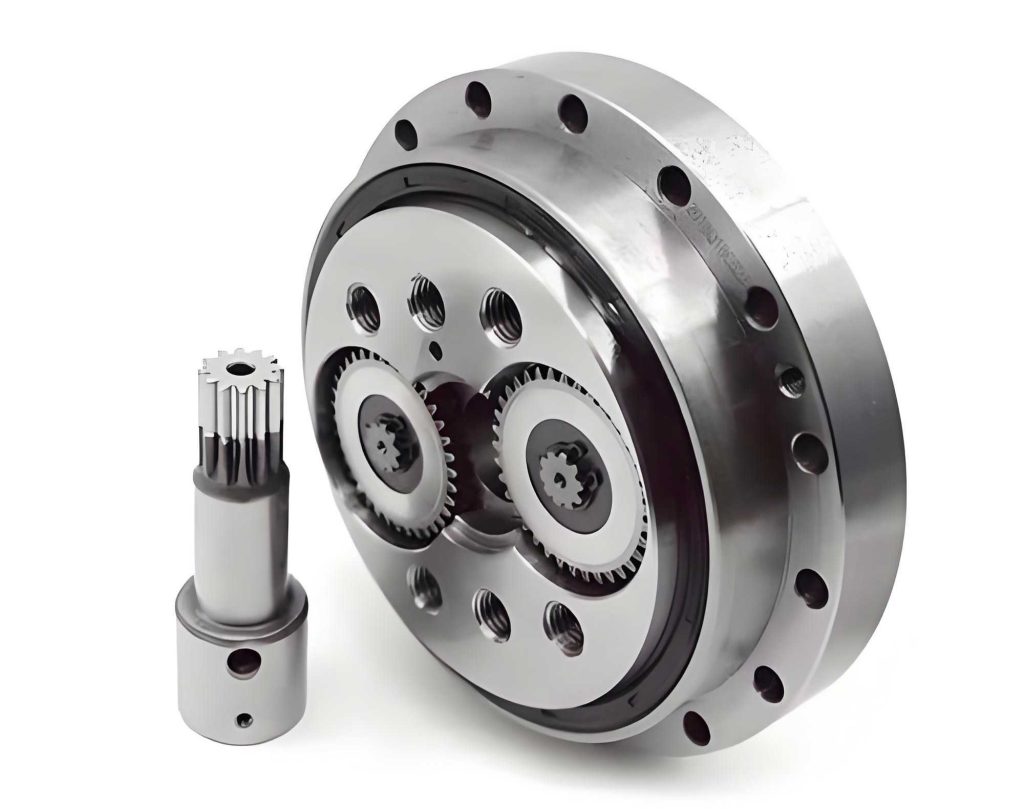
To understand the topological modification method, we first need to review the standard tooth profile of the cycloid gear in an RV reducer. The cycloid gear operates within a planetary system where it meshes with multiple pin gears arranged on a fixed ring. The standard tooth profile is derived from the epitrochoidal curve generated by the rolling motion of the pin gear relative to the cycloid gear. Using the inversion method, where the cycloid gear is held stationary and the pin gear rolls around it, we can express the tooth profile mathematically. Let the crank shaft rotation angle be $\phi$, and the cycloid gear rotation angle be $\theta = \phi / z_c$, where $z_c$ is the number of teeth on the cycloid gear. The position vector of the pin gear center relative to the cycloid gear can be written as:
$$
\mathbf{r} = a \mathbf{e}^{j(\phi_1 – \phi_2 – \pi)} + r_p \mathbf{e}^{j(-\phi_1)}
$$
Here, $a$ is the eccentricity, $r_p$ is the radius of the pin gear center circle, and $\phi_1$ and $\phi_2$ are angular parameters. The actual tooth profile of the cycloid gear is the inner equidistant curve of this path, offset by the pin gear radius $r_{rp}$. The unit normal vector $\mathbf{n}$ is given by $\mathbf{n} = \mathbf{Q} \dot{\mathbf{r}} / |\dot{\mathbf{r}}|$, where $\mathbf{Q} = \begin{bmatrix} 0 & 1 \\ -1 & 0 \end{bmatrix}$. Thus, the standard tooth profile equations in parametric form are:
$$
x = (r_p – r_{rp} S^{-1/2}) \sin((1 – i_H)\phi) + (A – K_1 r_{rp} S^{-1/2}) \sin(i_H \phi)
$$
$$
y = (r_p – r_{rp} S^{-1/2}) \cos((1 – i_H)\phi) – (A – K_1 r_{rp} S^{-1/2}) \cos(i_H \phi)
$$
In these equations, $S = 1 + K_1^2 – 2K_1 \cos \phi$, $K_1 = a z_c / r_p$ is the shortened coefficient, $i_H$ is the transmission ratio, and $A$ is the eccentric distance. These parameters are fundamental to the design of the RV reducer and influence the meshing characteristics. However, the standard profile often requires modification to account for manufacturing tolerances, thermal expansion, and lubrication needs. Our topological modification method divides the tooth profile into two segments: the working segment, where active meshing occurs, and the non-working segment, which includes the tooth tip and root. By applying different modifications to each segment, we can optimize the overall performance of the RV reducer. This segmentation is based on the actual working range of the cycloid gear, which we calculate using established methods to determine the angles $\phi_1$ and $\phi_2$ where meshing forces are significant.
The topological modification involves two key steps: corner modification for the working segment and variable equidistant modification for the non-working segment. Corner modification adjusts the tooth profile by rotating the cycloid gear through a small angle $\Delta \delta$, which introduces a controlled side clearance while preserving the conjugate nature of the meshing. This ensures that the working segment remains in optimal contact with the pin gears, reducing wear and improving transmission efficiency. Variable equidistant modification, on the other hand, alters the pin gear radius $r_{rp}$ by a function $\Delta r_{rp}(\phi)$ that varies with the angular parameter $\phi$. This function is designed to create larger clearances at the tooth tip and root, facilitating lubrication and preventing interference during assembly. The modified tooth profile equations combine these adjustments as follows:
$$
x = [r_p – (r_{rp} + \Delta r_{rp}) S^{-1/2}] \sin[(1 – i_H)\phi – \Delta \delta] + [A – K_1 (r_{rp} + \Delta r_{rp}) S^{-1/2}] \sin(i_H \phi + \Delta \delta)
$$
$$
y = [r_p – (r_{rp} + \Delta r_{rp}) S^{-1/2}] \cos[(1 – i_H)\phi – \Delta \delta] – [A – K_1 (r_{rp} + \Delta r_{rp}) S^{-1/2}] \cos(i_H \phi + \Delta \delta)
$$
Here, $\Delta r_{rp}$ is a function of $\phi$ defined piecewise based on the working segment boundaries. For the non-working segment, we express $\Delta r_{rp}$ as an exponential function fitted to known clearance values at specific points: at $\phi = 0$ (tooth root) with clearance $\mu_1$, at $\phi = \phi_1$ and $\phi = \phi_2$ (boundaries of the working segment) with zero clearance, and at $\phi = \pi$ (tooth tip) with clearance $\mu_2$. Using software like MATLAB, we can fit a function such as $\Delta r_{rp} = m_1 e^{a_c \phi} + m_2 e^{-a_d \phi} + m_3 e^{a_f \phi}$, where $m_1, m_2, m_3, a_c, a_d, a_f$ are coefficients determined from the clearance requirements. This flexible approach allows us to tailor the modification to specific RV reducer applications, ensuring that the tooth profile meets both meshing and clearance criteria. The choice of $\Delta \delta$ and the clearance parameters $\mu_1$ and $\mu_2$ can be adjusted based on operational conditions, making topological modification a versatile tool for RV reducer design.
To illustrate the application of topological modification, we consider a specific RV reducer with the following parameters: cycloid gear teeth $z_c = 39$, pin gear teeth $z_p = 40$, pin gear center circle radius $r_p = 114.5$ mm, pin gear radius $r_{rp} = 5$ mm, eccentricity $A = 2.2$ mm, and cycloid gear width $b = 10$ mm. Using established methods, we determine the working segment range as $\phi \in [\pi/6, 3\pi/4]$. For modification, we set the corner modification parameter $\Delta \delta = 0.005$ rad, which provides a side clearance of approximately 0.02 mm in the working segment. The clearances at the tooth root and tip are set as $\mu_1 = \mu_2 = 0.04$ mm. By fitting the exponential function, we obtain $\Delta r_{rp} = 9.004 \times 10^{-12} e^{7.071\phi} + 0.03998 e^{-7.071\phi}$ for the non-working segment. The resulting modified tooth profile is plotted and analyzed to assess its characteristics. The topological modification ensures that the working segment maintains a conjugate profile with minimal clearance, while the non-working segment has enlarged clearances to avoid contact and allow for lubricant flow. This design is particularly beneficial for RV reducers operating under high loads and precision requirements, as it balances meshing efficiency with durability.
One of the critical aspects of tooth profile modification is the initial meshing clearance, which affects the load distribution and backlash in the RV reducer. The initial clearance $\Delta \phi_i$ for the $i$-th tooth can be calculated using the formula derived from the variable equidistant modification. Assuming that only the variable equidistant part contributes to clearance in the non-working segment, we have:
$$
\Delta \phi_i = \Delta r_{rp} \left(1 – \frac{\sin \phi_i}{\sqrt{1 + K_1^2 – 2 K_1 \cos \phi_i}}\right)
$$
This equation shows that the initial clearance varies with the angular position $\phi_i$. For our topological modification, the clearance curve typically exhibits a U-shape, with smaller clearances in the working segment and larger clearances at the tooth root and tip. The shape of this curve depends on the parameters of the $\Delta r_{rp}$ function, particularly the exponential coefficients and clearance values. For instance, when $\mu_1$ and $\mu_2$ are fixed, the width of the U-shaped bottom (i.e., the region of small clearance) is influenced by the exponent $a$ in the exponential terms. A larger $a$ can make the transition between segments steeper, while a smaller $a$ results in a smoother transition. Similarly, if $a$ is fixed, increasing $\mu_1$ and $\mu_2$ enlarges the clearances at the extremes but does not affect the bottom width significantly. This behavior is summarized in the table below, which compares different parameter sets and their effects on initial clearance distribution.
| Parameter Set | $\mu_1$ (mm) | $\mu_2$ (mm) | Exponent $a$ | U-Shape Bottom Width | Clearance at Extremes |
|---|---|---|---|---|---|
| Set 1 | 0.04 | 0.04 | 7.071 | Wide | Moderate |
| Set 2 | 0.06 | 0.06 | 7.071 | Wide | Larger |
| Set 3 | 0.04 | 0.04 | 10.0 | Narrow | Moderate |
The U-shaped clearance curve is advantageous for RV reducer performance because it ensures that multiple teeth share the load during meshing, reducing stress on individual teeth. In the working segment, the clearance is nearly constant and minimal, promoting even load distribution and enhancing the reducer’s load-carrying capacity. Compared to traditional modification methods, topological modification offers better control over clearance distribution, leading to improved meshing stability and reduced vibration. This is especially important in high-precision applications where backlash must be minimized. By optimizing the parameters, we can achieve a clearance profile that supports smooth engagement and disengagement of teeth, thereby extending the service life of the RV reducer.
Load distribution is another key factor in evaluating the effectiveness of tooth profile modification. In an RV reducer, the cycloid gear typically meshes with several pin gears simultaneously, but due to modifications and elastic deformations, not all teeth may be in contact under load. The condition for contact is that the total deformation $\delta_i$ in the normal direction at the $i$-th meshing point exceeds the initial clearance $\Delta \phi_i$. The total deformation $\delta_i$ consists of contact deformation and bending deformation of the pin gear, though the latter is often negligible. Using Hertzian contact theory, we can express $\delta_i$ as:
$$
\delta_i = l_i \beta = \frac{\sin \phi_i}{\sqrt{1 + K_1^2 – 2 K_1 \cos \phi_i}} \delta_{\text{max}}
$$
Here, $l_i$ is the force arm at the meshing point, given by $l_i = a z_c \sin \phi_i (1 + K_1^2 – 2 K_1 \cos \phi_i)^{-1/2}$, and $\beta = \delta_{\text{max}} / l_{\text{max}}$ is the rotation angle due to deformation. The maximum deformation $\delta_{\text{max}}$ under the maximum contact force $F_{\text{max}}$ can be calculated as:
$$
\delta_{\text{max}} = W_{\text{max}} + f_{\text{max}}
$$
where $W_{\text{max}}$ is the maximum contact deformation and $f_{\text{max}}$ is the pin gear bending deformation. For materials like GCr15 steel, commonly used in RV reducers, the elastic modulus $E = 2.06 \times 10^5$ MPa and Poisson’s ratio $\nu = 0.3$. The contact deformation $W_{\text{max}}$ is given by:
$$
W_{\text{max}} = \frac{2(1 – \nu^2)}{E} \frac{F_{\text{max}}}{\pi b} \left( \frac{2}{3} + \ln \frac{16 r_{rp} \rho}{c^2} \right)
$$
with $c = 4.99 \times 10^{-3} \sqrt{\frac{2(1 – \nu^2)}{E} \frac{F_{\text{max}}}{b} \frac{2 \rho r_{rp}}{\rho + r_{rp}}}$, and $\rho$ being the curvature radius of the cycloid gear at the inflection point. The maximum contact force $F_{\text{max}}$ depends on the output torque $T$ and the load distribution among teeth. For a single cycloid gear, the torque $T_c = 0.55T$ is often assumed due to manufacturing and structural factors. The force at the $i$-th meshing point is:
$$
F_i = \frac{\delta_i – \Delta \phi_i}{\delta_{\text{max}}} F_{\text{max}}
$$
and $F_{\text{max}}$ can be iteratively solved from:
$$
F_{\text{max}} = \frac{T_c}{\sum_{i=m}^{n} \left( \frac{l_i}{r’_c} – \frac{\Delta \phi_i}{\delta_{\text{max}}} \right) l_i}
$$
where $r’_c$ is the pitch circle radius of the cycloid gear. For our RV reducer example with $T_c = 230$ N·m, we use MATLAB to solve these equations iteratively. The results show that the topological modification leads to 15 teeth in contact, with a maximum contact force $F_{\text{max}} = 393.27$ N. The load distribution across the meshing teeth is more uniform compared to traditional modifications, as evidenced by the lower peak force and higher number of contacting teeth. This uniformity reduces stress concentrations and wear, enhancing the durability and efficiency of the RV reducer. The table below summarizes the load distribution parameters for our case.
| Parameter | Value |
|---|---|
| Number of Meshing Teeth | 15 |
| Starting Meshing Tooth Index | 1 |
| Ending Meshing Tooth Index | 16 |
| Maximum Contact Force $F_{\text{max}}$ | 393.27 N |
| Material Elastic Modulus $E$ | 2.06 × 10⁵ MPa |
| Poisson’s Ratio $\nu$ | 0.3 |
The improved load distribution is a direct result of the topological modification’s ability to control initial clearances. By minimizing clearance in the working segment, more teeth participate in load sharing, which is crucial for high-torque applications in RV reducers. Additionally, the variable clearance in the non-working segment prevents premature contact at the tooth tips and roots, avoiding edge loading and associated failures. This balanced approach ensures that the RV reducer operates smoothly under varying loads, maintaining precision over time. Our analysis demonstrates that topological modification can significantly enhance the meshing performance, making it a valuable design strategy for advanced RV reducer systems.
Backlash, or lost motion, is a critical performance metric for RV reducers, especially in robotics where precise positioning is required. Backlash arises from clearances between meshing teeth and can be influenced by tooth profile modifications. In topological modification, the backlash is primarily controlled by the corner modification parameter $\Delta \delta$ and the clearances in the non-working segment. The overall backlash of the RV reducer can be estimated by summing the contributions from each meshing pair, considering both the initial clearances and elastic deformations. However, due to the conjugate nature of the working segment after corner modification, the backlash in that region is minimized and predictable. The non-working segment clearances, on the other hand, do not directly contribute to backlash under normal operating conditions because they are outside the active meshing zone. Therefore, topological modification allows for precise backlash control by adjusting $\Delta \delta$ to achieve the desired side clearance. For our example with $\Delta \delta = 0.005$ rad, the side clearance is about 0.02 mm, which translates to a minimal backlash that meets high-precision requirements. This controllability is a key advantage over traditional methods, where backlash might be more variable due to less targeted modifications.
Manufacturing considerations for topologically modified cycloid gears are also important. The modified tooth profile can be produced using form grinding, where the grinding wheel is dressed to the exact modified shape. This process is efficient and accurate, as it does not require complex adjustments to the machine tool. The corner modification and variable equidistant modification are both incorporated into the wheel profile, allowing for consistent production of gears with the desired clearances. This practicality makes topological modification feasible for industrial applications of RV reducers. Additionally, the flexibility in parameter selection enables customization for specific operating conditions, such as high-speed or high-load environments. By optimizing the modification parameters, manufacturers can produce RV reducers with enhanced performance and longevity.
In conclusion, our research on topological modification for RV reducer cycloid gears presents a novel approach to tooth profile optimization. By segmenting the tooth profile into working and non-working regions and applying tailored modifications, we achieve a balance between conjugacy, clearance, and load distribution. The derived mathematical equations provide a framework for designing modified profiles that meet specific operational needs. Our analysis of initial meshing clearance, load distribution, and backlash demonstrates the superiority of topological modification over traditional methods. The U-shaped clearance curve ensures smooth meshing transitions, while the uniform load distribution reduces wear and improves durability. For RV reducers used in precision applications like robotics, this method offers significant benefits in terms of accuracy, efficiency, and reliability. Future work could explore the effects of topological modification on dynamic behavior and thermal performance, further expanding its applicability. Overall, topological modification represents a promising advancement in the design and manufacturing of high-performance RV reducers.
The RV reducer is a complex system, and every component must be optimized for peak performance. Through topological modification, we address key challenges in cycloid gear design, contributing to the broader goal of enhancing robotic and industrial automation systems. As demand for precision motion control grows, innovations like this will play a crucial role in advancing RV reducer technology. We encourage further research and collaboration to refine this method and explore its integration with other optimization techniques. By continuing to push the boundaries of gear design, we can unlock new possibilities for RV reducers and the applications they enable.