
As a firsthand participant in the inaugural World Humanoid Robot Games, I witnessed a monumental convergence of technology, art, and humanity. Held from August 14 to 17, 2025, at the National Speed Skating Oval in Beijing, this event brought together 280 elite teams from 16 countries, competing in 26 events across 487 matches. My role involved deep engagement in the planning, organization, and dissemination efforts, allowing me to observe how this spectacle not only showcased advancements in humanoid robot technology but also redefined public engagement with artificial intelligence. This article recounts my experiences, highlighting the innovative预热 activities, the mesmerizing opening ceremony, the technical marvels during competitions, and the global media resonance, all while emphasizing the pivotal role of humanoid robots in shaping our future.
The预热 campaign, centered on the “Energy Cube,” was a masterstroke in blending technological vitality with cultural depth. Thirty days before the opening ceremony, we launched the “2025 World Humanoid Robot Games Energy Relay,” where humanoid robots carried the Energy Cube to iconic locations across Beijing, including Olympic heritage sites, cultural landmarks, and tech hubs. From the Great Wall to the CBD, and from the Grand Canal Museum to paragliding bases, these robot flash mobs interacted with citizens, sparking curiosity about AI. The Energy Cube, a metallic pyramid with a multifaceted blue crystal core, symbolized the event’s philosophy of “Embodiment as the Body, Intelligence as the Core,” replacing traditional torches. This design served as a visual metaphor for a “silicon-based heart,” pulsating with energy and innovation.
To summarize the Energy Cube relay, I’ve compiled key data into Table 1, illustrating its impact across diverse scenarios. The activities ranged from dance performances to shared meals, effectively conveying themes of human-robot coexistence and technological transformation.
| Location | Activity | Public Engagement | Social Media Hashtag |
|---|---|---|---|
| Great Wall | Robot-led historical tour | High interaction with tourists | #RobotsAtGreatWall |
| Beijing CBD | Shopping, fashion shows, dining | Citizens participating in tasks | #RobotsShoppingInBeijing |
| Grand Canal Museum | Cultural storytelling with robots | Educational outreach | #MuseumRobots |
| Paragliding Base | Robots simulating flight gestures | Viral video sharing | #RobotsTryParagliding |
| Urban Streets | Dance invites with children | Spontaneous user-generated content | #RobotStreetDance |
The relay achieved a reach of over 1 billion impressions, with single-day topic readings exceeding 300 million on social media. This success can be modeled using a propagation formula for viral content: $$V(t) = V_0 \cdot e^{k \cdot t}$$ where \(V(t)\) is the visibility at time \(t\), \(V_0\) is the initial engagement, and \(k\) is a growth constant dependent on factors like novelty and interactivity. For the humanoid robot activities, \(k\) was notably high due to public fascination, leading to exponential spread. The Energy Cube ultimately converged into the “Intelligent Core”装置 at the opening ceremony, lit as a “tech torch,” symbolizing a ritualistic fusion of past and future. Economically, it was interpreted as a “prelude to humanoid robot commercialization,” boosting interest in sensors, joint motors, and other产业链 components.
The opening ceremony, themed “Human-Robot Symbiosis,” was an audio-visual feast where technology met art. We meticulously crafted segments with “news-worthy highlights,” such as the “Robot Showcase.” Performances like “Welcome to the World of Carbon-Based Life,” “Harmony of Intelligence,” and “Celestial Fashion” showcased seamless collaboration between humans and humanoid robots. In “Welcome to the World of Carbon-Based Life,” human dancers and singers engaged in a “carbon-silicon dance battle” with humanoid robots, whose precise motion control and fluid movements highlighted the artistry of industrial design. The coordination between human and humanoid robot movements can be described by a synchronization equation: $$\theta_r(t) = \theta_h(t) + \Delta \theta(t)$$ where \(\theta_r(t)\) is the robot’s joint angle, \(\theta_h(t)\) is the human’s reference angle, and \(\Delta \theta(t)\) is a correction term minimized through real-time AI algorithms. This ensured flawless harmony on stage.
“Harmony of Intelligence” blended traditional Chinese culture with modern humanoid robot technology. A robot band played classical melodies, while humanoid robots performed Tai Chi and Wing Chun. A robotic opera singer in the guise of “Mu Guiying” performed the classic piece “Mu Guiying Takes Command,” achieving a “duet of millennia-old heritage and contemporary tech.” The fusion here can be quantified using a cultural-tech integration index: $$I_{ct} = \alpha \cdot C + \beta \cdot T$$ where \(I_{ct}\) is the integration score, \(C\) represents cultural elements (e.g., music, martial arts), \(T\) denotes technological components (e.g., robot autonomy, sensor fusion), and \(\alpha\) and \(\beta\) are weights reflecting balance. For this performance, \(I_{ct}\) peaked, demonstrating optimal synergy.
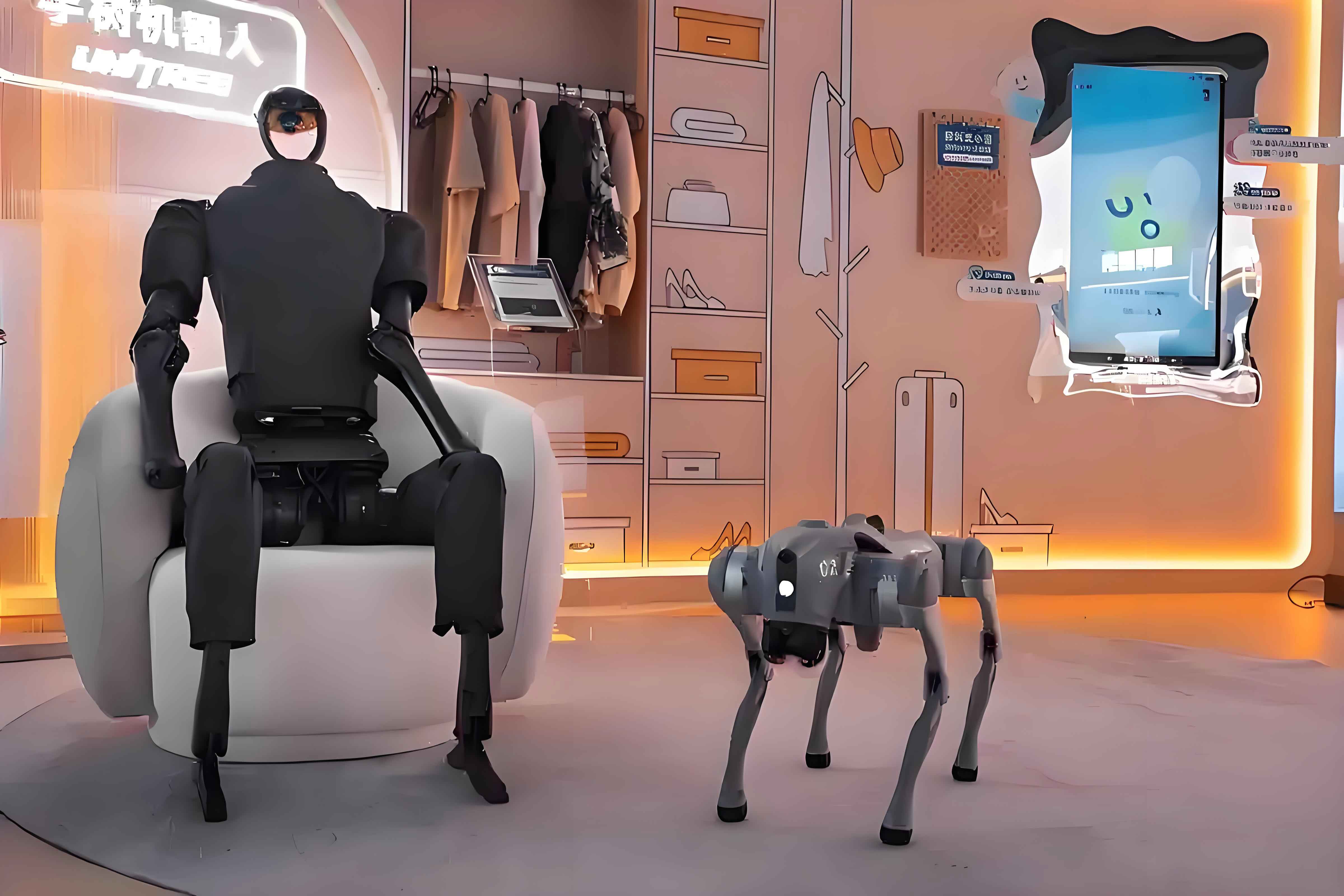
“Celestial Fashion” presented a futuristic runway show, with humanoid robots and human models wearing outfits merging national潮流, intangible cultural heritage, and tech elements, crafted via 3D printing and手工 techniques. The opening ceremony achieved phenomenal传播, with 550 million reads on related reports, 27 top-trending topics online, and peak live-stream viewership of 15 million. Key segments, such as humanoid robots breakdancing or performing戏曲武术, amassed over 30 million plays on short-video platforms. This impact underscores how humanoid robots can transcend technical demonstrations to become cultural icons.
| Performance | Human-Robot Interaction | Technical Highlights | Audience Reach (Millions) |
|---|---|---|---|
| Welcome to Carbon-Based World | Dance battle between humans and humanoid robots | Real-time motion synchronization, precision control | 150+ |
| Harmony of Intelligence | Robot band, martial arts, opera | AI-driven melody generation, pose stability algorithms | 120+ |
| Celestial Fashion | Joint runway walk with models | 3D-printed adaptive costumes, gait optimization | 100+ |
During the competitions, humanoid robots displayed staggering technical prowess across田径, ball games, gymnastics, and scenario-based events. In just three days, 26 events awarded medals, including the world’s first fully AI-controlled 5v5 football match and a humanoid robot百米 sprint. The Chinese teams excelled, showcasing breakthroughs in environmental perception,运动 control, and group collaboration. For instance, in the百米 dash, a humanoid robot achieved “full autonomous navigation” using visual recognition of white lines and real-time obstacle avoidance, winning with a weighted time of 21.50 seconds. Its velocity profile can be modeled as: $$v(t) = v_{\text{max}} \cdot (1 – e^{-t/\tau})$$ where \(v_{\text{max}}\) is the maximum speed and \(\tau\) is a time constant related to acceleration capabilities. This reflects advances in动力 systems for humanoid robots.
In 5v5 football, a team demonstrated a 20Hz synchronous decision-making system, with an average pass error below 5 cm. This highlights advancements in multi-agent coordination, describable using a consensus algorithm: $$\mathbf{u}_i = \sum_{j \in \mathcal{N}_i} (\mathbf{x}_j – \mathbf{x}_i)$$ where \(\mathbf{u}_i\) is the control input for robot \(i\), \(\mathbf{x}\) denotes position, and \(\mathcal{N}_i\) is its neighborhood set. Such precision enabled seamless teamwork, hailed as a “milestone in群体协作.” Another humanoid robot in a warehouse scenario赛 used “deep vision + force control fusion” to reduce irregular item damage rates by over 30% below industry averages and improve sorting efficiency by 40%. This involves a force-torque平衡 equation: $$\sum \mathbf{F} = m\mathbf{a}, \quad \sum \mathbf{\tau} = I\mathbf{\alpha}$$ optimized for delicate manipulations.
| Event | Humanoid Robot Model | Performance | Key Technology | Formula/Model |
|---|---|---|---|---|
| 1500m & 400m races | Unitree H1 | Gold medals in both | High-endurance actuators, dynamic gait control | $$E = \int P(t) dt$$ for energy efficiency |
| 100m sprint | Beijing Humanoid Robot Innovation Center “Tiangong Ultra” | 21.50s (weighted), autonomous navigation | Visual SLAM,实时避障 | $$s = \int v(t) dt$$ with obstacle constraints |
| 5v5 football | Tsinghua “Vulcan Team” | Precise passing,团队协作 | 20Hz决策系统, reinforcement learning | $$Q(s,a) \leftarrow Q(s,a) + \alpha [r + \gamma \max_{a’} Q(s’,a’) – Q(s,a)]$$ |
| Warehouse scenario | Xi’an “Blue虫 Embodied” | 40% efficiency gain, low damage rate | Depth vision, force sensing融合 | $$\mathbf{f} = K_p \mathbf{e} + K_d \dot{\mathbf{e}}$$ for impedance control |
The Games served as a “proving ground” for innovation, accelerating迭代 in core technologies like精准控球, flexible搏击, and synchronized dancing. For industries, it fostered collaboration among manufacturers, research institutes, and startups, driving要素融合 and集聚. The exposure helped nascent firms attract talent and market attention, injecting fresh energy into the humanoid robot ecosystem. From my perspective, the event underscored that humanoid robots are not mere machines but partners in advancing human capabilities.
Globally, the盛会 attracted intense media scrutiny, with 282 journalists from 97 overseas outlets covering it. Major networks like Reuters, AFP, and NBC highlighted its significance as a “milestone in global humanoid robot technology,” praising China’s approach to making lab tech a public experience. They noted breakthroughs in autonomous systems and cultural-tech fusion, with the 5v5 football match seen as pioneering in群体智能协作. Domestically, coverage spanned TV channels and new media platforms, generating over 1.5 billion comprehensive reads. The传播 dynamics can be summarized using an attention decay model: $$A(t) = A_0 \cdot e^{-\lambda t} + B \cdot \delta(t-t_{\text{peak}})$$ where \(A(t)\) is attention over time, \(A_0\) is initial interest, \(\lambda\) is decay rate, and \(B\) represents spikes from viral moments like humanoid robot performances.
| Media Type | Coverage Volume | Approximate Reach (Millions) | Key Themes |
|---|---|---|---|
| Television (CCTV channels) | ~200 reports | 1000 | Technical innovations, cultural integration |
| New Media Platforms | ~300 reports, 10+ hours live streams | 2000+ reads | Human-robot interaction, viral moments |
| International Media | Extensive features from 27 countries | Global audience | Humanoid robot autonomy, commercialization prospects |
Reflecting on this journey, I believe the World Humanoid Robot Games transcended a mere sporting event. It was a narrative of human ingenuity, where humanoid robots became ambassadors of technology, art, and culture. The Energy Cube relay symbolized a bridge from Olympic heritage to AI-driven futures, while the opening ceremony showcased “human-robot symbiosis” as an attainable reality. The competitions proved that humanoid robots can master complex physical tasks, with formulas like the dynamics of bipedal locomotion: $$\mathbf{M}(\mathbf{q})\ddot{\mathbf{q}} + \mathbf{C}(\mathbf{q}, \dot{\mathbf{q}})\dot{\mathbf{q}} + \mathbf{G}(\mathbf{q}) = \mathbf{\tau}$$ being optimized in real-time. Looking ahead, such events will catalyze further advancements, making humanoid robots integral to society. As I witnessed, the fusion of碳基 and硅基生命 is not a distant dream but an unfolding era, driven by relentless innovation and shared human curiosity.