
In the field of bionic robotics, the human hand stands as one of nature’s most perfect tools, capable of intricate grasping and manipulation tasks. Inspired by this, we have developed a novel underactuated dexterous robotic hand that addresses a critical limitation in traditional underactuated designs: the inability to independently control finger joint rotations. This limitation often restricts such hands to simple enveloping grasps, where finger postures adapt passively to object surfaces, rather than enabling precise grasps like fingertip pinching or precision holding. Our work introduces a joint-locking mechanism that allows each finger joint to be fixed at desired angles, thereby enhancing the hand’s versatility for both enveloping and precise grasping. This article details the design, analysis, optimization, and experimental validation of this dexterous robotic hand, emphasizing its mechanical innovations and performance. We will explore the hand’s configuration, transmission scheme, structural components such as the joint-locking and inter-finger coupling mechanisms, and key parameter optimizations. Through extensive testing, we demonstrate that our dexterous robotic hand achieves reliable joint locking, robust enveloping grasps, and enhanced precision grasping capabilities, marking a significant step forward in underactuated hand design.
The primary motivation behind our dexterous robotic hand stems from the need for cost-effective and adaptable robotic manipulation. Fully actuated dexterous hands, such as the Shadow Dexterous Hand or Robonaut 2, offer high dexterity but are often prohibitively expensive and complex to control. Underactuated hands, with fewer actuators than degrees of freedom (DoFs), provide a simpler alternative but typically lack joint controllability, limiting their grasp adaptability. Our design bridges this gap by incorporating a locking mechanism that enables selective joint fixation without additional actuators. This allows the dexterous robotic hand to perform not only adaptive enveloping grasps but also precise grasps where finger postures are actively controlled. We focus on a tendon-driven approach using pulleys and springs, with electromagnetic locks for joint fixation. The hand features five fingers, each with three rotational DoFs (15 DoFs total), mirroring human hand kinematics while simplifying the thumb for practical implementation. In the following sections, we will delve into the hand’s design principles, mechanical analysis, and experimental results, showcasing how this dexterous robotic hand advances the state of the art in robotic manipulation.
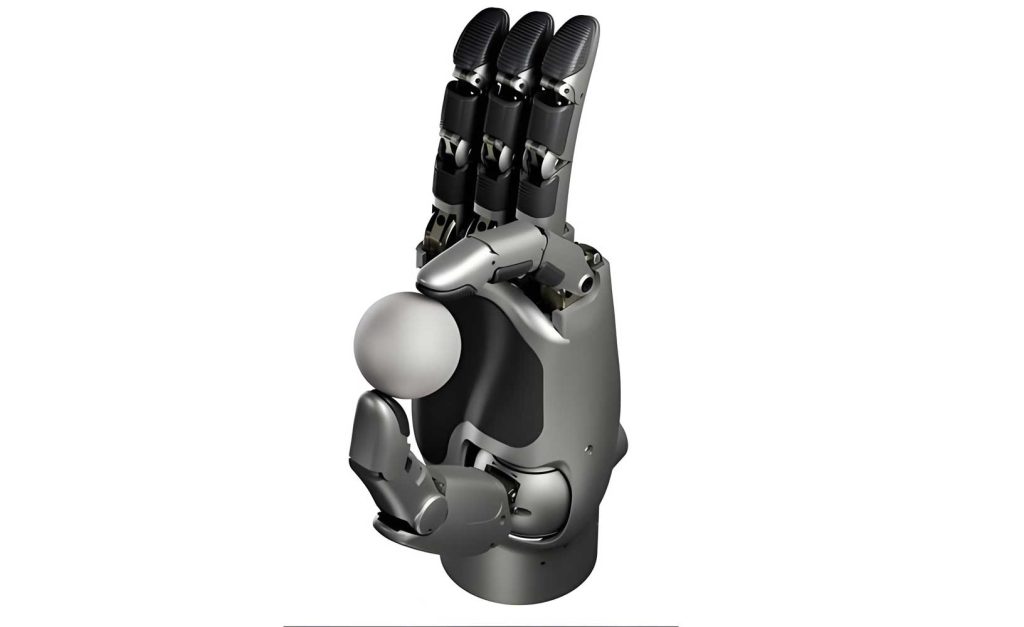
The configuration of our dexterous robotic hand is based on anthropomorphic principles, with five fingers: index, middle, ring, little, and thumb. Each finger, except the thumb, has three rotational joints corresponding to the distal interphalangeal (DIP), proximal interphalangeal (PIP), and metacarpophalangeal (MCP) joints. To simplify design and enhance modularity, the index, middle, ring, and little fingers share identical structural parameters, while the thumb is adapted with a simplified three-DoF arrangement that approximates human thumb opposition. The hand’s overall DoF count is 15, driven by only five motors—one per finger—making it underactuated yet capable of complex motions through tendon transmission and joint locking. The transmission scheme employs a single tendon per finger, routed through pulleys at each joint, with the tendon fixed at the fingertip and connected to a motor at the base. This setup allows finger flexion via tendon tension, while extension is provided by elastic cords on the dorsal side. The key innovation lies in the joint-locking mechanism, which uses electromagnetic actuators to fix joint angles selectively, enabling precise control over finger posture. This dexterous robotic hand design balances simplicity and functionality, offering a practical solution for diverse grasping tasks.
To understand the transmission dynamics, consider a single finger model. Let \( T \) be the tendon tension, \( R_i \) the pulley radius at joint \( i \) (where \( i=1,2,3 \) for DIP, PIP, and MCP joints, respectively), \( m_i \) the mass of each phalanx, \( l_i \) the phalanx length, \( d_i \) the distance from the joint to the phalanx’s center of mass, and \( \theta_i \) the joint angle relative to the previous phalanx. The tendon routing follows a path through pulleys, with geometric parameters influencing the driving torque at each joint. For the DIP joint, the driving torque \( M_1 \) is given by:
$$ M_1 = T \cdot R $$
where \( R \) is the pulley radius at the DIP joint. This simple relation indicates that increasing \( R \) enhances torque, a factor we optimize later. For the PIP and MCP joints, the torque analysis is more complex due to tendon routing via intermediate pulleys and coupling mechanisms. We will explore this in detail in the parameter optimization section. The dexterous robotic hand’s transmission is designed to maximize torque output under space constraints, ensuring sufficient force for grasping various objects.
The structural design of the fingers, particularly the index finger, incorporates the joint-locking and coupling mechanisms. Each joint features a locking assembly that functions like a sliding key. For instance, at the MCP joint, the joint pulley is integrated with a shaft that can slide axially. A spring keeps the shaft in a default position where a locking wheel disengages from teeth on the proximal phalanx, allowing free rotation. When an electromagnetic actuator is energized, it attracts an iron core attached to the shaft, moving it to engage the locking wheel with the phalanx teeth, thus fixing the joint. This mechanism is replicated across all joints, providing independent lockability. Additionally, to mimic human finger coupling where the DIP and PIP joints move in a 1:1 ratio during flexion, we incorporate a coupling mechanism using two coupling pulleys connected by a tendon. The coupling pulley can engage or disengage from the joint shaft via a spring-loaded design, allowing coupling when joints are unlocked and decoupling when any joint is locked. This ensures that the dexterous robotic hand can maintain natural finger kinematics during free movement while enabling independent joint control when needed.
The thumb design deviates slightly due to its unique role in opposition. The thumb has three joints: MCP, PIP, and DIP, with the MCP joint axis oriented at approximately 50° to the palm to simulate human thumb posture. The PIP and DIP joints include locking mechanisms, but the MCP joint omits locking to simplify design, as its rotation primarily provides grasping force rather than precise angle control. The thumb’s transmission is similar to other fingers, but without coupling between joints. This tailored approach ensures the dexterous robotic hand maintains high functionality while reducing complexity. To illustrate the finger dimensions, Table 1 summarizes the parameters for all fingers.
| Finger | Phalanx Lengths (mm) | Total Length (mm) | Joint Angle Range (°) |
|---|---|---|---|
| Index | 31.5, 33.0, 49.5 | 114 | 0–90 |
| Middle | 31.5, 33.0, 49.5 | 114 | 0–90 |
| Ring | 31.5, 33.0, 49.5 | 114 | 0–90 |
| Little | 31.5, 33.0, 49.5 | 114 | 0–90 |
| Thumb | 37.5, 50.0, 23.5 | 111 | 0–90 |
The workspace of the fingers is a critical metric for assessing dexterity. Using the Monte Carlo method in MATLAB, we simulated the workspace of the index finger and thumb by randomly sampling joint angles within their ranges (0° to 90°) and computing fingertip positions via forward kinematics. For the index finger, with 50,000 random angle sets, the workspace forms a point cloud that spans a region approximating the human finger’s reachable area. Similarly, the thumb workspace was generated, accounting for its unique joint axes. These simulations confirm that our dexterous robotic hand offers a substantial workspace for grasping objects of various sizes and shapes. The results validate the kinematic design, ensuring that the hand can perform both enveloping and precision grasps effectively.
Key to the functionality of our dexterous robotic hand are the spring parameters in the joint-locking and coupling mechanisms. Two types of springs are used: a coupling spring and a return spring. The coupling spring maintains engagement between the coupling pulley and joint shaft when joints are unlocked, enabling coupled motion between DIP and PIP joints. The return spring provides the force to return the joint shaft to its default unlocked position after locking is released. The design principles ensure that in the coupled state, the return spring force exceeds the coupling spring force, and in the locked state, the return spring force is less than the electromagnetic attraction force. Let \( k_1 \) and \( k_2 \) be the stiffnesses of the coupling and return springs, respectively. The stiffness is given by:
$$ k = \frac{G d^4}{8 D_2^3 n} $$
where \( G \) is the shear modulus of the spring material, \( d \) is the wire diameter, \( D_2 \) is the mean coil diameter, and \( n \) is the number of coils. For our design, we selected \( d_1 = 0.4 \, \text{mm} \), \( D_{2,1} = 9 \, \text{mm} \), \( n_1 = 3 \) for the coupling spring, and \( d_2 = 0.8 \, \text{mm} \), \( D_{2,2} = 14 \, \text{mm} \), \( n_2 = 3 \) for the return spring. Using stainless steel for the return spring (to avoid magnetic interference) and carbon spring steel for the coupling spring, we computed \( k_1 = 0.35 \, \text{N/mm} \) and \( k_2 = 0.49 \, \text{N/mm} \). These values ensure reliable operation of the locking and coupling mechanisms in the dexterous robotic hand.
Optimizing the driving torque at each joint is essential for maximizing the grasping force of our dexterous robotic hand. We analyzed the tendon transmission geometry, focusing on parameters like pulley radii and tendon routing paths. For the DIP joint, the torque \( M_1 \) is directly proportional to the pulley radius \( R \), so we maximized \( R \) within spatial constraints. For the PIP joint, the torque \( M_2 \) depends on multiple factors, including the geometry of intermediate pulleys (often used for tendon tensioning). Let \( r \) be the radius of a small tensioning pulley, \( a_i \) distances from pulleys to joints, and angles like \( \beta_1 \) representing tendon wrap. The torque can be expressed as:
$$ M_2 = T \left( l_2′ \sin\left(\frac{\beta_1}{2}\right) – l_1′ \sin\left(\phi_1 + \frac{\alpha_1 – \theta_1}{2}\right) \right) $$
where \( l_1′ \) and \( l_2′ \) are effective lever arms, \( \alpha_1 \) is the tendon wrap angle at the DIP pulley, and \( \phi_1 \) is a structural angle. To increase \( M_2 \), we should increase \( r \) and position the small pulley farther from the joint center, which enlarges \( \beta_1 \) and \( l_2′ \). Additionally, reducing \( \phi_1 \) minimizes negative torque contributions. Similarly, for the MCP joint, optimizing pulley placement and radii enhances torque. We conducted a parametric study using MATLAB to iteratively adjust these parameters, balancing torque maximization with practical design limits. Table 2 summarizes the optimized values for key transmission parameters in the index finger.
| Parameter | Symbol | Optimized Value (mm) |
|---|---|---|
| DIP pulley radius | \( R_1 \) | 5.0 |
| PIP pulley radius | \( R_2 \) | 5.0 |
| MCP pulley radius | \( R_3 \) | 5.0 |
| Small pulley radius | \( r \) | 2.5 |
| Distance a2 | \( a_2 \) | 15.0 |
| Distance a3 | \( a_3 \) | 20.0 |
These optimizations ensure that our dexterous robotic hand can generate sufficient grasping force across all joints, even with a single tendon drive. The tendon tensioning mechanism, integrated into the phalanges, allows for fine adjustment of tendon slack during joint locking, maintaining consistent torque transmission. This attention to detail in parameter optimization is crucial for the hand’s performance, enabling it to handle objects with varying weights and surfaces.
To validate our design, we fabricated a prototype of the dexterous robotic hand using photosensitive resin for the finger structures, with rubber coatings on fingertips to increase friction. The hand is equipped with FSR400 pressure sensors on each phalanx to monitor grasping forces. We conducted two types of grasping experiments: enveloping grasps and precision grasps. In enveloping grasp tests, all fingers flex without joint locking, adapting to object shapes. The dexterous robotic hand successfully grasped objects like square and cylindrical bottles, as well as small tool bottles, demonstrating stable and adaptive enveloping capabilities. In precision grasp tests, we activated the joint-locking mechanisms to fix finger postures for fingertip pinching. The hand reliably pinched small items such as bottle caps, coils, tweezers, and screwdrivers, showing that the locking mechanisms work effectively and provide stable precision grasps. These experiments confirm that our dexterous robotic hand combines the adaptability of underactuated designs with the controllability of fully actuated hands, making it versatile for real-world applications.
The success of these tests underscores the innovation in our dexterous robotic hand. By integrating joint locking without additional actuators, we have created a cost-effective solution that bridges the gap between simple underactuated hands and complex fully actuated ones. The hand’s modular design allows for easy maintenance and scalability, while the optimization of transmission parameters ensures robust performance. Future work may focus on enhancing the control system for autonomous operation or extending the design to multi-fingered manipulation tasks. Nonetheless, the current prototype proves the feasibility and effectiveness of our approach.
In conclusion, we have presented a novel underactuated dexterous robotic hand with independently controllable finger joints through a joint-locking mechanism. This dexterous robotic hand features a tendon-driven transmission, modular finger design, and optimized parameters for maximum torque. The locking mechanism allows selective joint fixation, enabling both enveloping and precision grasps—a significant advancement over traditional underactuated hands. Our analysis of spring parameters and transmission geometry, supported by simulations and experiments, validates the hand’s design and functionality. The dexterous robotic hand demonstrates strong grasping adaptability and stability, making it suitable for various robotic manipulation tasks. This work contributes to the field by offering a practical, low-cost dexterous robotic hand that does not compromise on performance, paving the way for broader adoption in industries such as manufacturing, healthcare, and service robotics.