
URKL, initiated by the humanoid robot company behind the T800 platform, is positioned as the world’s first industry-level humanoid robot fighting competition. The event is designed to turn the physical capabilities, control algorithms and real-time decision-making of humanoid robots into a visible, testable and publicly engaging form of technological demonstration. By placing full-size humanoid robots in a competitive arena, URKL is intended to do more than attract spectators. It is intended to create a shared platform where universities, technology companies and research institutions can test ideas, compare algorithms and accelerate the application of embodied intelligence.
The competition has already drawn attention through public demonstrations in which the T800 full-size general-purpose humanoid robot performed a range of high-dynamic movements. These movements included a kip-up, dragon-like evasive footwork and an airborne knee strike, reproducing movements that had previously attracted attention at URKL. The demonstrations in the Shenzhen showroom drew cheers from the audience and underlined how a humanoid robot can combine mechanical strength, balance control and motion planning in a single platform. For the humanoid robot industry, such demonstrations are important because they translate technical progress into observable performance.
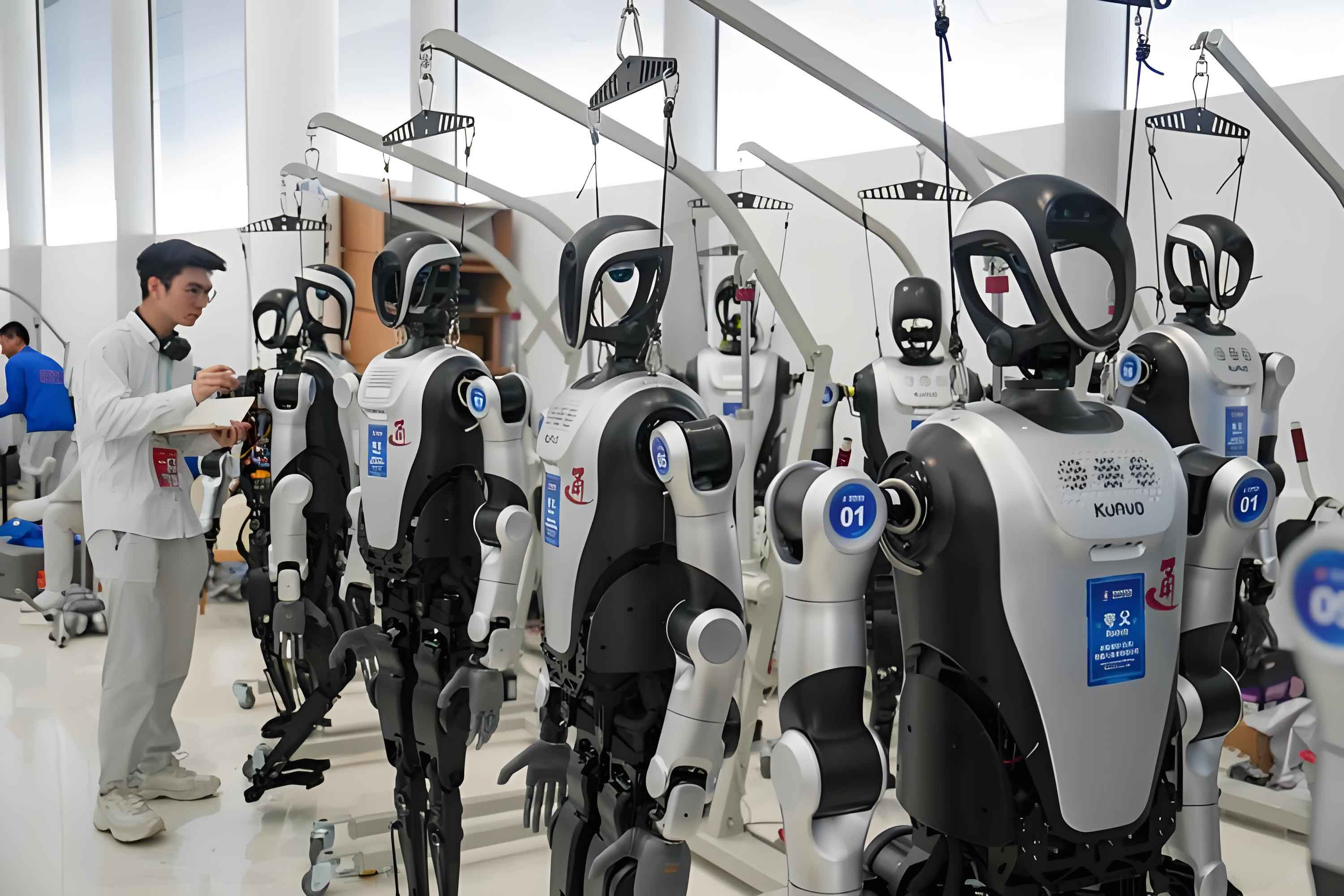
1. URKL Puts Humanoid Robot Combat on an Industry Stage
URKL is described as the world’s first industry-level humanoid robot fighting competition. It is not simply a show match for a single humanoid robot model. Instead, it is structured as an open competition in which the T800 serves as the unified competition platform. Teams from global universities, technology companies and research institutions are invited to participate by optimizing AI perception decision-making, balance control and motion algorithms. The goal is for the humanoid robot to achieve autonomous perception, autonomous attack and defense, and autonomous decision-making during combat.
The competition’s design reflects a broader shift in the humanoid robot sector. Early public demonstrations often focused on walking, waving or simple object interaction. URKL moves the humanoid robot into a more demanding setting where balance, impact resistance, rapid response and real-time decision-making matter at the same time. The humanoid robot must process sensory information, maintain posture and choose actions under pressure. That combination makes the competition a practical stress test for embodied intelligence.
The event’s high-threshold competition settings, complete event system and high-value prize incentives have helped it gain broad social attention. URKL has been held in Shenzhen and Shanghai, and it has attracted more than 30 million live broadcast views together with more than 510 million related video plays across the web. Those figures indicate that the humanoid robot competition format has moved beyond a narrow technical audience and into wider public conversation.
2. T800 Demonstrates the Physical Capability of a Humanoid Robot
The T800 is a full-size general-purpose humanoid robot and the competition model most familiar to the public because of its frequent appearances. It stands 1.73 meters tall and features a hard-edged mecha appearance with body proportions close to those of a human. That design fits the popular imagination of a mecha warrior while also giving the humanoid robot a distinctive visual identity. In a crowded humanoid robot track, visual and functional identity can help a platform gain market recognition and public understanding.
The T800 is equipped with the company’s latest full-stack self-developed core technologies. It has 450 N·m of high-burst torque, which supports high-dynamic and complex movements such as a spinning kick and rapid recovery after falling. During the demonstration, the humanoid robot showed that it could execute movements requiring coordinated control of multiple joints and rapid shifts in center of gravity. Such movements are not only visually striking. They also reveal how a humanoid robot can manage force, balance and timing in real time.
The robustness of the T800 was also placed on display. Even when multiple reporters applied external kicks and pushes, the humanoid robot remained standing. This demonstrated the platform’s impact-resistant structure and whole-body dynamic balance control. For future humanoid robot applications, this kind of anti-interference and posture-stabilizing capability is essential. A humanoid robot operating in a factory, a commercial space or a home will encounter uneven surfaces, unexpected contact and changing physical conditions. The ability to maintain stability under disturbance is therefore a core capability for real-world deployment.
3. A Humanoid Robot Portfolio Connects Multiple Application Scenarios
The company was founded in 2023 and has built a full-stack embodied intelligence technology base spanning the physical body, cerebellar motion control and brain-level cognition. This technology base supports a portfolio that includes the T800, PM01, SE01, SA01 and JS01. The portfolio covers entertainment and exhibition performances, commercial services, smart traffic management, industrial intelligent manufacturing, and scientific research and education. The range of scenarios shows that the humanoid robot is being developed not only as a single demonstration product but also as a platform family with different application directions.
For the humanoid robot industry, a portfolio approach can support several goals at once. It can allow different robot platforms to address different scenarios, while shared technology foundations can support motion control, perception and cognition. The T800, as the URKL competition platform, benefits from this broader technology base. Its public role in the competition also helps the company communicate the capabilities of its humanoid robot platform to a wider audience.
| Item | Reported Detail |
|---|---|
| Competition | URKL, described as the world’s first industry-level humanoid robot fighting competition |
| Competition platform | T800 full-size general-purpose humanoid robot |
| T800 height | 1.73 meters |
| T800 torque | 450 N·m high-burst torque |
| Demonstrated actions | Kip-up, dragon-like evasive footwork, airborne knee strike, spinning kick and rapid recovery after falling |
| Robustness demonstration | The humanoid robot remained standing after external kicks and pushes from multiple reporters |
| Humanoid robot portfolio | T800, PM01, SE01, SA01 and JS01 |
| Application coverage | Entertainment and exhibition performances, commercial services, smart traffic management, industrial intelligent manufacturing, and scientific research and education |
| URKL locations | Shenzhen and Shanghai |
| Live broadcast views | More than 30 million |
| Related video plays | More than 510 million across the web |
4. URKL Builds a Shared Humanoid Robot Innovation Platform
URKL is open to global universities, technology companies and research institutions. By providing the T800 as a unified competition platform, the event gives participating teams a common hardware base on which to optimize AI perception decision-making, balance control and motion algorithms. This structure is important for humanoid robot research because it allows different teams to focus on algorithms and strategies while working with the same physical platform. Comparisons become more meaningful when the hardware foundation is shared.
The competition requires humanoid robots to perform autonomous perception, autonomous attack and defense, and autonomous decision-making. These capabilities sit at the center of embodied intelligence. A humanoid robot must interpret what is happening in the arena, decide how to respond and execute a movement that maintains balance and effectiveness. The competition format therefore combines perception, cognition and action in a single task. For researchers, this can serve as a demanding benchmark for humanoid robot software and control systems.
The event also creates a public stage for technical display and algorithm comparison. In a conventional laboratory setting, progress in humanoid robot control may be difficult for non-specialists to evaluate. In a competition setting, performance becomes visible through movement, recovery, stability and decision-making. This visibility can help attract talent, encourage collaboration and communicate the state of humanoid robot technology to a broader audience. The company describes URKL as an innovation platform that integrates technology display, algorithm comparison and industry-academia-research collaboration.
5. Humanoid Robot Competition Reveals Gaps That Guide Iteration
The value of URKL is not limited to successful performances. High-intensity attack and defense confrontations can fully expose technical shortcomings in humanoid robot balance control, impact-resistant structures and real-time decision-making. These shortcomings become important reference points for technology iteration outside the arena. In this sense, the competition functions as a stress test that reveals where a humanoid robot platform needs further development.
For example, a humanoid robot may maintain balance during planned movements but struggle when contact or sudden disturbances occur. A competition environment introduces uncertainty and physical interaction that can reveal weaknesses in control algorithms, joint response and structural design. By observing how a humanoid robot reacts under pressure, teams can identify specific areas for improvement. The lessons learned in the arena can then feed back into research and development for future humanoid robot platforms.
The company states that the humanoid robot ecosystem is a cycle in which technology research and development, open collaboration, scenario validation and commercial deployment reinforce one another. URKL is presented as a representative case of this ecosystem exploration. The competition creates a scenario for validation, attracts external teams and generates public attention. These elements can support further technical development and industrial collaboration. The event is therefore not separated from product development but connected to it through testing, feedback and iteration.
6. Humanoid Robot Ecosystem Links Research, Validation and Commercial Deployment
The humanoid robot sector requires more than isolated breakthroughs. It requires a connected system in which research institutions, technology companies, component suppliers, application partners and end users can exchange knowledge and validate performance. URKL is designed to support this kind of connection by bringing multiple participants onto a shared platform. The competition provides a common task and a common hardware base, allowing teams to compare approaches and learn from one another.
Scenario validation is particularly important for humanoid robots. A humanoid robot that performs well in a laboratory may face different challenges in a factory, a commercial service environment or a home. These environments involve changing surfaces, human presence, unexpected contact and real-time decision-making. Although URKL is a competition, its emphasis on balance, impact resistance and autonomous decision-making connects to these broader application requirements. The company states that anti-interference and posture-stabilizing motion capabilities are indispensable for future humanoid robots entering factories and homes.
Commercial deployment also depends on public understanding and market recognition. A humanoid robot platform needs a distinctive identity and demonstrated capability to gain attention in a crowded market. The T800’s mecha-style appearance and high-dynamic movements help create that identity. URKL amplifies this effect by placing the humanoid robot in a competitive and visually engaging format. The result is a platform that can communicate technical progress while also building public interest in the humanoid robot category.
7. Humanoid Robot Public Engagement Extends Beyond the Arena
The public response to URKL shows that humanoid robot competition can reach audiences beyond engineering circles. More than 30 million live broadcast views and more than 510 million related video plays across the web indicate strong interest in the event. This attention can support the humanoid robot industry by increasing awareness, attracting talent and encouraging discussion about future applications. It also gives companies a way to demonstrate capabilities in a format that is easier to understand than a technical paper or laboratory report.
At the same time, public engagement must be connected to substantive technical development. URKL is designed to do this by requiring participating teams to work on AI perception decision-making, balance control and motion algorithms. The competition is not only a display of pre-programmed movements. It is a test of autonomous perception, autonomous attack and defense, and autonomous decision-making. This combination of public spectacle and technical challenge is what makes the humanoid robot competition relevant to the industry.
The T800 demonstration in the Shenzhen showroom illustrated this connection. The humanoid robot performed a kip-up, dragon-like evasive footwork and an airborne knee strike, reproducing movements from URKL and drawing cheers from the audience. The same platform also demonstrated robustness when multiple reporters applied external kicks and pushes, yet the humanoid robot remained standing. These moments show how physical performance can become a communication tool for the humanoid robot industry while still reflecting underlying engineering capabilities.
8. Humanoid Robot Development Benefits From Open Collaboration
The company behind URKL emphasizes open collaboration as part of its humanoid robot ecosystem strategy. By inviting global universities, technology companies and research institutions to participate, the competition creates opportunities for external teams to work with the T800 platform. This can accelerate algorithm development and generate new approaches to perception, balance and decision-making. It can also help identify common challenges that are best addressed through collaborative research.
Open collaboration is especially valuable for humanoid robots because the technology spans multiple disciplines. Mechanical design, actuators, control systems, perception, AI decision-making and human-robot interaction all contribute to overall performance. A competition platform can bring specialists from different fields together around a shared problem. The URKL format gives them a common reference point and a clear performance environment. This can make collaboration more concrete and measurable.
Zhao Tongyang, founder and CEO of the company, said that the humanoid robot ecosystem is a cycle in which technology research and development, open collaboration, scenario validation and commercial deployment reinforce one another. He described URKL as a representative case of the company’s ecosystem exploration. He also said that the arena is not only a stage for mecha-style competition but also an innovation platform integrating technology display, algorithm comparison and industry-academia-research collaboration. The company hopes to use the event as a link to connect industry, academia and research, and to let URKL gradually become a platform for technical exchange and industrial collaboration, achieving the goal of promoting research through competition and promoting industry through competition.
9. Humanoid Robot Competition as a Practical Route to Embodied Intelligence
The humanoid robot industry is often described in terms of long-term potential, but progress depends on practical validation. URKL provides a setting in which humanoid robots must act under pressure, recover from disturbance and make decisions in real time. These requirements connect directly to embodied intelligence, where perception, cognition and action are integrated in a physical system. The competition therefore offers a practical route for testing and demonstrating embodied intelligence capabilities.
The T800’s 450 N·m high-burst torque, 1.73-meter height and full-size general-purpose design support the physical demands of the competition. Its ability to perform a spinning kick, recover quickly after falling and remain standing under external force demonstrates the importance of coordinated motion control and structural robustness. These capabilities are relevant to future humanoid robot applications in factories, commercial environments and homes. The competition format turns these capabilities into observable events that can be compared and discussed.
URKL also supports the development of a humanoid robot community. Teams from universities, companies and research institutions can share ideas, compare algorithms and learn from common challenges. The event’s locations in Shenzhen and Shanghai, together with its online reach, create opportunities for broader participation and attention. As the humanoid robot sector continues to grow, platforms that connect research, validation and public engagement can help accelerate the transition from demonstration to application.
The company’s stated goal is to use URKL as a link between industry, academia and research. The competition is intended to evolve from a pure competitive event into a platform for technical exchange and industrial collaboration. In this vision, the humanoid robot arena becomes a place where technical shortcomings are exposed, algorithms are compared and scenarios are validated. The lessons learned can then support further development of humanoid robot platforms and the wider embodied intelligence ecosystem.
For the humanoid robot industry, the significance of URKL lies in its combination of physical performance and collaborative research. The T800 provides a full-size general-purpose humanoid robot platform with high-burst torque and dynamic balance capabilities. URKL provides a structured competition in which autonomous perception, autonomous attack and defense, and autonomous decision-making are required. Together, they create a practical setting for testing humanoid robot technology and communicating its progress to the public. The event also supports the company’s broader effort to build a humanoid robot ecosystem in which research, collaboration, validation and commercial deployment reinforce one another.
As humanoid robot development moves toward real-world applications, the ability to withstand disturbance, maintain balance and make rapid decisions will remain central. URKL places these requirements at the center of a competitive format. The competition’s open structure, shared T800 platform and emphasis on algorithm optimization give participating teams a common ground for innovation. The public attention generated by the event adds another layer by increasing awareness of humanoid robot capabilities and encouraging wider discussion about future applications. In this way, URKL aims to contribute to the humanoid robot sector not only through competition but also through collaboration, technical exchange and industry-academia-research linkage.