
Xi’an, China — The School of Mechanical Engineering at Xi’an Jiaotong University has developed a virtual simulation experiment system for humanoid robot education, creating an immersive and knowledge-graph-guided environment in which students can assemble, control, debug, and evaluate a humanoid robot. The system is designed to address long-standing constraints in physical robotics laboratories, including limited space, high operating costs, safety risks, and short teaching windows. By allowing repeated practice in a virtual setting, the platform enables students to explore the full process of humanoid robot design and implementation without being restricted by physical hardware. The work involves contributions from Xi’an Jiaotong University’s School of Mechanical Engineering and Beijing Zengyi Huichuang Technology Co., Ltd.
The humanoid robot virtual simulation experiment system organizes learning around four experimental projects: system explanation and motion control, component recognition and assembly and disassembly, component control, and virtual-real integration. A knowledge graph functions as a learning navigation map, helping students move through the major modules of the humanoid robot system while providing real-time feedback on their progress. The system is also used for automatic grading and assessment, strengthening the interaction between teaching and learning.
- Humanoid Robot Education Moves Beyond the Physical Laboratory
Robotics is an interdisciplinary field that brings together mechanical engineering, automation, electronics, information technology, and artificial intelligence. As a highly integrated technology, the humanoid robot represents one of the most visible and demanding expressions of this convergence. A humanoid robot can execute complex tasks, use sensors to perceive its environment, and apply intelligent algorithms for decision-making and response. These capabilities connect directly to applications in industrial manufacturing, medical services, agricultural production, education, and scientific research. Because of this breadth, the humanoid robot has become an important subject in engineering education and a practical platform for teaching system integration.
Traditional humanoid robot education has relied heavily on physical laboratories. Physical teaching is intuitive and authentic, but it also presents significant difficulties. Laboratory space is often limited, making it hard to provide every student with enough hands-on time. The purchase, maintenance, and operation of humanoid robot hardware can be expensive, placing pressure on educational institutions. Safety risks, complex debugging procedures, and the need for careful supervision further reduce the time available for exploration. In many cases, the reversibility of physical experiments is poor: once a humanoid robot is damaged or a control parameter causes unstable motion, the learning process may be interrupted. Hardware limitations and a single experimental scenario can also restrict student creativity and practical problem-solving.
Virtual simulation offers a different pathway. By using modern information technology, virtual simulation can break through physical limitations, reduce costs, and provide flexible and reversible experimental content. For humanoid robot education, virtual simulation creates an open, interactive, and immersive learning experience. Students can test control strategies, assemble mechanisms, and observe motion responses without risking expensive equipment. They can repeat experiments, vary parameters, and learn from failure in a safe environment. The humanoid robot virtual simulation experiment system developed at Xi’an Jiaotong University is positioned within this educational shift.
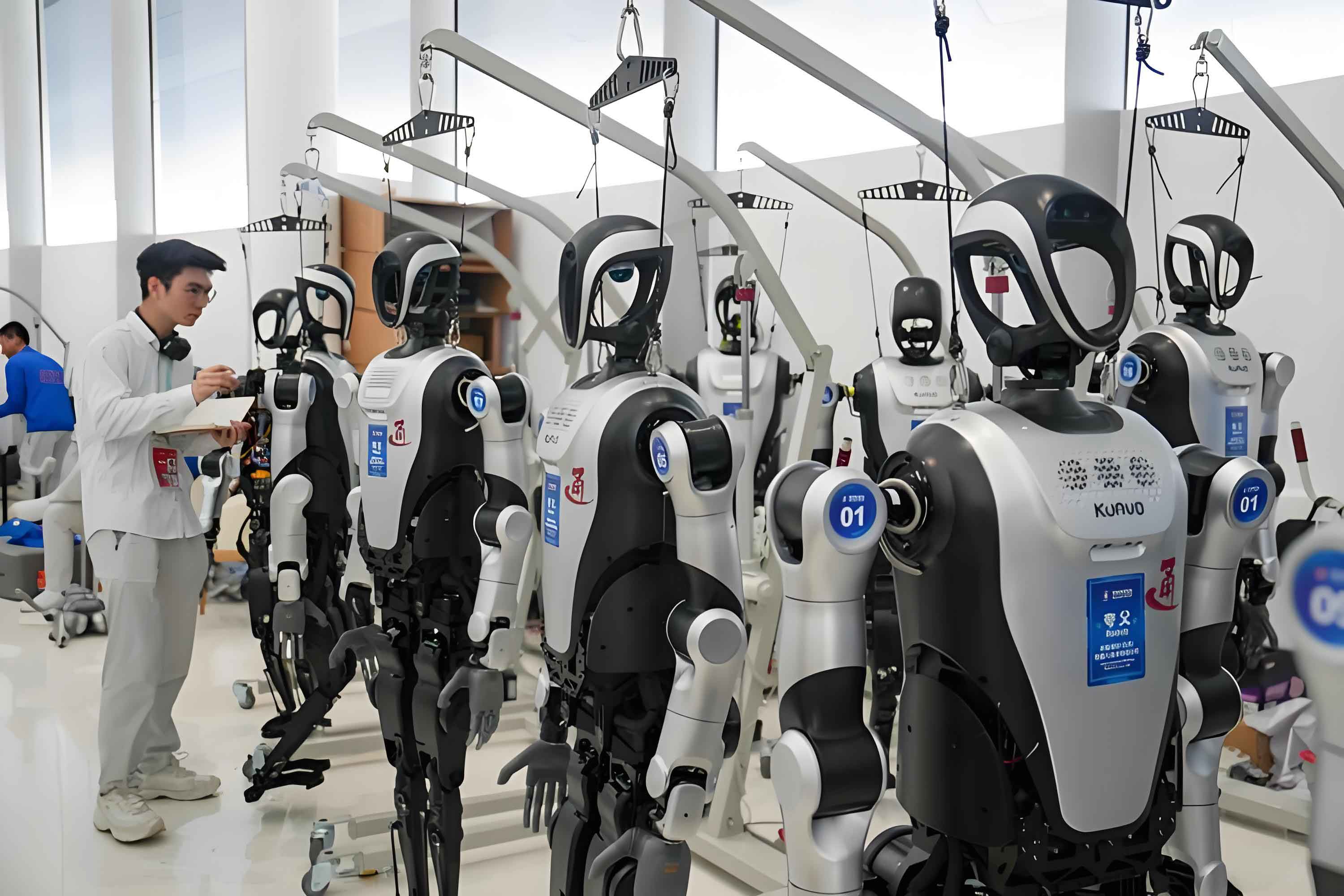
As humanoid robot technology advances, quality inspection and reliable performance evaluation remain important concerns for both industry and education. Students who learn through a humanoid robot virtual simulation environment can gain a stronger understanding of how mechanical structure, electronic control, sensing, and software algorithms interact. This understanding is essential for future work in robotics, smart manufacturing, and intelligent systems.
- The Humanoid Robot Curriculum Challenge and the Case for Virtual Simulation
Robotics courses have become increasingly common in universities around the world. Leading institutions have integrated theory and practice to teach robot design, control, perception, and system integration. The humanoid robot is particularly valuable in this context because it combines mechanical design, motion control, artificial intelligence, and embedded systems in a single platform. It allows students to see how individual components contribute to a complete robotic system and how software decisions produce physical behavior.
Despite this value, humanoid robot teaching faces persistent obstacles. A physical humanoid robot requires a controlled environment, careful handling, and regular maintenance. Its joints, servos, motors, sensors, and controllers can be damaged by improper operation. The cost of replacing components and maintaining multiple units can be high. In a typical course, the number of available humanoid robots may be small relative to the number of students, which reduces individual practice time. Scheduling is another challenge: laboratory sessions must be arranged within limited hours, and students may not have the opportunity to repeat experiments at their own pace.
These constraints have encouraged educators to explore virtual simulation as a complementary or alternative teaching method. A virtual humanoid robot can be assembled, wired, programmed, and tested without physical wear. Students can reset the system instantly, try different configurations, and observe the results of control algorithms. Virtual simulation also supports remote learning and flexible scheduling. However, virtual teaching introduces its own questions: how to preserve realism, how to maintain interactivity, and how to assess learning effectively.
The humanoid robot virtual simulation experiment system addresses these questions by combining structured content, interactive operation, and a knowledge graph. The humanoid robot is not presented as a single animated object but as a system with mechanical, electronic, and control layers. Students encounter the humanoid robot as a complete engineering problem: they must recognize parts, understand connections, apply control principles, and evaluate motion outcomes.
Challenge in Physical Humanoid Robot Teaching Virtual Simulation Response Educational Effect Limited laboratory space and equipment Virtual humanoid robot models accessible through a software platform More students can practice without waiting for physical hardware High purchase, maintenance, and operating costs Reusable digital components and resetable experiments Reduced cost pressure while preserving system-level learning Safety risks and hardware damage Risk-free trial of assembly, wiring, and control parameters Students can explore failure and recovery without damaging equipment Limited time and inflexible scheduling Self-paced access and repeated practice Improved flexibility and stronger autonomous learning Single experimental scenario Multiple modules covering assembly, component control, and motion control Broader understanding of humanoid robot system integration - A Knowledge-Graph-Guided Humanoid Robot Virtual Simulation System
The humanoid robot virtual simulation experiment system integrates mechanical engineering, virtual reality technology, and automatic control theory. Its overall design covers mechanism design, control strategy, and comprehensive debugging. The system presents the humanoid robot as a complete system and places overall debugging at the center of the learning experience. It includes three major modules: assembly, component control, and motion control. These modules cover key areas of humanoid robot technology and allow students to move from mechanical structure to automatic control and then to motion commissioning.
The assembly module concerns the design and function of the arm, head, hand, and chassis. Students learn how the humanoid robot is constructed and how different mechanical parts work together. The component control module introduces wiring methods, control principles, and core technologies related to humanoid robot movement. The motion control module uses kinematic models and mathematical tools to achieve precise control of the humanoid robot. This systematic design helps students understand not only individual components but also the coordination mechanisms that allow a humanoid robot to operate as an integrated system.
A knowledge graph serves as the navigation map for the humanoid robot virtual simulation experiment system. It helps students quickly master the three modules and the relationships among knowledge points. As students complete tasks, the knowledge graph records their progress and reflects their learning status through the illumination of knowledge points. This visual representation allows learners to see what they have covered and what remains to be explored. It also supports instructors by providing a structured view of student progress across the humanoid robot curriculum.
Module Main Focus Related Experiment Learning Objective Assembly Arm, head, hand, and chassis design and function Component recognition and assembly and disassembly Understand humanoid robot mechanical structure and assembly sequence Component Control Wiring, servo control, motor control, and PID principles Component control Understand electronic connections and low-level humanoid robot control Motion Control Kinematic models and mathematical tools System explanation and motion control Understand how humanoid robot motion is planned and controlled Virtual-Real Integration Sensor signals, posture capture, and shared viewpoints Virtual-real integration Connect virtual control paths with physical humanoid robot behavior - Inside the Humanoid Robot Virtual Simulation Experiments
The humanoid robot virtual simulation experiment system is organized into four projects. Each project targets a different layer of humanoid robot competence, and together they form a sequence from awareness to assembly, from component control to full-system integration. The sequence allows students to build knowledge progressively and then apply it in a virtual-real setting.
System explanation and motion control. In this experiment, students enter a highly realistic virtual scene and control a humanoid robot. They learn about the history of robotics and the main components of the humanoid robot. The experience is designed to feel like being in a real laboratory, providing an immersive learning environment. Students can freely view and operate key parts of the humanoid robot, observe motion forms, and analyze behavioral characteristics. The interactive and operational nature of virtual simulation makes learning more engaging and effective. Students can repeatedly try different operations and deepen their understanding of complex kinematics and dynamics. Abstract theory is transformed into practical operation, and the limitations of time and space are reduced. Students can learn at any time and place, improving efficiency and helping them master humanoid robot knowledge comprehensively.
Component recognition and assembly and disassembly. This part includes four submodules for the head, arm, hand, and chassis, along with an overall assembly module. Combining mechanical structure and design knowledge, the system provides a detailed breakdown and analysis of the humanoid robot structure. Students divide the humanoid robot structure into key parts and use the parts library to assemble components step by step until the complete humanoid robot is constructed. In the virtual assembly interface, joint modules can be dragged and connected, and teaching prompts are provided. The parts library contains various servos, sheet metal parts, and DC motors. The central area displays the target assembly shape, helping students clarify the assembly direction. When the cursor hovers over a part, relevant information about that part is displayed. After assembly is completed, the system automatically generates a structural motion animation, helping students understand the function and working principle of the mechanical mechanism.
Component control. The humanoid robot virtual simulation system includes circuit knowledge, servo motion control, and DC motor PID control. These are divided into three modules that are connected to one another, deepening students’ understanding of servo control and motor control principles. The virtual simulation interface uses Arduino, one of the most commonly used control chips. Students simulate wiring by clicking with the mouse, and only after completing the wiring can they proceed to the next experiment. For servo circuit wiring, the servo has three lines to connect: ground, +5 V power, and signal reception. Students determine how to connect them by clicking the mouse. In the humanoid robot model, servos are widely used in the head and arms. The system shows the correspondence between servo control angle and PWM waveform, helping students understand how PWM affects the servo control angle and master the basic principles of servo control. The chassis of the humanoid robot uses motor control. In servo motor control, PID control is one of the most common methods. The system establishes a second-order transfer function model between motor control voltage and rotation angle. By adjusting different PID parameters, students can visually understand the time-domain response curves of the motor under different PID settings.
Virtual-real integration. After students complete the earlier virtual experiments and master humanoid robot control methods, they proceed to physical experiments. Posture sensors capture human posture information, and sensors placed on multiple body parts collect signals. These signals are processed by control algorithms to achieve precise control of the humanoid robot. Students wear VR glasses and observe a viewpoint shared with the humanoid robot, integrating visual, posture, and position information. This process combines human motion, a physical humanoid robot, and a virtual humanoid robot into a single learning experience. It strengthens students’ understanding of humanoid robot control, allows them to intuitively experience how sensor data drives humanoid robot motion, reinforces the connection between theory and practice, and improves operational ability and innovative thinking.
Experimental Project Core Activity Key Technology or Concept Student Learning Outcome System Explanation and Motion Control Observe and operate a humanoid robot in a virtual scene Humanoid robot history, components, kinematics, dynamics Build foundational understanding of humanoid robot motion Component Recognition and Assembly and Disassembly Drag, connect, and assemble humanoid robot parts Mechanical structure, servos, sheet metal parts, DC motors Understand humanoid robot construction and mechanism function Component Control Complete wiring and tune servo and PID control Arduino, PWM, servo angle, DC motor PID Understand low-level humanoid robot electronic control Virtual-Real Integration Control a physical humanoid robot through posture and sensor signals Posture sensors, VR viewing, control algorithms Transfer virtual control paths to real humanoid robot behavior - Teaching Reform: Problem-Oriented Learning and Flexible Access
The humanoid robot virtual simulation experiment system supports a teaching model that is more flexible than traditional laboratory instruction. In the reformed approach, student experiments are no longer limited to a centrally scheduled time and place. Instead, instructors assign experimental tasks, and students complete them independently. Students can choose when to log in to the platform and conduct experiments, and they can communicate with teachers in real time through the network. This model helps alleviate problems such as limited laboratory space, insufficient equipment, difficult scheduling, and shortage of teaching staff. It also improves teaching flexibility and students’ autonomous learning ability.
The humanoid robot virtual simulation system also provides strong support for theoretical teaching. For example, when explaining the D-H matrix for humanoid robot kinematics, instructors can use the motion control of a mechanical arm to visually demonstrate the relevant content. This helps students better understand and master complex theoretical knowledge, improving teaching effectiveness and efficiency. The humanoid robot becomes a bridge between mathematical representation and physical motion, allowing students to see how coordinate frames, joint parameters, and control commands relate to observable behavior.
Problem-oriented learning is central to the humanoid robot virtual simulation approach. Rather than treating the humanoid robot as a collection of isolated topics, the system presents tasks that require students to apply multiple knowledge points. Students must recognize components, understand their functions, complete connections, adjust control parameters, and evaluate motion results. This process encourages active inquiry and helps students develop engineering judgment. Because the virtual environment is reversible, students can revise their solutions and test alternative strategies without fear of permanent damage. The humanoid robot thus becomes a safe space for experimentation and discovery.
- Assessment Through Knowledge Graphs and Question Banks
In the assessment of humanoid robot virtual simulation teaching, the close coupling between knowledge points and course content is an important consideration. The system adopts a problem-oriented assessment method to help students understand and remember humanoid robot knowledge more deeply. At the same time, the experiment serves as an important part of course preview and review. Using the knowledge graph as a link, question banks corresponding to each knowledge module are systematically arranged. Through question bank activities, learning points are evaluated and summarized. The score is displayed in real time in the upper right corner of the answering interface, allowing students to track their learning progress and review effect.
This assessment design strengthens students’ mastery of key knowledge points and improves their autonomous learning ability. It also gives instructors a structured view of student performance across the humanoid robot curriculum. Because the knowledge graph connects modules, question banks, and learning progress, assessment is not separated from learning. Instead, assessment becomes another route through which students navigate the humanoid robot system. The humanoid robot virtual simulation platform therefore supports both formative and summative evaluation within a single environment.
The use of a knowledge graph also helps prevent fragmented learning. In a complex field such as humanoid robotics, students may otherwise study mechanical assembly, electronics, and control as separate subjects. The knowledge graph shows relationships among these areas and guides students toward an integrated understanding. When a student answers a question or completes a task, the system can relate that activity to specific knowledge points and update the learning map. This feedback loop supports reflection and helps students identify areas that need further practice.
- Classroom Application and Observed Outcomes
The humanoid robot virtual simulation experiment teaching plan has been applied in two consecutive Modern Robotics course experiments at Xi’an Jiaotong University’s School of Mechanical Engineering. The application has produced notable results. The plan has stimulated students’ learning enthusiasm and innovative thinking while significantly improving learning efficiency. During the virtual simulation experiments, students gained a deeper understanding of humanoid robot knowledge and showed stronger interest in the course. In addition, students were able to transfer control paths that were successfully tested in the virtual environment directly to a real humanoid robot for verification, further improving the experimental effect.
This transfer from virtual to real is a key feature of the humanoid robot virtual simulation system. Students first develop and test their control logic in simulation, where they can iterate quickly and safely. Once the control path is validated, they apply it to a physical humanoid robot. This process helps students understand the differences between simulated models and real hardware, including issues such as sensor noise, actuator limitations, timing, and environmental variation. It also reinforces the value of simulation as a preparation tool rather than a replacement for all physical experience.
The humanoid robot virtual simulation platform has been used to support both preview and review. Students can explore the humanoid robot before a physical laboratory session, becoming familiar with components and procedures. After the session, they can return to the virtual environment to review concepts, repeat experiments, or try alternative control strategies. This flexibility supports different learning speeds and gives students more control over their progress. The humanoid robot becomes a persistent learning resource that is available beyond the scheduled laboratory hour.
- Implications for Engineering Education and Workforce Development
The humanoid robot virtual simulation experiment system reflects a broader trend in engineering education: the use of digital tools to expand access, improve safety, and connect theory with practice. Humanoid robot technology is complex and multidisciplinary. It requires knowledge of mechanical design, electronics, control theory, embedded programming, sensing, and artificial intelligence. A virtual simulation platform cannot replace every aspect of physical experimentation, but it can provide a structured environment in which students encounter the full humanoid robot system before working with hardware.
For institutions with limited resources, the humanoid robot virtual simulation system offers a scalable way to introduce advanced robotics content. Students can access the platform remotely, practice repeatedly, and receive immediate feedback. Instructors can assign tasks, monitor progress, and use the knowledge graph to identify common difficulties. The system also supports standardized assessment, which can be challenging in physical humanoid robot laboratories where equipment availability and setup time vary.
The humanoid robot is also a powerful motivator for students. Its human-like form and movement make abstract engineering concepts visible and engaging. When students assemble a humanoid robot in a virtual environment, wire its servos and motors, tune PID parameters, and observe motion responses, they see how engineering decisions produce behavior. This connection between decision and outcome is central to engineering learning. The humanoid robot virtual simulation system brings that connection into a controlled, repeatable, and accessible setting.
In the context of smart manufacturing, the humanoid robot represents a convergence of automation, data, sensing, and intelligent decision-making. Educational experiences with humanoid robot systems can help prepare students for careers in robotics, advanced manufacturing, healthcare technology, service robotics, and research. The virtual simulation system developed at Xi’an Jiaotong University contributes to this preparation by combining humanoid robot knowledge with practical experimentation and structured assessment.
- Conclusion
The humanoid robot virtual simulation experiment system developed by the School of Mechanical Engineering at Xi’an Jiaotong University uses a knowledge graph as a navigation map and a humanoid robot as its central learning载体. The experiment content covers the complete process of humanoid robot system design, from mechanical assembly of the robot body and circuit control wiring to circuit control algorithms and virtual motion of the humanoid robot. Through a combination of virtual and real methods, students can comprehensively master the composition and functions of a humanoid robot system in a short time. They can also transfer control paths verified in simulation to a real humanoid robot, promoting the integration of theory and practice.
As an important part of robotics courses, the humanoid robot virtual simulation experiment provides a safe and efficient learning environment. It reduces teaching costs while evaluating students’ mastery of humanoid robot technology through an integrated assessment platform. It supports efficient use and broad dissemination of teaching resources. The humanoid robot virtual simulation model significantly improves student learning enthusiasm and experimental results, offering strong support for cultivating engineering talents with innovative thinking and practical ability.
The continued development of humanoid robot education will depend on platforms that connect mechanical design, control theory, electronics, and software in meaningful ways. The humanoid robot virtual simulation experiment system is one such platform. By allowing students to assemble, control, debug, and evaluate a humanoid robot in a virtual environment, it opens new possibilities for robotics teaching. It also demonstrates how virtual simulation can complement physical laboratories, extend learning beyond time and space constraints, and make complex humanoid robot technology more accessible to a wider range of students.