
In our research, we focus on the development of a vision system for a bionic robot inspired by the grasshopper. The bionic robot is designed to mimic the agility and adaptability of its biological counterpart, and vision is a critical component for autonomous navigation and obstacle avoidance. This article presents our comprehensive approach to designing both hardware and software systems for the bionic robot’s vision, emphasizing the use of deep learning for real-time object detection. We aim to create a lightweight, efficient system that can be integrated into the compact structure of the bionic robot, enabling it to perceive its environment and make intelligent decisions. The integration of advanced technologies like 4G communication and cloud computing further enhances the capabilities of this bionic robot, making it suitable for野外 applications where real-time data processing and minimal on-board hardware are essential.
The vision system for our bionic robot is divided into two main parts: hardware and software. The hardware is simplified to fit the small space and low payload of the bionic robot, consisting of essential components like cameras and communication modules. The software leverages deep learning algorithms, specifically YOLOv3, for fast and accurate obstacle detection. We conducted experiments to validate the system, achieving high recognition rates. Throughout this work, the term “bionic robot” is central, as we explore how biomimicry can inform robotic design, particularly in vision systems. Below, we detail each aspect, using tables and formulas to summarize key points.
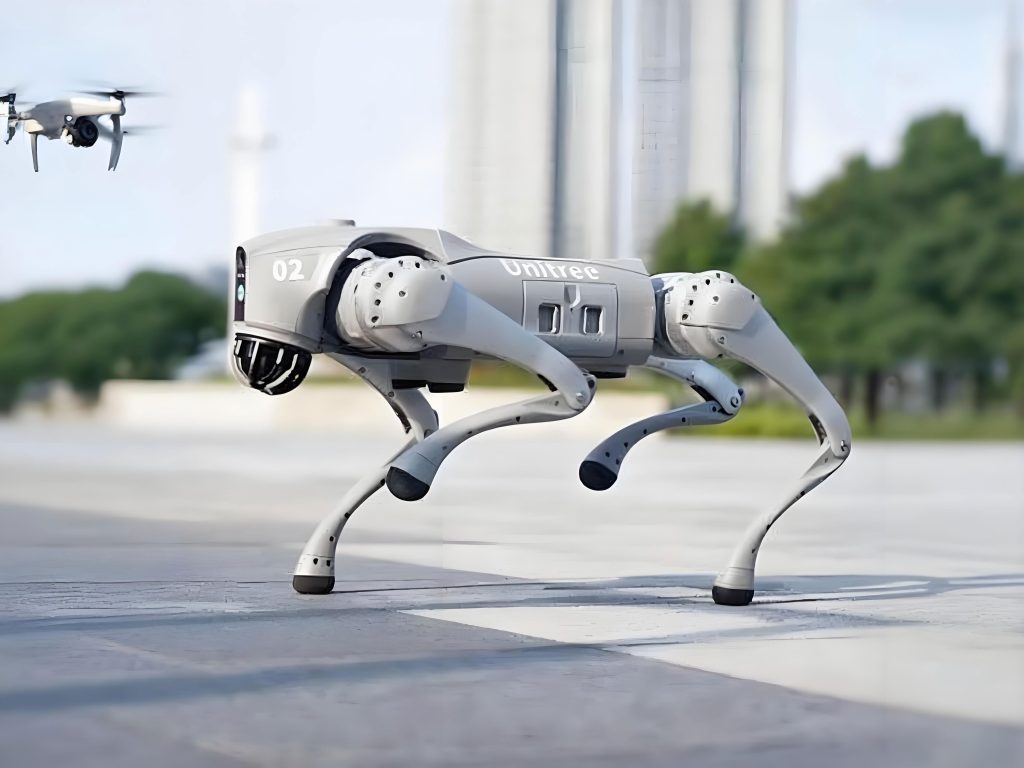
Our bionic robot’s vision system begins with the hardware design. Given the constraints of the bionic robot’s morphology—being small, compact, and lightweight—we minimized the hardware footprint. The core components include two high-resolution cameras, a 4G communication module for data transmission, a routing module, data cables, and a lithium battery pack for power. This setup allows the bionic robot to capture video of its surroundings and stream it to a cloud server via the 4G module. The use of dual cameras enables stereoscopic vision, which is crucial for depth estimation in obstacle detection for the bionic robot. The hardware workflow is straightforward: cameras capture video, the 4G module transmits it to the cloud, and the cloud server processes the data. This design ensures that the bionic robot can operate with minimal on-board computation, reducing energy consumption and hardware complexity. To summarize the hardware components, we present Table 1.
| Component | Description | Purpose in Bionic Robot |
|---|---|---|
| Cameras (2) | High-resolution, dual-lens for stereoscopic vision | Capture environmental video for obstacle detection |
| 4G Communication Module | Wireless data transmission unit | Stream video to cloud server for processing |
| Routing Module | Network management device | Facilitate data flow between components |
| Data Cables | Connectors for power and data | Link cameras and modules to power source |
| Lithium Battery Pack | Rechargeable power supply | Provide energy to cameras and 4G module |
The software system for our bionic robot’s vision is built around two key functions: video processing and target detection. First, video streams from the cameras are processed using OpenCV, an open-source computer vision library. We perform frame extraction to convert videos into images, followed by noise reduction to enhance image quality. This preprocessing step is vital for preparing data for the target detection phase in the bionic robot. Second, we employ a deep neural network based on YOLOv3 (You Only Look Once version 3) for obstacle detection. YOLOv3 is chosen for its speed and accuracy, making it suitable for real-time applications in the bionic robot. The algorithm divides images into grids and predicts bounding boxes and class probabilities for obstacles. The software workflow involves capturing video, transmitting it to the cloud, processing images, and running detection models. This allows the bionic robot to identify obstacles autonomously, with results fed back for navigation decisions. The integration of cloud computing enables offloading heavy computations, which is beneficial for the resource-limited bionic robot.
To understand the depth estimation capability of our bionic robot’s dual-camera system, we use a stereoscopic vision principle. The depth measurement relies on the disparity between images from the two cameras. Let \(b\) represent the baseline distance between the camera centers, \(f\) denote the focal length of the cameras, and \(D\) be the disparity calculated as \(D = X_l – X_r\), where \(X_l\) and \(X_r\) are the horizontal coordinates of a point \(P\) in the left and right images, respectively. The depth \(Z_c\) (distance from the point to the camera plane) is given by:
$$Z_c = \frac{f \cdot b}{D}$$
This formula allows the bionic robot to estimate the distance to obstacles, enhancing its spatial awareness. For example, if \(b = 10 \, \text{cm}\), \(f = 5 \, \text{mm}\), and \(D = 2 \, \text{pixels}\), then \(Z_c\) can be computed to guide the bionic robot’s movements. Such calculations are integral to the bionic robot’s ability to navigate complex environments.
In the target detection phase, we utilize YOLOv3, which involves a convolutional neural network (CNN) architecture. The loss function used during training combines classification loss, localization loss, and confidence loss. For a bionic robot, minimizing loss is crucial for accurate obstacle detection. The total loss \(L\) can be expressed as:
$$L = \lambda_{\text{coord}} \sum_{i=0}^{S^2} \sum_{j=0}^{B} \mathbb{1}_{ij}^{\text{obj}} \left[ (x_i – \hat{x}_i)^2 + (y_i – \hat{y}_i)^2 \right] + \lambda_{\text{coord}} \sum_{i=0}^{S^2} \sum_{j=0}^{B} \mathbb{1}_{ij}^{\text{obj}} \left[ (\sqrt{w_i} – \sqrt{\hat{w}_i})^2 + (\sqrt{h_i} – \sqrt{\hat{h}_i})^2 \right] + \sum_{i=0}^{S^2} \sum_{j=0}^{B} \mathbb{1}_{ij}^{\text{obj}} \left( C_i – \hat{C}_i \right)^2 + \lambda_{\text{noobj}} \sum_{i=0}^{S^2} \sum_{j=0}^{B} \mathbb{1}_{ij}^{\text{noobj}} \left( C_i – \hat{C}_i \right)^2 + \sum_{i=0}^{S^2} \mathbb{1}_{i}^{\text{obj}} \sum_{c \in \text{classes}} \left( p_i(c) – \hat{p}_i(c) \right)^2$$
Here, \(S^2\) is the number of grid cells, \(B\) is the number of bounding boxes per cell, \(\mathbb{1}_{ij}^{\text{obj}}\) indicates if the \(j\)-th box in cell \(i\) is responsible for an object, \(x_i, y_i, w_i, h_i\) are the predicted box coordinates, \(\hat{x}_i, \hat{y}_i, \hat{w}_i, \hat{h}_i\) are the ground truth coordinates, \(C_i\) is the confidence score, and \(p_i(c)\) is the class probability. The parameters \(\lambda_{\text{coord}}\) and \(\lambda_{\text{noobj}}\) weight the losses. For our bionic robot, we set these parameters to optimize detection performance, as shown in the experiments.
We conducted extensive experiments to validate the vision system for the bionic robot. The dataset was created by capturing videos using the bionic robot’s cameras and extracting frames to obtain images. We focused on three types of obstacles, with 500 images per type, totaling 1500 images for training and testing. Each image was annotated using LabelImg software to generate XML files containing bounding box coordinates and labels. These were converted to TXT files for YOLOv3 training. The training environment included an Ubuntu system with an NVIDIA GPU, and we used the Darknet framework for implementation. The training parameters are summarized in Table 2, which highlights the settings tailored for the bionic robot’s vision tasks.
| Parameter Name | Value | Role in Bionic Robot Training |
|---|---|---|
| Batch Size | 16 | Number of images processed per batch for efficient learning |
| Image Size | 416 × 416 | Input resolution for the neural network |
| IOU Threshold | 0.7 | Intersection over Union for bounding box matching |
| Momentum | 0.95 | Optimizer parameter to accelerate convergence |
| Initial Learning Rate | 1 × 10⁻⁵ | Step size for weight updates during training |
| Number of Epochs | 50 | Total training iterations over the dataset |
During training, we monitored the loss and IOU (Intersection over Union) curves. The loss decreased steadily, stabilizing after 40 epochs, indicating effective learning for the bionic robot’s detection model. The IOU curve remained above 0.8 after stabilization, reflecting high localization accuracy. To evaluate the bionic robot’s vision system, we used mean Average Precision (mAP) as the primary metric. mAP is the average of AP (Average Precision) values across all classes, with AP calculated at an IOU threshold of 0.5. For our bionic robot, the mAP values for the three obstacle types were consistently high, demonstrating the system’s robustness. The results are shown in Table 3, which compares the performance metrics relevant to the bionic robot’s obstacle detection.
| Obstacle Type | AP (Average Precision) | mAP Contribution | Detection Rate in Bionic Robot |
|---|---|---|---|
| Type A | 0.97 | 0.323 | 96% |
| Type B | 0.95 | 0.317 | 95% |
| Type C | 0.96 | 0.320 | 96% |
| Overall | — | 0.96 (mAP) | 95%+ (average) |
The detection phase involved testing the bionic robot with unseen images containing one or multiple obstacles. For single-obstacle images, the recognition accuracy exceeded 96%, while for images with all three types, it was above 90%. This confirms that the bionic robot can reliably identify obstacles in various scenarios. The YOLOv3 model outputs bounding boxes and class labels, allowing the bionic robot to perceive its environment in real-time. We attribute this success to the optimized hardware-software integration tailored for the bionic robot. The use of cloud processing reduces latency, and the dual-camera system enhances depth perception, both critical for the bionic robot’s autonomy.
In terms of control and communication, the bionic robot’s vision system includes commands for camera management. These are sent via HTTP requests to the cloud server. For instance, to activate the cameras on the bionic robot, a command like http://yunfuwuqi:9091/step37/machine_control/?machine_id=${machine_id}&op_camera=1 is used. The parameters include machine_id for the bionic robot identifier and op_camera to specify operations (0 for off, 1 for on). This remote control capability is essential for managing the bionic robot in field operations, where manual intervention might be needed. The 4G module ensures stable connectivity, enabling seamless data flow for the bionic robot’s vision tasks.
Looking ahead, the future of our bionic robot’s vision system is promising. With the advent of 5G technology, faster data transmission will allow for even more real-time processing, enhancing the bionic robot’s responsiveness. We plan to expand the dataset to include more obstacle types and environmental conditions, improving the bionic robot’s adaptability. Additionally, integrating advanced algorithms like YOLOv4 or transformer-based models could boost accuracy. The bionic robot could also benefit from on-edge AI chips to reduce cloud dependency, making it more self-sufficient. Our goal is to enable the bionic robot to perform complex tasks autonomously, such as path planning in unstructured terrains, leveraging its vision system as the primary sensor.
In conclusion, we have presented a comprehensive vision system for a bionic robot, focusing on hardware simplification and software intelligence. The bionic robot’s design incorporates dual cameras, 4G communication, and cloud-based deep learning to achieve high obstacle detection rates. Through experiments, we validated the system’s effectiveness, with mAP values around 0.96 and recognition rates over 95%. The use of formulas like depth estimation and YOLOv3 loss functions underpins the technical rigor, while tables summarize key parameters and results. This work demonstrates how bionic robots can leverage biomimicry and modern AI to navigate environments autonomously. As we continue to refine the bionic robot, its vision system will play a pivotal role in enabling smarter, more capable robotic systems for diverse applications.
To further illustrate the concepts, consider the relationship between detection accuracy and hardware constraints in a bionic robot. The trade-off can be modeled using a simple efficiency equation. Let \(A\) denote the accuracy of obstacle detection, \(H\) represent the hardware complexity (e.g., number of components), and \(S\) be the software sophistication (e.g., deep learning model size). For a bionic robot, we aim to maximize \(A\) while minimizing \(H\), given by:
$$A = \alpha \cdot \log(S) – \beta \cdot H + \gamma$$
where \(\alpha\), \(\beta\), and \(\gamma\) are constants specific to the bionic robot’s design. This highlights the balance needed in developing vision systems for bionic robots. Our approach minimizes \(H\) through cloud offloading and maximizes \(S\) with YOLOv3, resulting in high \(A\) values as observed in our experiments.
Overall, the bionic robot’s vision system represents a significant step towards autonomous robotics. By combining biomimetic inspiration with cutting-edge technology, we have created a platform that can perceive, learn, and adapt. The bionic robot serves as a testbed for future innovations, and we are excited to explore its potential in real-world scenarios. As research progresses, the bionic robot will undoubtedly evolve, but its core vision system will remain a foundation for intelligent behavior.