
Beijing, March 5, 2025 – The world’s inaugural humanoid robot half marathon, the 2025 Beijing E-Town Half Marathon and Humanoid Robot Half Marathon, will commence at 7:30 a.m. on April 13. For the first time in history, humanoid robots will start alongside human participants on the same 21.0975-kilometer course, marking a milestone in robotics development. The announcement was made during yesterday’s press conference organized by Beijing authorities.
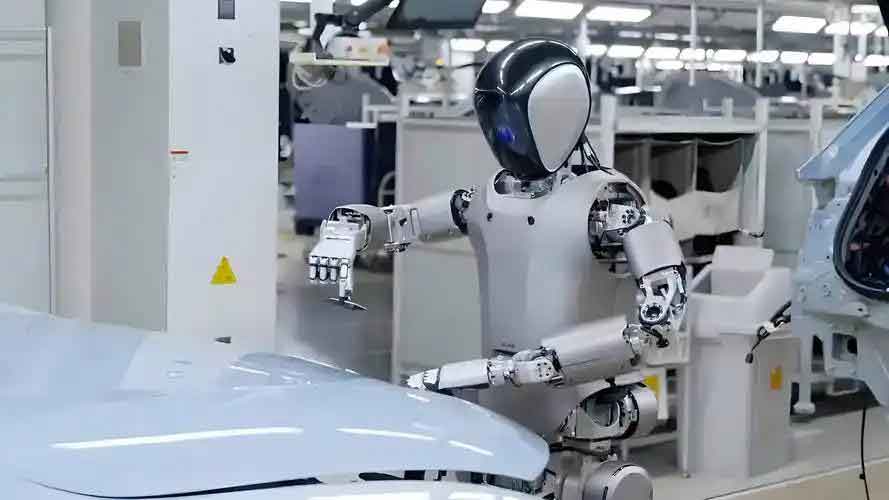
Li Quan, Deputy Director of the Beijing Economic and Technological Development Area Management Committee, confirmed that this event represents a radical evolution from last year’s Beijing E-Town Half Marathon, where a humanoid robot named “Tiāngōng” merely cheered runners and symbolically crossed the finish line. This year, humanoid robots will transform from spectators into full participants competing as athletes.
The competition framework includes these key specifications:
- All participating humanoid robots must maintain anthropomorphic morphology and demonstrate bipedal locomotion capabilities; wheeled or non-humanoid configurations are expressly prohibited.
- Control modalities permit either manual remote operation (including semi-autonomous systems) or fully autonomous operation without human intervention.
- Participating teams must guarantee their humanoid robots will not damage the course, interfere with other humanoid robots, or endanger human participants under any circumstances.
- Safety protocols require complete separation between human runners and humanoid robot participants through physical barriers (fences) or greenbelt partitioning throughout the entire course.
- The maximum completion time for humanoid robots is set at 3 hours and 30 minutes, reflecting current technological capabilities.
- Battery replacement during the race is permitted, while robot substitution will be allowed under relay format rules with a 10-minute time penalty per substitution.
- Final rankings for humanoid robots will be determined through comprehensive evaluation of finish times adjusted by substitution penalties.
Liu Weiliang, Deputy Director of the Beijing Municipal Bureau of Economy and Information Technology, emphasized the unprecedented technical challenges facing humanoid robots in marathon conditions. “This event constitutes the ultimate stress test for humanoid robot endurance, motion control, and environmental adaptability,” he stated, outlining three critical technological barriers:
- Development of specialized marathon components: Long-distance running requires optimized joint articulation systems, enhanced biomimetic foot designs, rapid battery exchange technology, and thermal management solutions to prevent joint overheating while maintaining stability.
- Advanced algorithmic frameworks: Humanoid robots must overcome limitations in high-reliability running control, precision positioning during dynamic movement, and real-time obstacle avoidance navigation for sustained high-speed operation.
- Rigorous endurance validation: Extensive testing and training protocols are essential to ensure humanoid robots can maintain operational integrity throughout prolonged, high-intensity running conditions.
Li Quan elaborated on the event’s significance: “The humanoid robot marathon serves as both a showcase for breakthrough applications and a catalyst for investment. By demonstrating humanoid robot capabilities in extreme physical challenges, we accelerate technological advancement while exploring practical implementation scenarios.”
Global participation is actively being coordinated with invitations extended to humanoid robot manufacturers, research institutions, university teams, and robotics clubs worldwide. Multiple domestic teams have already confirmed participation and are conducting intensive testing and training regimens.
Looking beyond the April marathon, Beijing authorities revealed plans for the inaugural World Humanoid Robot Games, scheduled to precede the 2025 World Robot Conference. This multi-disciplinary competition will feature nearly 20 events across categories including:
- Athletics competitions demonstrating mobility and agility
- Soccer matches testing coordination and strategic interaction
- Gymnastics routines evaluating balance and complex motion sequencing
- Practical application scenarios simulating real-world environments
The games will comprehensively demonstrate advancements in humanoid robot athletic performance, intelligent interaction, and functional adaptability across diverse settings.
Technological foundations for these events have been strengthened by the Beijing Humanoid Robot Innovation Center, upgraded in October 2024 to become the National-Local Co-construction Embodied Intelligence Robot Innovation Center. Its proprietary humanoid robot platform has achieved notable milestones:
- Navigation through complex terrains including snow-covered surfaces
- Continuous ascent of staircases exceeding 100 steps with significant elevation differentials
- Peak movement velocity surpassing 12 kilometers per hour
- Motion control capabilities matching international leading standards
Industry analysts note that the humanoid robot marathon represents more than athletic exhibition – it provides critical validation data for energy systems, actuator durability, and real-world navigation algorithms. Successfully completing the 21km course under competitive conditions would establish new benchmarks for humanoid robot operational endurance and reliability. The simultaneous participation of human athletes creates unprecedented comparative data for evaluating humanoid robot biomechanical efficiency against biological systems.
With registration ongoing, technical teams continue refining their humanoid robot platforms specifically for marathon conditions. Key focus areas include optimizing power consumption profiles during sustained running, enhancing shock absorption mechanisms for varied pavement surfaces, and developing fail-safe systems to prevent collisions during high-density operation. The April 13 event will mark the first systematic evaluation of humanoid robot capabilities under extended real-world physical stress, potentially accelerating commercial deployment timelines across logistics, emergency response, and industrial applications.