
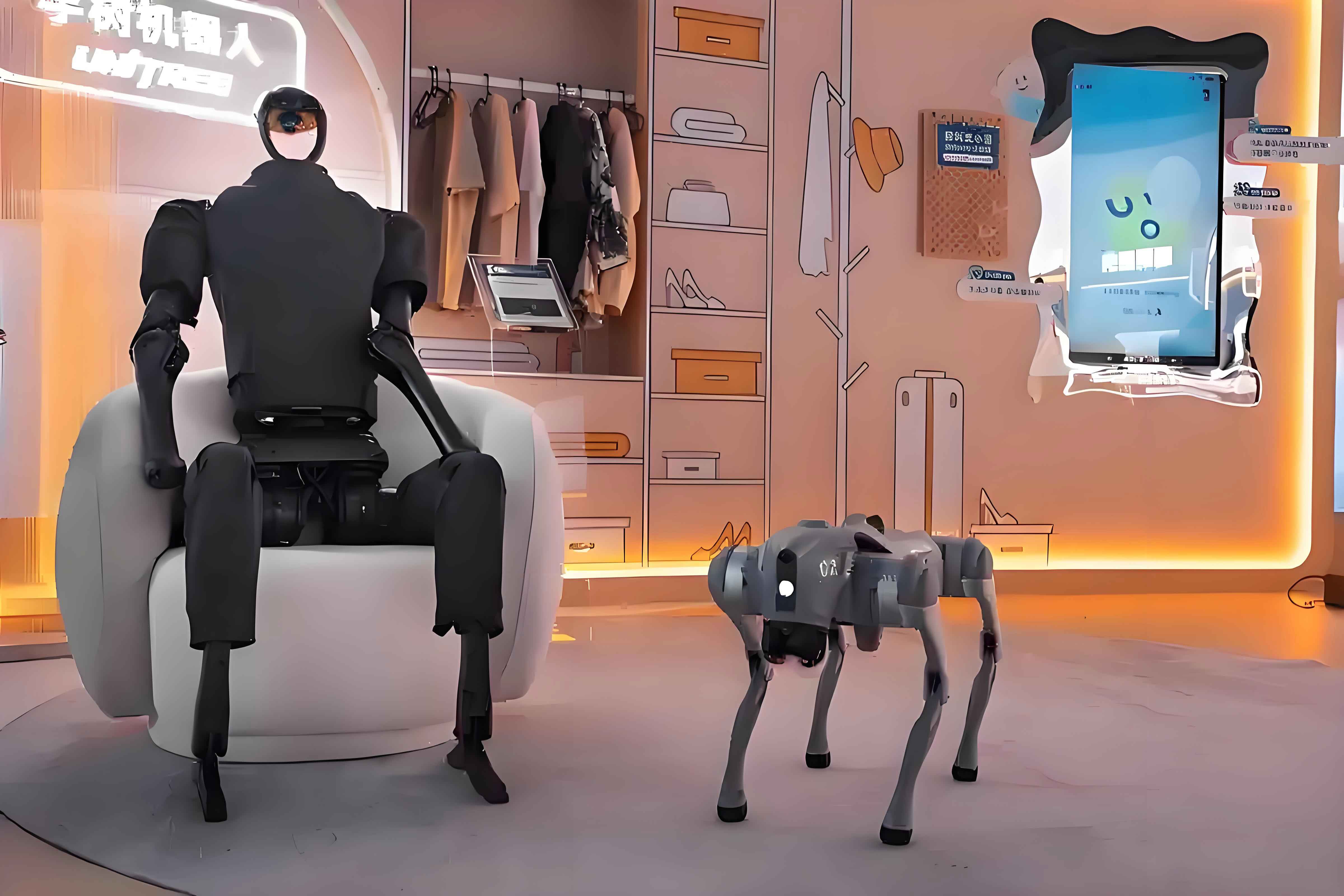
BEIJING – The Beijing Humanoid Robot Innovation Center has launched the world’s first general-purpose embodied intelligence platform capable of multi-skill control across multiple robot types. This breakthrough system, named “Huisi Kaiwu,” provides enhanced cognitive and motor capabilities for humanoid robots, marking a significant advancement in robotics technology.
1. Universal Platform Breaks Barriers in Robotics
Traditional robots typically perform specialized tasks in isolated environments – warehouse handlers move boxes, hospitality robots deliver meals, and industrial robots tighten screws. The newly unveiled platform solves this limitation through its “one-brain multi-skill, one-brain multi-machine” architecture. This innovation enables a single humanoid robot to master diverse capabilities across various scenarios.
The platform functions through coordinated “brain” and “cerebellum” components. The AI-powered brain handles task comprehension and planning, while the cerebellum manages physical execution through a growing skill repository. “Think of robotic skills like pearls on a necklace,” explained Tang Jian, CTO of Beijing Humanoid Robot Innovation Center. “The brain selects appropriate skills from the cerebellum’s library to complete tasks.”
During demonstrations, the humanoid robot Tiangong showcased this versatility by accurately replicating randomly assembled block structures after visual inspection. This humanoid robot later performed complex operations including industrial sorting, desktop organization, and parcel packaging without reprogramming.
2. Cognitive Architecture: Brain and Cerebellum Synergy
The platform’s effectiveness stems from its dual-component design:
- AI Brain: Powered by large language models, it processes natural language instructions and environmental perception. This enables complex task decomposition and long-sequence planning for humanoid robots.
- Robotic Cerebellum: Currently housing over 30 physical skills with plans to exceed 100 capabilities, it provides stable motion control. This component allows humanoid robots to navigate complex terrains while maintaining balance during full-body coordination and bimanual operations.
When instructed to clear a demonstration table, the Tiangong humanoid robot systematically organized items: arranging cups and lunchboxes, collecting paper waste into containers, and disposing materials in bins. This humanoid robot maintained focus when objects were unexpectedly moved during the process.
3. Adaptive Learning and Error Correction
The platform employs a “fast-think reasoning, slow-think learning” methodology that enables continuous improvement:
| Learning Phase | Functionality | Benefit for Humanoid Robots |
|---|---|---|
| Real-time Execution | Immediate task reasoning and response | Enables prompt reaction to dynamic environments |
| Post-task Analysis | Scenario simulation and failure review | Develops optimized solutions through reinforcement learning |
“When failures occur during humanoid robot operations, the system uses them as learning opportunities,” Tang Jian noted. “The brain redesigns action sequences while the cerebellum ensures precise skill selection with high accuracy.” This dual-phase learning allows the platform to refine performance iteratively, enhancing the intelligence of humanoid robots over time.
4. Cross-Platform Compatibility
The platform achieves unprecedented versatility through:
- Single-system control of robotic arms, wheeled robots, and humanoid robots
- Unified software architecture reducing development barriers
- Streamlined implementation processes for commercial applications
This cross-platform compatibility allows diverse robotic forms to access the same skill repository and cognitive framework. Manufacturers can now deploy the system across multiple robot types without extensive re-engineering, accelerating adoption of humanoid robots in industrial settings.
5. First Commercial Implementation
Concurrently released, the Tiangong Walker humanoid robot becomes the first platform-integrated system. Developed collaboratively by Beijing Humanoid Robot Innovation Center and UBTECH Robotics, this research-oriented humanoid robot is priced below 300,000 yuan.
- 20 degrees of freedom enabling human-like mobility
- 10 km/h running speed with stability on slopes, stairs, and uneven terrain
- Advanced impact resistance and motion control systems
“Unlike standard humanoid robots, research-grade models demand exceptional precision and stability,” stated a UBTECH representative. The Tiangong Walker humanoid robot meets these requirements while maintaining unprecedented affordability for educational and research institutions.
The Beijing Humanoid Robot Innovation Center will promote global adoption of this platform, accelerating development in intelligent robotics. This humanoid robot technology advancement demonstrates China’s growing capabilities in next-generation artificial intelligence systems, potentially transforming automation across logistics, manufacturing, and service industries worldwide.