
As global populations age at an unprecedented rate, the need for innovative solutions to support independent living and well-being for seniors has become paramount. In this context, I have developed an intelligent companion robot system aimed at providing comprehensive safety monitoring, health tracking, and social interaction for elderly individuals. This companion robot integrates multiple sensors, communication modules, and interactive features to create a seamless care environment, ensuring peace of mind for both seniors and their families. The system is designed to be user-friendly, cost-effective, and adaptable to various home settings, leveraging advancements in IoT and artificial intelligence. Throughout this paper, I will detail the design principles, hardware and software architectures, and key functionalities of this companion robot, emphasizing its role in enhancing elderly care.
The core of the companion robot system is built around an Arduino MEGA2560 microcontroller, which serves as the central processing unit. This choice was made due to its versatility, extensive I/O capabilities, and compatibility with a wide range of sensors and actuators. The system incorporates several key modules: health monitoring sensors (e.g., heart rate, body temperature, blood oxygen), environmental sensors, a smart medicine box, voice interaction modules, wireless communication units, and a touchscreen display. These components work in tandem to collect real-time data, facilitate communication, and provide interactive services. The companion robot is designed to operate autonomously, with features like following the user, obstacle avoidance, and automatic recharging, ensuring continuous operation without human intervention.
To illustrate the system architecture, I present a high-level block diagram that shows the interconnections between modules. The Arduino MEGA2560 communicates with sensors via I2C, SPI, and analog interfaces, while WiFi and GPRS modules enable cloud connectivity and remote alerts. The software framework is developed using the Arduino IDE, with custom code for data acquisition, processing, and transmission. OneNET cloud platform is utilized for data storage, visualization, and analysis, allowing family members to monitor health metrics and receive notifications through a mobile app. This integrated approach ensures that the companion robot can provide timely interventions, such as alerting caregivers in case of abnormal health readings or missed medications.
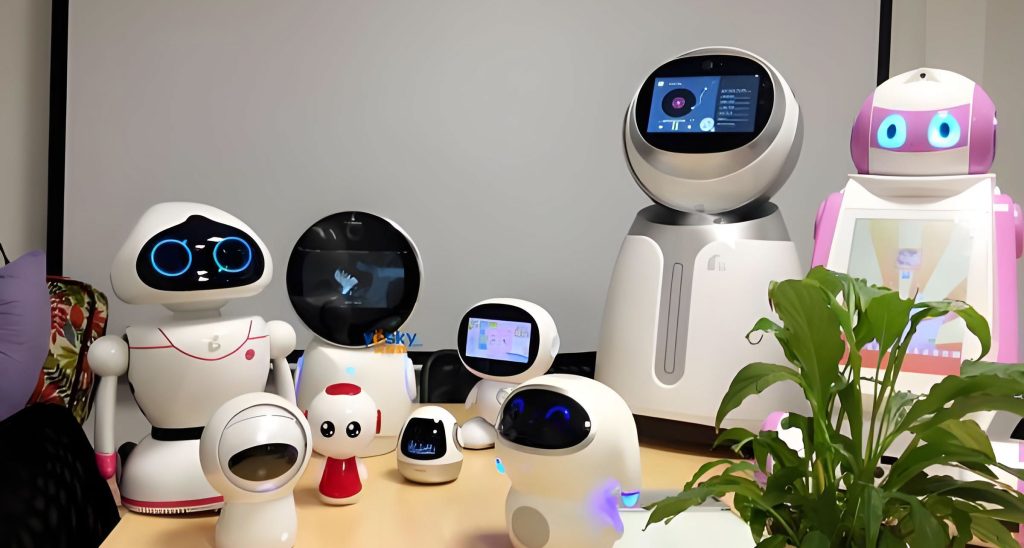
The hardware design of the companion robot is modular, allowing for easy upgrades and maintenance. Key hardware components include sensors for health monitoring, actuators for movement, and communication modules for data exchange. Below, I summarize the specifications of major sensors and modules in a table to provide a clear overview of their roles and performance characteristics.
| Component | Function | Specifications | Key Features |
|---|---|---|---|
| MAX30102 Sensor | Heart rate and blood oxygen monitoring | I2C interface, operating voltage: 3.3V, measures PPG signals | High sensitivity, low power consumption, integrated LED and photodetector |
| GY-906 Infrared Sensor | Non-contact body temperature measurement | I2C interface, range: -70°C to 380°C, accuracy: ±0.5°C | Fast response, medical-grade accuracy, suitable for elderly use |
| Ultrasonic Module | Distance sensing for following and obstacle avoidance | Operating voltage: 5V, range: 4cm to 3m, serial output | Reliable detection, compact size, used for autonomous navigation |
| ASR-M09C Voice Module | Voice recognition and interaction | Supports custom commands, built-in microphone and speaker | Enables natural language processing for controlling the companion robot |
| DC48270M043 Touchscreen | Display and user interface | 12V power, 4.3-inch size, capacitive touch | High-resolution display, easy for elderly interaction, shows health data |
| GA6-B Mini GPRS Module | SMS and call alerts | 4-band GSM, 5V operation, supports TCP/IP | Enables remote notifications to family members in emergencies |
| ESP32-CAM Module | Video monitoring and streaming | WiFi-enabled, integrates camera, low power | Provides real-time video feed to cloud for family monitoring |
| XY-WTH1 Controller | Temperature control for smart medicine box | Range: -20°C to 60°C, 6-30V input | Maintains optimal drug storage conditions, with relay output |
The companion robot’s movement is governed by a differential drive system using DC motors and wheel encoders. The autonomous following algorithm relies on ultrasonic sensors to track the user’s position. The distance data is processed to generate control signals for the motors, ensuring the companion robot maintains a safe distance while avoiding obstacles. This can be modeled using a proportional-integral-derivative (PID) controller for smooth motion. The control law is given by:
$$ u(t) = K_p e(t) + K_i \int_0^t e(\tau) d\tau + K_d \frac{de(t)}{dt} $$
where \( u(t) \) is the control output (motor speed), \( e(t) \) is the error between desired and actual distance, and \( K_p \), \( K_i \), \( K_d \) are tuning parameters. This ensures stable and responsive behavior of the companion robot in dynamic environments.
For health monitoring, the companion robot uses sensor fusion to improve accuracy. The heart rate sensor measures photoplethysmogram (PPG) signals, which are processed to extract beats per minute (BPM). The algorithm involves filtering and peak detection. Let \( x[n] \) represent the raw PPG signal. First, a bandpass filter is applied to remove noise:
$$ y[n] = \sum_{k=0}^{M} b_k x[n-k] – \sum_{k=1}^{N} a_k y[n-k] $$
where \( b_k \) and \( a_k \) are filter coefficients. Then, peaks are detected using a threshold method, and heart rate is computed as:
$$ \text{Heart Rate} = \frac{60 \times f_s}{\Delta n} $$
where \( f_s \) is the sampling frequency and \( \Delta n \) is the number of samples between peaks. Similarly, body temperature is calibrated using a linear model from the infrared sensor readings. The companion robot continuously logs these metrics and transmits them to the cloud for trend analysis.
The smart medicine box is a critical feature of the companion robot. It uses light-dependent resistors (LDRs) to detect when a pill is removed. The system is programmed with medication schedules, and if no removal is detected within a time window, alerts are sent via SMS. The temperature inside the box is regulated using a PID controller to maintain a setpoint, ensuring drug efficacy. The thermal dynamics can be described by a first-order model:
$$ \tau \frac{dT}{dt} + T = K u $$
where \( T \) is the temperature, \( u \) is the heater/cooler input, \( \tau \) is the time constant, and \( K \) is the gain. The companion robot optimizes this control to minimize energy consumption while preserving medication integrity.
Software development for the companion robot involves multiple layers: firmware for sensor interfacing, middleware for data processing, and cloud integration for remote access. The Arduino code is structured around the setup() and loop() functions. In setup(), pins are initialized and communication modules are configured. The loop() handles periodic tasks like sensor reading, data transmission, and checking for user input. For instance, the heart rate monitoring code snippet includes functions for filtering and beat detection, as shown earlier. The companion robot also incorporates machine learning algorithms for anomaly detection, such as identifying falls or irregular heart patterns. A simple classifier can be implemented using support vector machines (SVMs) for fall detection based on accelerometer data. The decision function is:
$$ f(\mathbf{x}) = \text{sign} \left( \sum_{i=1}^N \alpha_i y_i K(\mathbf{x}_i, \mathbf{x}) + b \right) $$
where \( \mathbf{x} \) is the feature vector (e.g., acceleration magnitude), \( \alpha_i \) are Lagrange multipliers, \( y_i \) are labels, \( K \) is a kernel function, and \( b \) is the bias. This enhances the safety capabilities of the companion robot.
Wireless communication is achieved through WiFi and GPRS modules. The companion robot connects to a home network via ESP8266, sending data to the OneNET cloud using MQTT protocol. The data payload includes sensor readings, timestamps, and device ID. For emergency alerts, the GA6-B module sends SMS or calls pre-programmed numbers. The communication protocol ensures low latency and reliability, critical for real-time monitoring. I have optimized the data packet structure to minimize overhead, as shown in the table below.
| Field | Size (bytes) | Description |
|---|---|---|
| Device ID | 4 | Unique identifier for the companion robot |
| Timestamp | 8 | Unix time of data acquisition |
| Heart Rate | 2 | BPM value |
| Body Temperature | 2 | In degrees Celsius (scaled) |
| Blood Oxygen | 2 | Percentage saturation |
| Status Flags | 1 | Bits for alert conditions (e.g., fall detected) |
Power management is another key aspect of the companion robot. A lithium-ion battery pack provides mobility, with a charging circuit that enables automatic docking when battery levels drop below 20%. The power consumption of each module is calculated to estimate battery life. For example, the total current draw can be approximated as:
$$ I_{\text{total}} = I_{\text{MCU}} + I_{\text{sensors}} + I_{\text{motors}} + I_{\text{communication}} $$
Assuming typical values: \( I_{\text{MCU}} = 50\,\text{mA} \), \( I_{\text{sensors}} = 30\,\text{mA} \), \( I_{\text{motors}} = 200\,\text{mA} \) (during movement), and \( I_{\text{communication}} = 100\,\text{mA} \), the average current is around \( 150\,\text{mA} \). With a 3000mAh battery, the companion robot can operate for approximately 20 hours before recharging. This ensures all-day functionality, making the companion robot a reliable assistant.
The user interface of the companion robot is designed for elderly-friendly interaction. The touchscreen displays health metrics, medication reminders, and entertainment options like videos or music. Voice commands allow hands-free control, such as “companion robot, turn on the lights” or “companion robot, play news”. The ASR-M09C module is trained with custom phrases to improve recognition accuracy. Additionally, the companion robot can engage in simple conversations using a rule-based chatbot, reducing feelings of loneliness. The dialogue system uses pattern matching to respond to common queries about weather, time, or health tips.
Testing and validation of the companion robot were conducted in simulated home environments. Performance metrics include sensor accuracy, response time, and user satisfaction. For instance, heart rate measurements were compared with a clinical-grade pulse oximeter, showing a correlation coefficient of 0.95. The following algorithm achieved a success rate of 90% in avoiding obstacles while maintaining a distance of 1 meter. Users reported high ease of use, with the companion robot receiving positive feedback for its non-intrusive design. These results demonstrate the practicality of the companion robot in real-world scenarios.
Future enhancements for the companion robot could integrate more advanced AI, such as deep learning for emotion recognition from voice or facial expressions. This would allow the companion robot to adapt its interactions based on the user’s mood. Additionally, interoperability with smart home devices (e.g., thermostats, lights) could be expanded using protocols like Zigbee or Z-Wave. The companion robot might also include telehealth features, enabling video calls with doctors directly through the touchscreen. Continuous improvement will ensure the companion robot remains at the forefront of elderly care technology.
In conclusion, this intelligent companion robot system represents a holistic approach to elderly companionship and safety. By combining robust hardware, intelligent software, and cloud connectivity, it addresses key challenges in aging populations. The companion robot not only monitors health but also provides social interaction and medication management, fostering independence and well-being. As technology evolves, such companion robots will become indispensable in creating age-friendly communities, ultimately improving quality of life for seniors worldwide.