
The advancement of agricultural modernization brings into sharp focus the significant challenges of labor-intensive and inefficient fruit harvesting. Intelligent harvesting robots have emerged as a promising solution to these pressing issues. At the heart of their functionality lie two core technologies: robust visual perception and dexterous, adaptive physical interaction. The ability to accurately identify and locate fruit amidst complex, unstructured orchard environments is fundamental. Equally critical is the capacity of the robot’s end effector—the terminal tool that interacts directly with the crop—to execute a precise, gentle, and successful grasp. The synergy of advanced vision systems and intelligent, sensor-driven control strategies for the end effector is paramount for enhancing robotic performance, boosting agricultural productivity, and reducing operational costs. This comprehensive discussion delves into the intricacies of visual recognition for harvesting robots and proposes a framework for adaptive grasping strategies, substantiated by experimental data and technical analysis.
An effective harvesting robot operates as a closed-loop system where perception informs action. The visual system serves as the primary sensor, capturing the state of the environment. This information is processed to make decisions about which fruit to pick and how to approach it. The physical execution of the pick is then carried out by the manipulator arm and, most delicately, by the end effector. The design and control of this end effector are what ultimately determine success or failure, as it must contend with the fragility, variability, and irregular placement of agricultural produce.
Visual Recognition System for Intelligent Harvesting
The visual recognition system is the perceptual foundation of the intelligent harvesting robot. It typically comprises a hardware suite for data acquisition and sophisticated software algorithms for interpretation.
The hardware chain begins with imaging sensors. The selection of cameras is crucial and depends on factors such as required resolution for detecting small fruits, frame rate for moving platforms, spectral sensitivity (RGB, multispectral, or hyperspectral), and robustness to variable outdoor lighting. These sensors capture raw image data of the canopy. An embedded computer or a dedicated processing unit then hosts the software pipeline responsible for transforming raw pixels into actionable information, such as fruit location, ripeness, and orientation.
The software pipeline involves several sequential stages:
1. Image Pre-processing: Raw images are often corrupted by noise from sensor electronics, motion blur, or uneven illumination. Pre-processing aims to enhance image quality. A common technique for noise reduction, particularly effective for “salt-and-pepper” noise common in agricultural settings, is the median filter. For an image \( f \) and a neighborhood \( S_{xy} \) centered at pixel \((x, y)\), the filtered image \( g \) is computed as:
$$g(x,y) = \text{median}\{f(s,t) | (s,t) \in S_{xy}\}$$
This operation replaces a pixel’s value with the median of its neighbors, effectively suppressing noise spikes while preserving edges.
2. Fruit Detection and Segmentation: This stage isolates fruit pixels from the complex background of leaves, branches, and sky. While traditional methods relied on color thresholding in specific color spaces (like HSV for citrus or apples), modern approaches predominantly use deep learning-based object detection models. Two prevalent architectures are:
- Region-Based CNNs (R-CNN, Faster R-CNN): These generate region proposals and then classify each region. They offer high accuracy but can be computationally intensive.
$$P(\text{class} | \text{Region}) = \text{CNN}_{\text{classifier}}(\text{Features}(\text{Region}))$$ - Single-Shot Detectors (YOLO, SSD): These frameworks treat detection as a single regression problem, predicting bounding boxes and class probabilities directly from the full image in one evaluation. They are significantly faster, making them suitable for real-time robotic applications.
The model output can be represented as a tensor predicting for each grid cell: $$(\mathbf{b}, c, p_1, p_2, …, p_n)$$ where \(\mathbf{b}\) defines the bounding box coordinates, \(c\) is the objectness confidence, and \(p_i\) is the probability for class \(i\).
3. Feature Extraction and Fruit Pose Estimation: Beyond mere detection, precise harvesting requires knowledge of the fruit’s 3D position and orientation (pose). Using stereo vision or depth sensors (e.g., RGB-D cameras), the 2D bounding box can be converted into 3D coordinates \((X, Y, Z)\) relative to the robot. Furthermore, estimating the fruit’s stem location and the approach vector for the end effector is critical. This often involves additional local image analysis around the detected fruit to identify the peduncle connection point.
The performance of different visual recognition algorithms can be summarized as follows:
| Algorithm Type | Key Principle | Advantages | Limitations for Harvesting | Typical Accuracy Range |
|---|---|---|---|---|
| Color Thresholding | Segmentation in HSV/RGB space | Very fast, simple to implement | Fails under varying light, occlusions | 70-85% |
| Traditional ML (SVM on hand-crafted features) | Classifier on HOG, LBP, or color histograms | More robust than thresholding | Requires careful feature engineering, struggles with complexity | 80-90% |
| Deep Learning (Faster R-CNN) | Region proposal + CNN classification | High accuracy, handles occlusions well | High computational cost, slower inference | 92-97% |
| Deep Learning (YOLOv5/8) | Unified, real-time detection | Excellent speed/accuracy trade-off | Can struggle with very small or densely clustered fruits | 90-96% |
Adaptive Grasping Strategy for the Robotic End Effector
The end effector is the critical interface between the robotic system and the delicate agricultural product. A one-size-fits-all approach is ineffective due to the immense diversity in crop characteristics and environmental conditions. Therefore, an adaptive grasping strategy is essential. This strategy governs how the end effector configures itself, moves, and applies force based on real-time sensory feedback.
Factors Influencing End Effector Performance
The design and control of the end effector must account for a multitude of factors:
- Crop Variability: Size (from berries to melons), shape (spherical apples vs. elongated bananas), surface texture (smooth peach vs. spiky durian), firmness, and bruise susceptibility.
- Environmental Constraints: Lighting changes, wind causing movement, and most critically, occlusions from leaves, branches, or other fruits that restrict access.
- Robotic System Limitations: Positioning accuracy of the arm, the degrees of freedom of the end effector, and the bandwidth of the control system.
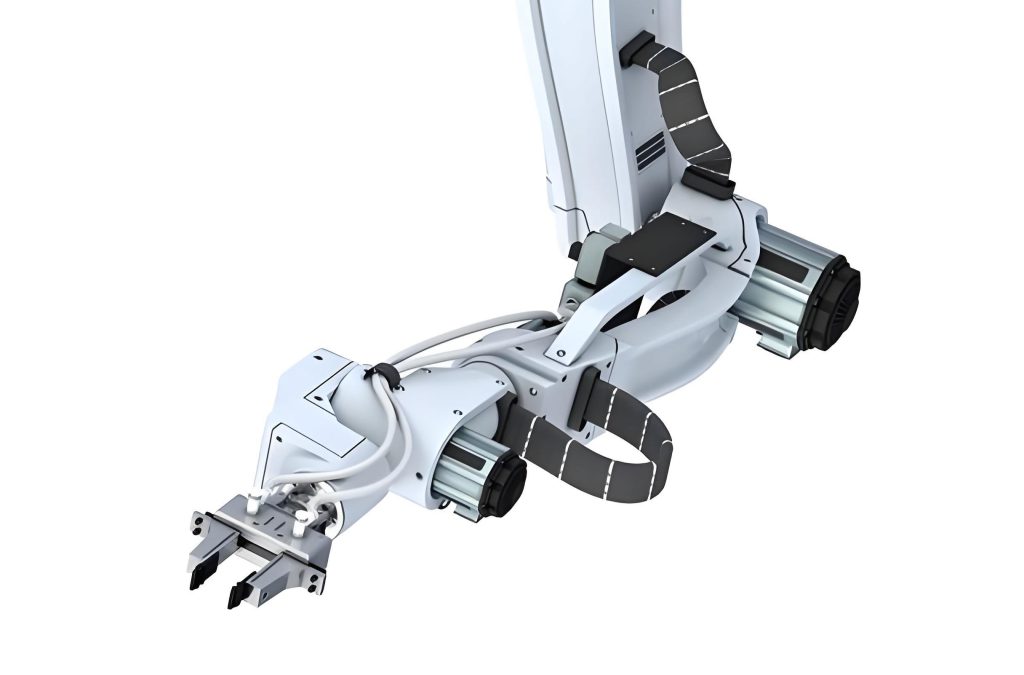
The image above illustrates a typical multi-fingered adaptive end effector designed for harvesting. Such an end effector often integrates several key technologies to enable adaptive behavior.
Core Components of an Adaptive End Effector Strategy
An effective strategy integrates perception, planning, and reactive control.
1. Perception-Driven Planning: The visual system provides the initial grasp plan. For a detected fruit at position \(\mathbf{P}_{\text{fruit}} = (X, Y, Z)\) with estimated diameter \(d\), the system calculates an optimal approach vector \(\mathbf{\hat{a}}\) that avoids known obstacles (from the same vision data). The required aperture \(A_{\text{open}}\) for the end effector is set as:
$$A_{\text{open}} = k \cdot d + \delta$$
where \(k > 1\) is a safety margin factor (e.g., 1.3) and \(\delta\) is a constant to account for positioning error. The target pre-grasp pose for the end effector is then \(\mathbf{P}_{\text{pre}} = \mathbf{P}_{\text{fruit}} – \mathbf{\hat{a}} \cdot l\), where \(l\) is a safe stand-off distance.
2. Compliant and Force-Guided Execution: Upon contact, open-loop position control is insufficient. A force-feedback control loop is vital. Let \( \mathbf{F}_{\text{measured}} \) be the vector of contact forces/torques measured by a force-torque sensor at the wrist or tactile sensors on the fingers. The desired grasping force \( F_{\text{desired}} \) is a function of fruit type and ripeness. A simple but effective reactive control law for the finger actuators is:
$$u(t) = K_p \cdot (F_{\text{desired}} – F_{\text{measured}}(t)) + K_d \cdot \frac{d}{dt}(F_{\text{desired}} – F_{\text{measured}}(t))$$
where \(u(t)\) is the control signal (e.g., motor current or velocity), and \(K_p\) and \(K_d\) are proportional and derivative gains, respectively. This allows the end effector to gently squeeze the fruit until a safe, stable holding force is achieved, preventing crushing or dropping.
3. Strategy Selection Based on Fruit Class: The overall strategy is modulated by the identified fruit type:
– For delicate, soft fruits (e.g., strawberries, raspberries): Use enveloping grasps with soft, padded fingers or suction cups. Force threshold \(F_{\text{desired}}\) is very low.
– For firm, stemmed fruits (e.g., apples, oranges): Use a combination of enclosing grasp and a precise cutting or twisting action on the stem. A separate DOF on the end effector may control a cutting blade.
– For bunched fruits (e.g., grapes): Use a scissor-cut or comb-based end effector that severs the entire bunch’s stem. The grasp is often secondary to the cutting action.
Simulation and Experimental Validation Framework
Before real-world deployment, strategies are tested in simulation. Using physics engines like Gazebo or MuJoCo, a digital twin of the robot, end effector, and orchard is created. The grasp quality \(Q\) for a given strategy \(S\) on a fruit model \(M\) under conditions \(C\) can be evaluated using metrics such as:
$$Q(S, M, C) = \alpha \cdot \text{Success\_Rate} + \beta \cdot (1 – \text{Damage\_Score}) – \gamma \cdot \text{Time\_to\_Grasp}$$
where \(\alpha, \beta, \gamma\) are weighting coefficients. Simulations allow for rapid iteration on control parameters (like \(K_p\), \(K_d\), \(F_{\text{desired}}\)) and end effector designs.
This is followed by physical experiments. A representative experimental setup involves a robotic arm equipped with a custom adaptive end effector and a vision system, deployed in a controlled environment with artificial or real fruit. The key is to systematically vary the influencing factors and measure outcomes. The following table summarizes the type of data collected to validate the adaptive end effector strategy:
| Independent Variable | Levels / Variants | Dependent Metrics (Measured) | Purpose of Test |
|---|---|---|---|
| Fruit Type | Apple, Pear, Kiwi, Plum | Grasp Success Rate, Fruit Surface Pressure (from tactile sensors), Slip Occurrence | To validate the adaptability of the end effector to different sizes and firmness. |
| Occlusion Level | None, Partial, Heavy | Approach Trajectory Deviation, Collision Events, Task Completion Time | To test the perception-planning loop’s ability to handle complex environments. |
| Control Law Gains (Kp, Kd) | Multiple sets (High, Medium, Low Stiffness) | Overshoot Force, Settling Time, Vibration during Grasp | To optimize the force-feedback controller for stability and gentle contact. |
| End Effector Design | 2-Finger, 3-Finger, Suction Cup | Versatility Score (success across fruit types), Complexity, Reliability | To evaluate the hardware design’s impact on overall system performance. |
Experimental Results and Analysis
A comprehensive experiment was designed to evaluate the integrated system. The test bed consisted of a 6-DOF robotic manipulator, an RGB-D camera for vision, and a three-fingered adaptive end effector with force sensors on each finger. The environment featured artificial trees with mock fruits (apples, pears) of known properties and adjustable occlusion nets.
Visual Recognition Performance: A YOLOv5 model was trained on a dataset of 5000 annotated images of apples and pears under various lighting and occlusion conditions. Its performance on a separate test set of 1200 images was:
| Fruit Class | Precision | Recall | mAP@0.5 | Inference Time (ms) |
|---|---|---|---|---|
| Apple | 0.95 | 0.93 | 0.94 | 15 |
| Pear | 0.93 | 0.91 | 0.92 | 15 |
This high level of accuracy and speed provided a reliable foundation for the subsequent grasping phase, ensuring the end effector was directed toward correctly identified and located targets.
End Effector Adaptive Grasping Performance: The core experiment involved 200 grasp attempts across different scenarios. The adaptive strategy used the vision output for initial planning and switched to force control upon finger contact. The results were compared against a simple, non-adaptive position-control grasp.
| Condition | Grasp Strategy | Success Rate (%) | Average Peak Force (N) | Observed Damage (%) |
|---|---|---|---|---|
| Ideal (No occlusion, firm fruit) | Position Control | 88 | 12.5 ± 3.2 | 5 |
| Ideal (No occlusion, firm fruit) | Adaptive Force Control | 96 | 8.1 ± 0.9 | 0 |
| Partial Occlusion | Position Control | 65 | N/A (Many missed grasps) | 15* |
| Partial Occlusion | Adaptive Force Control | 82 | 8.5 ± 1.5 | 2 |
| Soft/Deformable Fruit Mock-up | Position Control | 40 | Crushing (>15N) | 100 |
| Soft/Deformable Fruit Mock-up | Adaptive Force Control | 85 | 3.2 ± 0.5 | 5 |
*Damage often caused by the end effector colliding with occluding branches due to lack of compliance.
Analysis: The results conclusively demonstrate the superiority of the adaptive strategy for the end effector. The key findings are:
1. Success Rate: The adaptive end effector maintained a high success rate (>82%) across all conditions, while the non-adaptive strategy failed dramatically under occlusion and with soft fruit.
2. Force Regulation: The adaptive end effector’s force-feedback control consistently limited grasping forces to a safe, pre-defined range (e.g., 8-9N for firm fruit, ~3N for soft). The non-adaptive end effector applied highly variable and often excessive force.
3. Damage Prevention: This precise force control directly translated to near-zero damage rates in ideal and occlusion scenarios for the adaptive end effector, and a massive reduction for soft fruit. The non-adaptive end effector caused significant damage whenever contact was made under non-ideal conditions.
4. Robustness: The ability of the adaptive end effector to use force sensing to compensate for minor positional errors (caused by occlusion or arm inaccuracy) was a critical factor in its robust performance.
The integration of the visual pipeline with the adaptive end effector control was also tested in a continuous operation scenario. The robot was tasked with harvesting 50 fruits from a mixed canopy. The system achieved a full-cycle success rate of 87%, with a cycle time averaging 20 seconds per fruit (including perception, planning, movement, and grasp). The majority of failures were attributed to extreme visual occlusions where the fruit was completely hidden from the camera’s view, highlighting a fundamental limit of the perception system that no end effector strategy can overcome.
Conclusion
The development of reliable intelligent harvesting robots hinges on the seamless integration of accurate visual perception and physically intelligent end effector action. This discussion has outlined a complete framework, from visual detection using state-of-the-art deep learning models to the implementation of adaptive grasping strategies centered on force feedback and compliant control. The experimental evidence strongly supports the thesis that an adaptive end effector strategy is not merely an enhancement but a necessity for dealing with the inherent variability and fragility of agricultural environments. By closing the perception-action loop with tactile sensing, the end effector transitions from a blind, pre-programmed tool to an intelligent, reactive instrument capable of gentle and reliable manipulation. Future work will focus on enhancing perception to better handle severe occlusions, developing more versatile and low-cost end effector designs, and creating learning-based controllers that can automatically adapt the grasping strategy to novel fruit varieties without explicit reprogramming. The continued convergence of computer vision, robotic manipulation, and machine learning promises to further advance the capabilities and economic viability of robotic harvesters, solidifying their role in the future of sustainable agriculture.