
In the context of modern agriculture, the automation of fruit harvesting presents a significant opportunity to enhance efficiency, reduce labor costs, and improve working conditions. As a researcher focused on agricultural robotics, I have dedicated efforts to designing an effective end effector specifically for guava harvesting. Guava, a vital economic fruit crop in tropical and subtropical regions, currently relies heavily on manual picking, which is labor-intensive and inefficient. This article details my design process for a guava harvesting end effector, emphasizing mechanical analysis, structural design, and performance considerations. The end effector is a critical component of a harvesting robot, responsible for gripping and severing the fruit. Throughout this discussion, the term ‘end effector’ will be recurrently emphasized to underscore its central role in robotic harvesting systems.
The agricultural requirements for guava harvesting dictate that the robotic end effector must perform two primary functions: securely gripping the fruit and cleanly cutting the peduncle (fruit stem). Manual harvesting involves holding the fruit and cutting the stem with a knife, a process that the end effector must replicate. To inform the design, I conducted a study on guava fruit characteristics. A sample of guavas from various regions was analyzed, and key parameters are summarized in the following table.
| Parameter | Minimum Value | Maximum Value | Average Value |
|---|---|---|---|
| Transverse Diameter (mm) | 40 | 60 | 50 |
| Longitudinal Diameter (mm) | 45 | 65 | 55 |
| Mass (g) | 58 | 63 | 60.5 |
Based on this data, the end effector must accommodate guavas with diameters ranging from 40 mm to 60 mm and a maximum mass of approximately 63 g. Furthermore, biomechanical testing established critical force thresholds. A gripping force exceeding 100 N can cause bruising or damage to the guava, while insufficient force may lead to instability and fruit drop. The maximum cutting resistance of the guava peduncle was found to be 88 N. Therefore, the design specifications for the end effector are: a gripping force below 100 N (with a safe operational target) and a cutting force greater than 88 N. These specifications are fundamental to ensuring the end effector performs its task without damaging the produce.
The overall design philosophy for this guava harvesting end effector was to create a simple, lightweight, and efficient mechanism. A significant design choice was to use a single motor to drive both the gripping and cutting actions, thereby reducing the number of actuators, simplifying control, and minimizing weight. The end effector primarily consists of a motor housing, a main frame, a transmission output shaft, an intermediate power distribution plate, a gripping mechanism, and a cutting mechanism. The gripping mechanism employs a two-finger design, which provides the necessary opposing forces for stable grasping while keeping the structure simple. The cutting mechanism is integrated such that the motor’s motion sequentially first closes the fingers for gripping and then activates the cutter for severing the stem.
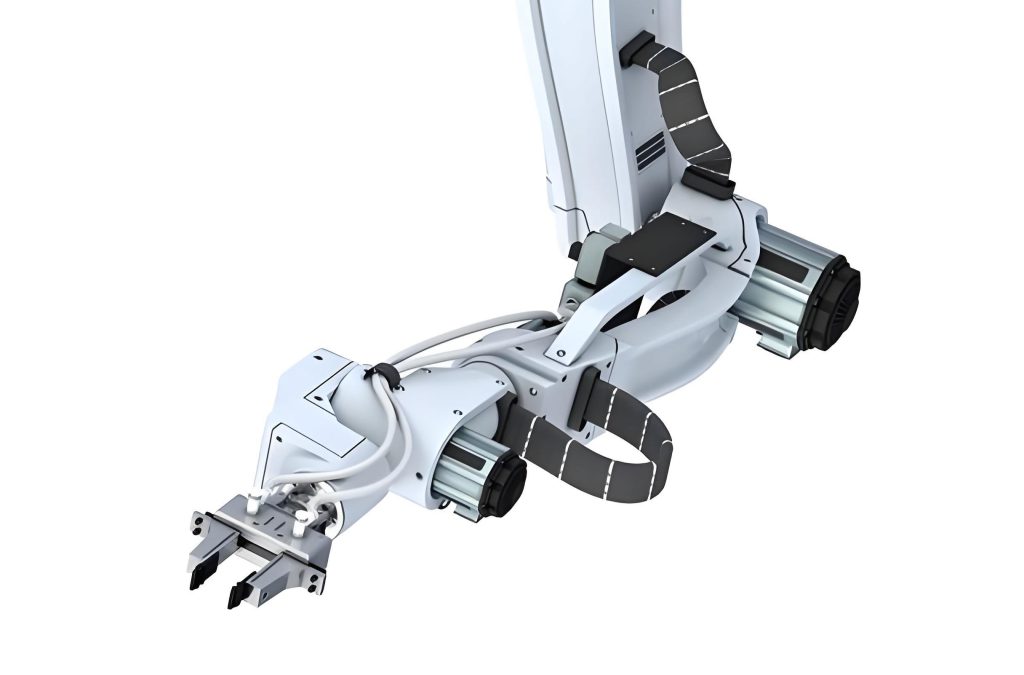
The operational sequence of the end effector is as follows: As the robotic arm positions the end effector near a target guava, the motor rotates in the forward direction. This rotation is converted into linear motion via a screw mechanism on the motor shaft, which retracts the main transmission shaft. This retraction pulls the intermediate power distribution plate, which simultaneously actuates both the gripping and cutting mechanisms. For the gripper, the motion is transferred through linkages, causing the two finger arms to pivot inward and grasp the fruit. Concurrently, the motion is transmitted via linkages to the cutting mechanism, bringing the scissors blades together to cut the peduncle. After the cut, the motor reverses, extending the shaft and causing the fingers to open and release the harvested fruit into a collection bin, while the scissors open. This synchronized operation is key to the efficiency of this end effector design.
To ensure the end effector applies appropriate force, detailed mechanical models for both the gripping and cutting mechanisms were developed. For the gripping mechanism, a force analysis was performed on the finger arm. The goal is to relate the actuator force $F_P$ to the normal gripping force $F_N$ applied to the fruit. The geometry of the linkage plays a crucial role. Let us define the angle between the finger arm and the line of action of the input force as $\alpha$. Analysis showed that an optimal angle of $\alpha = 30^\circ$ minimizes the required actuator force for a given grip force. The force balance at the contact point and the linkage joint leads to the following relation. The gripping force $F_N$ at the finger tip is related to the input force $F_P$ at the driving link by the mechanical advantage of the linkage. A simplified model, considering static equilibrium and neglecting friction in the joints for initial sizing, gives:
$$ F_N = \frac{F_P \cdot \cos(\theta)}{2 \cdot \sin(\alpha)} $$
where $\theta$ is the angle of the connecting link. For the designed geometry with $\alpha = 30^\circ$ and specific link lengths, the relationship simplifies. Given the requirement that the safe gripping force $F_N$ should be around 30 N (30% of the 100 N damage threshold), the required actuator driving force $F_P$ can be calculated. Substituting values:
$$ F_P = \frac{2 \cdot F_N \cdot \sin(\alpha)}{\cos(\theta)} $$
With $F_N = 30 \text{ N}$, $\alpha = 30^\circ$, and $\theta \approx 15^\circ$ from the geometry, we get:
$$ F_P = \frac{2 \times 30 \times \sin(30^\circ)}{\cos(15^\circ)} = \frac{60 \times 0.5}{0.9659} \approx 31.06 \text{ N} $$
However, this is an idealized calculation. Accounting for friction, dynamic forces, and a safety factor, the design actuator force was determined to be approximately 69.28 N to reliably achieve the 30 N grip force. This ensures the end effector holds the guava securely without slippage or damage.
The cutting mechanism requires a more substantial force to overcome the peduncle’s resistance. The mechanism uses a lever system to amplify the force from the actuator. A force analysis of the scissors and the driving lever was conducted. Let $F_C$ be the cutting force at the scissor blades, and $F_D$ be the driving force supplied by the main shaft via the distribution plate. The following equations describe the static equilibrium. First, consider the moment balance on the lever about its pivot. The input force $F_D$ acts at a distance $L_1$ from the pivot, and the force transmitted to the scissors linkage, $F_S$, acts at a distance $L_2$. Thus:
$$ F_D \cdot L_1 = F_S \cdot L_2 \quad \Rightarrow \quad F_S = F_D \cdot \frac{L_1}{L_2} $$
Next, for the scissors mechanism, the force $F_S$ is applied to one handle, and the cutting force $F_C$ is generated at the blades. The scissors act as a pair of levers. The relationship depends on the distances from the pivot to the point of application of $F_S$ ($d_1$) and to the cutting point ($d_2$). For a symmetric scissor design:
$$ F_C = F_S \cdot \frac{d_1}{d_2} $$
Combining both equations, the overall relationship between the driving force $F_D$ and the cutting force $F_C$ is:
$$ F_C = F_D \cdot \frac{L_1}{L_2} \cdot \frac{d_1}{d_2} $$
The inverse of the product $\frac{L_1}{L_2} \cdot \frac{d_1}{d_2}$ represents the force amplification factor. In the designed end effector, the geometric parameters were chosen to meet the cutting requirement. With $F_C$ required to be at least 88 N, and selected lever arm ratios, the necessary $F_D$ can be computed. Assuming $\frac{L_1}{L_2} = 2.5$ and $\frac{d_1}{d_2} = 0.8$, the amplification factor is $2.5 \times 0.8 = 2.0$. Therefore:
$$ F_D = \frac{F_C}{2.0} = \frac{88}{2.0} = 44 \text{ N} $$
However, this is an ideal case. In practice, friction, the angle of cut, and dynamic effects increase the required force. A more comprehensive model accounting for the angle of the scissor blades and the coefficient of friction $\mu$ at the joints yields a higher requirement. A revised formula incorporating an efficiency factor $\eta$ (e.g., 0.65 due to friction) gives:
$$ F_D = \frac{F_C}{\eta \cdot \frac{L_1}{L_2} \cdot \frac{d_1}{d_2}} = \frac{88}{0.65 \times 2.0} \approx 67.7 \text{ N} $$
Further considering force losses in the linkages leading to the cutter, the final design driving force for the cutting action was determined to be approximately 680 N from the motor’s perspective when combined with the gripper actuation through the same shaft. This seems high compared to the gripper force, but it is manageable with a suitably geared motor. The single motor provides a total force that is distributed sequentially; the initial motion encounters lower resistance for gripping, and the continued motion builds up force for cutting. The transmission system must be strong enough to deliver this peak force. This analysis underscores the intricate force dynamics within the integrated end effector.
Material selection is crucial for the end effector’s performance and durability. To minimize weight, which is important for the robotic arm’s payload and energy consumption, aluminum alloy 7075-T6 was chosen for most structural components like the finger arms, links, and frames. This alloy offers high strength-to-weight ratio and good fatigue resistance, essential for repeated harvesting cycles. For the finger contact surfaces, a soft rubber lining is attached to provide a compliant grip, protect the guava skin from abrasion, and increase friction for better holding. The scissors blades are made of hardened steel to maintain sharpness and withstand the cutting forces. The choice of materials directly impacts the reliability and longevity of the end effector in field conditions.
To further elaborate on the design parameters and performance metrics, several tables can summarize key aspects. Below is a table outlining the major components of the end effector and their specifications.
| Component | Material | Key Dimension/Property | Function |
|---|---|---|---|
| Motor | Standard DC Geared Motor | Rated Torque: 2 Nm, Speed: 30 rpm | Provides rotary input for both gripping and cutting |
| Main Frame | 7075-T6 Aluminum | Dimensions: 150x100x50 mm | Supports all components and attaches to robot arm |
| Finger Arms (2) | 7075-T6 Aluminum | Length: 120 mm, Pivot at 40 mm from base | Pivot to open/close, equipped with rubber pads |
| Transmission Shaft | Stainless Steel | Diameter: 10 mm, Thread: M8x1.25 | Converts motor rotation to linear motion via screw |
| Power Distribution Plate | 7075-T6 Aluminum | Thickness: 5 mm, with multiple linkage holes | Distributes linear motion to gripper and cutter linkages |
| Scissors Mechanism | Blades: Tool Steel, Lever: Aluminum | Blade length: 50 mm, Lever arm ratio (L1/L2): 2.5 | Amplifies force to cut peduncle |
| Linkages (Rods & Pins) | Stainless Steel | Diameter: 4 mm, various lengths | Transmit motion between components |
Another important aspect is the force and motion analysis. The following table summarizes the key forces and geometric parameters used in the design calculations.
| Parameter | Symbol | Value | Description |
|---|---|---|---|
| Safe Gripping Force | $F_N$ | 30 N | Target normal force on fruit surface |
| Required Actuator Force for Grip | $F_{Pg}$ | 69.28 N | Force at gripper linkage input |
| Cutting Force Requirement | $F_C$ | 88 N | Minimum force to sever peduncle |
| Required Actuator Force for Cut | $F_{Pc}$ | 680 N | Peak force at cutter linkage input |
| Gripper Linkage Angle | $\alpha$ | 30° | Optimal angle for force transmission |
| Lever Arm Ratio (Gripper) | $L_g / l_g$ | 1.5 | Mechanical advantage in gripper |
| Lever Arm Ratio (Cutter) | $L_1 / L_2$ | 2.5 | First-stage amplification in cutter lever |
| Scissor Arm Ratio | $d_1 / d_2$ | 0.8 | Second-stage amplification in scissors |
| Overall System Efficiency | $\eta$ | 0.65 | Estimated accounting for friction losses |
The design also considered the kinematic profile. The motor’s rotation $\theta_m$ translates to linear displacement $x$ of the main shaft via the screw pitch $p$:
$$ x = \frac{p \cdot \theta_m}{2\pi} $$
If $p = 1.25 \text{ mm}$ (for an M8 screw), then for one full motor revolution ($\theta_m = 2\pi$), $x = 1.25 \text{ mm}$. This linear displacement is then transformed into angular displacement of the finger arms. For a finger arm of length $L_f$ from pivot to contact point, and a linkage geometry that converts linear motion $x$ to angular rotation $\phi$, the relationship can be derived from trigonometry. Assuming a simplified model where the driving link is connected at a distance $r$ from the finger pivot, and the linkage is initially at an angle, the angular rotation $\phi$ is approximately:
$$ \phi \approx \arctan\left(\frac{x}{r}\right) $$
For small displacements, this is linear. The grip opening width $W$ is then:
$$ W = 2 \cdot L_f \cdot \sin(\phi_0 + \phi) $$
where $\phi_0$ is the initial angle. This kinematic analysis ensures the end effector can open wide enough to approach guavas of various sizes and then close sufficiently to grip them firmly. Similarly, for the cutter, the linear motion $x$ is translated into angular motion of the scissor blades via the lever system. If the lever rotates by an angle $\beta$, the blade displacement $y$ at the cutting point is:
$$ y = d_2 \cdot \sin(\beta) $$
and $\beta$ is related to $x$ through the lever geometry. These kinematic equations are essential for controlling the end effector’s motion sequence precisely.
In addition to the core mechanics, the integration of the end effector with a robotic arm and sensing system is vital. The end effector must be mounted on a manipulator capable of positioning it accurately in the orchard environment. Vision systems or other sensors would identify ripe guavas and guide the end effector to the correct position. The control algorithm for the end effector’s single motor must coordinate the timing: first, move to a position where the fingers surround the fruit, then continue the motion to grip and subsequently cut. The force models developed earlier can inform control strategies to prevent excessive force. For instance, a current sensor on the motor could indirectly monitor the force; if the current spikes beyond a threshold corresponding to the safe grip force, the motor could halt or adjust to avoid damage. This adaptive control would enhance the robustness of the harvesting end effector.
Potential challenges and areas for improvement were also considered during the design phase. One challenge is dealing with guavas growing in clusters or with obstructive leaves. The physical dimensions of the end effector, particularly the scissors, must allow access to the peduncle without colliding with adjacent fruits or branches. Another consideration is variability in peduncle thickness and toughness, which may affect the required cutting force. The design incorporates a safety margin in the cutting force capacity. Furthermore, endurance testing would be needed to evaluate wear on the rubber grips and scissor blades over thousands of cycles. Future iterations of the end effector might include features like a fruit collection cup to catch the severed fruit immediately, reducing the risk of dropping. Nonetheless, the current design represents a balanced solution focused on simplicity and functionality.
The significance of developing such an end effector extends beyond guava harvesting. The principles of force analysis, material selection, and integrated actuation can be adapted to other soft fruit harvesting robots. The end effector is a pivotal element in automating agriculture, potentially transforming labor-intensive practices. By designing an end effector that meets specific agronomic and biomechanical requirements, we move closer to practical, cost-effective robotic harvesters. This project underscores the interdisciplinary nature of agricultural robotics, combining mechanical engineering, control theory, and plant science.
In conclusion, the design and study of this guava harvesting end effector have covered detailed mechanical modeling, material selection, and system integration. The end effector successfully addresses the key requirements of secure gripping and effective cutting through a synchronized, single-motor mechanism. The force analysis provided formulas to size components and ensure performance within safe limits. Tables summarized critical data and parameters. This end effector design contributes to the advancement of agricultural automation, promising increased efficiency and reduced reliance on manual labor for guava harvesting. Continued research will focus on prototyping, testing, and refining the end effector for real-world deployment, ultimately aiming to make robotic fruit harvesting a widespread reality.