
In the aftermath of major nuclear incidents like the Fukushima Daiichi disaster, the critical role of robotic systems in nuclear power plant emergency response has been starkly highlighted. These robots must perform diverse tasks such as valve manipulation, door opening, drilling, and stair climbing, often in hazardous environments with high radiation, temperature, and humidity. A significant challenge lies in the functional singularity of many robotic end-effectors; a single end-effector cannot efficiently handle multiple, disparate operations. To address this, we have developed an autonomous end-effector exchange mechanism that enables robots to swap different end-effectors on-the-fly, enhancing operational versatility. This mechanism not only facilitates the exchange but also separates the drive electronics from the transmission system, allowing for centralized protection of sensitive components in harsh nuclear environments—a crucial design consideration. The core innovation is a passive compliant docking system based on double Hooke joints, which accommodates substantial misalignments during the exchange process without complex active control, thereby improving reliability and reducing control demands. In this article, I will detail the design, analysis, and implementation of this end-effector exchange mechanism, emphasizing its passive compliance, tolerance performance, and practical validation through experiments.
The fundamental requirement for any end-effector exchange system in nuclear settings is robust tolerance to misalignment during docking. Inaccuracies in positioning, due to factors like sensor errors or environmental disturbances, can lead to jamming or wedging during the insertion of the exchange interface into the tool rack. Traditional rigid docking methods are inadequate here because they demand high precision and are prone to failure. Instead, we leverage passive compliance through a double Hooke joint configuration. This approach allows the end-effector exchange mechanism to adapt to positional and angular deviations automatically, without relying on real-time sensor feedback or complex control algorithms. The principle involves two Hooke joints: one on the robot-side end-effector exchange unit and another on the tool rack. When misalignment occurs, these joints rotate freely, guiding the docking shaft into the receptacle smoothly. This passive behavior is analyzed through static equilibrium equations that describe the forces and moments during contact. For instance, during the initial contact with the chamfered guide region, the contact forces can be expressed as:
$$F_N \mu = F_f$$
where $F_N$ is the normal contact force, $F_f$ is the friction force, and $\mu$ is the coefficient of friction. The equilibrium equations for this phase are:
$$
\begin{cases}
F_N \sin\varphi – F_f \cos\varphi – F_x = 0 \\
F_N \cos\varphi + F_f \sin\varphi – F_z = 0 \\
F_N l_0 – M_U – F_f [l_U \cos(\varphi + \delta) + r \sin(\varphi + \delta)] = 0
\end{cases}
$$
Here, $F_x$ and $F_z$ are the lateral and insertion forces applied by the robot manipulator, $\varphi$ is the chamfer angle, $\delta$ is the angular misalignment, $l_U$ is the distance from the Hooke joint center to the shaft tip, $r$ is the shaft radius, $l_0$ is the moment arm, and $M_U$ is the docking moment. As the end-effector exchange proceeds into the receptacle, dual-point contact may occur, but the Hooke joints continue to self-align, reducing contact forces and preventing jamming. The final stage sees the forces diminish as the joints align, ensuring smooth docking. This passive compliance is key to the end-effector exchange mechanism’s reliability.
Tolerance analysis quantifies the misalignment that the end-effector exchange system can accommodate. Consider the coordinate frames: $\{O_U\}$ for the upper Hooke joint (on the exchange mechanism) and $\{O_D\}$ for the lower Hooke joint (on the tool rack). The upper joint rotates by angles $\alpha’$ and $\beta’$, while the lower rotates by $\alpha$ and $\beta$. The position deviation between the joints is represented by coordinates $(a, b, c)$. For successful docking, the endpoints must coincide, leading to the condition:
$$
\begin{bmatrix} a \\ b \\ c \end{bmatrix} = \begin{bmatrix} l_D \sin\beta – l_U \sin\beta’ \\ -l_D \sin\alpha \cos\beta – l_U \cos\beta’ \sin\alpha’ \\ l_D \cos\alpha \cos\beta – l_U \cos\alpha’ \cos\beta’ \end{bmatrix}
$$
with $|\alpha| = |\alpha’|$ and $|\beta| = |\beta’|$. Here, $l_U$ and $l_D$ are the lengths from the joint centers to the docking interfaces. This equation defines the allowable deviations $a$, $b$, and $c$ for given joint angles, effectively characterizing the tolerance envelope of the end-effector exchange system. In practice, parameters like $l_U = 60\,\text{mm}$ and $l_D = 50\,\text{mm}$ yield tolerances of up to $\pm5\,\text{mm}$ in lateral directions, as validated experimentally. Such tolerance is sufficient for nuclear environments where precise positioning is challenging.
To meet the need for multiple power outputs—specifically, for driving the end-effector itself, providing rotational torque for tasks like valve turning, and operating the locking mechanism—we designed a concentric triple-Hooke joint parallel transmission system. This innovative configuration integrates three independent torque paths through nested Hooke joints sharing a common rotation center. The layout is summarized below:
| Torque Path | Input Source | Function | Output Torque Equation |
|---|---|---|---|
| Outer Hooke Joint | Robot Arm Joint | Transmit rotational torque for tasks | $\tau_1′ = \tau_1 \times \eta_1$ |
| Middle Hooke Joint | Locking Motor | Actuate locking/release mechanism | $\tau_2′ = \tau_2 \times \eta_2 \times i_{g2}$ |
| Inner Hooke Joint | End-Effector Motor | Drive the end-effector fingers | $\tau_3′ = \tau_3 \times \eta_3 \times i_{g3}$ |
In these equations, $\tau_1$, $\tau_2$, and $\tau_3$ are the input torques, $\eta_1$, $\eta_2$, and $\eta_3$ are mechanical efficiencies, and $i_{g2}$ and $i_{g3}$ are gear ratios. This design ensures that all power transmission occurs mechanically, with motors located away from the harsh environment, aligning with the goal of separating electronics from the end-effector. The concentric arrangement minimizes size and weight, crucial for mobile robotic platforms.
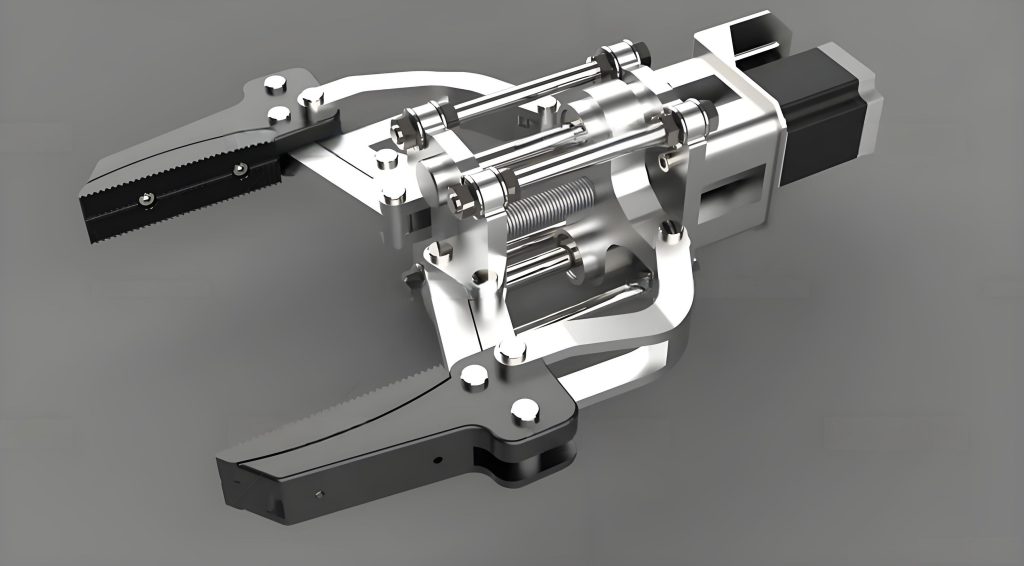
The end-effector exchange mechanism comprises five main subsystems: the torque transmission input, locking/release mechanism, end-effector power input, triple-Hooke joint parallel transmission, and robot interface. Each plays a vital role in ensuring reliable end-effector exchange. The torque transmission input connects to the robot’s sixth joint, delivering torque through the outer Hooke joint to a spline expansion sleeve for tasks like valve rotation. The locking/release mechanism uses a ball-lock design: a motor drives the middle Hooke joint to rotate a trapezoidal screw, which moves a nut that pushes steel balls into or out of a groove on the end-effector interface, securing or releasing it. This mechanism is self-locking after engagement, enhancing safety. The end-effector power input involves an internal motor that transmits torque via the inner Hooke joint to drive the fingers of underactuated end-effectors, such as grippers or valve wrenches. The triple-Hooke joint assembly enables all three torque paths to operate independently while maintaining passive compliance. Finally, the robot interface includes a standard mounting plate and a six-axis force/torque sensor for monitoring contact forces during docking.
A standardized tool interface is critical for interoperability with various end-effectors. Our design features three key interfaces on each end-effector: Interface 1 for the drive input (connected to the inner Hooke joint), Interface 2 for locking (engaging with the steel balls), and Interface 3 for rotational torque input (linked to the outer Hooke joint). This standardization allows modular end-effector swapping, whether it’s a gripper for object manipulation or a specialized tool for nuclear maintenance. The tool rack incorporates a passive adaptive Hooke joint that pairs with the exchange mechanism’s joint, forming the double-Hooke system for compliant docking. This rack holds end-effectors securely while allowing easy pickup and drop-off.
For autonomous docking, we developed a control strategy based on contact force thresholds, eliminating the need for high-precision vision systems—a cost and reliability advantage in nuclear settings. The process begins with coarse positioning using a 3D camera to bring the end-effector exchange mechanism near the tool rack’s expected location. The area is divided into a grid with spacing $\Delta d$, calculated as:
$$\Delta d = \lambda (D_c – D_h)$$
where $\lambda$ is a grid density coefficient (typically $\lambda < 0.5$), $D_c$ is the chamfer diameter, and $D_h$ is the hole diameter. The robot then executes a search pattern: at each grid point, it moves the end-effector exchange shaft downward by increments $\Delta l$ while monitoring the $F_z$ force from the wrist sensor. If $F_z$ exceeds a threshold $F_{z\text{max}}$ before reaching a position threshold $l_t$, the shaft is not aligned, and the robot moves to the next grid point based on the lateral force directions $F_x$ and $F_y$. The displacement vector is:
$$\Delta \vec{d} = [\Delta d_x, \Delta d_y] \begin{bmatrix} \vec{x_s} & \vec{y_s} \end{bmatrix}^T$$
where $\vec{x_s}$ and $\vec{y_s}$ are unit vectors along decreasing $F_x$ and $F_y$. If $F_z$ remains below $F_{z\text{max}}$ until $l_t$ is reached, the shaft is inside the receptacle, and the robot continues along a planned trajectory. The double Hooke joints provide passive alignment, and upon reaching the final position, the locking motor secures the end-effector. This strategy balances simplicity and robustness, essential for autonomous end-effector exchange in unpredictable environments.
We implemented and tested the end-effector exchange system on a SCHUNK LWA4/SDH 6-DOF manipulator mounted on a mobile platform. A six-axis force/torque sensor (SRI M3715C) was installed between the manipulator and the exchange mechanism to measure contact forces. The software control, developed in C++, uses CAN communication for distributed interaction between upper and lower computers. Experimental parameters included $D_c = 12.9\,\text{mm}$, $D_h = 10.9\,\text{mm}$, $\lambda = 0.6$, $\Delta d = 1.2\,\text{mm}$, $l_0 = 60\,\text{mm}$, $\Delta l = 2\,\text{mm}$, $l_t = 70\,\text{mm}$, and $F_{z\text{max}} = 45\,\text{N}$ (derived from the tool rack’s spring stiffness). The testing involved exchanging two end-effectors: an underactuated three-finger gripper and a valve-wrenching hand, both designed for single torque input.
The results demonstrated successful autonomous end-effector exchange with significant tolerance. During docking, the force profiles showed that when misaligned, $F_z$ spiked to the threshold, triggering a repositioning move. After realignment, $F_z$ dropped near zero, indicating smooth insertion due to passive compliance. The table below summarizes key performance metrics:
| Metric | Value | Description |
|---|---|---|
| Lateral Tolerance | ±5 mm | Allowable misalignment in x and y directions |
| Angular Tolerance | ±3° | Allowable angular deviation |
| Docking Time | < 30 s | Average time for full exchange cycle |
| Locking Force | 200 N | Force exerted by ball-lock mechanism |
| Torque Transmission | Up to 50 Nm | Maximum torque via outer Hooke joint |
Following exchange, the robot performed tasks like valve turning and object grasping, confirming power transmission through all three torque paths. The end-effector exchange mechanism proved reliable, with no jamming or wedging observed even under deliberate misalignments. This validates the passive compliance design and the effectiveness of the force-threshold-based control strategy for end-effector exchange.
In conclusion, our autonomous end-effector exchange mechanism addresses the critical need for multi-functional robotics in nuclear power plants. By integrating a concentric triple-Hooke joint parallel transmission, we enable passive compliant docking with substantial tolerance, separation of drive electronics from transmission, and modular power delivery to various end-effectors. The force-threshold docking strategy reduces reliance on precise sensing, enhancing robustness in harsh conditions. Experimental verification with a 6-DOF manipulator confirms the system’s capability to swap end-effectors like grippers and valve wrenches seamlessly, supporting tasks such as manipulation and rotation. Future work could focus on miniaturization for broader robotic applications or integration with AI for adaptive task planning. This end-effector exchange technology paves the way for more versatile and resilient robots in nuclear and other hazardous environments, where reliable end-effector exchange is paramount for operational success.