
In modern agriculture, the mechanization of pest control in mountainous and hilly regions remains a significant challenge due to complex terrain features such as steep slopes, uneven ground, and scattered rocks. Large-scale spraying equipment is often impractical in these areas, leading to low mechanization levels and reliance on manual labor, which hinders the development of mountain orchard cultivation. To address this issue, we have designed an autonomous spraying robot tailored for mountainous orchards, with a focus on enhancing the reliability and efficiency of the end effector—the critical component responsible for precise pesticide application. This paper presents a comprehensive analysis and optimization of the end effector using ANSYS Workbench, including finite element analysis of gear transmission and computational fluid dynamics simulations for nozzle selection, aiming to ensure durable performance and effective spray coverage in harsh environments.
The overall structure of the mountain orchard spraying robot incorporates a tracked chassis to improve ground grip and prevent overturning on slopes, along with a foldable robotic arm for high degrees of freedom and easy storage. However, the core innovation lies in the end effector, which employs a encircling spray mechanism to minimize weight and avoid entanglement with tree branches. This end effector features a gear transmission system within a compact gearbox, enabling the synchronous movement of spray rods along circular tracks to envelop target trees. The design prioritizes lightweight construction and robustness, but given the dynamic loads during operation, it is essential to validate the structural integrity of the gears and optimize the spray parameters for superior atomization. Our study leverages simulation tools to achieve these goals, ensuring the end effector can withstand prolonged use while delivering consistent spray performance.
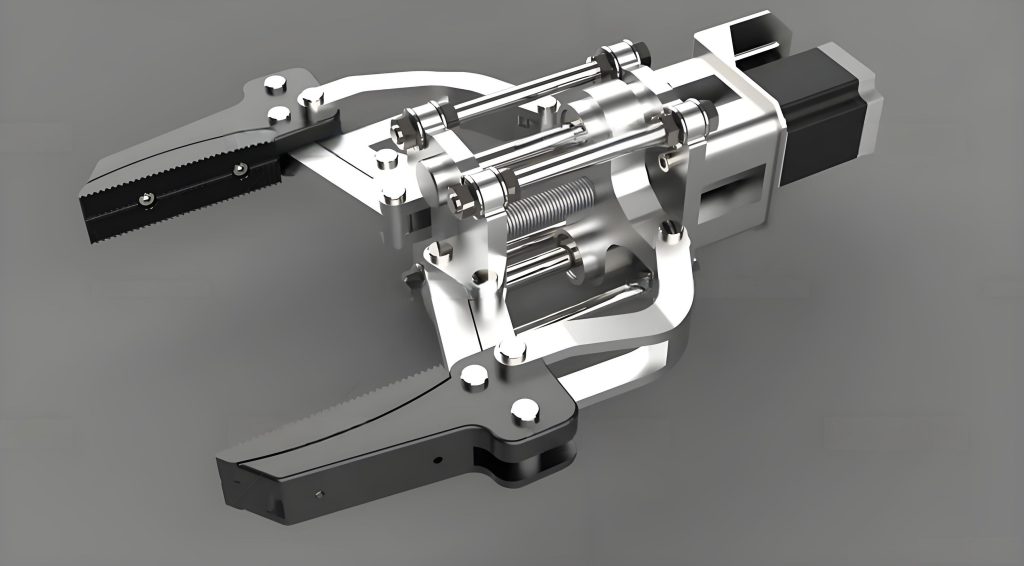
The end effector is designed as a ring-shaped spraying mechanism, where the spray rods are driven by a gear train to open and close around tree canopies. This configuration reduces the overall weight of the end effector, facilitating easier manipulation by the robotic arm. The gear transmission system consists of a driving pinion and multiple driven gears arranged in a staggered mesh to achieve reverse rotations, thereby enabling the encircling motion. Specifically, a stepper motor transmits torque through a coupling to the input shaft, which engages with internal gears in the gearbox. These gears then mesh with larger gears attached to the spray rods, causing them to slide along dedicated circular tracks. Each spray rod includes one inlet for pesticide supply and three nozzles for output, ensuring uniform distribution. The end effector’s functionality hinges on precise gear engagement and efficient fluid dynamics, both of which are analyzed in detail to prevent failures such as tooth deformation or inadequate spray coverage.
To assess the mechanical strength of the gear transmission in the end effector, we conducted a static structural analysis using ANSYS Workbench 2022R2. The gears are made of cast steel with a density of 7,580 kg/m³, Poisson’s ratio of 0.3, elastic modulus of 206 GPa, and yield strength of 530 MPa. The gear parameters include a module of 1.5 mm, face width of 15 mm, and tooth counts of 30 for the driving gear and intermediate gears, and 1,340 for the large gears connected to the spray rods. The input torque is set at 250 N·mm for the primary drive, with reduced torques at subsequent stages due to gear ratios. The three-dimensional model, created in SolidWorks, was imported into Workbench for simulation. Meshing was performed using first-order tetrahedral elements, with refined sizing of 0.07 mm at contact surfaces and 0.6 mm elsewhere to balance accuracy and computational cost. The contact type was defined as frictional with a coefficient of 0.1, and boundary conditions included fixed supports on driven gears and remote displacement constraints on driving gears to allow only rotational motion. The solution was obtained over a 1-second interval with adaptive time stepping.
The results from the finite element analysis reveal that the stress concentrations are localized to partial regions of the meshing tooth surfaces, owing to the incomplete engagement design necessitated by space constraints in the end effector’s gearbox. For the gear pair between the driving gear and the first intermediate gear, the maximum equivalent stress is 27.14 MPa, and the maximum total deformation is 0.0032793 mm, with the deformation primarily attributed to rigid body displacement from initial gaps rather than elastic strain. After subtracting this rigid body effect, the actual deformation of the driving gear is approximately 0.00007 mm, and that of the intermediate gear is 0.00011989 mm. Similarly, for the gear pair between an intermediate gear and a large gear, the maximum stress is 18.757 MPa, and the true deformations are about 0.000034 mm and 0.000074715 mm, respectively. These values are significantly below the allowable contact stress for cast steel, which exceeds 355 MPa, indicating that the gear design in the end effector is safe against fatigue and wear under typical operating loads. The stress and strain distributions can be expressed using the Hertz contact theory, where the contact stress $\sigma_H$ is given by:
$$ \sigma_H = \sqrt{ \frac{F_t}{b d_1} \cdot \frac{u+1}{u} \cdot \frac{Z_H Z_E Z_\epsilon}{\cos^2 \alpha} } $$
Here, $F_t$ is the tangential load, $b$ is the face width, $d_1$ is the pitch diameter, $u$ is the gear ratio, $Z_H$ is the zone factor, $Z_E$ is the elasticity factor, $Z_\epsilon$ is the contact ratio factor, and $\alpha$ is the pressure angle. Given the low torque requirements in our end effector, the computed stresses align with theoretical expectations, confirming the gear transmission’s reliability without risk of tooth bending or pitting.
Following the structural validation, we focused on optimizing the spray performance of the end effector, particularly the nozzle selection, which directly influences atomization quality and pesticide utilization. The spray rod in the end effector has three nozzles, and we first investigated whether the output pressures across these nozzles vary significantly due to internal flow losses. Using ANSYS Fluent, we modeled the fluid domain of the spray rod with one inlet and three outlets, assuming a nozzle orifice diameter of 0.66 mm and a spray angle of 45°. The mesh was generated with hexahedral elements of 0.5 mm size, refined to 0.1 mm near the nozzles. The material was set as liquid water, and simulations were run for inlet pressures of 0.5, 1.0, 1.5, and 2.0 MPa—typical ranges for agricultural spraying. The results, summarized in Table 1, show that the outlet pressures for all three nozzles are consistent within a 6% margin, with nozzle 2 exhibiting slightly higher values. Therefore, subsequent analyses considered only one nozzle as representative, simplifying the optimization process for the end effector.
| Inlet Pressure (MPa) | Outlet Pressure – Nozzle 1 (MPa) | Outlet Pressure – Nozzle 2 (MPa) | Outlet Pressure – Nozzle 3 (MPa) |
|---|---|---|---|
| 0.5 | 0.46266 | 0.46335 | 0.46285 |
| 1.0 | 0.95073 | 0.95999 | 0.95121 |
| 1.5 | 1.43093 | 1.43691 | 1.43218 |
| 2.0 | 1.91219 | 1.91526 | 1.91387 |
Next, we explored the influence of inlet pressure, spray angle, and nozzle orifice diameter on droplet size, a key metric for spray effectiveness. Smaller droplets offer better penetration into tree canopies and adhesion to targets, reducing pesticide waste. We created an external cylindrical flow domain with a diameter of 2000 mm and length of 510 mm in Fluent, using the SST turbulence model and discrete phase model (DPM) with the TAB breakup model. Injections were configured as pressure-swirl atomizers, varying parameters across simulations. For a fixed orifice diameter of 0.66 mm, we examined droplet sizes at inlet pressures of 0.5 to 2.0 MPa and spray angles of 45°, 65°, 80°, and 110°. The data, presented in Table 2, indicate that droplet size decreases with increasing pressure and larger spray angles. This relationship can be approximated linearly, as shown in the derived trend lines, where droplet diameter $d_d$ is inversely proportional to pressure $P$ and spray angle $\theta$:
$$ d_d \propto \frac{1}{P \cdot \theta} $$
Specifically, at 0.5 MPa, the droplet size ranges from 329.82 μm for 45° to 118.34 μm for 110°, while at 2.0 MPa, it drops to 78.04 μm for 45° and 27.07 μm for 110°. The sharpest reduction occurs between 0.5 and 1.0 MPa, with gradual declines thereafter. This underscores the importance of higher pressures for finer atomization in the end effector.
| Inlet Pressure (MPa) | Droplet Size at 45° (μm) | Droplet Size at 65° (μm) | Droplet Size at 80° (μm) | Droplet Size at 110° (μm) |
|---|---|---|---|---|
| 0.5 | 329.8234 | 260.7089 | 214.4564 | 118.3439 |
| 1.0 | 159.6471 | 131.9386 | 107.9621 | 59.4658 |
| 1.5 | 105.8624 | 87.8726 | 71.7680 | 38.4300 |
| 2.0 | 78.0367 | 64.9973 | 52.9400 | 27.0711 |
Additionally, we investigated the effect of nozzle orifice diameter on droplet size while holding inlet pressure at 1.5 MPa and spray angle at 80°. The results, compiled in Table 3, demonstrate that larger orifices produce coarser droplets. For instance, increasing the diameter from 0.66 mm to 1.30 mm raises the droplet size from 71.77 μm to 81.70 μm. This trend can be modeled using an empirical correlation:
$$ d_d = k \cdot D^n $$
where $D$ is the orifice diameter, $k$ is a constant dependent on fluid properties and pressure, and $n$ is an exponent typically between 0.5 and 1.0. For our end effector, a smaller orifice is preferable to generate finer droplets, but it must balance with flow rate requirements to ensure adequate coverage.
| Nozzle Orifice Diameter (mm) | Droplet Size (μm) |
|---|---|
| 0.66 | 71.7680 |
| 0.91 | 75.2116 |
| 1.10 | 78.3314 |
| 1.30 | 81.7028 |
Based on these simulations, we optimized the nozzle configuration for the end effector. In agriculture, droplet classifications include coarse spray (>400 μm), fine spray (101–400 μm), mist (51–100 μm), and smoke (0–50 μm). For mountain orchard applications, smaller droplets in the mist range are desirable due to their penetration and adhesion capabilities. Our analysis suggests that a nozzle with an orifice diameter of 0.66 mm and a spray angle of 80° operating at pressures above 1.0 MPa yields droplet sizes between 52.94 μm and 107.96 μm, effectively falling within the mist category. This setup ensures uniform deposition on tree canopies while minimizing environmental drift. Thus, we selected this nozzle type for the end effector, enhancing the overall spray efficiency of the robot.
In conclusion, this study successfully designed and analyzed the end effector for a mountain orchard spraying robot using ANSYS Workbench. The finite element analysis confirmed that the gear transmission system within the end effector withstands operational loads with stresses well below material limits, ensuring durability and minimal deformation. The computational fluid dynamics simulations provided insights into spray characteristics, leading to an optimized nozzle selection with a 0.66 mm orifice and 80° spray angle for fine atomization. These findings contribute to the development of robust and efficient spraying mechanisms for challenging terrains, highlighting the importance of integrated simulation tools in the design process. Future work may involve experimental validation and further refinements to the end effector, such as adaptive control based on real-time canopy detection, to advance precision agriculture in mountainous regions.