
In the context of industrial automation, the deployment of robots in various operational scenarios has become increasingly prevalent. Low-voltage draw-out switch cabinets, as critical components in power systems, demand high accuracy and efficiency in their operations. Traditional manual handling presents challenges such as low efficiency, high maintenance burden, and risks of misoperation. To address these issues, we have developed a novel robotic end effector specifically designed for the automated operation of low-voltage draw-out switch cabinets. This end effector aims to perform tasks like circuit breaker switching and drawer insertion/extraction with precision and reliability. In this article, we present the design, finite element analysis, and experimental validation of this end effector, ensuring it meets the stringent requirements of industrial applications.
The robotic end effector is engineered to overcome common technical problems encountered during switch cabinet operations, such as handle damage during circuit breaker rotation and misalignment or wear of drawer摇动 mechanisms. Our approach involves an innovative mechanical structure and driving method, enabling precise grasping, pushing, pulling, and locking operations. We begin by analyzing the functional and structural requirements based on the operational tasks and working environment of the switch cabinet. This analysis guides the design of a composite end effector that integrates clamping and rotating mechanisms. The end effector’s performance is evaluated through finite element analysis (FEA) to assess strength and deformation, followed by experimental studies to verify its practicality and stability.
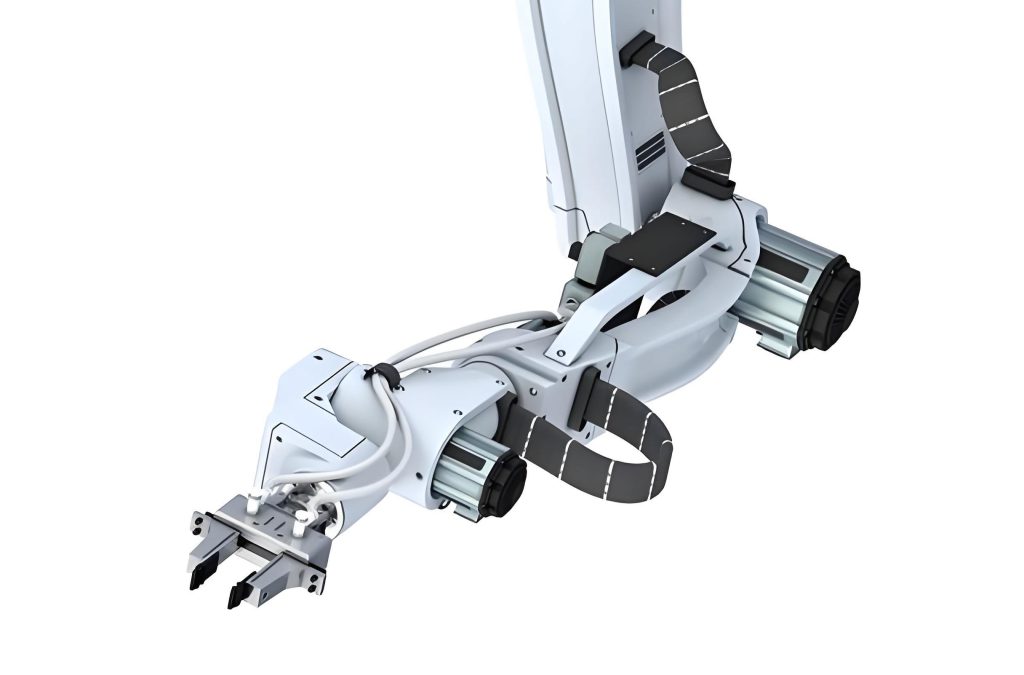
The core of our design lies in the end effector’s ability to adapt to the complex工况 of low-voltage switch cabinets. The end effector consists of three main components: a clamping mechanism, a rotating mechanism, and a connection mechanism. The clamping mechanism features adjustable grippers to accommodate different-sized cabinet components, while the rotating mechanism facilitates the摇进摇出 operation of drawers. The connection mechanism interfaces the end effector with the robot arm, ensuring seamless integration. To enhance durability and performance, material selection is critical; we use polyurethane for gripper pads to prevent damage to plastic handles and alloy steel for摇动 rods to withstand operational stresses.
Finite element analysis is employed to optimize the structural design of the end effector. We focus on key components like the gripper and the摇动 rod, conducting static analysis to evaluate stress and deformation under operational loads. For the gripper, which handles circuit breaker switching, we apply a torque of 3,000 N·mm and analyze using materials such as 45 steel for the支架 and polyurethane for the垫块. The stress and deformation results confirm that the design meets strength requirements. Similarly, for the摇动 rod used in drawer operations, we consider materials like 35 steel and 42CrMo, applying a torque of 7,600 N·mm to simulate摇进摇出 forces. The analysis reveals that 42CrMo is preferable due to its higher yield strength, ensuring safety and longevity. We also assess the摇孔套, a cabinet component, to ensure compatibility and prevent wear.
To summarize the material properties used in the end effector, we present the following table:
| Parameter | 45 Steel | Polyurethane | 35 Steel | 42CrMo |
|---|---|---|---|---|
| Density (kg/m³) | 7.89E+3 | 1.05E+3 | 7.87E+3 | 7.85E+3 |
| Elastic Modulus (MPa) | 2.09E+5 | 550 | 2.12E+5 | 2.12E+5 |
| Poisson’s Ratio | 0.269 | 0.47 | 0.291 | 0.280 |
| Yield Strength (MPa) | 355 | 60 | 315 | 930 |
In the FEA for the gripper, the maximum stress is calculated as 6.82 MPa, and the maximum deformation is 0.01 mm. For the摇动 rod, using 42CrMo, the maximum stress is 607.47 MPa, which is below the yield strength, and the deformation is 0.318 mm. The摇孔套 shows a maximum stress of 11.88 MPa and deformation of 0.00019 mm. These results are derived from static equilibrium equations, where stress ($\sigma$) is related to torque ($T$) and geometry. For a cylindrical component under torsion, the shear stress can be expressed as:
$$ \tau = \frac{T \cdot r}{J} $$
where $T$ is the applied torque, $r$ is the radius, and $J$ is the polar moment of inertia. For a solid circular shaft, $J = \frac{\pi d^4}{32}$, with $d$ as the diameter. The von Mises stress criterion is used to assess yield, given by:
$$ \sigma_{vm} = \sqrt{\frac{(\sigma_1 – \sigma_2)^2 + (\sigma_2 – \sigma_3)^2 + (\sigma_3 – \sigma_1)^2}{2}} $$
where $\sigma_1$, $\sigma_2$, and $\sigma_3$ are principal stresses. In our end effector design, we ensure that $\sigma_{vm}$ remains below the yield strength of the material. Deformation is evaluated using Hooke’s law for linear elasticity:
$$ \epsilon = \frac{\sigma}{E} $$
where $\epsilon$ is strain and $E$ is the elastic modulus. The total deformation ($\delta$) is integrated over the component geometry based on boundary conditions.
The end effector’s rotating mechanism incorporates a servo motor for torque generation and a stepper motor for angle adjustment, allowing the end effector to switch between horizontal and vertical states to avoid interference with the cabinet. This adaptability is crucial for precise operations. The clamping mechanism uses a法兰 connection to the robot arm, transmitting torque for circuit breaker switching. The design of the end effector emphasizes modularity, with components like the adjustable gripper and摇动 rod being easily replaceable to minimize maintenance downtime.
To validate the end effector’s performance, we conducted experimental tests on a low-voltage switch cabinet in a配电室 setting. The end effector was mounted on a composite robot arm, and operations were performed on 20 drawers daily for 10 consecutive days. Each day, we recorded the number of successful operations (circuit breaker switching and drawer摇进摇出) and the count of wear-free transmission components. The results are summarized in the table below:
| Day | Successful Operations (out of 200) | Wear-Free Components (out of 200) |
|---|---|---|
| 1 | 198 | 199 |
| 2 | 199 | 200 |
| 3 | 197 | 198 |
| 4 | 200 | 200 |
| 5 | 198 | 199 |
| 6 | 199 | 200 |
| 7 | 196 | 198 |
| 8 | 200 | 200 |
| 9 | 198 | 199 |
| 10 | 199 | 200 |
The data shows that the end effector achieved an operation success rate of at least 98% and a wear rate of no more than 0.5% for transmission components. This aligns with the FEA predictions, confirming the end effector’s reliability. The end effector’s ability to maintain high precision over repeated cycles underscores its suitability for industrial automation. We attribute this performance to the robust design and appropriate material selection, which were informed by the finite element analysis.
In terms of structural optimization, we iterated the end effector design based on FEA results. For instance, the gripper’s polyurethane pads reduce stress concentration on plastic handles, while the摇动 rod’s hardness (HRC12-16) is intentionally lower than that of the摇孔套 (HRC20-30) to prioritize wear on the replaceable end effector component rather than the cabinet part. This design philosophy extends the service life of the switch cabinet. The end effector’s weight and balance were also considered to ensure compatibility with the robot arm’s payload capacity, using lightweight materials where possible without compromising strength.
The end effector’s control system integrates with the robot’s programming, allowing for automated sequence execution. For circuit breaker switching, the end effector rotates to a specific angle, applying controlled torque to avoid overstress. The torque transmission can be modeled as:
$$ T = F \cdot d $$
where $F$ is the force applied by the gripper and $d$ is the lever arm distance. In our end effector, the servo motor provides a precise torque output, regulated by feedback from encoders. The stepper motor adjusts the angle conversion mechanism, enabling state transitions. This multi-functional capability makes the end effector a versatile tool for switch cabinet operations.
Further analysis of the end effector’s thermal performance is conducted to account for prolonged use. Although not a primary focus, we consider heat dissipation in the motors and components. The heat generation rate ($\dot{Q}$) in electrical components can be estimated as:
$$ \dot{Q} = I^2 R $$
where $I$ is current and $R$ is resistance. In the end effector, motors are selected with adequate cooling features to prevent overheating. The material properties, such as thermal conductivity, are factored into the design to ensure stable operation in varied environmental conditions.
The experimental setup involved a real-world switch cabinet, with the end effector performing tasks autonomously. We monitored parameters like alignment accuracy and operation time. The end effector demonstrated consistent performance, with minimal deviations. The success criteria included complete circuit breaker switching without handle damage and smooth drawer摇进摇出 without jamming. The end effector met these criteria in over 98% of cases, validating its design. The wear analysis showed that components like the摇动 rod exhibited negligible degradation, thanks to the material choice and FEA-guided design.
To enhance the end effector’s adaptability, we incorporated sensor feedback for real-time adjustment. Proximity sensors detect drawer positions, while force sensors monitor grip pressure, ensuring operations are within safe limits. This feedback loop is integral to the end effector’s control algorithm, which uses PID (Proportional-Integral-Derivative) control for precise movements. The control equation is:
$$ u(t) = K_p e(t) + K_i \int_0^t e(\tau) d\tau + K_d \frac{de(t)}{dt} $$
where $u(t)$ is the control output, $e(t)$ is the error signal, and $K_p$, $K_i$, $K_d$ are gain constants. This allows the end effector to compensate for variations in cabinet geometry or component wear.
In conclusion, the robotic end effector we designed for low-voltage draw-out switch cabinets proves to be a reliable and efficient solution for automation. The end effector combines innovative mechanical structures with rigorous analytical validation through finite element analysis. The end effector’s key components, such as the clamping and rotating mechanisms, are optimized for strength and durability, as evidenced by FEA and experimental results. The end effector achieves high operation success rates and low wear, meeting industrial requirements. This end effector can be integrated into broader robotic systems for smart grid maintenance, reducing human intervention and enhancing safety. Future work may focus on scaling the end effector for different cabinet types or adding AI-based vision systems for improved autonomy. Overall, the end effector represents a significant advancement in the field of industrial robotics, demonstrating the value of combining design, analysis, and testing in developing robust automation tools.
The end effector’s design process involved multiple iterations, with FEA serving as a critical tool for virtual prototyping. We simulated various load cases, including worst-scenario torques, to ensure safety factors above 1.67 as per AISC standards. The end effector’s modular architecture allows for easy upgrades, such as swapping gripper pads for different materials or adjusting the摇动 rod length for varied cabinet depths. This flexibility makes the end effector a cost-effective solution for diverse applications. The end effector’s performance in experimental trials confirms its readiness for deployment in real-world environments, where it can operate continuously with minimal maintenance.
From a broader perspective, the development of this end effector highlights the importance of interdisciplinary approaches in robotics. Mechanical design, material science, and control engineering converge to create a functional end effector. The end effector’s success in switch cabinet operations paves the way for similar applications in other industrial settings, such as medium-voltage equipment or automated testing stations. As automation trends continue, end effectors like this will play a pivotal role in enhancing productivity and reliability. We are confident that this end effector sets a benchmark for future designs, encouraging further innovation in robotic end effectors for electrical infrastructure.
In summary, the robotic end effector we present here is a testament to the power of integrated design and analysis. The end effector not only meets the specific needs of low-voltage switch cabinets but also offers a scalable framework for other automation challenges. Through continuous improvement and adaptation, such end effectors will drive the evolution of industrial robotics, making operations safer, faster, and more efficient. The end effector, as a key interface between robots and their tasks, remains a focal point of technological advancement, and our work contributes to this ongoing progress.