
In the current era of rapid technological advancement, the robotics industry stands as a pivotal strategic sector supported by national initiatives, with vast prospects for growth. As frontier technologies like artificial intelligence evolve, the structure and functionality of robots have become increasingly sophisticated. In recent years, various industries have embarked on automation and intelligent reform, during which a significant demand for robots has emerged, particularly in industrial sectors where production lines have already achieved robotic automation. To enhance robot performance, it is essential to optimize and adjust the robot’s end effector, ensuring more灵敏 and accurate transitions during tool changes. This necessity stems from the fact that during operations, robots often require switching between different end effectors to adapt to diverse tasks, and the conventional practice of placing these tools on tables or floors leads to space wastage and increased changeover time. Therefore, to improve robot efficiency, I focus on designing a specialized placement apparatus—a quick-change placement rack for robot end effectors.
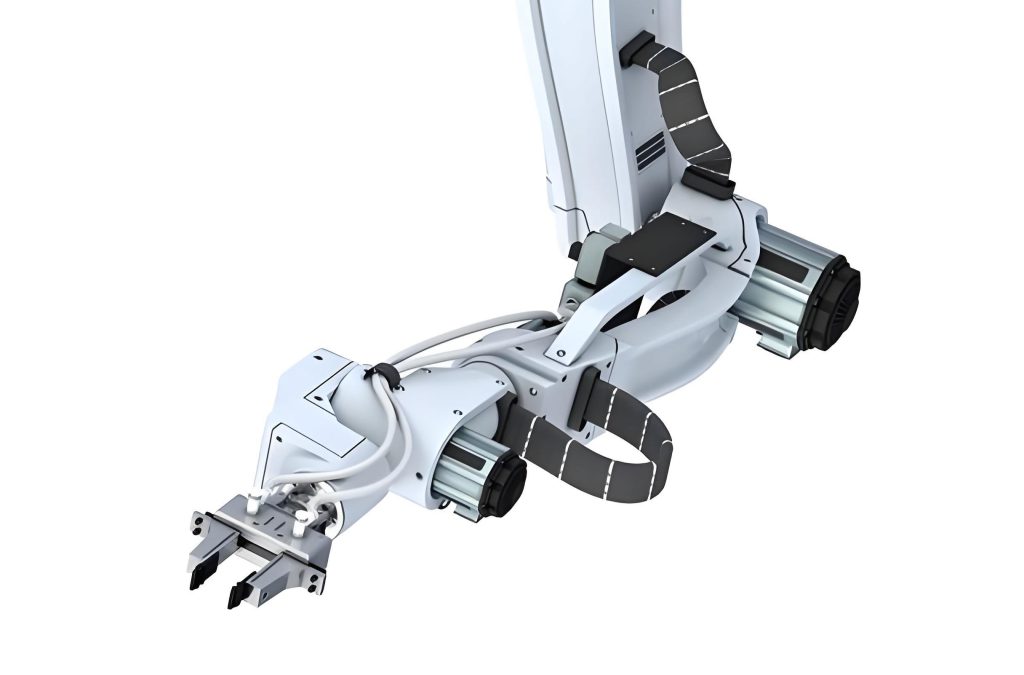
The end effector is a critical component of any robot, serving as the interface between the robot and its environment. In my observation, the development of robot end effectors has progressed significantly, with types including industrial robots, space robots, and underwater robots. Industrial robots, in particular, have capabilities such as assembly, spot welding, arc welding, painting, stamping, injection molding, and handling, forming automated production lines in manufacturing. Some of these technologies have even reached world-leading levels. Initially applied in automotive manufacturing, industrial robots are now utilized in fields like chemicals, construction, machinery, mining, shipbuilding, and light industry, with作业 scenarios diversifying to include assembly lines and logistics sorting. The ability to perform multifunctional operations across multiple contexts relies heavily on the quick-change device, an intermediate component that facilitates the swapping of end effector tools. However, the lack of an organized placement system for these tools hampers overall performance, prompting my investigation into existing solutions and the development of an optimized design.
To understand the landscape, I analyze existing quick-change placement racks both domestically and internationally. Internationally, the robotics industry has recognized the importance of these racks early on, developing various models to accommodate different robot specifications and functions. These are categorized into large, medium, and small sizes, with further subdivisions based on placement methods. I summarize these in the following table to provide a clear comparison.
| Type of Placement Rack | Key Features | Advantages | Limitations |
|---|---|---|---|
| Hook Placement Rack | Utilizes tool hooks for hanging end effectors | Occupies minimal space, low负重 | May not suit heavy or irregularly shaped end effectors |
| Pin and Bracket Tool Placement Rack | Installed on robot立柱 or horizontal beams, uses transition plates for fixation | Versatile for pneumatic tools with air孔支柱 | Requires additional components like transition plates |
| V-shaped Plate Horizontal Placement Rack | Employs V-shaped slots to guide transition盘 support columns | Provides stable horizontal placement | Mandatory use of transition盘, limiting flexibility |
| Pin and Bushing Placement Rack | Mounted as external blocks, allows adjustable spacing and uses pin孔定位 | High customization and precise positioning | Can be complex to install and maintain |
Additionally, specialized racks exist for specific applications, such as welding robot快换放置架 that can hold up to four焊枪 tools, often integrated with PLC control and sensors for monitoring. While effective, these are limited to welding scenarios and lack general applicability. Domestically, progress has been made with the development of large, medium, and small racks using methods like limit销 and bracket support, supplemented by transition plates. Some designs even eliminate the need for transition plates by incorporating pin孔定位 directly into the tool盘, reducing侧重量 and enhancing quick-change conditions. Despite these advancements, I identify gaps in handling diverse end effector types, particularly those with uneven weight distribution or unique shapes, which motivates my design approach.
In designing a universal quick-change placement rack for robot end effectors, my overall思路 revolves around creating a compact, integrated structure that minimizes space占用 while accommodating various end effector types. The rack comprises a main frame,导向定位销, placement板,压缩弹簧板系统, and到位传感器. The导向定位销 are conical to match the定位销孔 on end effectors, facilitating导正 and精准定位 during placement and retrieval. To ensure stable placement, the到位传感器 detects the force exerted by the end effector on the rack, allowing for real-time adjustment and verification. This design aims to provide a普适性 solution that can handle偏心型,悬臂型,较重型,较轻型, and重心居中型 end effectors, which I will detail in the following sections with mathematical formulations and tabular summaries.
For eccentric and cantilever-type end effectors, where the center of gravity is far from the定位点,放置 can lead to tipping or instability. To address this, I incorporate顶撑支座 structures that redistribute the load and mitigate压力不均. The力学 involved can be described using equilibrium equations. For instance, if an end effector has a weight \( W \) acting at a distance \( d \) from the support point, the moment \( M \) is given by:
$$ M = W \times d $$
To prevent侧翻, the顶撑支座 provides an opposing moment through a force \( F \) at a distance \( l \), ensuring stability when:
$$ F \times l \geq W \times d $$
This ensures that the重力 is均匀分摊, protecting the rack from damage and reducing冲击 during placement.
Heavy-type end effectors impose higher强度 requirements on the placement板. To maintain空间 efficiency, I integrate these with other types in a single rack using a compression spring plate system. This system consists of springs,下撑板, and上撑板, which undergo弹性变形 to absorb冲击 and adjust the placement位态. The spring force \( F_s \) follows Hooke’s law:
$$ F_s = k \times x $$
where \( k \) is the spring constant and \( x \) is the displacement. When a heavy end effector is placed, the springs compress to accommodate the weight, ensuring平稳放置. I optimize this by selecting appropriate \( k \) values based on the expected weight range, as summarized in the table below for different end effector categories.
| End Effector Type | Typical Weight Range (kg) | Recommended Spring Constant \( k \) (N/m) | Placement Mechanism |
|---|---|---|---|
| Eccentric/Cantilever | 5-20 | 500-2000 | 顶撑支座 with moment平衡 |
| Heavy | 20-100 | 2000-10000 | Compression spring plate system |
| Light/Center-Gravity | 1-10 | 100-500 | 导向定位销 for精准定位 |
Light and center-gravity end effectors are more straightforward, relying on the导向定位销 for导正 and定位. The锥形 structure of the销 ensures a snug fit into the销孔, minimizing placement error. The positioning accuracy \( \Delta p \) can be expressed as a function of the销 angle \( \theta \) and tolerance \( \delta \):
$$ \Delta p = \delta \times \tan(\theta) $$
By optimizing \( \theta \) and \( \delta \), I achieve precise placement, which is crucial for efficient tool changes.
The到位传感器 plays a vital role in monitoring placement stability. I design it to detect pressure variations, with the output signal \( S \) proportional to the force \( F \) applied by the end effector:
$$ S = \alpha \times F + \beta $$
where \( \alpha \) is the sensitivity coefficient and \( \beta \) is the offset. A threshold value \( S_{\text{th}} \) is set to indicate proper placement; if \( S \geq S_{\text{th}} \), the end effector is deemed稳定到位. This sensor data can be used for real-time feedback to the robot控制系统, enabling automatic adjustments and enhancing the overall reliability of the quick-change process.
In terms of application, the modern industrial landscape increasingly relies on robots as key支撑装备 for smart manufacturing. As robotics enters the 2.0 era, with capabilities like self-execution, self-decision-making, and self-perception, the demand for versatile end effector handling grows. My designed quick-change placement rack addresses this by providing a普适性, space-efficient solution that accommodates various end effector types. For instance, in an自动化生产线, multiple robots can share a single rack, reducing clutter and improving workflow. The integration of传感器 and弹簧系统 ensures that even in dynamic environments, tools are placed securely, minimizing downtime and enhancing productivity. To quantify benefits, consider a scenario where a robot performs 100 tool changes per day; with traditional floor placement, each change might take 10 seconds, but with my rack, it could be reduced to 5 seconds due to organized access and stable positioning, leading to a time saving of 500 seconds daily. This efficiency gain translates to higher throughput and cost savings, making the rack a valuable addition to any robotic system.
In conclusion, as robotics technology becomes a cornerstone of modern industry, optimizing ancillary components like the end effector placement system is essential. My research and design of a quick-change placement rack for robot end effectors offer a comprehensive solution that tackles the challenges of space utilization, stability, and versatility. By incorporating elements like导向定位销, compression spring plates, and到位传感器, I create a structure that not only supports diverse end effector types but also integrates seamlessly into existing robotic workflows. This innovation represents a step forward in enhancing robot performance and operational efficiency, paving the way for more advanced automation in the future. Future work could involve testing the rack in real-world industrial settings or exploring adaptive designs using machine learning to predict placement needs based on end effector usage patterns.