
In the era of intelligent manufacturing, industrial robots have become indispensable across various sectors such as material handling, precision assembly, and packaging. As these systems evolve towards lightweight, high-speed, and intelligent configurations, the design of critical components like the end effector gains paramount importance. The end effector, often referred to as the “hand” of the robot, directly interacts with workpieces, and its mass significantly influences the robot’s agility, accuracy, and energy consumption. Therefore, achieving lightweight design without compromising mechanical performance is a key challenge. In this article, I delve into a comprehensive methodology utilizing Creo for 3D modeling and Altair Inspire for topology optimization to redesign an industrial robot end effector, specifically focusing on its finger structure. Through this approach, I aim to demonstrate how advanced finite element analysis and optimization techniques can drastically reduce material usage while maintaining structural integrity, ultimately enhancing the efficiency and functionality of the end effector.
The end effector is a pivotal component in robotic systems, responsible for executing tasks like gripping, lifting, and manipulating objects. Traditional designs often rely on empirical methods, leading to over-engineering with excessive material and weight. This not only increases inertia and power demands but also limits operational speed and precision. To address this, topology optimization emerges as a powerful tool. It is a mathematical approach that optimizes material distribution within a given design space under specified loads, constraints, and performance goals. By strategically removing non-critical material, topology optimization reveals the most efficient structural forms, paving the way for lightweight end effector designs. In my work, I leverage Creo 7.0, a robust parametric CAD software, to create the initial 3D model of the end effector’s finger component. Subsequently, I employ Altair Inspire 2020, which integrates the OptiStruct solver, to perform topology optimization and strength validation. This integrated workflow ensures that the optimized end effector not only meets mechanical requirements but also aligns with manufacturing feasibility.
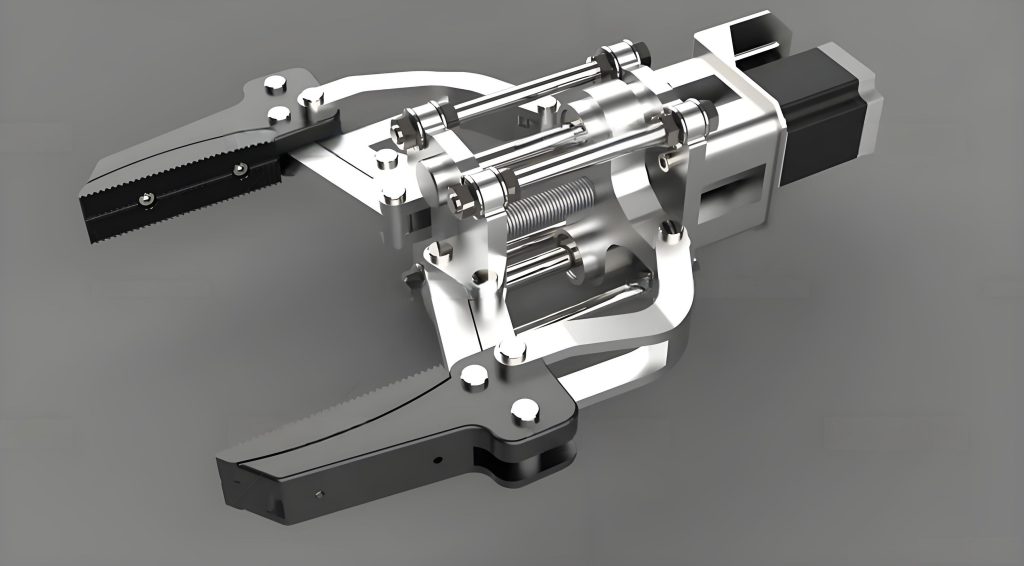
To begin, I developed the 3D model of the finger part of the end effector using Creo 7.0. This finger is designed for gripping small, lightweight workpieces, typically in applications like machine loading and assembly. The initial model was created based on functional requirements, incorporating features such as mounting holes and contact surfaces. However, this preliminary design often contains redundant material, making it ideal for optimization. After modeling, I imported the geometry into Altair Inspire 2020 for finite element analysis and topology optimization. The first step involved defining the material properties. For the end effector finger, I selected AA6061-T6 aluminum alloy due to its favorable characteristics: low density, good machinability, weldability, and corrosion resistance. These properties are crucial for ensuring the end effector remains lightweight and durable. The material properties are summarized in the table below.
| Property | Value |
|---|---|
| Tensile Strength (MPa) | 315 |
| Yield Strength (MPa) | 205 |
| Elongation (%) | 12 |
| Elastic Modulus (GPa) | 68.6 |
| Poisson’s Ratio | 0.3 |
| Density (kg/m³) | 2.7e3 |
With the material defined, I proceeded to analyze the loading conditions of the end effector finger during operation. The finger experiences various forces when gripping a workpiece, including fixed constraints at the mounting holes, frictional forces, and normal contact forces. For this study, I considered a worst-case scenario with a maximum payload of 3 kg. The gravitational force of the workpiece is calculated as:
$$G_{work} = m g$$
where \(m = 3 \, \text{kg}\) and \(g = 10 \, \text{N/kg}\), yielding \(G_{work} = 30 \, \text{N}\). To prevent slippage, the frictional force \(F_{friction}\) must satisfy \(F_{friction} \geq G_{work}\). Thus, I set \(F_{friction} = 30 \, \text{N}\). The normal force \(F_{normal}\) is related to the frictional force through the coefficient of friction \(\mu\):
$$F_{friction} = \mu F_{normal}$$
For aluminum alloy contacting common materials, \(\mu\) ranges from 0.17 to 0.34. To ensure safety, I used a conservative value of \(\mu = 0.15\), resulting in \(F_{normal} = 200 \, \text{N}\). These loads are applied to the contact surfaces of the end effector finger, while fixed constraints are imposed at the mounting holes. The loading conditions are tabulated below.
| Load Type | Magnitude (N) |
|---|---|
| Workpiece Weight (\(G_{work}\)) | 30 |
| Tangential Friction Force (\(F_{friction}\)) | 30 |
| Normal Constraint Force (\(F_{normal}\)) | 200 |
Before optimization, I conducted an initial strength analysis to assess the baseline performance of the end effector finger. Using Inspire’s finite element solver with a mesh size of 2.5 mm and high accuracy settings, I evaluated displacement, von Mises stress, and safety factor. The results indicated a maximum displacement of 0.05524 mm, a maximum von Mises stress of 30.09 MPa, and a minimum safety factor of 8.0. Since the yield strength of AA6061-T6 is 205 MPa, the stress is well below the limit, revealing significant potential for lightweight optimization. This analysis confirms that the original end effector design is over-engineered, providing a solid rationale for topology optimization to reduce mass without compromising safety.
Topology optimization requires defining design and non-design spaces. The design space is the region where material can be redistributed or removed, while the non-design space includes areas that must remain intact, such as load-bearing surfaces and mounting points. For the end effector finger, I designated the gripping zones and bolt holes as non-design spaces, with the rest as the design space. Additionally, to ensure manufacturability, I applied shape controls like symmetry planes and bidirectional draft constraints. These controls prevent complex geometries that are difficult to produce, ensuring the optimized end effector remains practical. The optimization goal was to maximize stiffness under the given loads, with a mass target set as a percentage of the initial design space volume. I explored multiple scenarios by varying mass targets and thickness constraints, as detailed in the following table.
| Scheme | Mass Target (% of Design Space Volume) | Thickness Constraint (mm) | Shape Controls |
|---|---|---|---|
| Scheme 1 | 30% | 5.0 | Bidirectional symmetry, bidirectional draft |
| Scheme 2 | 30% | 4.0 | |
| Scheme 3 | 30% | 3.5 | |
| Scheme 4 | 30% | 3.0 | |
| Scheme 5 | 25% | 5.0 | |
| Scheme 6 | 25% | 3.0 | |
| Scheme 7 | 35% | 5.0 | |
| Scheme 8 | 35% | 3.0 |
After running the topology optimization for each scheme, I performed strength validation on the resulting geometries. The optimization process iteratively removes material from low-stress regions, generating organic, load-path-efficient shapes for the end effector finger. Key evaluation criteria included structural continuity (no isolated islands), minimum wall thickness (≥ 3 mm), maximum von Mises stress below 205 MPa, and a safety factor of at least 2. The results for all schemes are compared in the table below, highlighting mass reduction, displacement, stress, and safety factors.
| State | Mass (kg) | Max Displacement (mm) | Max von Mises Stress (MPa) | Min Safety Factor |
|---|---|---|---|---|
| Original Finger | 0.24562 | 0.05524 | 30.09 | 8.0 |
| Scheme 1 | 0.13820 | 0.08837 | 30.34 | 8.0 |
| Scheme 2 | 0.13792 | 0.08857 | 32.00 | 7.5 |
| Scheme 3 | 0.13799 | 0.08821 | 32.93 | 7.3 |
| Scheme 4 | 0.13766 | 0.08865 | 33.44 | 7.2 |
| Scheme 5 | 0.12974 | 0.10200 | 33.89 | 7.1 |
| Scheme 6 | 0.12948 | 0.10110 | 37.16 | 6.5 |
| Scheme 7 | 0.14715 | 0.07893 | 28.08 | 8.6 |
| Scheme 8 | 0.14588 | 0.07955 | 31.07 | 7.8 |
Analyzing these results, Schemes 5 and 6 offered the lowest mass but exhibited structural discontinuities, making them unsuitable for the end effector. Schemes 7 and 8 had higher masses, reducing lightweight benefits. Among the remaining, Scheme 2 and Scheme 4 showed comparable mass reductions of approximately 43.85% and 43.95%, respectively. However, Scheme 2 demonstrated slightly lower maximum stress (32.00 MPa vs. 33.44 MPa) and similar displacement, with a safety factor of 7.5, well above the required threshold. Therefore, I selected Scheme 2 as the optimal design for the end effector finger. The optimized geometry features a truss-like structure with material concentrated along primary load paths, significantly reducing weight while maintaining strength. This outcome underscores the effectiveness of topology optimization in reimagining the end effector for enhanced performance.
The mass reduction achieved through this process is substantial. The original end effector finger weighed 0.24562 kg, whereas the optimized version from Scheme 2 weighs 0.13792 kg, a reduction of 43.85%. This lightweight directly translates to lower inertia, allowing the robot to operate at higher speeds with improved precision and reduced energy consumption. Moreover, the maximum von Mises stress in the optimized end effector is 32.00 MPa, which is only 15.6% of the material’s yield strength (205 MPa), indicating ample safety margins. The displacement increased slightly to 0.08857 mm, but this remains within acceptable limits for most industrial applications. These improvements highlight how topology optimization can eliminate unnecessary material, leading to a more efficient end effector design without compromising reliability.
To further illustrate the benefits, let’s consider the broader implications for industrial robot systems. An end effector is often the most frequently customized component, as it must adapt to various tasks. By integrating topology optimization into the design workflow, engineers can rapidly develop lightweight end effectors tailored to specific payloads and environments. This reduces development time and cost, as physical prototyping is minimized. Additionally, the use of software like Inspire enables quick iteration; for instance, adjusting mass targets or constraints can generate multiple design alternatives in hours. The optimized end effector finger can be manufactured using techniques like additive manufacturing or CNC machining, depending on volume and precision requirements. The table below summarizes the key performance metrics before and after optimization, emphasizing the gains achieved.
| Metric | Original End Effector Finger | Optimized End Effector Finger (Scheme 2) | Improvement |
|---|---|---|---|
| Mass (kg) | 0.24562 | 0.13792 | 43.85% reduction |
| Max von Mises Stress (MPa) | 30.09 | 32.00 | 6.3% increase (still safe) |
| Max Displacement (mm) | 0.05524 | 0.08857 | 60.3% increase (within limits) |
| Min Safety Factor | 8.0 | 7.5 | 6.25% decrease (still > 2) |
From a mathematical perspective, topology optimization involves solving a material distribution problem. The objective function often aims to minimize compliance (maximize stiffness) subject to a volume constraint. This can be expressed as:
$$\min_{\rho} c(\rho) = \mathbf{U}^T \mathbf{K} \mathbf{U}$$
subject to:
$$V(\rho) \leq V_{\text{target}}$$
and
$$\mathbf{K} \mathbf{U} = \mathbf{F}$$
where \(\rho\) is the material density field, \(c\) is compliance, \(\mathbf{U}\) is the displacement vector, \(\mathbf{K}\) is the stiffness matrix, \(\mathbf{F}\) is the force vector, and \(V\) is the volume. In Altair Inspire, the OptiStruct solver implements such algorithms using the SIMP (Solid Isotropic Material with Penalization) method, which penalizes intermediate densities to drive the solution towards solid-void designs. For the end effector finger, this resulted in an optimal material layout that efficiently transmits loads from the gripping surfaces to the mounting points. The process also considered manufacturing constraints, such as symmetry, which ensures the end effector is balanced and easier to produce.
In practice, the workflow for designing an optimized end effector involves several steps. First, I define the functional requirements, including payload, workspace, and interface specifications. Next, I create a parametric 3D model in Creo, focusing on key features like finger geometry and attachment points. This model is then imported into Inspire for simulation. I set up the finite element model by assigning materials, applying loads and constraints, and meshing. After initial analysis, I define the design space and run topology optimization with appropriate goals and constraints. The output is a conceptual geometry, which I refine using Inspire’s PolyNURBS tools to generate a smooth, manufacturable CAD model. Finally, I validate the design through further finite element analysis to ensure it meets all criteria. This iterative process allows for rapid exploration of design alternatives, significantly accelerating the development of high-performance end effectors.
The advantages of this approach extend beyond weight reduction. For instance, a lighter end effector reduces the dynamic loads on the robot’s joints, potentially extending their lifespan and reducing maintenance costs. It also enables the use of smaller actuators, lowering overall system cost and energy consumption. In collaborative robot (cobot) applications, where safety is paramount, a lightweight end effector minimizes kinetic energy in case of collisions, enhancing operator safety. Furthermore, topology optimization can reveal innovative structural forms that are not intuitive through traditional design methods, leading to more efficient and aesthetically pleasing end effectors. As industries embrace automation, such optimized components contribute to sustainable manufacturing by reducing material waste and energy usage.
Looking ahead, the integration of topology optimization with emerging technologies like generative design and artificial intelligence promises even greater advancements. For example, AI algorithms could automatically suggest optimal mass targets or shape controls based on historical data, further streamlining the design process. Additionally, the rise of additive manufacturing allows for the production of complex topologically optimized geometries that were previously impossible to make. This synergy enables the creation of next-generation end effectors that are not only lightweight but also multifunctional, incorporating features like embedded sensors or cooling channels. As a researcher, I believe that continued innovation in these areas will drive the evolution of industrial robots towards unprecedented levels of efficiency and adaptability.
In conclusion, this study demonstrates the successful application of Creo and Inspire for the structural topology optimization of an industrial robot end effector. By focusing on the finger component, I achieved a mass reduction of 43.85% while maintaining mechanical performance within safe limits. The methodology outlined—from 3D modeling and finite element analysis to topology optimization and strength validation—provides a robust framework for lightweight design. The optimized end effector exemplifies how advanced simulation tools can transform traditional components into efficient, high-performance systems. As manufacturing demands grow, such approaches will be crucial for developing agile, cost-effective, and sustainable robotic solutions. I encourage engineers and designers to adopt similar techniques to unlock the full potential of their end effectors, paving the way for smarter and more responsive industrial automation.