
In the evolving landscape of industrial automation, the demand for high-precision, compact, and reliable transmission systems has surged. Among these, the rotary vector reducer stands out as a critical component in robotics, particularly for joint actuation. This device, often abbreviated as RV reducer, combines planetary gear传动 with cycloidal pin-wheel mechanisms to achieve high reduction ratios, exceptional torque capacity, and minimal backlash. Its widespread adoption in sectors like automotive manufacturing, electronics assembly, and aerospace underscores its importance. However, due to proprietary technologies held by leading manufacturers, detailed standard parameters are often inaccessible, posing challenges for reverse engineering, education, and independent development. This study addresses this gap by presenting a comprehensive methodology for modeling and assembling a rotary vector reducer using Solidworks, based solely on physical measurement data from a disassembled unit. The approach emphasizes hands-on learning, enhancing understanding of mechanical design principles while fostering skills in 3D modeling and simulation. By focusing on the rotary vector reducer, we aim to demystify its complex architecture and provide a replicable framework for analyzing similar mechanical systems.
The rotary vector reducer’s superiority lies in its hybrid design. Traditionally, it integrates a primary stage of planetary gear reduction with a secondary stage of cycloidal drive. This configuration results in a compact form factor, high stiffness, and smooth motion transmission—attributes essential for precision robotics. The core components include an input shaft with a sun gear, planetary gears mounted on crankshafts, cycloidal gears (also known as摆线齿轮), a pin wheel housing with针齿, and an output flange. Understanding these elements is pivotal for accurate modeling. In this work, we begin by dissecting a physical rotary vector reducer, meticulously measuring each part to gather dimensional data. Subsequently, we employ Solidworks to construct detailed 3D models, ensuring that the geometric and kinematic properties align with the实物. The process involves critical steps such as deriving the cycloidal profile mathematically, adjusting fits to mimic real-world assemblies, and performing hierarchical assembly simulations. This exercise not only elucidates the inner workings of the rotary vector reducer but also cultivates proficiency in dealing with non-standardized mechanical components—a valuable competency in both academic and industrial settings.
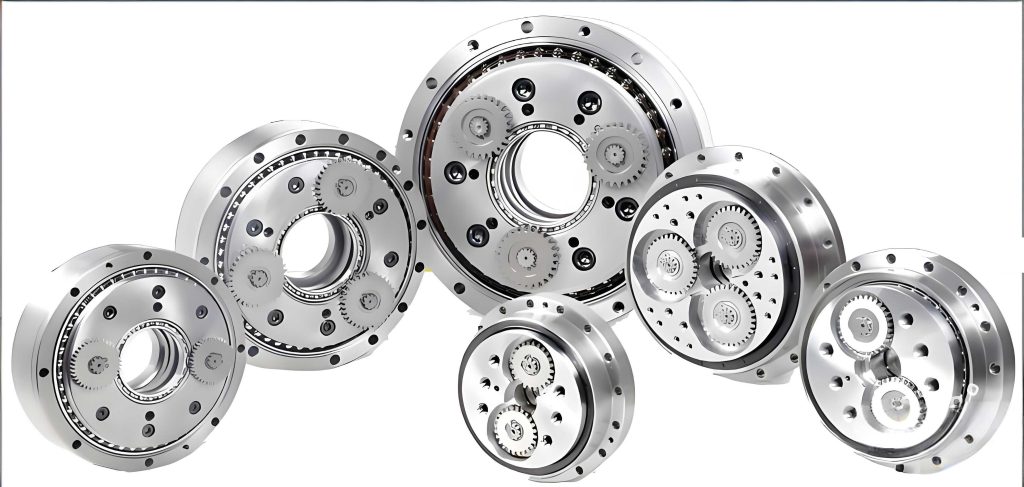
To appreciate the modeling endeavor, one must first grasp the operational theory of the rotary vector reducer. The传动 sequence initiates at the input shaft, which rotates the sun gear. This action drives two or more planetary gears, causing them to revolve around the sun gear (公转) while simultaneously spinning on their own axes (自转). The planetary gears are connected via splines to crankshafts, which inherit this dual motion. Mounted on these crankshafts through cylindrical roller bearings are cycloidal gears—typically two, phased 180 degrees apart to balance loads. These cycloidal gears engage with a stationary ring of针齿 (pins) housed in the pin wheel. As the crankshafts orbit, the cycloidal gears undergo a compound motion: they公转 around the pin wheel center and自转 in the opposite direction due to the eccentricity of the crankshafts. The自转 component is then extracted by the output flange, which is linked to the cycloidal gears via bearings, resulting in a significant speed reduction and torque amplification. The overall reduction ratio i of a rotary vector reducer can be expressed as:
$$ i = (1 + \frac{z_p}{z_c}) \cdot i_{planet} $$
where z_p is the number of pin teeth, z_c is the number of cycloidal gear teeth, and i_{planet} is the reduction ratio of the planetary stage. For instance, if the planetary stage has a ratio of 3:1 and the cycloidal stage has z_p = 40 and z_c = 39, the total ratio becomes:
$$ i = (1 + \frac{40}{39}) \cdot 3 \approx 6.08 $$
This multi-stage interplay is what赋予 the rotary vector reducer its remarkable performance. Table 1 summarizes key parameters measured from the physical unit, which serve as the foundation for our modeling.
| Parameter Description | Symbol | Value |
|---|---|---|
| Number of cycloidal gear teeth | z_c | 39 |
| Pin center circle radius (mm) | r_p | 64 |
| Number of pin teeth | z_p | 40 |
| Pin radius (mm) | r_{rp} | 3 |
| Short幅 coefficient | K_1 = \frac{a \cdot z_p}{r_p} | 0.8125 |
| Eccentricity (mm) | a | 1.30 |
| Planetary gear teeth count | z_{planet} | 20 |
| Sun gear teeth count | z_{sun} | 30 |
With these parameters in hand, the three-dimensional modeling phase commences in Solidworks. The most challenging aspect is crafting the cycloidal gear, whose tooth profile is not a standard involute but a摆线 curve derived from the rolling of a circle around another. Two methods are viable: programming via Solidworks API or using the equation-driven curve tool. We opt for the latter for its accessibility. The tooth profile of a cycloidal gear in a rotary vector reducer is defined by parametric equations that account for the interaction with pins. The simplified Cartesian parametric equations, based on the measured data, are:
$$ x(t) = r_p \left[ \sin\left(\frac{t}{z_c}\right) – K_1 \frac{z_p}{z_c} \sin\left(\frac{z_p}{z_c} t\right) \right] $$
$$ y(t) = r_p \left[ \cos\left(\frac{t}{z_c}\right) – K_1 \frac{z_p}{z_c} \cos\left(\frac{z_p}{z_c} t\right) \right] $$
where t is the parameter ranging from \pi to 3\pi to capture one full tooth flank. Substituting the values from Table 1:
$$ x(t) = 64 \left[ \sin\left(\frac{t}{39}\right) – 0.8125 \cdot \frac{40}{39} \sin\left(\frac{40}{39} t\right) \right] $$
$$ y(t) = 64 \left[ \cos\left(\frac{t}{39}\right) – 0.8125 \cdot \frac{40}{39} \cos\left(\frac{40}{39} t\right) \right] $$
In Solidworks, we create a new part, open a sketch, and use the “Equation Driven Curve” feature to input these equations. This generates a segment of the cycloidal curve. We then offset this curve by the pin radius r_{rp} = 3 mm to account for the mating clearance, and circularly pattern it z_c = 39 times to form the complete gear profile. Extruding this sketch yields the cycloidal gear body, to which we add mounting holes and other features based on measurements. This precise modeling ensures that the rotary vector reducer’s cycloidal stage will function correctly in simulation.
The pin wheel, which houses the针齿, is modeled next. Using the same cycloidal profile as reference, we draw an eccentric circle of radius a = 1.30 mm (the crankshaft eccentricity) and array pin holes along it at the pin center circle radius r_p = 64 mm. Each pin is represented as a cylinder of radius r_{rp}. This approach allows visual verification of the meshing: if the pins and cycloidal gear teeth interfere or have excessive gaps, the parameters need adjustment. Other components, such as planetary gears, sun gear, and crankshafts, are modeled using Solidworks’ built-in tools. For gears, the Design Library offers pre-configured spur and planetary gear templates, which we modify with our measured tooth counts and module. This saves time and ensures proper involute profiles. The crankshafts, with their eccentric journals, are extruded from sketches based on caliper measurements. Throughout, we maintain a tolerance-conscious mindset, as physical parts exhibit slight variations. Table 2 outlines the modeling steps for major components of the rotary vector reducer.
| Component | Modeling Approach | Key Dimensions |
|---|---|---|
| Cycloidal Gear | Equation-driven curve for tooth profile, offset, circular pattern, extrusion. | z_c = 39, r_p = 64 mm, K_1 = 0.8125 |
| Pin Wheel | Base on cycloidal profile, create eccentric circle, array pin holes, extrude pins. | z_p = 40, r_{rp} = 3 mm, a = 1.30 mm |
| Planetary Gears | Solidworks Design Library spur gear, customize teeth, module. | Module = 1 mm, z_{planet} = 20 |
| Crankshaft | Sketch eccentric journals and splines, revolve and extrude features. | Eccentricity = 1.30 mm, journal diameters per measurement |
| Housing and Flanges | Extrude from measured outlines, add bolt holes and bearing seats. | Wall thickness = 8 mm, bearing IDs/ODs as measured |
Assembly of the rotary vector reducer is a meticulous process that benefits from a hierarchical, bottom-up strategy. Instead of assembling all parts in one complex environment, we break it down into sub-assemblies, each representing a functional module. This mirrors real-world assembly lines and simplifies constraint management. The primary sub-assemblies include: (A) Pin wheel assembly (pin wheel and pins), (B) Bearing sets (various roller bearings), (C) Crankshaft assemblies (crankshaft with mounted bearings), (D) Output flange assembly, and (E) Support flange assembly. Each sub-assembly is created separately in Solidworks by importing parts and applying mates like concentricity, coincidence, and distance. For example, in sub-assembly A, pins are mated to the pin wheel holes with a press-fit simulation. In sub-assembly C, cylindrical roller bearings are assembled onto the crankshaft journals, ensuring proper alignment for the cycloidal gears.
The final assembly of the rotary vector reducer begins with inserting the pin wheel assembly as a fixed component. Then, we introduce the two cycloidal gears and mate them to the crankshaft sub-assemblies using concentric and coincident mates, respecting the 180-degree phase difference. Next, the planetary gears are assembled onto the crankshaft splines, followed by the sun gear on the input shaft. The output and support flange sub-assemblies are added, aligned with the housing via bearing fits. Finally, auxiliary parts like seals, screws, and covers are positioned. Throughout, we use Solidworks’ interference detection tool to identify collisions—a common issue due to measurement inaccuracies. When interferences occur, we revisit the part models, adjusting dimensions slightly based on standard fit tables (e.g., H7/g6 for bearing seats) to reflect realistic manufacturing tolerances. This iterative correction is crucial for achieving a functional virtual prototype of the rotary vector reducer.
To illustrate the assembly sequence mathematically, consider the kinematic constraints. For the cycloidal gear to mesh correctly with pins, the center distance d between the cycloidal gear axis and pin wheel axis must satisfy:
$$ d = a = 1.30 \text{ mm} $$
during operation. In assembly, we enforce this via mates. Similarly, the planetary gear train must obey the gear ratio relation:
$$ i_{planet} = 1 + \frac{z_{sun}}{z_{planet}} = 1 + \frac{30}{20} = 2.5 $$
which dictates the relative speeds. By simulating motion in Solidworks with a motor applied to the input shaft, we can observe these ratios and validate the design. The table below summarizes the hierarchical assembly approach for the rotary vector reducer.
| Sub-Assembly | Components Included | Key Mates Applied |
|---|---|---|
| A: Pin Wheel | Pin wheel body, pin teeth (cylinders) | Concentric (pin to hole), Coincident (pin end to surface) |
| B1: Ball Bearing Set | Inner race, outer race, balls, cage | Concentric races, Tangential balls to races |
| B2: Cylindrical Roller Bearing | Outer ring, cylindrical rollers | Coincident roller ends, Tangential rollers to ring |
| C: Crankshaft Module | Crankshaft, bearings B2 and B3, spacers | Concentric bearings to journals, Coincident shoulders |
| D: Output Flange | Flange, ball bearing, seal | Concentric bore to bearing, Coincident faces |
| Main Assembly | All sub-assemblies plus remaining parts | Cycloidal gears to crankshafts (concentric), Planetary gears to sun (gear mate), Flanges to housing (concentric) |
Measurement errors inevitably arise when dealing with physical components. Calipers and micrometers have limited resolution, and worn parts may deviate from nominal sizes. Thus, the initial 3D models often require localized modifications to achieve proper fits. For the rotary vector reducer, critical fit areas include bearing seats on the crankshafts and housing, pin holes in the pin wheel, and spline connections. We adopt a systematic correction method: first, identify the fit type from the实物 (e.g., sliding fit, interference fit). Second, consult engineering standards like ISO 286 to obtain tolerance grades. Third, adjust the model dimensions within the tolerance range. For instance, if a bearing seat measures 25.02 mm but the standard calls for 25H7 (+0.021/0), we might set the model to 25.01 mm to ensure a slight clearance. This process enhances the realism of the simulation and prepares the model for potential manufacturing. Importantly, it underscores the iterative nature of mechanical design, where virtual models must be refined to match physical constraints.
The advantages of this Solidworks-based approach extend beyond mere visualization. By constructing the rotary vector reducer from scratch, we gain deep insights into its load distribution, weight balance, and potential failure points. For example, stress analysis can be performed on the cycloidal gear teeth using Finite Element Analysis (FEA) tools within Solidworks, evaluating contact stresses against material limits. The reduction ratio can be verified dynamically through motion studies, plotting input vs. output angular velocity. Moreover, the hierarchical assembly model serves as an excellent educational tool, allowing students or engineers to disassemble and reassemble the rotary vector reducer virtually, exploring each component’s role. This hands-on experience is invaluable for mastering complex machinery like the rotary vector reducer, which is often treated as a black box in industry.
In conclusion, this study demonstrates a practical workflow for modeling and assembling a rotary vector reducer using Solidworks, based on direct physical measurements. The process encompasses parameter extraction, mathematical modeling of cycloidal curves, part modeling, hierarchical assembly, and fit correction. Throughout, the rotary vector reducer serves as a compelling case study due to its sophistication and industrial relevance. The methodology not only yields an accurate digital twin of the device but also cultivates essential skills in reverse engineering, tolerance management, and simulation. As robotics continues to advance, the ability to dissect and understand core components like the rotary vector reducer becomes increasingly vital. This work provides a foundation for further exploration, such as optimizing tooth profiles for noise reduction or lightweight design. Ultimately, by bridging the gap between physical artifacts and digital models, we empower a deeper comprehension of mechanical systems, paving the way for innovation in transmission technology.