
The rotary vector reducer stands as a cornerstone in modern precision machinery, particularly within industrial robotics and aerospace applications. Its compact design, high torque density, and superior backlash performance make it indispensable. However, its operational reliability is paramount, as failures can lead to significant downtime and economic loss. A major challenge in maintaining rotary vector reducers lies in their failure characteristics: incipient faults often manifest subtly, diagnostic sample data can be scarce, and the complex internal dynamics make accurate diagnosis difficult. This article addresses these challenges by proposing a novel, data-driven fault diagnosis model, and theoretically establishes the foundation for one of its core diagnostic features.
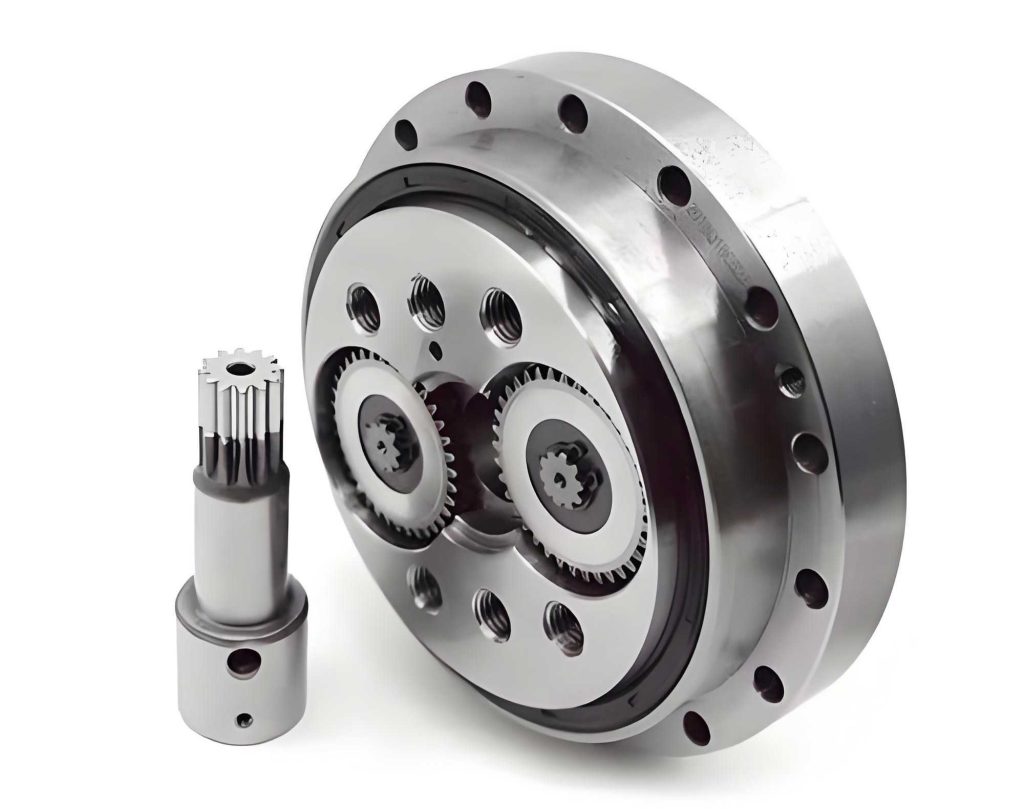
The operational principle of a rotary vector reducer involves a two-stage speed reduction process. The primary stage typically involves a planetary gear train, while the unique secondary stage employs a cycloidal pinwheel mechanism driven by a crankshaft. It is within this secondary stage that a critical periodic behavior emerges during normal operation. The torque transmission from the crankshaft to the cycloidal disks is not constant. Due to inherent eccentricities in the crankshaft and the cycloidal disks themselves, the transmitted torque varies periodically with the rotation angle. This periodicity is a fundamental characteristic of a healthy rotary vector reducer.
We can derive this relationship. The torque on the crankshaft ( $$ M_x $$ ) can be expressed considering its dynamic unbalance. For a rotary vector reducer’s simplified crankshaft model, it can be represented as:
$$ M_x = W’_b R_b \sin(\theta_x + \gamma) $$
where $$ W’_b $$ is the effective weight of the crankshaft, $$ R_b $$ is the distance from the crankshaft axis to its center of mass, $$ \theta_x $$ is the crank angle, and $$ \gamma $$ is a phase constant.
This crankshaft torque is then transmitted to the cycloidal disk. Assuming the center of the cycloidal disk is offset from the crankshaft axis by a distance $$ s $$, and the disk’s pitch radius is $$ r $$, the torque at the cycloidal disk ( $$ M_r $$ ) is modified by the geometry:
$$ M_r = M_x \frac{[r + s \sin(\theta + \beta)]}{r + s} $$
where $$ \beta $$ is another phase angle related to the assembly.
Finally, considering the meshing efficiency factor $$ c_1 $$ between the cycloidal disk and the stationary pin gear, the output torque ( $$ M_{output} $$ ) and the instantaneous efficiency ( $$ \eta $$ ) for a reduction ratio $$ n $$ and input torque $$ M_{input} $$ become:
$$ M_{output} = c_1 M_r = c_1 M_x \frac{[r + s \sin(\theta + \beta)]}{r + s} $$
$$ \eta = \frac{M_{output}}{n M_{input}} = \frac{c_1 M_x [r + s \sin(\theta + \beta)]}{n M_{input} (r + s)} $$
Substituting the expression for $$ M_x $$ reveals that the efficiency $$ \eta $$ is fundamentally a function of sinusoidal terms ( $$ \sin(\theta_x + \gamma) $$ and $$ \sin(\theta + \beta) $$ ). Therefore, under normal conditions, the operational efficiency of a rotary vector reducer exhibits a distinct periodic signature linked to its rotational frequency. Early faults, such as wear on the crankshaft or cycloidal disks, disrupt this precise periodic relationship by altering the parameters (e.g., $$ s $$, $$ \gamma $$, $$ \beta $$) or the waveform itself, providing a crucial diagnostic clue.
Overcoming Diagnostic Challenges with Signal Decomposition and Intelligent Classification
The subtle and periodic nature of fault signatures in a rotary vector reducer calls for sophisticated signal processing. Direct time- or frequency-domain analysis of raw vibration or torque signals may not adequately capture these evolving periodic features, especially with limited data. This is where the Ensemble Empirical Mode Decomposition (EEMD) method proves invaluable. EEMD is an adaptive, noise-assisted data analysis method designed to handle non-linear and non-stationary signals—precisely the type generated by complex machinery like a rotary vector reducer.
EEMD works by repeatedly adding different realizations of white noise to the target signal and performing Empirical Mode Decomposition (EMD). EMD itself decomposes a signal into a set of intrinsic mode functions (IMFs), which represent oscillatory modes embedded in the data. The ensemble averaging over multiple noise realizations helps alleviate the mode mixing problem common in standard EMD. The process for preparing rotary vector reducer monitoring data is as follows:
- Data Segmentation & Noise Addition: The acquired signal (e.g., torque, vibration), $$ x(t) $$, is divided into sample segments. To each segment, a unique white noise series, $$ S_w(\omega) $$, is added to create a noise-assisted signal: $$ x_s(t) = x(t) + S_w(\omega) $$.
- Decomposition: Each $$ x_s(t) $$ is decomposed via EMD into a collection of IMFs and a residual: $$ x_s(t) = \sum_{c=1}^{n} imf_c(t) + r_n(t) $$.
- Ensemble Averaging: Steps 1 and 2 are repeated with different white noise seeds. The corresponding IMFs from each ensemble member are averaged to obtain the final, noise-canceled set of IMFs.
- Feature Extraction: To form a concise feature vector from the numerous IMFs, the absolute value of each IMF is taken and its mean is calculated over the sample segment. This provides a set of robust features that capture the energy distribution across different intrinsic oscillatory modes, which are sensitive to changes in the periodic behavior of the rotary vector reducer.
The extracted features then need to be classified into different health states (e.g., normal, crankshaft wear, bearing fault). For this task, we employ an Extreme Learning Machine (ELM) due to its fast learning speed and good generalization capability, which is ideal for scenarios with relatively small datasets, a common constraint when diagnosing specific rotary vector reducer faults. However, the random initialization of input weights and hidden biases in a standard ELM can lead to instability in diagnosis results.
To enhance the robustness and accuracy, we optimize the ELM’s parameters using the Particle Swarm Optimization (PSO) algorithm. PSO efficiently searches for the optimal set of input weights ( $$ \mathbf{W} $$ ) and hidden layer biases ( $$ \mathbf{B} $$ ) that minimize the network’s prediction error. The fitness function for the PSO is typically the root mean square error (RMSE) on a validation set. The optimized PSO-ELM model ensures consistent and reliable classification of the EEMD-derived features from the rotary vector reducer data.
| Stage | Component | Core Function | Benefit for Rotary Vector Reducer Diagnosis |
|---|---|---|---|
| 1. Signal Preprocessing | Ensemble Empirical Mode Decomposition (EEMD) | Adaptively decomposes non-stationary signals into IMFs, revealing intrinsic oscillatory modes. | Effectively captures the subtle, periodic fault signatures disrupted by wear or damage. |
| 2. Feature Extraction | IMF Statistical Analysis (Mean of Absolute Values) | Converts decomposed IMFs into a compact, representative feature vector. | Reduces data dimensionality while preserving critical diagnostic information related to periodicity. |
| 3. Classification Model | Particle Swarm Optimized Extreme Learning Machine (PSO-ELM) | A fast, single-hidden-layer neural network with parameters optimized by PSO for stability. | Provides accurate, stable, and fast fault state classification even with limited fault samples. |
Model Validation and Experimental Analysis
Prior to applying the model to a dedicated rotary vector reducer test platform, its general performance was validated using a publicly available bearing dataset (XJTU-SY). Bearings share similar failure mode characteristics with gearbox components in a rotary vector reducer, such as inner race, outer race, and cage faults. Horizontal vibration signals were processed using the EEMD-PSO-ELM framework. The model successfully distinguished between different fault types and normal conditions, demonstrating superior accuracy and stability compared to a standard ELM, as shown in a representative test run.
| Sample No. | Actual Condition | Standard ELM Prediction | Proposed PSO-ELM Prediction |
|---|---|---|---|
| 1 | Outer Race Fault | Outer Race Fault | Outer Race Fault |
| 2 | Cage Fault | Compound Fault | Cage Fault |
| 3 | Compound Fault | Cage Fault | Cage Fault* |
| 4 | Normal | Normal | Normal |
| … | … | … | … |
*Note: While not perfect, the PSO-ELM showed significantly improved overall accuracy and consistency across multiple runs compared to the unstable standard ELM.
The core experimental validation was conducted on a dedicated rotary vector reducer test platform. The setup applied a controlled load via a magnetic powder brake and measured input/output torque and speed to calculate real-time efficiency. Data was collected over a prolonged run until performance degradation indicated a fault.
| Component | Specification / Model |
|---|---|
| Servo Motor | 5 kW |
| Input Torque Sensor | Range: ±15 N·m |
| Rotary Vector Reducer | RV-20E |
| Output Torque Sensor | Range: ±200 N·m |
| Loading Unit | Magnetic Powder Brake, 1.5 kW |
| Sampling Rate | 1 sample every 0.5 seconds |
The calculated efficiency signals before and after the fault were analyzed. The periodic nature of the healthy signal was evident, while the fault signal showed a clear disruption of this periodicity, corroborating the theoretical derivation. Post-test disassembly confirmed crankshaft wear as the root cause. The efficiency increase observed post-fault can be attributed to a reduction in meshing friction due to altered load distribution after wear.
For diagnosis, efficiency data samples (1680 points each) from healthy and faulty states were processed through the EEMD-PSO-ELM framework. The mean of the absolute values of the first six IMFs from each sample formed a 12-dimensional feature vector (6 IMFs from healthy state + 6 IMFs from faulty state, averaged per class). This feature set was used to train and test the classifier.
The performance of the proposed EEMD-PSO-ELM model was rigorously compared against several other diagnostic models under identical conditions. The results, averaged over 20 runs to ensure statistical significance, are summarized below:
| Diagnostic Model | Average Classification Accuracy (%) over 20 Runs | Remarks on Stability |
|---|---|---|
| Standard ELM | 45.5 | Very low and highly unstable (30%-50% range). |
| EEMD-ELM | 61.5 | Improved but unstable (50%-80% range). |
| EEMD-PNN (Probabilistic Neural Network) | 50.0 | Stable but low accuracy. |
| EEMD-GRNN (General Regression Neural Network) | 47.0 | Stable but low accuracy. |
| EEMD-DE-ELM (Differential Evolution Optimized) | 70.0 | Extremely unstable (20%-100% range). |
| EEMD-GA-ELM (Genetic Algorithm Optimized) | 79.0 | Good accuracy, relatively stable (~80% typical). |
| Proposed EEMD-PSO-ELM | 91.5 | Highest accuracy and excellent stability (consistently >90%). |
The results conclusively demonstrate the efficacy of the proposed approach. The EEMD stage is crucial, as it significantly boosts the performance of even a basic ELM by extracting periodicity-sensitive features from the rotary vector reducer signals. Among the classifiers, the PSO-ELM hybrid proved superior, achieving the highest average accuracy (91.5%) with remarkable consistency. This combination effectively addresses the core challenges of diagnosing a rotary vector reducer: subtle faults, limited data, and the need for reliable, rapid assessment.
Conclusion
This work presents a comprehensive solution for the fault diagnosis of rotary vector reducers. By first establishing the theoretical basis for periodic torque transmission in a healthy reducer, we identify a key diagnostic signature. The proposed EEMD-PSO-ELM model is specifically designed to detect anomalies in this periodicity. The EEMD method adeptly preprocesses the non-stationary signals to reveal intrinsic oscillatory modes, while the PSO-optimized ELM provides a stable and highly accurate classification mechanism. Experimental validation on a dedicated test platform confirms that the model can effectively distinguish between healthy and faulty states of a rotary vector reducer, outperforming several alternative diagnostic models in both accuracy and reliability. This methodology offers a practical and powerful tool for predictive maintenance, enabling timely intervention, reducing unplanned downtime, and enhancing the operational reliability and longevity of systems dependent on rotary vector reducers.