
The pursuit of creating machines that can interact with and learn from the physical world as humans do is a central goal of embodied artificial intelligence. As an ideal physical platform for such embodied agents, the humanoid robot presents a unique set of challenges and opportunities. Its anthropomorphic form holds the promise of executing human-like tasks and movements, yet its high center of mass, complex multi-degree-of-freedom (DoF) structure, and inherent instability make learning and controlling sophisticated motor skills, such as dance, exceptionally difficult. This work presents a comprehensive research and development effort focused on enabling a humanoid robot to master complex, high-dynamic dance movements through a novel, integrated system framework grounded in embodied intelligence principles.
Traditional approaches for humanoid robot motion control, including reinforcement learning (RL) and imitation learning (IL), often fall short when applied to the demanding domain of dance. While RL can teach basic locomotion with minimal prior knowledge, it frequently results in unnatural, energetically inefficient gaits under sparse reward signals. IL, which leverages expert demonstration data—such as that obtained via motion capture—offers higher data efficiency but is typically limited to reproducing slow, smooth movements and struggles with generalization and physical feasibility when the expert motions violate the robot’s kinematic or dynamic constraints. The gap between simulation and reality (Sim-to-Real Gap) further exacerbates these challenges, as policies trained in idealized virtual environments often fail when deployed on physical hardware due to unmodeled dynamics, sensor noise, and mechanical imperfections.
To address these limitations, we have developed and validated a robust system framework that significantly advances the state-of-the-art in humanoid robot dance imitation. Our methodology builds upon the foundation of Physics-Based Humanoid motion Control (PBHC) but introduces critical innovations in motion processing, adaptive tracking, and training architecture. The core of our contribution lies in a two-stage pipeline: a preprocessing stage that filters and corrects captured human dance motions to ensure physical plausibility for the target robot, and a learning stage that employs an enhanced RL framework with adaptive reward shaping to achieve stable, high-fidelity imitation.
| Challenge | Traditional Limitation | Our Framework’s Solution |
|---|---|---|
| Physical Feasibility of Reference Motions | Human motions often exceed robot joint limits or stability margins, causing failure. | Physics-based filtering and contact-aware motion correction. |
| Tracking High-Dynamic, Complex Motions | Methods are efficient only for short (~10s), slow, smooth motion clips. | Adaptive motion tracking with dynamically optimized tolerance factors. |
| Simulation-to-Reality Gap | Policies trained in simulation degrade on real hardware. | Domain randomization, asymmetric actor-critic design, and an estimator for base velocity. |
| Exploration in High-DoF Action Space | Policy gets stuck in sub-optimal local minima, leading to jerky or unstable motions. | Integration of an explorable curiosity reward mechanism. |
Research Background and Motivation
The vision of humanoid robots performing artistic tasks like dance is not new, but recent advancements in actuation, sensing, and machine learning have made it a tangible research frontier. The application of such robots as performers in film, theater, and interactive art installations provides strong motivation for developing reliable and expressive motion control systems. The fundamental problem is formulated as a Markov Decision Process (MDP) for goal-conditioned reinforcement learning:
$$M = (S, A, S^{ref}, \gamma, r, P)$$
Here, \(S\) and \(S^{ref}\) represent the state spaces of the humanoid robot and the reference motion, respectively. \(A\) is the robot’s action space, \(\gamma\) is the discount factor, \(r\) is a composite reward function, and \(P\) is the state transition probability. The objective is to learn a policy \(\pi\) that maps the robot’s proprioceptive state \(s^{prop}_t\) to an action \(a_t\) (typically target joint positions for a PD controller), such that the resulting state trajectory closely follows the reference motion \(S^{ref}\).
Proposed System Framework
Our framework consists of three integrated modules: 1) Motion Capture and Processing, 2) Adaptive Motion Tracking for training, and 3) an Asymmetric Actor-Critic RL training setup with mechanisms for Sim-to-Real transfer.
1. Motion Processing Pipeline
The first step involves acquiring and preparing expert motion data suitable for the humanoid robot. We employ an optical motion capture system to record a dancer’s performance. This raw data is fitted to a parametric human model (SMPL) to obtain a continuous motion sequence. However, this human motion is not directly executable by a humanoid robot due to differences in morphology and physical limits.
Our processing pipeline involves four key steps:
- Physics-Based Filtering: We analyze the motion’s physical quantities (e.g., Center of Mass vs. Center of Pressure) to detect and filter out dynamically infeasible segments.
- Contact-Aware Motion Correction: Accurate foot-ground contact labels are crucial for stable locomotion. We estimate a contact mask \(c^t\) for each foot by analyzing ankle velocity and height thresholds. For the right foot:
$$c^t_{right} = I[\, \| p^t_{r-ankle} – p^{t-1}_{r-ankle} \|_2^2 < \epsilon_{vel} \,] \cdot I[\, p^t_{r-ankle, z} < \epsilon_{height} \,]$$
Where \(I[\, \cdot \,]\) is the indicator function. This mask is then used to correct “foot-floating” artifacts by adjusting the height of the root. - Motion Retargeting: The processed human motion is retargeted to the specific kinematics of our humanoid robot platform (e.g., the Noetix N2) using inverse kinematics (IK). This step solves for the robot’s joint angles that best match the pose of the human skeleton, respecting joint limits.
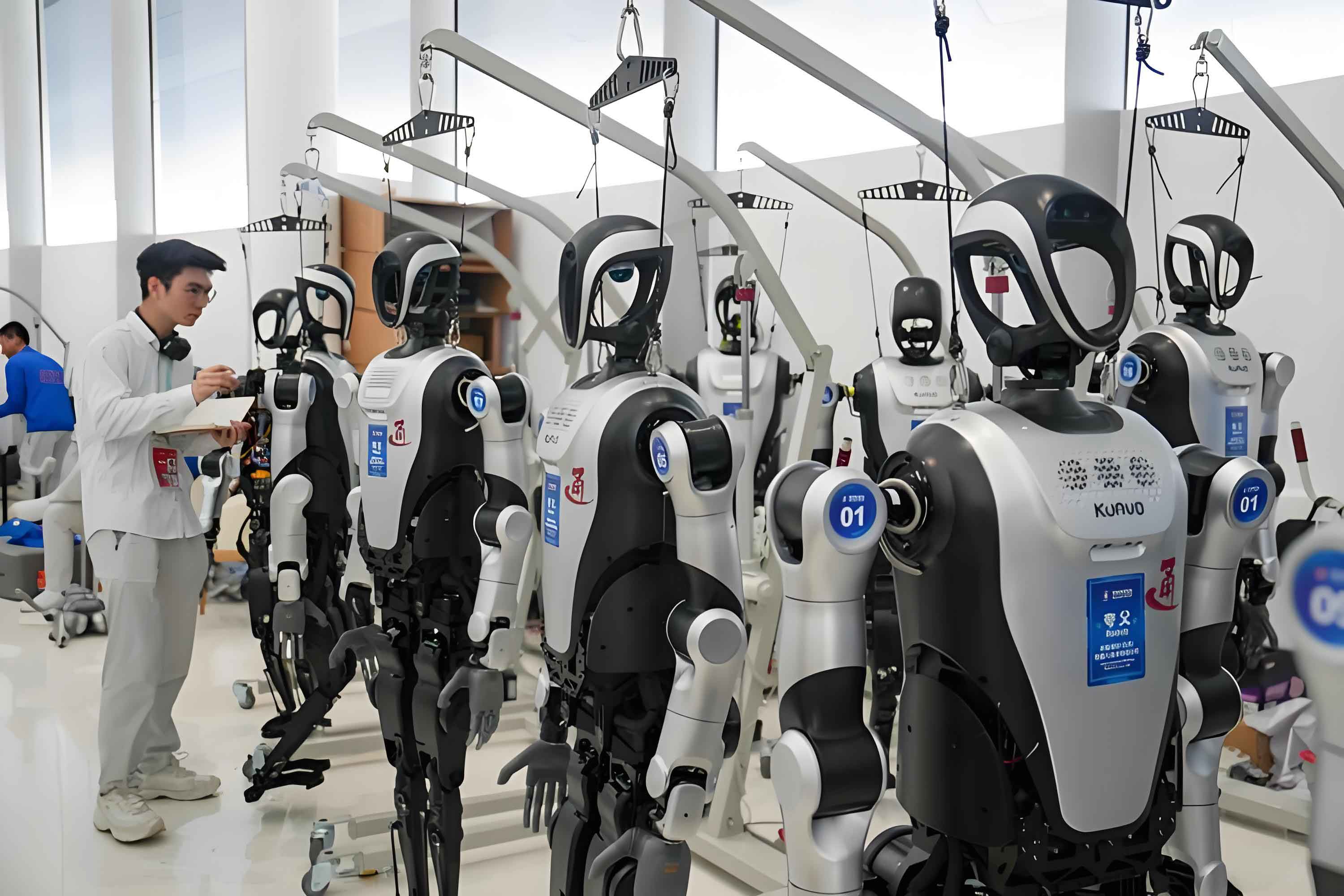
2. Adaptive Motion Tracking Mechanism
A core innovation in our training framework is the adaptive tuning of the reward function’s tracking tolerance. Standard PBHC uses an exponential reward of the form \(r(x) = \exp(-x / \sigma)\), where \(x\) is a tracking error (e.g., joint angle error) and \(\sigma\) is a tracking factor controlling error tolerance. A fixed \(\sigma\) is suboptimal across different motion styles and complexities.
We formulate the optimal selection of \(\sigma\) as a bi-level optimization (BLO) problem. The inner loop finds the optimal error sequence \(x^*\) for a given \(\sigma\), and the outer loop adjusts \(\sigma\) to maximize overall performance. Under certain assumptions, the theoretically optimal tracking factor \(\sigma^*\) is the average of the optimal tracking errors:
$$\sigma^* = \frac{1}{N} \sum_{i=1}^{N} x^*_i$$
Since \(x^*\) and \(\sigma^*\) are coupled and unknown beforehand, we implement an online adaptive mechanism. Starting from a large initial \(\sigma_{init}\), we continuously monitor the current average tracking error \(\bar{x}\). The factor \(\sigma\) is then updated in a non-increasing manner to gradually tighten the tolerance as the policy improves:
$$\sigma \leftarrow \min(\sigma, \bar{x})$$
This closed-loop adjustment allows the humanoid robot to initially focus on coarse imitation and progressively refine its tracking precision throughout training, leading to more robust learning of complex motions.
3. Enhanced RL Training Architecture
We utilize Proximal Policy Optimization (PPO) within a carefully designed asymmetric actor-critic architecture.
- Asymmetric Design: The actor network operates solely on realistic proprioceptive observations \(s^{prop}_t\), which include a history of joint positions, velocities, root angular velocity, projected gravity, and past actions. This ensures the policy is deployable on real hardware. The critic network, however, is granted privileged information (\(s^{critic}_t\)) including the reference motion state, time phase, and system dynamics parameters to make more accurate value estimates.
- Vectorized Rewards & Value Functions: We decompose the total reward \(r\) into a vector \(r = [r_1, r_2, …, r_n]\) corresponding to different objectives (e.g., joint tracking, foot contact, smoothness). The critic outputs a corresponding vector of value estimates \(V(s) = [V_1(s), …, V_n(s)]\), which are aggregated to compute advantages. This provides richer training signals.
- Key Enhancements:
- Base Velocity Estimator: We integrate an estimator for the robot’s base linear velocity into the state observation. This is a latent state not directly measured by IMUs alone and is critical for stabilizing dynamic motions and eliminating drift or shaking in the real world.
- Explorable Curiosity Reward: To encourage exploration in the high-dimensional action space and avoid degenerate solutions, we add an intrinsic curiosity reward \(r^c\). It is inversely proportional to the visitation count \(N(\phi(s_t))\) of a hashed state representation:
$$r^c_t(s_t) = \frac{1}{\sqrt{N(\phi(s_t))}}$$
This promotes visits to under-explored state regions, leading to more natural and diverse motion discovery.
- Training Techniques: We employ Reference State Initialization (RSI) to start episodes from random points in the reference motion, enabling parallel learning of all movement phases. Domain randomization of physical parameters (masses, friction, motor strengths) during simulation training is crucial for bridging the Sim-to-Real gap.
| Component | Description | Dimension |
|---|---|---|
| Joint Position History \(q_{t-4:t}\) | Last 5 steps of 18 joint angles. | 90 |
| Joint Velocity History \(\dot{q}_{t-4:t}\) | Last 5 steps of 18 joint velocities. | 90 |
| Root Angular Velocity \(\omega^{root}_{t-4:t}\) | Last 5 steps of base angular velocity (roll, pitch, yaw). | 15 |
| Projected Gravity \(g^{proj}_{t-4:t}\) | Last 5 steps of gravity vector in root frame. | 15 |
| Previous Actions \(a_{t-5:t-1}\) | Last 5 applied actions. | 90 |
| Total Dimension | 300 |
Experimental Validation and Results
We validated our framework by teaching a Noetix N2 humanoid robot a segment of the traditional Chinese “Yingge” dance, known for its vigorous, rhythmic movements and complex body coordination. The experimental workflow followed four stages: Preparation (simplifying and adapting the choreography for the robot), Simulation Training, Real-World Deployment, and Optimization.
The training process successfully learned a policy for a 90-second motion sequence. Comparative experiments showed that the inclusion of the contact mask reward was essential for the humanoid robot to learn proper foot lifting during backward steps, and the addition of the base velocity estimator significantly reduced high-frequency body shaking observed in earlier trials.
The ultimate test was the deployment on the physical N2 humanoid robot. The policy transferred successfully from simulation to reality, with the real humanoid robot demonstrating highly consistent gait and dance movements compared to its simulated counterpart. Quantitative evaluation of key performance indicators—including base pose and joint angle/velocity trajectories—showed close alignment between simulated and real-world execution, confirming the effectiveness of our Sim-to-Real strategies.
The success of this framework was further demonstrated in international competition, where the humanoid robot utilizing this system achieved a high-ranking performance. This practical validation underscores the robustness and applicability of the approach.
Discussion and Future Directions
While this framework represents a significant step forward, several limitations and future research directions are apparent. First, the current system operates in a largely static, known environment. For true autonomy in performances or film sets, the humanoid robot must integrate environmental perception for terrain adaptation, obstacle avoidance, and dynamic interaction with other actors or set pieces.
Second, the pipeline remains specialized. Each new dance requires a tailored process of motion capture, retargeting, and policy training. The future lies in developing more generalizable skill models and efficient few-shot learning techniques, where a humanoid robot can learn new movement primitives from minimal human guidance, leveraging a large prior knowledge base.
A profound artistic question also arises: what is lost when human dance is translated to a humanoid robot, and what new, uniquely robotic movement aesthetics might emerge? Moving beyond pure imitation to enable collaborative choreography between humans and machines, or even improvisational dance generation by the robot itself, presents exciting interdisciplinary challenges at the confluence of robotics, machine learning, and the arts.
Conclusion
This research has presented and validated a novel, holistic framework for enabling a humanoid robot to learn and perform complex, high-dynamic dance movements. By advancing the PBHC paradigm with an adaptive motion tracking mechanism, a robust motion processing pipeline, and key enhancements like a base velocity estimator and curiosity-driven exploration, we have demonstrated that a humanoid robot can achieve stable, expressive, and physically plausible dance imitation. The successful real-world deployment confirms the framework’s efficacy in bridging the simulation-to-reality gap. This work not only pushes the boundaries of humanoid robot motor control but also opens new technological pathways for the application of embodied intelligent agents in creative industries such as film production, theatrical performance, and interactive art, where the humanoid robot can transition from a tool to a performer.